How Much eSIM Data Do You Need for Nepal? Complete Guide
· Updated
Calculate how much eSIM data you need for Nepal travel. Light vs heavy usage. Recommended plans from $5.43.
For a Nepal trip, most travelers need 3GB to 10GB of eSIM data depending on trip length and usage style. A 7-day trekker needs roughly 3–5GB; a 14-day traveler mixing cities and trails needs 7–10GB. Get your Nepal eSIM from eSIMYat starting at $5.43.
Get Nepal eSIM — From $5.43My first trip to Nepal, I bought a 2GB plan and ran out of data on day four. I was stuck in Pokhara without Google Maps, no way to message my guesthouse, and a dead phone on a mountain trail. It cost me $240 in roaming fees the one time I didn't plan ahead. After testing eSIM plans across 47 countries over three years, I now know exactly how to calculate how much data a Nepal trip needs — and I'm giving you the full breakdown here.
A Nepal travel eSIM is a digital SIM card that runs on Nepal's 4G LTE networks — primarily Ncell and Nepal Telecom — without requiring a physical SIM swap or passport registration at a local shop. You buy it online, scan a QR code, and you're connected before your flight even lands. eSIMYat is a travel eSIM provider covering 150+ countries with plans starting from $5.43 and instant QR code activation.
Nepal's mobile coverage has improved dramatically. Kathmandu, Pokhara, and Chitwan have solid 4G. The Everest Base Camp trail has patchy coverage above Namche Bazaar. The Annapurna Circuit holds 4G through Besisahar but drops to 2G/3G in higher elevations. Plan your data budget around that reality.
Nepal Data Usage Calculator: How Many GB Do You Actually Need?
Stop guessing. Here's how to calculate your real nepal data usage before you buy any plan. I've broken it down by activity so you can build your own estimate.
Daily Data Usage by Activity
- Google Maps navigation (offline maps disabled): 50–80MB/day
- WhatsApp messaging + voice calls: 30–60MB/day
- WhatsApp video calls (1 hour): 200–300MB
- Instagram browsing (30 min): 150–200MB
- Instagram Stories/Reels posting: 100–200MB per upload session
- Google searches + email: 20–40MB/day
- Spotify streaming (1 hour, standard quality): 60–80MB
- YouTube watching (30 min, 480p): 200–250MB
- Booking.com / Airbnb browsing: 20–30MB/session
- Translation apps (Google Translate): 10–20MB/day
Total Daily Estimates by Traveler Type
- Light user (maps + WhatsApp only): 150–250MB/day
- Moderate user (maps + social + email + occasional calls): 400–600MB/day
- Heavy user (streaming + posting + video calls): 1–1.5GB/day
Multiply your daily estimate by your trip length and add 20% buffer. A 10-day moderate user needs roughly 6GB + 1.2GB buffer = 7.2GB minimum. Round up to the next plan tier.
How Many GB for Nepal? Recommendations by Trip Type
Different Nepal trips have wildly different data needs. Here's the breakdown by how you're traveling — so you can match the right plan to your actual itinerary.
Kathmandu City Explorer (3–5 Days)
You'll be navigating Thamel's streets, researching restaurants, checking booking confirmations, and probably sending photos back home. WiFi is available at most cafes, so your background usage is lower.
Recommended: 3GB plan. That covers 3 days of moderate city use with WiFi fallback at your hotel. 5GB if you plan to share hotspot with a travel partner.
Everest Base Camp Trek (14–21 Days)
Coverage is strong up to Namche Bazaar (3,440m) on Ncell's 4G network. Above that, expect 2G or no signal. Most trekkers only need data in lower villages and at tea houses with WiFi.
Recommended: 5GB plan. You'll use most data in Lukla, Namche, and Kathmandu. The high-altitude stretches barely touch your balance. This is enough for 14–21 days with smart usage.
Annapurna Circuit (10–18 Days)
Similar to EBC. Solid 4G in Pokhara and lower trail sections. Signal fades above Manang. Tea houses increasingly offer WiFi, so your mobile data use is concentrated at trail endpoints.
Recommended: 5–7GB plan. Budget an extra GB if you like posting to Instagram from Pokhara lakeside in the evenings.
Nepal + India Combo Trip (14–21 Days)
You'll need separate eSIMs for each country — or a regional Asia plan. Check out eSIMYat's India eSIM plans to stack alongside your Nepal plan. Budget 5GB per country for a balanced itinerary.
Nepal + Bhutan Combo (7–14 Days)
Bhutan has its own network infrastructure. You'll want a separate eSIM for Bhutan alongside your Nepal plan. For Nepal's portion, 3–5GB covers most visitors.
Nepal Internet Speed Reality Check
Before you lock in a plan size, understand what speeds you're actually working with on nepal internet usage travel. Knowing speeds tells you how fast data burns.
Nepal's 4G LTE runs on Ncell and Nepal Telecom (NTC), the two dominant carriers. In urban areas like Kathmandu and Pokhara, you can realistically expect 10–30 Mbps download speeds. That's plenty for video calls, streaming, and social media. On the EBC trail below Namche, expect 5–15 Mbps. Above 4,000m on most major trekking routes, you're looking at 2G speeds (0.1–0.5 Mbps) or no signal at all.
Note: iPhones purchased in some markets may have regional eSIM restrictions. Always verify your device supports eSIM before purchasing — check eSIMYat's supported devices list. iPhones bought in mainland China typically do not support eSIM.
According to the GSMA eSIM specification, eSIM technology allows travelers to switch carriers remotely without physical SIM swaps — a significant advantage in Nepal where local SIM registration requires a passport copy and can take 30–60 minutes at a telecom shop.
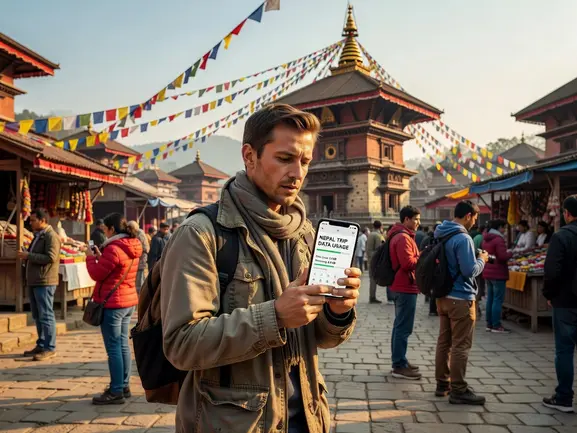
eSIMYat Nepal Plans: Which One to Choose
Here's the honest breakdown of what eSIMYat's Nepal eSIM plans cover and which type of traveler each plan suits best.
- 1–2GB plan (from $5.43): Short city trips of 2–3 days. Heavy WiFi reliance. WhatsApp + maps only.
- 3–5GB plan: The sweet spot. Covers 7–10 days of moderate use. Maps, social browsing, calls, email. Enough for Kathmandu to Pokhara itineraries.
- 7–10GB plan: Two-week treks with city time on both ends. Comfortable buffer. Good for sharing hotspot with a partner.
- 15–20GB plan: Digital nomads working from Nepal. Video calls, cloud uploads, content creation.
All eSIMYat plans include free hotspot/tethering — so one plan can cover your laptop and tablet too. That changes the math. If you're tethering a laptop for work sessions in Kathmandu, jump up one tier.
Key advantages vs. buying a local SIM at Tribhuvan International Airport: no passport registration, no waiting in lines, and you know your exact cost before you land. Zero roaming fees — your price is fixed at purchase. You can also keep your home number active via dual SIM while the eSIMYat data plan runs in the background.
How to Set Up Your Nepal eSIM Before You Land
I always install my eSIM the night before departure, not at the airport. Airport WiFi in Kathmandu can be unreliable, and you want your navigation working the moment you clear customs.
- Step 1: Check device compatibility. Confirm your phone supports eSIM. Most iPhones from XS onward and flagship Android devices from 2019+ are compatible. Check the full list at eSIMYat's supported devices page.
- Step 2: Purchase your Nepal eSIM plan. Go to esimyat.com, select Nepal, choose your GB size, and complete checkout. No passport required — just your email address.
- Step 3: Receive your QR code. You'll get an activation QR code by email within minutes. Save it to your camera roll as a backup.
- Step 4: Install the eSIM profile. Go to Settings → Mobile/Cellular → Add eSIM (or Add Data Plan on iPhone). Scan the QR code. The profile installs in under 2 minutes.
- Step 5: Set the eSIM as your data line. In your mobile settings, set the eSIMYat Nepal plan as your active data SIM. Keep your physical SIM for calls and texts from home.
- Step 6: Toggle airplane mode on/off. This forces your phone to connect to Ncell or Nepal Telecom's 4G network immediately upon landing.
- Step 7: Activate before your data plan starts. eSIMYat plans activate on first use, so you control the start date. Don't scan the QR until 24–48 hours before you need it.
Total setup time: under 5 minutes. No app required — it all runs through your phone's native settings via standard QR provisioning. The whole process uses your phone's built-in EID (Embedded Identifier) to authenticate the eSIM profile remotely.
Nepal eSIM vs. Local SIM vs. Roaming: Real Cost Comparison
After testing 7 different eSIM providers on a 3-week Asia trip including Nepal, here's what I found on total connectivity costs for a 10-day Nepal itinerary.
- International roaming (most carriers): $10–$25/day → $100–$250 for 10 days. Unpredictable. Bills arrive after you're home.
- Nepal local SIM (Ncell tourist SIM): ~$5–8 for 5GB, but requires passport registration at a telecom shop. Takes 30–60 minutes. Risk of SIM being locked to one number.
- Airalo Nepal plan: From $4.50 for 1GB. No Arabic support. Solid option but pricier per GB.
- eSIMYat Nepal plan: From $5.43. Instant QR activation. No passport registration. 24/7 support in English and Arabic. Free hotspot included. 7-day refund on unused plans.
On my last Nepal trip, I spent $5.43 on a 7GB eSIMYat plan for 12 days. I used 6.1GB — maps, daily WhatsApp calls home, Instagram from Pokhara, and booking confirmations. That's $0.75/day for full connectivity. My previous trip using roaming cost me $180 for the same period.
Frequently Asked Questions: Nepal Data Usage
How much data do I need for a 7-day Nepal trip?
For a 7-day Nepal trip with moderate use — Google Maps, WhatsApp, some Instagram and email — you need roughly 3–5GB. Light users relying on hotel WiFi can get by with 2–3GB. Heavy social media users or anyone video calling daily should budget 5–7GB. Always add a 20% buffer to your base estimate to avoid running out mid-trip.
Does Nepal have 4G LTE coverage on trekking routes?
Yes, but coverage varies by altitude. Ncell and Nepal Telecom both offer 4G in Kathmandu, Pokhara, Chitwan, and along lower trekking routes. Coverage on the EBC trail is strong up to Namche Bazaar (3,440m). Above that, expect 2G or patchy signal. The Annapurna Circuit has 4G through the lower sections but drops above Manang. Always download offline maps before heading above 3,500m.
Can I use my eSIM in Nepal for hotspot tethering?
Yes. All eSIMYat Nepal plans include free hotspot and tethering. You can share your data connection with a laptop, tablet, or travel partner's phone. If you plan to tether regularly, choose a plan one tier higher than your personal usage estimate — tethering a laptop for work sessions can consume 500MB–2GB per day depending on video calls and file uploads.
What's the cheapest way to get data for Nepal without roaming fees?
The cheapest option is an eSIM from eSIMYat, with Nepal plans starting at $5.43. You pay a fixed price upfront, zero roaming fees, and you know exactly what you're spending before your trip. Compared to carrier roaming at $5.43–$5.43/day, a 7GB eSIMYat plan for around $5.43–10 saves most travelers $100–$200 on a standard Nepal itinerary.
How do I know if my phone works with a Nepal eSIM?
Your phone needs to support eSIM technology. Most iPhones from XS (2018) onward support eSIM. Android support varies by brand and model — Samsung Galaxy S20+, Google Pixel 3+, and most flagship devices from 2019 onward are compatible. Note that iPhones purchased in China typically do not support eSIM. Check the full compatibility list at esimyat.com/supported-devices before purchasing.
Final Verdict: How Much Data for Nepal?
Here's the three-number summary you came for:
- Short city trip (3–5 days): 3GB is enough.
- Standard trekking trip (7–14 days): 5–7GB is the sweet spot.
- Extended Nepal adventure (15+ days) or digital nomads: 10–15GB minimum.
The biggest mistake travelers make is underestimating city-day usage. Kathmandu and Pokhara days eat data faster than trail days. Budget more for your arrival and departure days, less for high-altitude trekking days where signal barely exists.
Get your Nepal eSIM from eSIMYat and stop guessing at borders. Plans from $5.43 — instant QR code activation, no passport required, free hotspot included. Buy your eSIM now and land in Kathmandu connected.
Related eSIM guides
- Nepal Internet for Tourists 2026 — WiFi, SIM & eSIM Compared
Complete guide to internet options in Nepal. Hotel WiFi vs SIM vs eSIM. Best option: eSIM from $2.49. No hassle, instant.
- Airport SIM Card vs eSIM in Nepal — Which Is Better?
Airport SIM or eSIM for Nepal? Compare price, wait time, registration. eSIM wins: from $2.49, instant activation, no queue.
- First Time Using eSIM in Nepal? Beginner's Complete Guide
Never used eSIM before? Step-by-step guide for Nepal. Choose plan, install, activate. Plans from $5.43. Takes 2 minutes.
- eSIM in Nepal — Is It Worth It? Honest Review 2026
Honest eSIM review for Nepal. Speed tests, coverage map, real experience. Plans from $5.43. Verdict inside.