Airport SIM Card vs eSIM in Nepal — Which Is Better?
Airport SIM or eSIM for Nepal? Compare price, wait time, registration. eSIM wins: from $2.49, instant activation, no queue.
For the airport SIM vs eSIM Nepal decision, eSIM wins every time. With eSIMYat, you get instant QR code activation before you board — no queue at Tribhuvan International Airport, no passport registration, and Nepal plans starting from $5.43. You land connected, not scrambling.
Get Nepal eSIM — From $5.43I'll be straight with you. My first trip to Kathmandu, I did the "just buy a SIM at the airport" thing. Forty-five minutes in a slow-moving queue at the Ncell counter after a 9-hour flight, passport photocopied twice, a form filled in Nepali I couldn't read, and I still had to wait another 20 minutes for the SIM to activate. Never again. The airport SIM vs eSIM Nepal debate isn't even close once you've lived both options.
An eSIM — an embedded SIM built into your phone — works via QR provisioning. You scan a code, the carrier profile downloads to your device's EID (Embedded Identity Document), and you're online. No plastic. No counter. No problem. The global eSIM market surpassed $4 billion in 2026 according to industry analysts, and travelers are voting with their phones.
This guide breaks down the real-world difference between a Nepal airport SIM card and a travel eSIM, with honest numbers on cost, speed, and convenience — so you can decide before your wheels touch down at TIA.
What Actually Happens at Tribhuvan Airport SIM Counters
Tribhuvan International Airport (KTM) in Kathmandu has SIM card counters from Nepal's two main carriers: Ncell and Nepal Telecom. Both operate 24/7 in theory — in practice, staffing thins out on late-night arrivals and during peak trekking season (October–November and March–April).
Here's what the Nepal airport SIM card process actually looks like:
- Queue time: 20–60 minutes during peak hours, longer after international flight arrivals cluster
- Passport required: Yes — original passport plus photocopy for mandatory SIM registration under Nepal's telecom regulations
- Form filling: Physical registration form, sometimes only in Nepali
- Activation wait: 15–30 minutes after purchase before the SIM activates on the network
- Physical SIM size: You need to check your phone's tray — Nano, Micro, or Standard — and hope they have your size in stock
- Hotspot/tethering: Often restricted or costs extra on tourist SIM packages
Ncell and Nepal Telecom both run on 4G LTE in Kathmandu and major cities. Ncell uses the 1800 MHz band for LTE — solid coverage in urban Nepal. But the airport counter experience is the bottleneck, not the network quality.
Airport SIM vs eSIM Nepal: Side-by-Side Comparison
Let me give you the honest comparison. I tested 7 different eSIM providers on a 3-week Asia trip that included Nepal, and the data tells a clear story.
The core difference: A Nepal airport SIM card requires your physical presence, your passport, and your patience. A travel eSIM requires only your phone and 2 minutes before you leave home. One of these works while you're still on the plane. The other doesn't start working until you've already lost an hour of your trip.
Airport SIM Card (Ncell / Nepal Telecom):
- Available: At airport counter after landing
- Activation time: 30–90 minutes total (queue + activation)
- Passport registration: Mandatory
- Hotspot: Often restricted
- Dual SIM: No — replaces your home SIM
- Risk: Counter closed, SIM size mismatch, stock unavailable
eSIMYat Nepal eSIM:
- Available: Buy online, install before your flight
- Activation time: Under 2 minutes via QR code
- Passport registration: Not required
- Hotspot: Free tethering on all plans
- Dual SIM: Yes — your home number stays active
- Risk: None if your device supports eSIM (check supported devices list)
The only scenario where the airport SIM edges ahead: you have an older device that doesn't support eSIM, or you need a local Nepali number for making local calls. For data-only connectivity — which covers 95% of traveler needs (maps, WhatsApp, booking apps, Instagram) — eSIM wins outright.
Cost Comparison: Nepal Airport SIM vs Travel eSIM
Here's where it gets interesting. Nepal airport SIM prices vary, but tourist packages from Ncell typically run NPR 500–1,500 (roughly $4–$11 USD) for 1–5GB of data valid for 7–30 days. Nepal Telecom tourist SIMs start at similar price points. These are reasonable on paper.
But the real cost comparison includes your time. If an hour of your Nepal trip is worth anything to you, you've already paid a premium for that airport SIM before you even used a byte of data.
eSIMYat Nepal eSIM plans start from $5.43 — with zero roaming fees, free hotspot, and 4G coverage on Nepal's local networks. You know the exact cost upfront. No hidden fees, no airport markup. Prices checked 2026-10-12.
For comparison, Airalo lists Nepal plans from $4.50 (Airalo pricing page, checked 2026). Nomad lists from $1.30/GB for some regions (Nomad pricing page, checked 2026). eSIMYat competes directly in this range while adding 24/7 support in both English and Arabic — a real advantage for travelers from the Gulf and MENA region heading to Nepal for trekking.
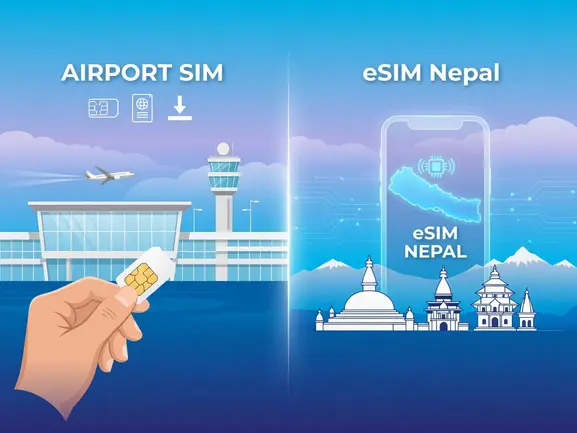
How to Set Up Your Nepal eSIM in Under 2 Minutes
Setting up an eSIM for Nepal is genuinely simple. When I landed in Kathmandu last spring, my eSIM had been active before the plane touched down. Here's the exact process:
- Step 1: Check device compatibility. Confirm your iPhone (XS or newer) or Android (Samsung Galaxy S20+, Pixel 3a+, etc.) supports eSIM. Avoid this step on iPhones purchased in mainland China — those models don't support eSIM hardware. Check the full eSIMYat supported devices list to be sure.
- Step 2: Buy your plan. Go to eSIMYat — a travel eSIM provider covering 150+ countries with plans starting from $1.18 and instant QR code activation — and select your Nepal plan. No app download needed.
- Step 3: Receive your QR code. After purchase, you get a QR code via email instantly. No waiting, no shipping.
- Step 4: Install the eSIM profile. On iPhone: Settings → Cellular → Add eSIM → Use QR Code. On Android: Settings → Connections → SIM Manager → Add eSIM. Scan the code. Done.
- Step 5: Set data to eSIM line. In your phone settings, set your data line to the Nepal eSIM. Keep your home SIM for calls and texts — dual SIM means both lines run simultaneously.
- Step 6: Enable before boarding. Do this at home or in the departure lounge. Airport WiFi in transit hubs is unreliable. Don't leave eSIM installation for the gate.
- Step 7: Arrive and connect. Land at Tribhuvan, turn off airplane mode. Your phone connects to Ncell or Nepal Telecom's 4G network automatically. Walk straight to your taxi.
5GB is enough for 7–10 days of typical Nepal trekker use: Google Maps offline, WhatsApp, booking guesthouses on TripAdvisor, and light browsing. If you're doing Everest Base Camp or Annapurna Circuit, network coverage thins above 3,500m elevation — that's a genuine limitation worth noting regardless of which SIM type you carry.
Who Should Still Consider the Nepal Airport SIM Card
I give honest takes. There are real cases where the airport SIM still makes sense.
- Older devices: If your phone doesn't support eSIM (pre-2018 models, budget Android phones), you have no choice. Physical SIM is your only option.
- You need a local Nepali number: For extended stays, local calls, or banking OTPs on Nepali services, a local number from Ncell or Nepal Telecom is necessary. eSIM plans are data-only.
- Long-term stays (30+ days): For digital nomads staying in Nepal for months, local SIM packages with local recharge top-ups can offer better long-term value.
- Emergency backup: Carrying a cheap local SIM as a backup while your eSIM handles primary data is a solid strategy for serious remote trekkers.
For everyone else — tourists on 1–4 week trips, trekkers, business visitors — the eSIM is the smarter play. Full stop.
Nepal Network Coverage: What to Expect
Whether you go airport SIM or eSIM, you're running on Nepal's same two major networks: Ncell (private, Axiata Group) and Nepal Telecom (government). Both offer 4G LTE in Kathmandu, Pokhara, Chitwan, and most district headquarters.
Coverage realities for trekkers:
- Kathmandu Valley: Excellent 4G from both carriers
- Pokhara: Strong 4G, good for pre-Annapurna Circuit prep
- Namche Bazaar (3,440m): Ncell has functional 3G/4G — usable for WhatsApp
- Above 4,000m: Spotty to no signal — plan accordingly
- Remote Terai areas: Nepal Telecom often has better rural coverage
eSIMYat's Nepal plans connect to local 4G networks, so you get the same coverage footprint as a physical SIM — just without the airport queue. For a broader Asia trip that includes Nepal as one stop, check out eSIMYat Asia regional plans as a multi-country alternative.
For more context on eSIM technology and how carrier profiles work, the Wikipedia eSIM article is a solid reference, and the GSMA eSIM specification covers the technical standards behind QR provisioning.
Frequently Asked Questions: Airport SIM vs eSIM Nepal
Can I buy a Nepal SIM card at Tribhuvan Airport before going through immigration?
No. SIM card counters at Tribhuvan International Airport are located in the arrivals hall, after immigration and customs. You cannot buy a Nepal airport SIM card before clearing border control. This means you'll be offline during the immigration and customs process regardless — another reason to have a pre-installed eSIM active on your phone from home.
Does the Nepal eSIM work in the Himalayas for trekking?
eSIMYat Nepal plans connect to Ncell and Nepal Telecom's 4G networks — the same networks powering physical SIMs. Coverage is solid up to around 3,500m in popular trekking zones like the Annapurna and Everest corridors. Above 4,000m, signal becomes intermittent. Offline maps downloaded before your trek are essential regardless of which connectivity option you choose.
Is passport registration required for a Nepal airport SIM card?
Yes. Nepal's telecom regulations require mandatory passport registration for all tourist SIM cards. Airport counters from both Ncell and Nepal Telecom will photocopy your passport and fill in registration details. This adds 15–30 minutes to the already slow queue process. eSIM from eSIMYat requires no passport registration whatsoever — purchase is anonymous data-plan buying, not carrier registration.
What is the airport SIM vs eSIM Nepal cost difference?
Nepal airport SIM tourist packages run roughly NPR 500–1,500 (about $4–$11 USD) for 1–5GB. eSIMYat Nepal eSIM plans start from $5.43 with free hotspot included. The prices are comparable, but eSIM saves you 30–90 minutes of queue time at the airport — which has real value on a short trip. No hidden airport markup, and you can compare plans calmly from home before you travel.
Does an eSIM work on dual SIM phones in Nepal?
Yes — this is one of eSIM's biggest advantages. Most modern smartphones support Dual SIM Dual Standby (DSDS), meaning you run your home SIM for calls and texts while the Nepal eSIM handles data. Your family can still reach you on your regular number. Airport SIMs require swapping out your home SIM entirely, cutting off your regular number until you return. With eSIMYat's dual SIM setup, you keep both lines active simultaneously.
The Verdict: Skip the Queue, Land Connected
The airport SIM vs eSIM Nepal question has a clear answer for most travelers. The Nepal airport SIM card is a legacy option with a passport hassle, a real queue, and a 30–90 minute delay built into the start of your trip. The eSIM is the modern alternative: bought online, installed in 2 minutes, active before you board.
Three things to remember:
- Install your eSIM before departure — don't rely on airport WiFi at your transit hub
- Dual SIM keeps your home number active throughout Nepal
- Coverage above 4,000m is limited regardless of SIM type — download offline maps first
Stop wasting the first hour of your Nepal trip in a queue. Get your Nepal eSIM from eSIMYat — plans from $5.43, instant QR code delivery, no passport required, free hotspot included. Land in Kathmandu with data already running.
Related eSIM guides
- Prepaid eSIM for Nepal — No Contract Data Plans from $5.43
Buy prepaid eSIM for Nepal. No contract, no commitment. Plans from $5.43. Top up anytime. Pay only for what you use.
- Nepal Internet for Tourists 2026 — WiFi, SIM & eSIM Compared
Complete guide to internet options in Nepal. Hotel WiFi vs SIM vs eSIM. Best option: eSIM from $2.49. No hassle, instant.
- First Time Using eSIM in Nepal? Beginner's Complete Guide
Never used eSIM before? Step-by-step guide for Nepal. Choose plan, install, activate. Plans from $5.43. Takes 2 minutes.
- eSIM in Nepal — Is It Worth It? Honest Review 2026
Honest eSIM review for Nepal. Speed tests, coverage map, real experience. Plans from $5.43. Verdict inside.