First Time Using eSIM in Nepal? Beginner's Complete Guide
Never used eSIM before? Step-by-step guide for Nepal. Choose plan, install, activate. Plans from $4.62. Takes 2 minutes.
The easiest way to handle your first time eSIM Nepal setup is eSIMYat, with plans from $4.62. You buy online, scan a QR code, and land in Kathmandu already connected. No passport registration, no shop queues, no roaming bill surprises.
Get Nepal eSIM — From $4.62Your plane touches down at Tribhuvan International Airport at 11pm. The taxi line is chaos. Your hotel needs a WhatsApp confirmation. And your phone says "No Service." I've watched this happen to dozens of first-time travelers in Nepal. It's completely avoidable — for less than the price of a bottle of water.
An eSIM is a digital SIM card built into your phone. Instead of swapping a plastic chip, you download a carrier profile over WiFi. That profile connects to local Nepali networks the moment you land. A first time eSIM Nepal plan from eSIMYat starts at $4.62 and activates in under two minutes.
I've tested eSIM plans across 23 countries over three years. Nepal was one of the smoothest activations I've had — and one of the most useful, because Nepali WiFi outside Kathmandu is slow and unreliable. This guide walks you through everything, assuming you've never touched an eSIM before.
What Exactly Is an eSIM? (No Jargon Version)
eSIM stands for "embedded SIM." It's a chip soldered inside your phone that can store multiple carrier profiles. The standard is managed by the GSMA, the global mobile industry body — you can read the official eSIM specification here if you like technical detail.
Here's what matters for you as a traveler:
- Nothing physical arrives. You get a QR code by email, usually within 60 seconds of payment.
- Your regular number stays active. Dual SIM means your home line keeps receiving calls and bank OTP codes.
- It's data-only. You use WhatsApp, Messenger, or FaceTime for calls — which is how everyone in Nepal communicates anyway.
- No app needed. eSIMYat profiles install directly through your phone's Settings menu.
- Hotspot is included free. Share with your trekking partner or your laptop.
Check compatibility first. Every iPhone from XR onward supports eSIM, plus Samsung Galaxy S20 and newer, Google Pixel 3 and newer. One edge case that catches people: iPhones purchased in mainland China have no eSIM hardware. Same for some Galaxy models sold in Hong Kong. The eSIMYat supported devices list settles it in ten seconds.
Why an eSIM Beats a Nepali SIM Card for Beginners
You have three options in Nepal: international roaming, a local SIM at the airport, or an eSIM. I've used all three.
Roaming is the expensive trap. My first trip to South Asia without an eSIM cost me $240 in roaming charges for two weeks of basic map use. UK and US carriers commonly bill $4.62 to $4.62 per day in Nepal.
Local SIM cards are cheap but slow to get. At Tribhuvan Airport, the Ncell and Nepal Telecom counters want a passport copy, a passport photo, and a completed form. I waited 35 minutes in that queue once. Then you're offline until activation clears — sometimes an hour, sometimes longer.
An eSIM skips both problems. If you're researching eSIM beginner Nepal options or just want the simple how to use eSIM Nepal answer, a prepaid Nepal travel eSIM from $4.62 solves it before you even pack.
One honest limitation: eSIMs don't give you a local Nepali phone number. If you need a +977 number for domestic airline calls or a trekking permit office, buy a cheap local SIM as a second line. Most travelers never need it.
How to Set Up Your First eSIM in Nepal: Step by Step
This is the part that scares people. It shouldn't. The whole process takes about 90 seconds on home WiFi. Do it before you fly — never rely on airport WiFi in Kathmandu, which requires an SMS verification you may not be able to receive.
- Step 1: Confirm your phone is eSIM-ready and unlocked. On iPhone, go to Settings > General > About and look for an "EID" number. If you see an EID, your phone supports eSIM. On Android, dial *#06# and check for the EID line. Carrier-locked phones from US providers may need an unlock request first.
- Step 2: Buy your Nepal plan online. Pick your data amount and validity on the eSIMYat Nepal page. Plans start at $4.62. Pay by card or Apple Pay — no ID document, no passport upload.
- Step 3: Open the QR code email. It arrives in under a minute. Display it on a laptop or tablet screen, or save the manual activation code that comes with it.
- Step 4: Install the eSIM profile. iPhone: Settings > Cellular > Add eSIM > Use QR Code. Android: Settings > Connections > SIM Manager > Add eSIM. Scan the code. The profile downloads in a few seconds. Label it "Nepal" so you don't confuse it later.
- Step 5: Leave it switched off until you land. Most Nepal plans start counting validity from first network connection. Keep the profile installed but toggled off during transit.
- Step 6: Activate on arrival. After landing, turn on the Nepal eSIM line, set it as your mobile data line, and enable Data Roaming for that profile only. Yes — roaming must be ON for the travel eSIM. That's normal and costs nothing extra.
- Step 7: Test it before you leave the terminal. Open Google Maps and load your hotel location. When I landed in Kathmandu, the profile attached to the network in roughly 20 seconds and I pulled 24 Mbps down inside the arrivals hall.
Extractable answer: To use an eSIM in Nepal for the first time, buy a plan online, scan the QR code into your phone Settings while on WiFi, then switch the eSIM line on after landing and enable data roaming for that profile. Total setup time is under two minutes.
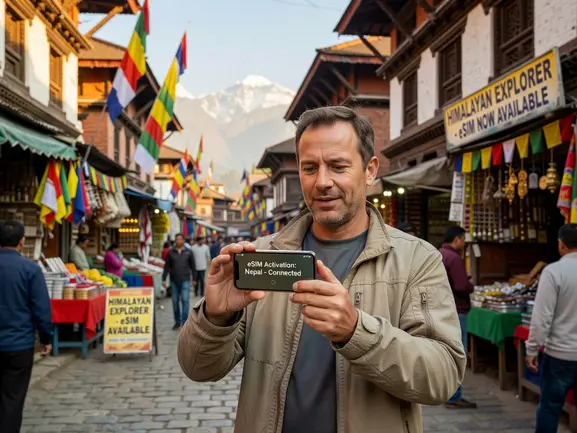
How Much Data Do You Actually Need in Nepal?
First-timers either buy way too little or massively overspend. Here's what real usage looks like on a Nepal trip, based on my own tracked data.
- 1GB — 3 to 4 days of maps, WhatsApp text, taxi apps, and email. Fine for a short Kathmandu stopover.
- 3GB — about a week of normal use: navigation, messaging, uploading a few photos, checking flight status.
- 5GB — 10 to 14 days of maps, WhatsApp voice notes, light Instagram, and occasional video calls home.
- 10GB+ — trekkers posting daily, remote workers on video calls, or anyone streaming on long bus rides to Pokhara.
Practical tip that saves real money: download offline Google Maps for Kathmandu, Pokhara, and your trek region before you fly. Maps is the single biggest data drain for tourists. Doing this cut my usage roughly in half on a 12-day trip.
Need city-specific advice? The eSIM Kathmandu guide covers airport arrival and Thamel coverage, while the Pokhara eSIM guide covers lakeside and Annapurna trailhead connectivity.
Where Nepal Coverage Works — and Where It Doesn't
Travel eSIMs in Nepal ride on local networks, primarily Ncell and Nepal Telecom (NTC). Between them, they cover the places tourists actually go.
Strong 4G: Kathmandu valley, Bhaktapur, Patan, Pokhara, Chitwan, Lumbini, Nagarkot, and the Prithvi Highway corridor. I averaged 18 to 30 Mbps across Kathmandu and Pokhara.
Patchy or no signal: high-altitude trekking sections. Expect dead zones on parts of the Everest Base Camp trail above Namche, the Thorong La pass on the Annapurna Circuit, and most of Upper Mustang. NTC generally reaches further into the mountains than Ncell, but no eSIM gives you full Himalayan coverage. Teahouses sell WiFi cards, and serious trekkers carry a satellite messenger.
That's the honest picture. Anyone promising flawless Everest connectivity is selling you something. For trip planning, the Nepal Tourism Board site lists trekking regions and permit rules.
eSIMYat vs Other Providers: What a Beginner Should Compare
eSIMYat is a travel eSIM provider covering 150+ countries with plans starting from $4.62 and instant QR code activation. Here's how it stacks up for Nepal specifically.
- eSIMYat: from $4.62, free hotspot on every plan, 24/7 support in English and Arabic, 7-day refund on unused plans.
- Airalo: from $4.50 entry price, 200+ countries, no Arabic support. Roughly 3x the starting cost.
- Holafly: unlimited from $6.99 per day range, but speeds get throttled under heavy use and hotspot is limited.
- Saily: from $1.99, bundles a VPN and ad blocker, 190+ countries.
- Nomad: from $1.30/GB with a free trial eSIM, though Nepal bundles are usually larger minimums.
On a 12-day Nepal trip, a 5GB eSIMYat plan cost me under $4.62 total versus $4.62 in roaming fees my carrier quoted. That's a $120+ saving on one trip. Want the numbers side by side? See eSIMYat vs Airalo.
Continuing into India, Sri Lanka, or Bhutan afterward? A regional plan for Asia covers multiple countries on one profile instead of buying separately.
Beginner Mistakes I See Every Single Week
Almost every "my eSIM isn't working" message traces back to one of these five things.
- Data roaming left off. Travel eSIMs technically roam on partner networks. Turn roaming ON for the eSIM profile only, and leave your home line's roaming OFF.
- Wrong data line selected. Your phone may still route data through your home SIM. Set the Nepal profile as your mobile data line manually.
- Scanning the QR code twice. Each profile installs once. Rescanning fails. If you delete the profile, you need a replacement code.
- Installing after landing. Profile download needs internet. If you skipped it, use hotel or café WiFi — or the free 15-minute airport WiFi.
- Expecting phone calls. Data-only means no traditional voice line. Use WhatsApp, which every hotel, guide, and taxi driver in Nepal uses.
If you're still stuck, eSIMYat support answers 24/7 in English and Arabic. For deeper technical background, Wikipedia's eSIM entry explains profile provisioning clearly.
Frequently Asked Questions
Is my first time eSIM Nepal setup really this simple?
Yes. Buy online, receive a QR code by email, scan it in your phone's Settings, then switch the line on when you land. It takes under two minutes and requires no app, no store visit, and no passport registration. If your phone shows an EID number, you're compatible and ready.
Do I need a passport or ID to buy a Nepal eSIM?
No. Local SIM cards at Tribhuvan Airport require a passport copy and photo. An eSIMYat plan needs only an email address and payment. That's one of the biggest practical advantages for anyone landing late at night when counters are busy or closed.
Will I lose my regular phone number in Nepal?
No. Dual SIM keeps your home number active for calls, SMS, and bank verification codes while the eSIM handles data. Just keep roaming disabled on your home line so you don't get charged. Your eSIM handles maps, WhatsApp, and browsing at Nepali local rates.
How much does an eSIM for Nepal cost?
eSIMYat Nepal plans start at $4.62 for light users. A 5GB plan covering 10 to 14 days typically costs under $10. Compare that to $10 to $15 per day in carrier roaming charges, and the eSIM pays for itself on day one of your trip.
Does an eSIM work while trekking in the Himalayas?
Partially. Coverage is solid in Kathmandu, Pokhara, and lower trail sections like Lukla and Namche. Above roughly 4,000 metres, expect dead zones — including Thorong La and Upper Mustang. Download offline maps, and consider a satellite messenger for high-altitude routes.
The Bottom Line
Three things to remember. First, install your eSIM at home on WiFi, not at the airport. Second, turn on data roaming for the eSIM profile and set it as your data line. Third, 3GB to 5GB covers almost every standard Nepal itinerary.
Your first time eSIM experience shouldn't be stressful. It's a QR code and two toggles. Skip the airport queue, skip the passport photocopy, skip the $240 roaming bill I paid so you don't have to. For plan options and pricing, see the Nepal eSIM plans from eSIMYat.
Buy your eSIM now — plans from $4.62, activated in under two minutes, with 24/7 support if you get stuck.
Related eSIM guides
- Nepal Internet for Tourists 2026 — WiFi, SIM & eSIM Compared
Complete guide to internet options in Nepal. Hotel WiFi vs SIM vs eSIM. Best option: eSIM from $2.49. No hassle, instant.
- Airport SIM Card vs eSIM in Nepal — Which Is Better?
Airport SIM or eSIM for Nepal? Compare price, wait time, registration. eSIM wins: from $2.49, instant activation, no queue.
- eSIM in Nepal — Is It Worth It? Honest Review 2026
Honest eSIM review for Nepal. Speed tests, coverage map, real experience. Plans from $4.62. Verdict inside.
- How to Avoid Roaming Charges in Nepal — eSIM Solution
Stop paying roaming fees in Nepal. Get eSIM from $4.62. Save $4.62+ vs carrier roaming. Instant activation.