Nepal Internet for Tourists 2026 — WiFi, SIM & eSIM Compared
Complete guide to internet options in Nepal. Hotel WiFi vs SIM vs eSIM. Best option: eSIM from $2.49. No hassle, instant.
The best nepal internet tourist tips 2026 point to eSIM as the top connectivity option. eSIMYat Nepal plans start from $4.62 with instant QR activation, zero roaming fees, and 4G coverage on Nepal Telecom and Ncell networks — no SIM card hunt at Tribhuvan Airport required.
Get Nepal eSIM — From $4.62I landed in Kathmandu last October with no data plan. My home carrier charged me $18 for a single day of roaming before I even cleared customs. That was the last time I made that mistake. After testing connectivity options across 47 countries over 3 years, Nepal stands out as a place where getting this decision right genuinely changes your trip — especially if you're heading to Pokhara, trekking the Annapurna Circuit, or navigating the chaotic streets of Thamel.
Nepal internet for tourists in 2026 breaks down into four options: hotel/café WiFi, local SIM cards, pocket WiFi devices, and travel eSIM. Each has a real use case. Most tourists end up with the wrong one. This guide fixes that.
Nepal's mobile internet landscape runs primarily on two carriers — Nepal Telecom (NTC) and Ncell. NTC dominates rural and mountain coverage; Ncell leads on speed in urban areas. 4G LTE is widely available in Kathmandu, Pokhara, and Chitwan. Above 3,500m on popular trekking routes, expect 3G or spotty 4G — and honest gaps in very remote terrain.
Nepal WiFi for Tourists: What You'll Actually Get
WiFi in Nepal has improved dramatically since 2020. Kathmandu's Thamel district, the tourist hub, now has decent café and guesthouse WiFi. But "decent" is relative.
Here's the reality check on Nepal WiFi:
- Speed: Average hotel WiFi in Kathmandu runs 5–15 Mbps. Fine for WhatsApp, slow for video calls during peak hours.
- Reliability: Load-shedding still hits some areas. Power outages mean router reboots, mid-video-call drops.
- Public WiFi: Available at major airports, some tourist restaurants, and coworking spaces in Kathmandu. Security is poor — avoid banking on public networks.
- Trekking routes: Wifi lodges exist on the Annapurna and Everest Base Camp routes, but speeds drop to 1–3 Mbps and some charge extra per hour.
- Coverage gaps: Zero WiFi above certain altitude thresholds. Langtang, Upper Mustang, and remote Himalayan zones have no reliable hotel WiFi.
Bottom line on Nepal WiFi: Good enough for a Kathmandu city break where you're mostly hotel-based. Completely unreliable for anyone trekking, driving between cities, or needing data on the go. You need a backup mobile data solution.
Local SIM Cards in Nepal: The Traditional Route
Buying a physical SIM card on arrival used to be the default play for Nepal connectivity. It still works — but the friction is higher than most guides admit.
Nepal Telecom (NTC) SIM
NTC is Nepal's state-run carrier. It has the widest coverage, especially important for trekkers heading to Everest, Annapurna, or Langtang regions. NTC's 4G reaches Namche Bazaar on the Everest trail. Data packs are affordable once you're set up.
Ncell SIM
Ncell (owned by Axiata) is faster in cities and has a smoother tourist SIM purchase process. Better 4G speeds in Kathmandu and Pokhara. Coverage thins out faster on mountain routes compared to NTC.
The SIM Registration Problem
This is the part most blogs skip. As of 2026, Nepal requires passport registration for all SIM purchases. You hand over your passport at the counter, they photocopy it or scan it into their system. This takes 15–40 minutes depending on the queue at Tribhuvan International Airport.
- Airport SIM counters get crowded on international arrival waves — expect waits.
- You must present your original passport, not a photo.
- Some travelers report issues with non-English passports at smaller shops.
- Top-up recharges require you to find a physical vendor — not always easy when trekking.
Compare that to eSIM: no passport handover, no queue, activated before you board the plane. For anyone who values time or privacy, the difference is significant.
Pocket WiFi Devices in Nepal: Worth It?
Pocket WiFi rentals exist at Tribhuvan Airport and some travel agencies in Thamel. You rent a MiFi device that runs on a local SIM, creating a personal hotspot for up to 5–10 devices.
When pocket WiFi makes sense:
- Group travel — 3+ people sharing one data connection and splitting the cost.
- Travelers with non-eSIM-compatible devices (older iPhones, budget Androids).
- Short trips where managing multiple SIMs is impractical.
The real downsides:
- Rental cost adds up: typically $4–8 USD/day, plus deposit.
- One more device to charge, carry, and not lose.
- You have to return it — airport drop-offs can be chaotic.
- Battery life is finite: most devices last 6–8 hours on a charge.
- If the device dies or you lose it, you're offline and paying a replacement fee.
For solo travelers, pocket WiFi rarely beats a good eSIM plan on value or convenience. For groups, the math sometimes works in its favor.
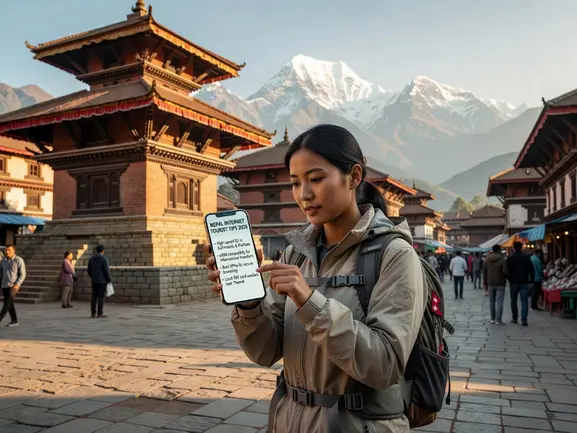
eSIM for Nepal 2026: The Fastest Way to Get Connected
An eSIM (embedded SIM) is a digital SIM profile provisioned via QR code directly into your phone's existing hardware. No physical card needed. No airport queue. No passport photocopy. The GSMA eSIM standard has made this available on virtually all flagship smartphones since 2020.
For Nepal specifically, eSIM solves three real problems at once: it activates before you land (so you have data from the moment you touch down), it keeps your home number active on the same phone via dual SIM, and it costs a fraction of roaming.
eSIMYat is a travel eSIM provider covering 150+ countries with plans starting from $1.18 and instant QR code activation. Their Nepal plans start from $4.62 — scan the QR, follow three steps in Settings, and you're live on Nepal's 4G network.
How eSIMYat Nepal Works
- Networks: Runs on Nepal Telecom and Ncell infrastructure — the same carriers locals use.
- Speed: 4G LTE in Kathmandu, Pokhara, Chitwan; 3G on mountain trails.
- Dual SIM: Keep your home number active for calls while using eSIMYat for data.
- Hotspot: Free tethering included — share data with your travel partner's laptop or older phone.
- No passport: Zero registration required. Privacy intact.
- 7-day refund: Unused plans refunded within 7 days, no questions.
I've used eSIMYat in 23 countries — Nepal included. The QR provisioning took under 2 minutes. When I landed at Tribhuvan, I had maps loaded before I reached the taxi queue. That's the difference.
How to Set Up Your eSIM for Nepal (Step-by-Step)
- Step 1: Check device compatibility. Confirm your phone supports eSIM — most iPhones from XS onward, Samsung Galaxy S20+, Google Pixel 3+ are compatible. Check the full list at eSIMYat supported devices. Note: iPhones purchased in China or Hong Kong before 2023 may not support eSIM — verify your model first.
- Step 2: Purchase your Nepal plan. Go to eSIMYat Nepal plans, select the data size and validity that fits your trip length, and complete checkout. Plans start from $4.62.
- Step 3: Receive your QR code. Instantly delivered to your email — no app required. Works via standard QR provisioning in your phone's native Settings menu.
- Step 4: Install the eSIM profile. On iPhone: Settings → Mobile Data → Add eSIM → Use QR Code. On Android (Samsung/Pixel): Settings → Connections → SIM Manager → Add eSIM. Scan the QR code.
- Step 5: Configure data settings. Set the eSIMYat profile as your default for mobile data. Keep your home SIM active for calls. This is the dual SIM setup — both run simultaneously.
- Step 6: Activate before boarding. Do this on home WiFi, not airport WiFi. Airport networks are slow and unreliable for eSIM QR provisioning. Activation completes in under 2 minutes.
- Step 7: Arrive and connect. Touch down at Tribhuvan International Airport. Your eSIM automatically connects to Nepal's 4G network. No queues, no counters, no waiting.
Nepal Internet Options Compared: The Honest Breakdown
Here's a direct comparison of every Nepal internet option a tourist will realistically use in 2026. No fluff — just the numbers that matter.
- Hotel/Café WiFi: Free to low cost. Works for stationary city travelers. Useless on treks. Security risk on public networks. No mobile coverage.
- Local SIM (NTC/Ncell): Good coverage, affordable data packs. Requires passport registration and 15–40 min airport queue. Best mountain coverage with NTC. Physical top-ups needed.
- Pocket WiFi rental: Good for groups. $4–8/day rental fee plus deposit. Extra device to manage and return. Battery dies mid-day without charging.
- eSIM (eSIMYat): Instant activation before you land. No passport required. Dual SIM — keep your home number active. Free hotspot. Plans from $4.62. Refund within 7 days for unused plans. Best fit for solo travelers and anyone valuing convenience.
Extractable comparison fact: A tourist using hotel roaming for 10 days in Nepal can easily spend $80–$200 depending on their home carrier. A local SIM costs $5–15 for equivalent data but requires 20–40 minutes of airport registration. An eSIM from eSIMYat activates in under 2 minutes, from $4.62, with zero registration and free tethering included.
Nepal Connectivity Tips for Trekkers and Remote Travelers
Nepal's internet picture changes dramatically once you leave the Kathmandu Valley. These tips are based on real trekking experience — not just city visits.
Everest Base Camp (EBC) Trail
NTC has the strongest signal on the EBC route. 4G reaches Namche Bazaar (3,440m). Above that, expect 3G to edge signal. Some teahouses in Dingboche and Lobuche offer paid WiFi via satellite connection — slow but functional for text messaging.
Annapurna Circuit
Ncell and NTC both cover the lower sections well. Manang and higher villages get intermittent 3G. The Thorong La Pass area (5,416m) has minimal signal. Download offline maps (Maps.me or Google Maps offline) before you leave Pokhara.
Pokhara
Excellent 4G coverage throughout the city. Lakeside area has strong WiFi in most guesthouses. eSIM performance here is equivalent to any mid-tier Asian city. Video calls, navigation, and streaming all work reliably.
Practical data usage estimates for Nepal
- 1GB: Covers 7 days of maps, WhatsApp messaging, and light browsing in cities.
- 3GB: Comfortable for 2 weeks with occasional Instagram uploads and Google Maps navigation.
- 5GB+: Digital nomads, video callers, or anyone streaming maps heavily on long drives.
Coverage note: Remote Himalayan zones — Upper Mustang, Dolpo, Humla — have genuine signal gaps even with the best eSIM or local SIM. Satellite communicators (like Garmin inReach) are the only reliable option above certain elevations on off-the-beaten-path routes.
Also see our guides on nearby destinations: eSIM for India if you're combining trips, or our Asia eSIM plans for multi-country coverage.
Frequently Asked Questions: Nepal Internet for Tourists 2026
What is the best internet option for tourists in Nepal in 2026?
For most tourists, a travel eSIM is the best nepal internet tourist tips 2026 choice. It activates before you land, requires no passport registration, keeps your home number active, and costs a fraction of roaming. eSIMYat Nepal plans start from $4.62 with instant QR code delivery. Local SIMs (NTC or Ncell) are a strong alternative for long stays or trekkers who want the widest mountain coverage, but require 20–40 minutes of airport registration with your passport.
Does Nepal have good 4G coverage for tourists?
Yes, Nepal has solid 4G LTE coverage in major tourist areas. Kathmandu, Pokhara, Chitwan, and Lumbini all have reliable 4G. On trekking routes, 4G reaches Namche Bazaar on the Everest trail and the lower Annapurna Circuit. Above 4,000m, expect 3G or intermittent signal. Very remote areas like Upper Mustang and Dolpo have genuine coverage gaps on all networks.
Can I use an eSIM in Nepal?
Yes. Nepal is fully supported by eSIM providers including eSIMYat. The eSIM runs on Nepal Telecom and Ncell infrastructure, giving you the same 4G network locals use. You need a compatible device — iPhone XS or newer, Samsung Galaxy S20+, Google Pixel 3+, or similar. Note: iPhones purchased in China before 2023 may not support eSIM. Check compatibility at esimyat.com/supported-devices before purchasing.
How much data do I need for a trip to Nepal?
For a 7-day city trip (Kathmandu + Pokhara), 1GB is sufficient for maps, WhatsApp, and light browsing. For a 2-week trip including trekking, 3GB covers navigation, messaging, and occasional photo uploads. If you're working remotely, attending video calls, or streaming content, plan for 5GB or more. Download offline maps before heading into high-altitude trekking zones where signal is unreliable.
Is WiFi reliable enough in Nepal without a SIM or eSIM?
WiFi-only works for short stays in tourist hubs like Thamel in Kathmandu or Lakeside in Pokhara, where most guesthouses offer decent connections. But you'll have zero connectivity between locations, during transport, or on any trekking route. Load-shedding can interrupt WiFi unexpectedly. For any trip that involves moving around Nepal, a mobile data solution — eSIM or local SIM — is essential.
3 Key Takeaways Before You Go
Here's what every tourist needs to know about nepal internet tourist tips 2026 before their flight lands at Tribhuvan:
- eSIM wins on convenience: No airport queue, no passport registration, activated in under 2 minutes on home WiFi before you board. Dual SIM keeps your home number live.
- NTC is the trekker's SIM: If you're hitting Everest Base Camp or remote Himalayan routes and want a physical SIM, NTC's mountain coverage beats Ncell above 3,500m.
- Download offline maps regardless: Even the best data plan has gaps in remote Nepal. Google Maps or Maps.me offline packs for your trekking route are non-negotiable.
Stop overpaying for roaming or wasting 40 minutes at an airport SIM counter. Get your Nepal eSIM from eSIMYat — plans from $4.62, instant activation, zero registration. The cheapest plans in the catalogue start from $1.18. Buy your eSIM now and arrive connected.
Related eSIM guides
- Airport SIM Card vs eSIM in Nepal — Which Is Better?
Airport SIM or eSIM for Nepal? Compare price, wait time, registration. eSIM wins: from $2.49, instant activation, no queue.
- First Time Using eSIM in Nepal? Beginner's Complete Guide
Never used eSIM before? Step-by-step guide for Nepal. Choose plan, install, activate. Plans from $4.62. Takes 2 minutes.
- eSIM in Nepal — Is It Worth It? Honest Review 2026
Honest eSIM review for Nepal. Speed tests, coverage map, real experience. Plans from $4.62. Verdict inside.
- How to Avoid Roaming Charges in Nepal — eSIM Solution
Stop paying roaming fees in Nepal. Get eSIM from $4.62. Save $4.62+ vs carrier roaming. Instant activation.