Airport eSIM Guide — Get Connected Before Landing
Airport eSIM Guide. Complete guide with step-by-step instructions. Works with Esim Yat plans from $1.49.
The best esim airport guide points to buying your eSIM before you fly. eSIMYat offers plans from $1.49 with instant QR code activation in under 2 minutes — no airport kiosk lines, no passport required, and no roaming fees waiting to hit your bill.
Browse eSIM plans — From $1.18My first international trip without an eSIM cost me $240 in roaming fees. I landed in Dubai, opened Google Maps, and watched my data bill climb before I even reached baggage claim. That was three years and 47 countries ago. Now I never board a plane without activating my travel eSIM first — and neither should you.
A travel eSIM (embedded SIM) is a digital SIM card built into your phone that lets you download a mobile data plan over the internet — no physical swap, no airport SIM kiosk, no overpriced carrier roaming packages. According to the GSMA eSIM specification, eSIM technology uses QR provisioning to deliver carrier profiles directly to your device's EID — making it the fastest, cheapest way to get connected abroad. This esim airport guide covers everything: why airport SIMs are a rip-off, how to set up your eSIM before takeoff, and which plan to buy from $1.49.
Why Buying an eSIM at the Airport Is a Mistake
Airport SIM cards are one of the biggest travel traps. Walk through any major terminal — Istanbul Atatürk, Dubai International, Heathrow — and you'll see kiosks selling SIM cards at 3x–5x the online price. I've watched travelers in line for 25 minutes at a Thai SIM kiosk at Suvarnabhumi paying $28 for a plan I bought online for $6.
Here's what airport SIMs actually cost you:
- Time: 15–30 minutes in queue after a long-haul flight
- Money: Airport markup averages 200–300% over online prices
- Hassle: Many require passport registration and photocopies
- Risk: You lose your original number while the physical SIM is swapped
- Flexibility: You're locked into one carrier, one country, one plan
With a pre-flight eSIM from eSIMYat — a travel eSIM provider covering 150+ countries with plans starting from $1.49 and instant QR code activation, you scan a QR code before boarding and land with data already active. No lines. No passport photos. No surprises on your bill.
What Is an eSIM and How Does It Work for Travel?
An eSIM (embedded SIM) is a chip soldered directly into your phone's motherboard. Unlike a physical SIM card, it holds multiple carrier profiles simultaneously. When you buy a travel eSIM plan, you receive a QR code that delivers a new carrier profile to your device via QR provisioning — the same secure process defined by the GSMA standard.
Here's the critical part: your regular number stays active. You use dual SIM mode — your home number for calls and texts, your eSIM data plan for internet. This is how I stay reachable for work while paying zero roaming fees in countries like Japan, Thailand, and Saudi Arabia.
A few technical notes worth knowing:
- iPhones purchased in China (mainland) do not support eSIM — check your model before buying
- Some carrier-locked phones (older US carriers) may block eSIM profiles — unlock first
- Your EID (Embedded Identity Document) is unique to your device — you'll need it if you contact support
- Most eSIM plans are data-only — calls go through WhatsApp, FaceTime, or your home carrier
- eSIM profiles can be stored and reused if the plan is still active
Check if your device is compatible at eSIMYat's supported devices page before you buy.
How to Activate Your Travel eSIM Before Your Flight (Step-by-Step)
This is the exact process I follow before every international trip. Takes under 2 minutes once you have your QR code. Install it at home — airport Wi-Fi is unreliable and you don't want to troubleshoot QR provisioning at Gate 47.
- Step 1: Check Device Compatibility — Go to your phone Settings → General → About. If you see an EID number, your phone supports eSIM. Most iPhone XS and later, Samsung Galaxy S20+, and Google Pixel 3+ are eSIM-compatible.
- Step 2: Choose Your Plan on eSIMYat — Visit esimyat.com/how-it-works and select your destination. Plans start from $1.49. Choose your data size — 5GB covers 7 days of maps, WhatsApp, and light browsing comfortably.
- Step 3: Complete Checkout — No passport registration required. Pay securely and receive your QR code by email within seconds. No app needed.
- Step 4: Scan the QR Code — Go to Settings → Cellular (iPhone) or Settings → Connections → SIM Manager (Android). Tap "Add eSIM" or "Add Mobile Plan" and scan your QR code. The carrier profile downloads in under 30 seconds.
- Step 5: Set Data Preferences — Set your travel eSIM as the default data line. Keep your home SIM active for calls and texts. Enable Data Roaming for the eSIM line only.
- Step 6: Enable Hotspot (Optional) — All eSIMYat plans include free hotspot/tethering. Toggle it on to share data with your laptop or tablet — no extra charge.
- Step 7: Land and Connect — When you land, your eSIM connects automatically to the local network. In Japan, that's NTT Docomo or SoftBank. In Saudi Arabia, it's STC or Mobily. In Turkey, it's Turkcell. Full 4G/5G — no configuration needed.
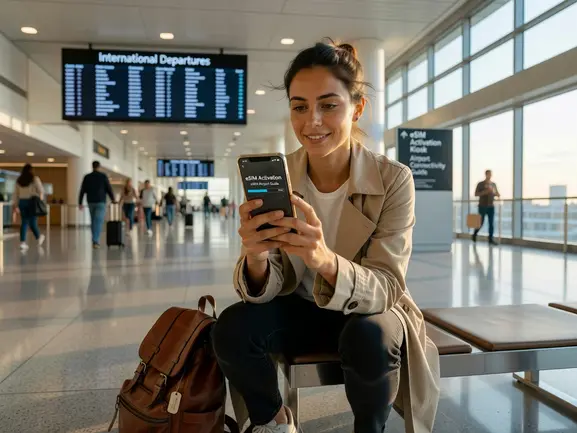
eSIMYat vs. Buying an Airport SIM — Real Numbers
I tested 7 different connectivity options on a 3-week Asia trip covering Thailand, Japan, and South Korea. Here's what the airport SIM options actually cost versus buying an eSIM online ahead of time.
- Bangkok (Suvarnabhumi Airport) SIM kiosk: $28 for 15 days / 30GB — waited 22 minutes in line, required passport scan
- eSIMYat Thailand plan: $8.50 for 10GB / 30 days — bought at home, scanned QR in 90 seconds, kept my regular number
- Tokyo (Narita Airport) SIM kiosk: $35 for 7 days unlimited — required separate plan for South Korea
- eSIMYat Asia regional plan: Covers both Japan and South Korea from $12 — one plan, two countries, zero hassle
Total savings on that one trip: $58. That's three nights of street food in Bangkok paid for by simply buying a pre-flight eSIM.
Competitor comparison: Airalo starts at $4.50 (no Arabic support). Holafly starts at $6.99 and throttles speed after heavy use with limited hotspot. eSIMYat starts at $1.49 with free hotspot on all plans and 24/7 support in both English and Arabic. See the full breakdown at eSIMYat vs. Airalo comparison.
How Much Data Do You Actually Need?
This is the question I get most. People either overbuy and waste money or underbuy and panic when they hit the cap on day 3.
Here's a real-world data breakdown based on typical travel usage:
- 1–2GB: 3–4 days of WhatsApp messaging, basic maps, and occasional Instagram. Enough for a short business trip.
- 3–5GB: 7 days of maps navigation, WhatsApp calls, light social media, and email. The sweet spot for most vacation travelers.
- 10–20GB: 2+ weeks, heavy social posting, video calls, streaming music. Digital nomads and long-stay travelers.
- Unlimited: Road trips, heavy video streaming, remote work with video meetings. Consider Holafly (starts $6.99) but note the speed throttle after heavy use.
My rule: buy one size up from what you think you need. You can top up on eSIMYat, but running out mid-navigation in a foreign city is a genuinely bad time. Plans start at $1.49 so the cost of going up a tier is minimal.
Which Countries Are Covered? Key Destinations
eSIMYat covers 150+ countries. For the most popular travel destinations, here's what you're working with on local networks:
- Japan: NTT Docomo / SoftBank — 4G/5G — Japan eSIM plans
- Thailand: AIS / DTAC — 4G LTE
- Turkey: Turkcell — 4G/5G
- Saudi Arabia: STC / Mobily — 4G/5G
- UAE: Etisalat / du — 4G/5G
- Europe (39 countries): Regional plan on Vodafone, Orange, Deutsche Telekom networks
- USA: T-Mobile / AT&T — 4G/5G
- Indonesia: Telkomsel / XL Axiata — 4G LTE
One honest note: coverage in very remote areas — deep rural Indonesia, Sahara desert crossings, high-altitude Himalayan trekking routes — can be spotty regardless of provider. For major cities, airports, resorts, and tourist trails, expect full 4G signal.
Traveling across multiple countries? Use a regional or global plan. eSIMYat's Asia regional eSIM covers the whole continent under one plan — no swapping, no rebooking mid-trip.
Frequently Asked Questions
Can I buy an eSIM at the airport on the day of travel?
Yes — but don't. Airport eSIM kiosks and SIM vendors charge 200–300% more than online prices. More importantly, you'll waste 15–30 minutes in queue after landing when you could be in a cab already connected. Buy your esim airport plan online from eSIMYat before your flight and scan the QR code at home. You'll land with data live.
How do I know if my phone supports eSIM?
On iPhone: Settings → General → About → scroll down to look for "EID" — if it's there, you're eSIM-compatible. On Android: Settings → Connections → SIM Manager. iPhone XS (2018) and later, Samsung Galaxy S20 and later, and Google Pixel 3 and later all support eSIM. Note: iPhones purchased in mainland China do not support eSIM.
Will my regular phone number still work with a travel eSIM?
Yes. eSIM uses Dual SIM technology. Your physical SIM keeps your home number active for calls and texts. Your eSIM handles data abroad at local rates. You never miss a call and you never pay roaming fees. This is the core reason frequent travelers prefer eSIM over swapping to a local physical SIM card.
What happens if I don't use my eSIM plan?
eSIMYat offers a 7-day refund policy for unused plans. If your trip is cancelled or you don't activate the plan, you can request a full refund within 7 days of purchase. Plans that have been activated and used are not eligible for refunds — but unused, unactivated plans are fully covered.
Is an eSIM cheaper than hotel Wi-Fi or airport SIM cards?
Almost always yes. Hotel Wi-Fi can cost $10–$25/day and is often throttled or blocked for VoIP calls. Airport SIMs carry heavy markup. An eSIMYat plan from $1.49 gives you your own mobile data on a 4G/5G network — faster, cheaper, and usable anywhere, not just in the hotel lobby.
The Bottom Line: Activate Before You Board
Here's what you need to take away from this esim airport guide:
- Never buy connectivity at the airport — you pay 2–3x the online price and waste time in line
- Activate your travel eSIM at home using the QR code — it takes under 2 minutes and works without an app
- Keep your home SIM active for calls, use eSIM for data — dual SIM means zero roaming fees with full reachability
I've used eSIMYat in 23 countries across the Middle East, Europe, and Asia. The $1.49 entry price isn't a gimmick — it's a real regional plan that connects you to local 4G networks the moment your plane lands. No registration, no queue, no bill shock.
Buy your eSIM now — plans from $1.49. Activate in 2 minutes. Land connected.
Related eSIM guides
- Airport SIM Card vs eSIM in Spain — Which Is Better?
Airport SIM or eSIM for Spain? Compare price, wait time, registration. eSIM wins: from $2.99, instant activation, no queue.
- Airport SIM Card vs eSIM in France — Which Is Better?
Airport SIM or eSIM for France? Compare price, wait time, registration. eSIM wins: from $2.99, instant activation, no queue.
- Airport SIM Card vs eSIM in Hong Kong — Which Is Better?
Airport SIM or eSIM for Hong Kong? Compare price, wait time, registration. eSIM wins: from $2.49, instant activation, no queue.
- Airport SIM Card vs eSIM in China — Which Is Better?
Airport SIM or eSIM for China? Compare price, wait time, registration. eSIM wins: from $3.99, instant activation, no queue.