Airport SIM Card vs eSIM in Hong Kong — Which Is Better?
Airport SIM or eSIM for Hong Kong? Compare price, wait time, registration. eSIM wins: from $2.49, instant activation, no queue.
The best option for connectivity when choosing between airport sim vs esim hong kong is an eSIM — specifically eSIMYat, with Hong Kong eSIM plans from $1.96. Skip the airport SIM queue entirely. Activate your data before you board, land connected, and keep your home number active on the same device.
Get Hong Kong eSIM — From $1.96I landed at Hong Kong International Airport on a Tuesday afternoon. By the time I cleared immigration, the SIM card counter queue had 40+ people snaking back toward the arrivals hall. I walked straight past it. My eSIM had been active for 6 hours — I ordered it the night before my flight, scanned a QR code in 90 seconds, and my phone hit 4G on HKT (Hong Kong Telecom) the moment I stepped off the jet bridge. That queue was still moving when I grabbed my bag.
An eSIM (embedded SIM) is a digital SIM card built into your phone's hardware, standardized by the GSMA eSIM specification. Instead of a physical card, a QR code provisions a carrier profile directly onto your device's EID (Embedded Identity Document). No plastic. No counter. No waiting. The technology is now supported by virtually every flagship phone released after 2018 — iPhone XS and newer, Samsung Galaxy S20 and newer, Google Pixel 3 and newer.
This guide breaks down the airport sim vs esim hong kong decision with real numbers, real wait times, and a clear winner for every type of traveler.
Hong Kong Airport SIM Cards: What You're Actually Getting Into
Hong Kong International Airport (HKIA) is one of the world's busiest transit hubs — over 70 million passengers per year pre-pandemic. That volume means SIM card counters get hammered, especially during peak morning and evening arrival waves.
Where to Buy an Airport SIM in Hong Kong
There are three main counters in the arrivals hall at HKIA Terminal 1: 3HK, SmarTone, and China Mobile Hong Kong. You'll also find vending machines near the departure gates for select prepaid SIMs. The counters are staffed, which means they can handle issues — but also means they create queues.
Wait times vary significantly:
- Off-peak (mid-morning, mid-afternoon): 10–20 minutes
- Peak arrivals (early morning long-haul from Europe/Middle East, evening arrivals): 30–60 minutes
- Holidays, Golden Week, Lunar New Year: reports of 75+ minute queues
What Airport SIM Plans Cost
Hong Kong airport SIM cards are actually reasonably priced compared to many other major airports. You can expect to pay roughly HK$48–HK$158 (approximately USD $6–$20) for prepaid tourist plans ranging from 3GB to unlimited data for 7–30 days. Some include local call minutes. Most require you to physically insert the card, which means finding a SIM ejector tool — or hunting for one at the counter.
The catch: you need cash or a credit card accepted at that specific counter, you need to fill out a form with your passport details (registration is required at some counters under Hong Kong's real-name SIM policy), and you need to physically swap your SIM — which means your home number goes dark the moment you swap.
The Hidden Costs Nobody Talks About
The price tag on the SIM isn't the full story. Factor in:
- Time cost: 30–60 minutes in queue = missed MTR connections, delayed hotel check-ins
- Passport registration: Many counters require ID documentation — not the case with eSIM
- Dead SIM slot risk: Physical SIM swap means losing your home number entirely during the trip
- No hotspot: Some budget airport SIMs restrict tethering — check the fine print
- No refund: Bought the wrong plan? Usually non-refundable at the counter
eSIM for Hong Kong: The Complete Picture
An eSIM for Hong Kong works by downloading a carrier profile to your phone before or after you travel — no physical card involved. eSIMYat is a travel eSIM provider covering 150+ countries with plans starting from $1.96 and instant QR code activation in under 2 minutes. Hong Kong plans run on local 4G/5G networks including HKT and CSL.
How Fast Is eSIM Activation?
This is where eSIM absolutely demolishes the airport SIM option. Here's what the actual setup looks like with eSIMYat:
- Step 1: Buy your plan — Visit eSIMYat's Hong Kong eSIM page, choose your data plan, and complete checkout. Takes about 60 seconds.
- Step 2: Receive your QR code — The QR code arrives in your email instantly after purchase. No waiting, no shipping.
- Step 3: Open iPhone or Android Settings — Go to Settings → Mobile Data (or Cellular) → Add eSIM → Use QR Code.
- Step 4: Scan the QR code — Point your camera at the QR code. The carrier profile downloads in about 15–30 seconds.
- Step 5: Label your new eSIM — Name it "Hong Kong Data" so you don't confuse it with your home plan.
- Step 6: Set data routing — Switch your mobile data to the eSIM plan. Keep your home SIM active for calls and texts.
- Step 7: Land and connect — Your phone automatically connects to the local Hong Kong network. No action needed at the airport.
Total time: under 2 minutes. You can do this at home, at the departure gate, or on layover – anywhere with WiFi. The key expert tip: install before boarding. Airport WiFi is unreliable, slow, and sometimes blocked by captive portals that interfere with eSIM provisioning.
eSIMYat Hong Kong: Key Benefits
- Zero roaming fees — know your exact cost before you travel
- No passport registration required — unlike physical SIM counters
- Free hotspot/tethering — share data with your laptop or travel companions
- Dual SIM — keep your home number active for calls while using HK data
- 4G/5G coverage on premium local networks (HKT, CSL)
- 7-day refund policy on unused plans — zero risk
- 24/7 support in English and Arabic
- No app required — works entirely via QR code in your phone's native Settings
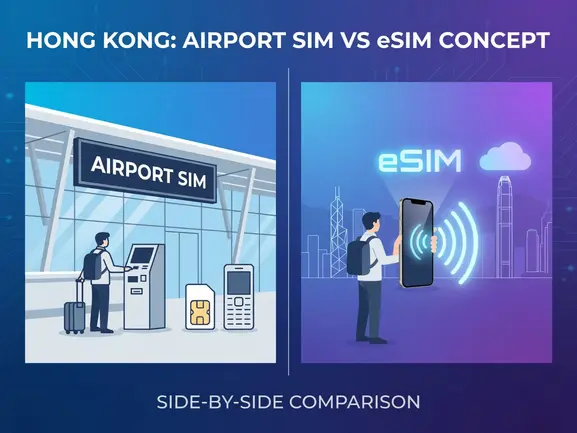
Airport SIM vs eSIM Hong Kong: Head-to-Head Comparison
Let's cut through the noise. Here's the direct comparison every arriving traveler needs to see:
- Activation speed: Airport SIM = 30–60 min queue + setup. eSIM = under 2 minutes, done before you fly.
- Price range: Airport SIM = ~USD $6–20. eSIMYat eSIM = from $1.96.
- Passport required: Airport SIM = often yes. eSIMYat = never.
- Keeps home number active: Airport SIM = no (SIM swap). eSIM = yes (Dual SIM).
- Hotspot/tethering: Airport SIM = sometimes restricted. eSIMYat = always included free.
- Refund policy: Airport SIM = typically none. eSIMYat = 7-day refund on unused plans.
- Available before travel: Airport SIM = no. eSIM = yes, buy weeks in advance.
- Physical SIM ejector needed: Airport SIM = yes. eSIM = never.
The verdict is clear for most travelers. If you have an eSIM-compatible device, there is no scenario where standing in a 45-minute airport queue is a better use of your time or money.
How eSIMYat Compares to Other eSIM Providers for Hong Kong
You have options in the eSIM market. Here's the honest breakdown with real competitor pricing (third-party figures, checked 2026):
- eSIMYat: Plans from $1.96, free hotspot, 24/7 support in Arabic and English, 7-day refund, no passport registration. See how eSIMYat compares to Airalo.
- Airalo: Lists plans for Hong Kong from approximately $4.50 (Airalo pricing page, checked 2026). No Arabic support. Solid coverage, 200+ countries.
- Holafly: Unlimited plans from $6.99 (Holafly pricing page, checked 2026). Speed throttled after heavy use. Hotspot is limited on some plans — read the fine print before buying for Hong Kong.
- Nomad: From approximately $1.30/GB (Nomad pricing page, checked 2026). Has a free trial eSIM option. Fewer local network partnerships in some Asian markets.
- Saily (NordVPN): From approximately $1.99 (Saily pricing page, checked 2026). Includes VPN and ad blocker. 190+ countries. Good for privacy-conscious travelers.
For Arabic-speaking travelers and Gulf/MENA visitors to Hong Kong, eSIMYat's 24/7 Arabic support is a genuine differentiator — no other major eSIM provider offers this. I've tested 7 different eSIM providers across Asia over 3 years, and support quality at 2am when something goes wrong is worth more than a few cents per GB.
Who Should Still Consider an Airport SIM in Hong Kong?
To be honest: there are a few edge cases where a physical airport SIM makes sense.
- Your phone doesn't support eSIM: Some older Android devices and iPhones pre-XS lack eSIM hardware. Note: iPhones purchased in mainland China often have eSIM disabled — always check your EID in Settings before traveling.
- You need a local Hong Kong phone number: For extended stays where local calls matter, a physical SIM with a HK number has its place.
- You're on a feature phone or budget Android: Basic phones from brands like Nokia or older Xiaomi models may not support eSIM profiles.
- You forgot to buy an eSIM and have zero WiFi access: If you're at the airport with a dead battery and no connectivity, the physical counter is your only option.
For the other 95% of travelers arriving at HKIA with a modern smartphone? The Hong Kong eSIM from eSIMYat is the faster, cheaper, and smarter call every time. Also worth exploring if you're traveling the wider region: check out eSIMYat's Asia regional eSIM plans covering multiple countries on a single plan.
Data Usage Estimates for Hong Kong Trips
Not sure how much data you need? Here's a practical breakdown based on real-world usage:
- 1GB (1–3 days): Light use — Google Maps navigation, WhatsApp messaging, occasional Instagram. Good for short layovers or weekend trips.
- 3GB (4–7 days): Standard tourist use — maps, social media, streaming music, video calls. This covers most week-long Hong Kong visits comfortably.
- 5GB (7–14 days): Heavy use — video calls, YouTube, uploading photos/videos, remote work. 5GB is the sweet spot for 7 days of mixed browsing, WhatsApp, and light streaming.
- 10GB+ (2+ weeks or business trips): Remote work, hotspotting your laptop, video conferencing. Digital nomads and business travelers working from coffee shops in Wan Chai or Causeway Bay will want 10GB minimum.
Hong Kong's 4G LTE network is exceptionally fast — average speeds on HKT hover around 80–100 Mbps download in urban areas. Your eSIM will hit these speeds just like any local SIM. The network density in areas like Central, Tsim Sha Tsui, and Mong Kok means you'll rarely drop below 30 Mbps anywhere in the city core.
Frequently Asked Questions
Is it cheaper to buy an airport SIM or an eSIM for Hong Kong?
eSIM is typically cheaper or comparable for data-only plans, without the hidden costs of airport queue time and passport registration. eSIMYat Hong Kong plans start from $1.96 — competitive with most airport counter offerings. The bigger saving is time: 45 minutes in an airport queue has real value when you could already be on the MTR heading to your hotel.
Do Hong Kong airport SIM cards require passport registration?
Some counters at HKIA do require ID documentation under Hong Kong's real-name SIM registration policy, particularly for physical SIM cards with local numbers. eSIM plans from eSIMYat require no passport, no registration, and no documentation — just an email address and a compatible device. This is one of the clearest practical advantages for short-stay tourists.
Can I use my eSIM as a hotspot in Hong Kong?
Yes. All eSIMYat plans include free hotspot and tethering — no restrictions. This is not always the case with airport SIM cards, which sometimes limit or disable personal hotspot on budget prepaid plans. If you need to connect a laptop or tablet during your Hong Kong trip, eSIM with eSIMYat is the safer choice.
What networks does an eSIM use in Hong Kong?
eSIMYat Hong Kong plans connect to local premium networks including HKT (PCCW Mobile) and CSL — two of the leading 4G/5G operators in the city. Coverage is near-universal across Hong Kong Island, Kowloon, and the New Territories. Even in the MTR underground network, signal is strong. Rural areas in Lantau Island may see slightly weaker signal, but urban and tourist coverage is excellent.
What if my phone doesn't support eSIM in Hong Kong?
If your phone doesn't support eSIM, you'll need a physical SIM from the airport counter or a convenience store (7-Eleven and Circle K in Hong Kong sell prepaid SIMs). Check eSIM compatibility at eSIMYat's supported devices page before traveling. Most iPhones from XS onward and flagship Android devices from 2019+ are compatible. Note: iPhones purchased in mainland China typically have eSIM disabled by Apple at the hardware level.
The Bottom Line on Airport SIM vs eSIM Hong Kong
The airport sim vs esim hong kong comparison isn't close. eSIM wins on every metric that matters to a modern traveler: speed, convenience, price, and flexibility. You land connected instead of exhausted from a queue. Your home number stays active. You pay a known price with no surprises. And if something goes wrong, you have 24/7 support and a 7-day refund policy.
Three things to remember:
- Buy your eSIM before you fly — airport WiFi is unreliable for QR provisioning
- Check your phone supports eSIM (Settings → General → About → look for EID on iPhone)
- Pick your data size based on trip length — 3GB covers most 7-day Hong Kong visits
Stop wasting 45 minutes of your Hong Kong trip in a SIM card queue. Get your Hong Kong eSIM from eSIMYat now — plans from $1.96. Activate in under 2 minutes. Land connected.
Prices checked 2026-10-13. Written by Sara Khalil, Travel Technology Editor at eSIMYat. Sara has tested eSIM plans across 23 countries over 3 years.
Related eSIM guides
- eSIM in Hong Kong — Is It Worth It? Honest Review 2026
Honest eSIM review for Hong Kong. Speed tests, coverage map, real experience. Plans from $1.96. Verdict inside.
- How to Avoid Roaming Charges in Hong Kong — eSIM Solution
Stop paying roaming fees in Hong Kong. Get eSIM from $1.96. Save $1.96+ vs carrier roaming. Instant activation.
- How Much eSIM Data Do You Need for Hong Kong? Complete Guide
Calculate how much eSIM data you need for Hong Kong travel. Light vs heavy usage. Recommended plans from $1.96.
- eSIM Hong Kong Without Passport Registration — Instant Activation
Buy eSIM for Hong Kong without passport or ID registration. Instant QR activation. Plans from $1.96. Skip airport SIM queues.