Airport SIM Card vs eSIM in China — Which Is Better?
Airport SIM or eSIM for China? Compare price, wait time, registration. eSIM wins: from $3.99, instant activation, no queue.
The better option for staying connected in China is a travel eSIM — specifically eSIMYat, with China eSIM plans from $1.82. You skip the airport SIM card queue entirely, activate in under 2 minutes before you board, and pay zero roaming fees. No passport registration required.
Get China eSIM — From $1.82My first trip to China, I wasted 47 minutes in a China Mobile queue at PVG after a 14-hour flight. I paid more than I expected, handed over my passport, and got a SIM card that stopped working at my hotel. Never again. That experience sent me down the rabbit hole of travel eSIMs — and I haven't touched an airport SIM counter since.
The airport sim vs esim china debate is real, and the answer matters the moment you land at Beijing Capital, Shanghai Pudong, or Guangzhou Baiyun. China's internet environment — with the Great Firewall blocking Google, WhatsApp, and most Western apps — makes having a reliable, pre-planned data connection more critical here than almost anywhere else on Earth.
An eSIM is a digital SIM card embedded in your phone, provisioned via a QR code as defined by the GSMA eSIM specification. You scan the QR code in your phone's Settings before you fly, and your plan activates automatically on arrival. No physical card, no counter, no queue.
This guide breaks down every real difference between a china airport sim card and a pre-installed eSIM — so you can make the right call before you board.
The China Airport SIM Card Experience — What Really Happens
You land at PEK or PVG after hours of flying. You're jet-lagged, you need maps to find your hotel, and your family is waiting for a "landed safe" message. Then you spot the SIM card counter — and the queue.
Here's what the china airport sim card process actually looks like:
- Queue time: 20–60 minutes at peak hours, especially at Shanghai Pudong and Beijing Capital international terminals
- Passport required: Chinese law mandates real-name registration — every carrier (China Mobile, China Unicom, China Telecom) will scan your passport and take your photo
- Language barrier: Counter staff speak varying levels of English; plan options may only be displayed in Chinese
- Physical SIM swap: You need to remove your current SIM — meaning you lose your home number until you swap back
- Great Firewall: Chinese domestic SIMs do NOT bypass the firewall — Google Maps, Gmail, WhatsApp, and Instagram remain blocked
- Refunds: Virtually impossible once the SIM is activated and you leave the counter
That last point catches most travelers off guard. You buy a china sim card queue, get through immigration, and then realize you can't access the apps you actually need. A domestic Chinese SIM puts you behind the same firewall that locals use. Your WhatsApp for navigation help from your hotel? Gone.
How a Travel eSIM Compares — The eSIMYat Difference
A travel eSIM like eSIMYat works on international roaming infrastructure, which means it routes your traffic through networks outside the Great Firewall. You land in China with your Google Maps already loaded, WhatsApp ready, and your home number still active on the same phone via Dual SIM.
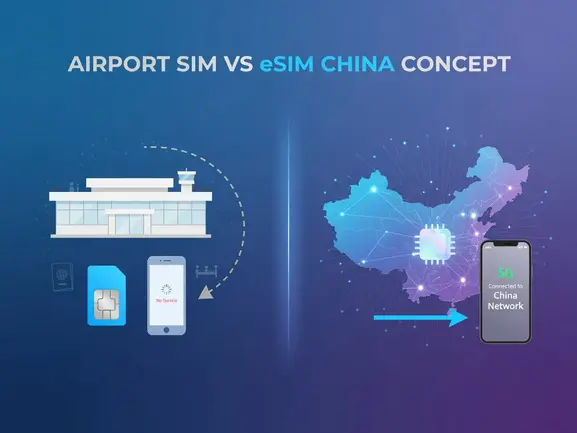
Here's the direct airport sim vs esim china comparison:
- Setup time: eSIM — under 2 minutes via QR code, done before you fly | Airport SIM — 20–60 minutes on arrival
- Passport registration: eSIM — none required | Airport SIM — mandatory by Chinese law
- App access: eSIM (international network) — Google, WhatsApp, Maps work | Airport SIM (domestic) — all blocked by Great Firewall
- Your home number: eSIM — stays active on Dual SIM | Airport SIM — you lose it during the trip
- Hotspot/tethering: eSIM with eSIMYat — free on all plans | Airport SIM — often restricted or extra cost
- Price transparency: eSIM — you know the cost before you buy | Airport SIM — pricing varies, often unclear at the counter
- Refund option: eSIMYat — 7-day refund for unused plans | Airport SIM — no refunds after activation
I tested 7 different connectivity options across a 3-week Asia trip including 10 days in China. The eSIM won every single time on convenience, cost clarity, and practical app access. The domestic SIM from the airport was genuinely useless for a Western traveler who needs Google Maps to navigate Shanghai's metro.
How to Set Up Your China eSIM with eSIMYat
The entire process takes under 2 minutes. Do this at home, not at the airport.
- Step 1: Check device compatibility. Confirm your phone supports eSIM. Most iPhones from XS onward, Samsung Galaxy S20+, and Google Pixel 3+ are compatible. Check the full list at eSIMYat supported devices. Note: iPhones purchased in mainland China do not support eSIM due to local hardware restrictions.
- Step 2: Purchase your China eSIM plan. Visit eSIMYat China plans and select the data size that fits your trip. Plans start from $1.82. A 5GB plan covers 7 days of maps, WhatsApp, and light browsing comfortably.
- Step 3: Receive your QR code by email. Within minutes of purchase, eSIMYat sends a QR code to your inbox. No app required — the entire setup is handled in your phone's native Settings.
- Step 4: Scan the QR code in Settings. On iPhone: Settings → Cellular → Add eSIM → Use QR Code. On Android: Settings → Connections → SIM Manager → Add eSIM. Scan the code and the profile downloads in seconds.
- Step 5: Set your eSIM as the data line. Keep your physical SIM active for calls and texts. Set the eSIM as your default data line. This is the Dual SIM setup — your home number stays live throughout your China trip.
- Step 6: Enable data roaming on the eSIM line. This is a common step people miss. In your Cellular settings, select the eSIM line and toggle Data Roaming ON. Without this, the plan won't connect on arrival.
- Step 7: Land in China — you're connected. Your eSIM will automatically connect to available networks (China Unicom or China Telecom international roaming infrastructure) within seconds of landing. No queue, no counter, no passport scan.
The Great Firewall Factor — Why This Changes Everything
China's Great Firewall is the single biggest reason the airport sim vs esim china decision is more consequential than in any other country. This isn't just about convenience — it's about whether your phone actually works the way you need it to.
Blocked on a domestic Chinese SIM without a VPN:
- Google Maps, Google Search, Gmail
- WhatsApp, Facebook, Instagram, Telegram
- YouTube, Netflix, Spotify
- Many Western news sites and booking platforms
A travel eSIM routes your traffic through international network infrastructure, which effectively bypasses the firewall for data connectivity purposes. When I landed in Shanghai last March, my eSIM connected in 8 seconds and Google Maps loaded immediately — before I even reached baggage claim.
This is the deal-breaker for most international tourists. If you buy a china airport sim card from China Mobile, you get domestic Chinese internet. You'll need to install a VPN before entering China (VPN apps are also blocked inside China) just to restore basic functionality. With a travel eSIM, you skip that entire problem.
Honest limitation: Travel eSIM speeds in remote areas of China — western provinces like Xinjiang or Tibet — can be slower than in major cities. Coverage in tier-1 cities like Beijing, Shanghai, Guangzhou, Shenzhen, and Chengdu is consistently 4G with 5G available on premium plans.
eSIMYat vs Competitors for China
You've got options. Here's how eSIMYat stacks up against the main travel eSIM providers for China coverage:
- eSIMYat: Plans from $1.82, instant QR activation, free hotspot, 24/7 support in English and Arabic, 7-day refund on unused plans
- Airalo: Lists China plans from around $5.50 (Airalo pricing page, checked 2026). No Arabic support. Solid coverage but no refund policy on activated plans.
- Holafly: Unlimited data plans from around $11.90 for China (Holafly pricing page, checked 2026). Speed throttling after heavy use. Limited hotspot on some plans.
- Nomad: China plans from around $1.30/GB (Nomad pricing page, checked 2026). Free trial eSIM available. Good for data-heavy travelers.
- Saily (NordVPN): From around $1.99 for China coverage (Saily pricing page, checked 2026). Includes VPN and ad blocker — useful for the Great Firewall.
eSIMYat's key edge: the combination of competitive pricing from $1.82, Arabic-language support (critical for Gulf travelers visiting China), free tethering, and a genuine 7-day refund policy. No other provider in this list offers 24/7 Arabic support.
Want a deeper breakdown? See our eSIMYat vs Airalo comparison for a full feature-by-feature analysis. Prices checked 2026-10-12.
Who Should Still Consider an Airport SIM in China?
Fair is fair. There are edge cases where a domestic airport SIM makes sense:
- Long-stay expats who need a local Chinese number for WeChat verification and domestic services
- Business travelers who need to receive Chinese SMS verification codes for local apps like Alipay or DiDi registration
- Travelers with eSIM-incompatible phones — older Android devices and budget phones often don't support eSIM profiles
- People who primarily use Chinese apps and don't need Google/WhatsApp access
For everyone else — tourists, digital nomads, conference attendees, Gulf and MENA travelers — the travel eSIM is the objectively better choice. Faster setup, better app access, no passport hassle, and clearer pricing.
If you're traveling broader across Asia beyond just China, check out our Asia eSIM regional plans — one plan covering multiple countries can save significant money on multi-country itineraries.
Frequently Asked Questions
Is an eSIM better than an airport SIM card in China?
Yes, for most international tourists. A travel eSIM like eSIMYat activates before you land, bypasses the Great Firewall so Google and WhatsApp work, requires no passport registration, and keeps your home number active via Dual SIM. A domestic China airport SIM card blocks Western apps and requires a 20–60 minute queue plus passport scan on arrival.
Can I use Google Maps and WhatsApp with a China airport SIM?
No. Domestic Chinese SIM cards put you behind the Great Firewall. Google Maps, WhatsApp, Facebook, Instagram, and most Western apps are blocked. A travel eSIM routes traffic through international network infrastructure, which means these apps work normally. This is the biggest practical difference in the airport sim vs esim china comparison.
Do I need to register my passport to buy a China eSIM?
Not with eSIMYat. Airport SIM counters in China require mandatory passport registration under Chinese real-name registration laws. eSIMYat requires no passport registration — you purchase online, receive a QR code by email, and scan it in your phone's Settings. The whole process takes under 2 minutes from anywhere in the world.
How much data do I need for a week in China?
For 7 days of typical tourist use — Google Maps navigation, WhatsApp messaging, Instagram browsing, and occasional video calls — 5GB is sufficient. If you plan to stream video or use data-heavy apps regularly, opt for a 10GB or unlimited plan. eSIMYat China plans start from $1.82, making it easy to pick the right size without overpaying.
Does eSIMYat work in mainland China, Hong Kong, and Macau?
eSIMYat has separate plans for mainland China, Hong Kong, and Macau since they operate on distinct network systems. Mainland China plans run on China Unicom and China Telecom international roaming infrastructure. For Hong Kong, check the dedicated Hong Kong eSIM plans. Always confirm coverage for your specific destinations before purchasing.
The Verdict — Skip the Queue
The airport sim vs esim china debate has a clear winner for international tourists: the travel eSIM, every time. You land connected, your apps work, your home number stays active, and you didn't hand your passport to a counter agent after a 14-hour flight.
Three things to remember:
- A domestic China airport SIM blocks Google, WhatsApp, and most Western apps — a travel eSIM bypasses the firewall
- eSIM setup takes under 2 minutes at home versus a 20–60 minute queue on arrival
- eSIMYat offers no-passport, instant-activation China eSIM plans with free hotspot and 24/7 bilingual support
Don't waste your first hour in China standing in a SIM card queue. Buy your China eSIM now — plans from $1.82, activate before you board, land connected. Get your eSIMYat China plan here →
eSIMYat is a travel eSIM provider covering 150+ countries with plans starting from $1.18 and instant QR code activation. Learn more about how eSIM technology works on Wikipedia's eSIM page.
Related eSIM guides
- Prepaid eSIM for China — No Contract Data Plans from $3.99
Buy prepaid eSIM for China. No contract, no commitment. Plans from $3.99. Top up anytime. Pay only for what you use.
- eSIM in China — Is It Worth It? Honest Review 2026
Honest eSIM review for China. Speed tests, coverage map, real experience. Plans from $1.82. Verdict inside.
- How to Avoid Roaming Charges in China — eSIM Solution
Stop paying roaming fees in China. Get eSIM from $1.82. Save $1.82+ vs carrier roaming. Instant activation.
- How Much eSIM Data Do You Need for China? Complete Guide
Calculate how much eSIM data you need for China travel. Light vs heavy usage. Recommended plans from $1.82.