Airport SIM Card vs eSIM in Spain — Which Is Better?
Airport SIM or eSIM for Spain? Compare price, wait time, registration. eSIM wins: from $2.99, instant activation, no queue.
When comparing airport SIM vs eSIM in Spain, the eSIM wins every time. Skip the Spain airport SIM card queue entirely — with eSIMYat, you get instant QR code activation before you even board, plans from $1.51, zero roaming fees, and 4G/5G coverage on Spain's top networks like Movistar and Vodafone ES.
Get Spain eSIM — From $1.51My first trip to Barcelona, I wasted 35 minutes standing in a SIM card queue at El Prat airport. By the time I got to my hotel, I'd missed half a dozen WhatsApp messages from my Airbnb host and had to use the airport's patchy WiFi to find my taxi. Never again. That experience is exactly why I switched to eSIM — and why I've never looked back across 23 countries since.
The best eSIM for Spain connects you before you land. No queues. No passport registration. No physical SIM card to lose. This article breaks down the real cost and hassle difference between a Spain airport SIM card and a travel eSIM — so you can make the right call before your flight.
An eSIM (embedded SIM) is a digital SIM profile downloaded directly to your phone via QR code provisioning. According to the GSMA eSIM specification, the technology is built into all modern smartphones — iPhone XS and later, Samsung Galaxy S20 and later, Google Pixel 3 and later. Spain is one of the best countries to use an eSIM, with 4G LTE coverage reaching over 98% of the population through carriers like Movistar, Vodafone ES, and Orange ES.
Prices checked 2026-10-13.
The Real Cost of a Spain Airport SIM Card
Walk out of arrivals at Madrid Barajas (MAD) or Barcelona El Prat (BCN) and you'll see the SIM card counters immediately. Movistar, Orange, and Vodafone ES all have kiosks. Looks convenient. But here's what actually happens.
First, the queue. During peak season — July, August, any long weekend — that queue is 20-40 minutes minimum. I've seen it hit 55 minutes at BCN in August. You're jet-lagged, your bags are heavy, and you're just standing there burning time.
Second, the registration requirement. Spanish law requires SIM card buyers to show a passport and provide personal data. The agent enters it manually. That's another 5-10 minutes per person even once you reach the counter.
Third, the price. Airport SIM cards in Spain carry a premium. A typical tourist SIM with 10GB for 30 days runs €20-€30 at the airport counter — that's before you factor in activation. Buy the same plan from an official carrier website before traveling and it's cheaper. Buy an eSIM from eSIMYat and it's cheaper still, with plans from $1.51.
Hidden Costs of Airport SIM Cards
- Activation time: 15-30 minutes for the network to provision your number
- Passport required: mandatory registration under Spanish telecom law
- Language barrier: counter agents may not speak your language fluently
- Physical SIM risk: you swap out your home SIM and lose access to calls and texts on your regular number
- Airport markup: prices at airport kiosks run 30-50% higher than online rates
- No refund: most airport SIM counters have no return policy once activated
The total hidden cost of a Spain airport SIM card isn't just money — it's time, data, and the stress of handling a physical card while managing luggage in a crowded terminal.
How eSIM Works for Spain Travel
Here's the core difference: you set up your eSIM from home, days before you fly. When your plane lands in Spain, your phone already has a live data connection. No queue. No counter. No passport. It just works.
eSIM technology works by downloading a carrier profile directly to your phone's embedded SIM chip. Your phone stores multiple profiles — your home carrier's profile stays active for calls and texts, while the travel eSIM profile handles data. That's the dual SIM advantage: you keep your regular number live the entire trip.
eSIMYat Spain plans run on Movistar and Vodafone ES — the two strongest networks in the country. Whether you're in Madrid, Barcelona, Seville, or driving through rural Andalucía, you're on the same infrastructure locals use. Note: coverage in very remote areas like the Picos de Europa mountains can be spotty, but that's true for any carrier.
What Networks Does eSIMYat Use in Spain?
- Movistar (Telefónica): Spain's largest network, 4G/5G, 98%+ population coverage
- Vodafone ES: strong 4G coverage, particularly in major cities and tourist zones
- Orange ES: solid coverage for the Canary Islands and coastal areas
5GB is enough for 7 days of Google Maps navigation, WhatsApp calls, Instagram browsing, and light video streaming. If you're working remotely or streaming heavily, go for 10GB or 20GB. All eSIMYat plans include free hotspot/tethering — a feature Holafly restricts on many of its plans.
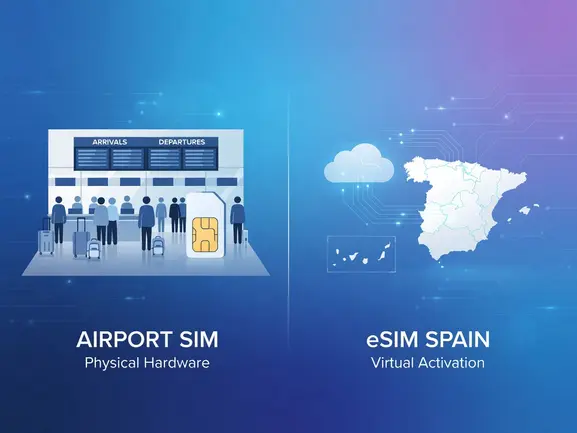
Airport SIM vs eSIM Spain — Head-to-Head Comparison
Let me put the numbers side by side. This is the comparison that actually matters when you're standing at the departure gate.
- Setup time: Airport SIM = 30-60 mins queue + registration | eSIM = under 2 minutes QR scan at home
- Price: Airport SIM = €20-€30 at the counter | eSIMYat Spain eSIM = from $1.51
- Passport required: Airport SIM = yes, mandatory | eSIM = no registration needed
- Dual SIM (keep your number): Airport SIM = no (you remove your home SIM) | eSIM = yes
- Works before landing: Airport SIM = no | eSIM = yes
- Hotspot/tethering: Airport SIM = varies by plan | eSIMYat = free on all plans
- Refund option: Airport SIM = typically none | eSIMYat = 7-day refund for unused plans
- 24/7 support: Airport SIM = counter hours only | eSIMYat = 24/7 in English & Arabic
The verdict on airport SIM vs eSIM in Spain is straightforward. The eSIM wins on price, convenience, speed, and flexibility. The only scenario where an airport SIM makes sense is if your phone is eSIM-incompatible — older Android devices, iPhones older than XS, or iPhones purchased in China (which have a hardware restriction on eSIM).
How to Set Up Your Spain eSIM with eSIMYat
eSIMYat is a travel eSIM provider covering 150+ countries with plans starting from $1.18 and instant QR code activation. Here's exactly how to get connected in Spain in under 2 minutes.
- Step 1: Check device compatibility. Confirm your phone supports eSIM. Go to Settings → General → About and look for an EID number. iPhones XS/XR and later, Samsung Galaxy S20 and later, and Google Pixel 3 and later all support eSIM. Check the full list at eSIMYat supported devices.
- Step 2: Choose your Spain plan. Visit the Spain eSIM page and select a plan based on your trip length. 5GB covers most 7-day trips. 10GB or 20GB suits 2-week stays or heavy data users.
- Step 3: Complete your purchase. Pay securely — no passport, no registration, no personal data beyond your email address. You'll receive a QR code instantly via email.
- Step 4: Scan the QR code before you board. Go to Settings → Cellular (iOS) or Settings → Connections → SIM Manager (Android). Tap "Add eSIM" and scan the QR code. Do this on WiFi at home — airport WiFi is unreliable and you want the profile installed before you fly.
- Step 5: Set the eSIM to data only and keep your home SIM active. Under cellular settings, set your eSIMYat plan as the default data line. Your home SIM stays active for calls and texts. Dual SIM — no compromise.
- Step 6: Activate on arrival (or before). Some plans activate on first connection. When your plane lands in Spain, your phone connects to Movistar or Vodafone ES automatically — typically within 8-15 seconds.
That's it. No queue. No counter. No passport. When I landed in Madrid last spring, my eSIM connected before the plane reached the gate. My maps were already loading while other passengers were still reaching for their carry-ons.
How eSIMYat Compares to Other eSIM Providers for Spain
Not all eSIM providers are equal. Here's how eSIMYat stacks up against the main competitors for Spain specifically.
- Airalo: Lists Spain plans from $4.50 (Airalo pricing page, checked 2026). No Arabic customer support. No hotspot guarantee on all plans.
- Holafly: Unlimited data plans from $6.99 (Holafly pricing page, checked 2026), but speed throttles after heavy use and hotspot is restricted on most plans. A real problem if you need to tether a laptop.
- Saily (by NordVPN): Plans from $1.99 (Saily pricing page, checked 2026), includes VPN + ad blocker, 190+ countries. Solid option, though no Arabic support.
- Nomad: From $1.30/GB (Nomad pricing page, checked 2026), free trial eSIM available. Good for high-data users who need flexibility.
- eSIMYat: Plans from $1.51 for Spain. Free hotspot on all plans. 24/7 support in English and Arabic. 7-day refund for unused plans. No app required — pure QR code setup.
Read the full breakdown in our eSIMYat vs Airalo comparison or the eSIMYat vs Holafly comparison if you want the full number-by-number breakdown for European destinations.
The key differentiator for Arabic-speaking travelers: eSIMYat is the only major provider with 24/7 support in Arabic. If you're traveling from Saudi Arabia, the UAE, Morocco, or Egypt to Spain, you get help in your language when you need it most.
Spain Travel Tips — Data Usage Guide
Choosing the right data plan matters as much as choosing eSIM over airport SIM. Here's a practical breakdown for Spain trips.
- 3-day city break (Madrid or Barcelona): 3GB is enough for maps, WhatsApp, and social media browsing
- 1-week holiday (Costa del Sol, Mallorca, Ibiza): 5GB covers maps, streaming music, and daily Instagram posts
- 2-week trip (multi-city: Barcelona → Madrid → Seville → Granada): 10GB recommended, especially if you're using Google Maps constantly for driving
- Digital nomads working remotely from Spain: 20GB+ or an unlimited plan — video calls eat data fast
- Camino de Santiago pilgrims: 5GB for the full 30-day Camino Francés — rural coverage is good along the main route, but expect gaps in Galicia's deep valleys
Spain's major cities have excellent 5G coverage. Barcelona and Madrid are both fully 5G-capable on Movistar and Vodafone ES. The Balearic and Canary Islands have strong 4G LTE coverage for tourists, though 5G rollout in rural island areas is still ongoing.
Frequently Asked Questions
Is buying a SIM card at Spain airport worth it?
No, for most travelers it's not worth it. Spain airport SIM cards require passport registration, cost 30-50% more than online plans, and come with 20-55 minute queues during peak season. An eSIM from eSIMYat gives you lower prices from $1.51, instant setup, no registration, and dual SIM so you keep your home number active. The only reason to buy at the airport is if your phone doesn't support eSIM.
Can I use an eSIM at Madrid Barajas or Barcelona El Prat airport?
Yes. Your eSIMYat Spain eSIM works the moment you land at MAD, BCN, or any other Spanish airport. Install the QR code before departure — it takes under 2 minutes on home WiFi. When you land, your phone connects automatically to Movistar or Vodafone ES. No airport WiFi needed, no counter visit required. You're online before you reach baggage claim.
What's the difference between an eSIM and a Spain airport SIM card for Arabic speakers?
For Arabic-speaking travelers, the eSIM advantage is even bigger. Airport SIM counters in Spain rarely have Arabic-speaking staff. eSIMYat offers 24/7 customer support in Arabic — so if you have any issue with your Spain eSIM, you get help in your language any time of day. No language barrier, no miscommunication at a busy airport counter.
Do I need to register my passport to buy a Spain eSIM?
No. Unlike a physical Spain airport SIM card — which legally requires passport registration under Spanish telecom law — eSIMYat requires no passport or personal ID. You provide an email address and payment. That's it. Your eSIM QR code arrives instantly. This saves 5-15 minutes at the counter and keeps your personal data private.
How much data do I need for a week in Spain?
For a typical 7-day Spain trip — Google Maps, WhatsApp calls, daily Instagram, some Spotify — 5GB is the sweet spot. If you're doing video calls or streaming Netflix in your accommodation, upgrade to 10GB. Digital nomads working remotely should go for 20GB or more. All eSIMYat plans include free hotspot so you can tether your laptop or tablet without an extra charge.
The Verdict: Skip the Spain Airport SIM Card Queue
The airport SIM vs eSIM Spain debate isn't really a debate. The eSIM wins on every metric that matters: price, convenience, setup speed, and flexibility. Airport SIM cards exist because not everyone has an eSIM-compatible phone — but if yours supports it, there's no rational reason to stand in a 40-minute queue at El Prat.
Three things to remember: First, install your eSIM before you board — don't rely on airport WiFi. Second, set your eSIMYat plan as your data line while keeping your home SIM active for calls. Third, check your data usage in Settings if you're on a capped plan — Spain's social media culture will tempt you to post constantly.
Get your Spain eSIM from eSIMYat today — plans from $1.51, instant QR activation, free hotspot, and 24/7 support in English and Arabic. You'll be online before the seat belt sign turns off.
Related eSIM guides
- Prepaid eSIM for Spain — No Contract Data Plans from $2.99
Buy prepaid eSIM for Spain. No contract, no commitment. Plans from $2.99. Top up anytime. Pay only for what you use.
- eSIM in Spain — Is It Worth It? Honest Review 2026
Honest eSIM review for Spain. Speed tests, coverage map, real experience. Plans from $1.51. Verdict inside.
- How to Avoid Roaming Charges in Spain — eSIM Solution
Stop paying roaming fees in Spain. Get eSIM from $1.51. Save $1.51+ vs carrier roaming. Instant activation.
- How Much eSIM Data Do You Need for Spain? Complete Guide
Calculate how much eSIM data you need for Spain travel. Light vs heavy usage. Recommended plans from $1.51.