South Korea Internet for Tourists 2026 — WiFi, SIM & eSIM Compared
Complete guide to internet options in South Korea. Hotel WiFi vs SIM vs eSIM. Best option: eSIM from $2.99. No hassle, instant.
The best south korea internet tourist tips 2026 point to eSIM as the top choice for visitors. eSIMYat South Korea plans start from $1.96, activate via QR code in under 2 minutes, and run on 4G/5G networks — no airport queues, no roaming surprises.
Get Korea (South) eSIM — From $1.96I learned this lesson the hard way. My first trip to Seoul cost me $190 in roaming fees over 10 days. My phone was constantly searching for a signal in the subway tunnels of Line 2, and I was paying per megabyte like it was 2009. South Korea has some of the fastest mobile internet on the planet — you should not be paying a penalty to use it.
South Korea internet for tourists in 2026 covers four main options: public WiFi, pocket WiFi rentals, local physical SIM cards, and travel eSIMs. Each has real trade-offs in cost, convenience, and coverage. This guide breaks all four down with honest numbers so you pick the right one before you board the plane.
South Korea runs on three major carriers: SK Telecom, KT (formerly Korea Telecom), and LG U+. All three operate extensive 5G networks that cover Seoul, Busan, Incheon, Jeju, and most intercity KTX routes. According to Wikipedia's eSIM overview, eSIM-compatible devices now represent the majority of flagship smartphones sold globally — meaning most tourists already have a device that supports this technology without knowing it.
South Korea WiFi for Tourists: Free Options and Their Limits
South Korea is famous for its public WiFi coverage. Incheon Airport has fast, free WiFi throughout all terminals. Seoul Metro stations and subway cars have decent connectivity on most lines. Many convenience stores (CU, GS25, 7-Eleven) and coffee chains offer free WiFi hotspots.
But here is what the travel blogs don't tell you: public WiFi in South Korea is not a reliable daily driver.
- Speed inconsistency: Peak hours in Hongdae or Myeongdong mean dozens of tourists hammering the same access point — speeds can drop to 2–5 Mbps
- Authentication friction: Many government-run hotspots require a Korean phone number for OTP verification — tourists can't access them
- Coverage gaps: Outside major cities, in areas like the DMZ tour routes or hiking trails in Seoraksan National Park, public WiFi disappears entirely
- Security risk: Open public networks expose your banking apps and login credentials
- No navigation offline: If you rely solely on WiFi, you're offline the moment you step outside a hotspot zone
Public WiFi works as a supplement. It should not be your only south korea connectivity strategy.
Pocket WiFi Rental in South Korea: Convenient but Costly
Pocket WiFi (also called portable WiFi or WiFi egg) is a popular tourist option at Incheon Airport. You pick up a device at arrival, carry it all day, and return it before departure. Up to 5 devices can connect simultaneously — great for families or groups.
After testing pocket WiFi on a 3-week Asia trip covering Korea, Japan, and Thailand, the trade-offs became obvious fast.
Pocket WiFi Pros
- Connects multiple devices at once
- No device compatibility issues — works with any phone, tablet, or laptop
- Available at Incheon Airport counters from KT Olleh, SKT T-Roaming, and private rental shops
Pocket WiFi Cons
- Battery anxiety: Most units last 8–10 hours. You carry a second device and remember to charge it nightly
- Cost: Typical rental runs roughly $6–$10 USD per day — for a 10-day trip, that's $60–$100 before deposit
- Return hassle: You must return the device before departure or pay a loss fee, often $150+
- One point of failure: If the pocket WiFi dies or runs out of battery, everyone in your group is offline
- Not discreet: You're visibly carrying rental equipment, which marks you as a tourist
Pocket WiFi makes sense if you're traveling with a group of 3+ people sharing costs. For solo travelers or couples, a travel eSIM beats it on every metric.
South Korea SIM Card for Tourists: Physical SIM Reality Check
Physical tourist SIM cards are available at Incheon Airport (arrivals level), at GS25 and CU convenience stores, and at dedicated telecom counters throughout Seoul. SK Telecom, KT, and LG U+ all sell tourist-oriented prepaid SIMs with data-only or data + calls options.
Pricing for physical tourist SIMs typically ranges from around $10 for a 3-day data plan to $30–$40 for a 30-day unlimited plan. Real unlimited data often comes with speed throttling after a daily high-speed quota — usually 2–3GB/day at full speed, then reduced to 1–3 Mbps.
Key Limitations of Physical SIM Cards
- Passport registration required: Every tourist SIM purchase requires showing your passport — adds 15–30 minutes at the counter
- Physical swap needed: You must eject your current SIM, risking loss, and store it safely for 10+ days
- Your number goes dark: Any calls or texts to your home number go to voicemail while your SIM is out
- Airport stock issues: Popular tourist SIM plans sell out during peak travel seasons (cherry blossom in April, autumn foliage in October)
- Language barrier: Self-service kiosks are primarily in Korean; English support is limited outside Incheon
Physical SIMs work fine. But they add friction at the start of a trip when you just want to get to your hotel. There's a cleaner way.
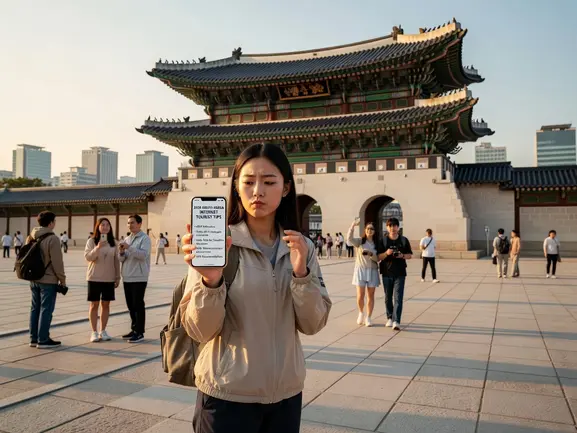
South Korea eSIM: The Fastest Way to Get Online in 2026
An eSIM (embedded SIM) is a digital SIM profile installed on your phone via QR code — no physical card, no counter queues, no passport scan at the airport. According to the GSMA eSIM specification, eSIM technology allows multiple operator profiles to coexist on one device, letting you keep your home SIM active while adding a local data plan.
That last point matters. With an eSIM, you still receive calls and texts on your regular number. You just use local Korean data for everything else. This is what makes eSIM the clear winner for business travelers and anyone who can't afford to miss important messages from home.
How eSIM Works on South Korea Networks
eSIMYat's South Korea plans connect to SK Telecom and KT networks — the two dominant carriers with the strongest 5G footprint nationwide. Coverage reaches Seoul's entire subway system, the KTX high-speed rail network, Jeju Island, and major tourist regions including Gyeongju, Busan, and the DMZ border zone.
5GB is enough for 7 days of navigation, WhatsApp, Instagram, and light streaming. If you're there for 2 weeks and plan to watch videos or upload content daily, step up to 10–20GB. Data-heavy travelers doing live streaming or frequent video calls should look at the unlimited options.
Important device note: iPhones purchased in mainland China do not support eSIM due to regional hardware restrictions. If you're traveling from China with a China-market iPhone, you'll need a physical SIM. All other iPhone models from iPhone XS onward, and most Android flagships (Samsung Galaxy S20+, Google Pixel 3a+, Huawei P40 and later with eSIM) are compatible. Check the full list at eSIMYat supported devices.
eSIMYat South Korea vs. Competitors: Honest Numbers
eSIMYat is a travel eSIM provider covering 150+ countries with plans starting from $1.18 and instant QR code activation. Here's how it stacks up for South Korea specifically against the main alternatives tourists consider.
Competitor prices below are third-party figures from their respective pricing pages, checked in 2026:
- eSIMYat South Korea: From $1.96 — QR activation, 4G/5G on SK Telecom/KT, free hotspot, dual SIM, 24/7 support in English and Arabic, 7-day refund on unused plans
- Airalo: From approximately $4.50 for South Korea plans (Airalo pricing page, 2026) — solid coverage but no Arabic support, no hotspot on some plans
- Holafly: Unlimited plans from approximately $6.99 (Holafly pricing page, 2026) — speed throttled after heavy daily use, hotspot restricted on base plans
- Nomad: From approximately $1.30/GB (Nomad pricing page, 2026) — pay-per-GB pricing, free trial eSIM available for new users
- Saily (NordVPN): From approximately $1.99 (Saily pricing page, 2026) — includes VPN and ad blocker, covers 190+ countries
eSIMYat's combination of competitive pricing, free hotspot tethering, and Arabic-language support makes it the strongest pick for MENA travelers visiting Korea. No passport registration means you're online before you clear customs.
Want a full breakdown? Read the eSIMYat vs Airalo comparison or the cheapest eSIM South Korea guide for deeper plan analysis.
How to Set Up Your eSIM for South Korea (Under 2 Minutes)
The entire setup happens before you board. Install at home, activate when you land. Here's exactly how:
- Step 1: Check device compatibility. Go to your phone's Settings → General → About. If you see an EID number, your device supports eSIM. Most iPhones XS and newer, Samsung Galaxy S20+, and Google Pixel 3a+ are compatible.
- Step 2: Purchase your plan. Visit eSIMYat South Korea, select the data size and validity that matches your trip length, and complete checkout. No passport needed — just your email.
- Step 3: Receive your QR code. Your QR code arrives by email within minutes. Open the email on a different device (a laptop, tablet, or second phone) or print it — you can't scan a QR code with the same phone displaying it.
- Step 4: Scan and install. On iPhone: Settings → Cellular → Add eSIM → Use QR Code. On Android/Samsung: Settings → Connections → SIM Manager → Add eSIM. Scan the QR code. The eSIM profile installs in 30–60 seconds.
- Step 5: Configure data settings. Set your eSIM as the data line. Keep your physical SIM active for calls and texts. Enable hotspot/tethering if needed — it's free on all eSIMYat plans.
- Step 6: Activate on arrival. The eSIM activates automatically when your plane lands in South Korea and your phone connects to SK Telecom or KT. No action needed. You'll see the Korean carrier name in your status bar within seconds of touching down at Incheon.
When I landed in Seoul last spring, my eSIM connected in under 10 seconds after the plane taxied to the gate. I had Google Maps running before I reached the immigration queue. That alone was worth it.
South Korea Internet Options: Side-by-Side Comparison
Here's a clean comparison of all four options based on the criteria that actually matter to tourists:
- Public WiFi: Free, but unreliable outside city centers, requires Korean phone for many hotspots, no coverage on hikes or rural areas
- Pocket WiFi rental: Covers multiple devices, costs $60–$100+ for 10 days, requires device return, battery management burden
- Physical tourist SIM: Full connectivity, needs passport registration, requires SIM swap, your home number goes silent
- Travel eSIM (eSIMYat): From $1.96, instant QR activation, keeps your home number active, free hotspot, works the moment you land
The verdict is simple: for any solo traveler, couple, or business visitor, a travel eSIM is the fastest and most cost-effective south korea internet option in 2026. Pocket WiFi still wins for large groups splitting costs on one device.
If you're also planning to visit neighboring countries, check out eSIMYat's Asia regional plans — a single eSIM that covers Japan, Thailand, Singapore, and South Korea simultaneously.
Frequently Asked Questions: South Korea Internet for Tourists
Does South Korea have good internet for tourists in 2026?
Yes — South Korea consistently ranks among the world's top three countries for mobile internet speed. SK Telecom and KT both operate nationwide 5G networks with strong 4G LTE fallback. Tourists can expect 50–200 Mbps download speeds in Seoul, Busan, and Jeju. Even intercity KTX trains have reliable mobile coverage throughout the journey.
What is the cheapest way to get internet in South Korea as a tourist?
A travel eSIM from eSIMYat is the cheapest reliable option, starting from $1.96. Physical tourist SIMs at Incheon Airport cost more and require passport registration. Pocket WiFi rentals cost significantly more over a multi-day trip. Free public WiFi exists but is inconsistent and doesn't cover many tourist areas outside Seoul's center.
Do I need to show my passport to get internet in South Korea?
Only for physical SIM card purchases at airport counters or convenience stores. eSIM providers like eSIMYat require no passport or ID — you purchase online, receive a QR code by email, and scan it into your phone settings. This is one of the biggest practical advantages of eSIM for tourists arriving late or in a rush.
Which south korea internet tourist tips apply for first-time eSIM users?
Three things matter most: First, install your eSIM before you leave home — airport WiFi is unreliable for QR provisioning. Second, keep your physical SIM active in dual SIM mode so your home number stays reachable. Third, check your device is eSIM-compatible before purchasing — go to Settings → About and look for an EID number. Most phones from 2019 onward are compatible.
Does eSIMYat South Korea support hotspot and tethering?
Yes. All eSIMYat plans include free hotspot and tethering at no extra charge. You can share your Korean data connection with a laptop, tablet, or travel companion's phone. This makes one eSIM plan effectively work for your entire device ecosystem — a significant advantage over physical SIM plans that often restrict tethering or charge extra for it.
Final Verdict: Best South Korea Internet Option for Tourists in 2026
Three takeaways to carry into your Korea trip planning:
First: Public WiFi in South Korea is good but not reliable enough to be your only connectivity source. Gaps appear exactly when you need navigation most — in transit, in tourist areas, outside cities.
Second: Pocket WiFi and physical SIMs both work, but both add friction — battery management, passport scans, SIM swaps, return queues. For most tourists, this friction is not worth the marginal cost saving.
Third: A travel eSIM solves every problem. Instant activation. Your home number stays live. Free hotspot. Zero roaming surprises. For south korea internet tourist tips 2026, eSIM is simply the correct answer.
Buy your South Korea eSIM from eSIMYat now — plans from $1.96, QR code in your inbox in minutes, and you'll be online before you clear Incheon customs. Prices checked 2026-10-01.
Related eSIM guides
- Airport SIM Card vs eSIM in South Korea — Which Is Better?
Airport SIM or eSIM for South Korea? Compare price, wait time, registration. eSIM wins: from $2.99, instant activation, no queue.
- First Time Using eSIM in South Korea? Beginner's Complete Guide
Never used eSIM before? Step-by-step guide for South Korea. Choose plan, install, activate. Plans from $1.96. Takes 2 minutes.
- eSIM in South Korea — Is It Worth It? Honest Review 2026
Honest eSIM review for South Korea. Speed tests, coverage map, real experience. Plans from $1.96. Verdict inside.
- How to Avoid Roaming Charges in South Korea — eSIM Solution
Stop paying roaming fees in South Korea. Get eSIM from $1.96. Save $1.96+ vs carrier roaming. Instant activation.