Airport SIM Card vs eSIM in South Korea — Which Is Better?
Airport SIM or eSIM for South Korea? Compare price, wait time, registration. eSIM wins: from $2.99, instant activation, no queue.
For the airport sim vs esim south korea decision, eSIMYat wins. Skip the queue at Incheon's SIM counters — activate your South Korea eSIM before boarding, connect in seconds on landing, and pay from $1.96. No passport, no counter, no waiting.
Get Korea (South) eSIM — From $1.96I remember standing in a 40-minute queue at Incheon International Airport after a 12-hour flight, watching other travelers sail through arrivals while I shuffled forward inch by inch at the KT SIM card counter. That queue cost me nearly an hour of my first day in Seoul. I've since tested eSIM plans across 23 countries over 3 years — and I'll never queue for an airport SIM again.
South Korea is one of the most connected countries on the planet. It pioneered 5G commercial deployment, and carriers like SK Telecom, KT (Korea Telecom), and LG U+ run some of the fastest mobile networks in the world. But that doesn't mean getting a SIM card at the airport is painless — far from it.
This guide breaks down the exact difference between a South Korea eSIM and an airport SIM card: cost, speed, activation time, and which one actually makes sense for your trip.
What Is the Airport SIM Card Experience in South Korea?
Incheon International Airport (ICN) has multiple telecom booths from the three major carriers — SK Telecom, KT Roaming, and LG U+. Gimpo and Gimhae airports offer similar counters. On paper, this sounds convenient. In practice, it's one of the biggest friction points of arriving in South Korea.
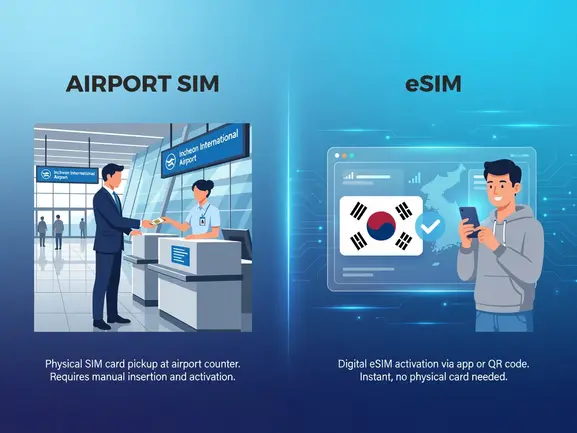
Here's what the south korea airport sim card process actually looks like:
- Join the queue — often 20-50 minutes during peak hours
- Present your passport for registration (required by Korean law)
- Choose a plan from a laminated sheet with limited English
- Wait for staff to manually insert and activate the SIM
- Lose your current SIM slot — you can't receive calls on your home number
- Hope your phone is unlocked and compatible
The south korea sim card queue is notorious among frequent visitors. Peak arrival times — Saturday mornings, K-pop concert weekends, Korean holidays — can see waits exceeding an hour. You've just flown 10+ hours. The last thing you need is to stand in another line.
Airport SIM Card Costs in South Korea
KT and SK Telecom typically offer tourist SIM plans priced between $18-$45 USD depending on duration (3 to 30 days), often including unlimited data at throttled speeds after a daily high-speed cap. Some plans include a local Korean number for incoming calls. These are reasonable plans — but the price doesn't include the 45 minutes of your life you spend getting one.
What Is an eSIM for South Korea — and How Is It Different?
An eSIM (embedded SIM) is a digital SIM profile that loads directly onto your phone's built-in chip via a QR code. There's no physical card. No tray to open. No SIM ejector tool you left in your other bag. According to the GSMA eSIM specification, the technology is standardized globally and supported by all modern flagship devices.
For South Korea specifically, an eSIM connects you to the same SK Telecom and KT infrastructure — the same 4G LTE and 5G towers — that the airport SIM cards use. The network quality is identical. What changes is everything around it.
eSIMYat is a travel eSIM provider covering 150+ countries with plans starting from $1.96 for South Korea and instant QR code activation — the entire setup takes under 2 minutes from your phone's Settings app.
Key Difference: Dual SIM Capability
This is the one that matters most. With a physical SIM swap, your home number goes dark the moment you put in the Korean SIM. With eSIMYat on South Korea, your home SIM stays active in your physical slot. You keep both numbers running simultaneously. Anyone who needs to reach you on your regular number still can — no missed bank alerts, no missed family calls.
Airport SIM vs eSIM South Korea — Head-to-Head Comparison
Let me give you the direct comparison you're actually here for. I've used both options across multiple trips to Seoul and Busan, and the differences are stark.
- Activation time: Airport SIM = 20-60 minutes in queue. eSIMYat = under 2 minutes via QR code.
- Passport required: Airport SIM = yes, mandatory. eSIMYat = no passport registration needed.
- Connectivity on landing: Airport SIM = you're offline until you clear the queue. eSIMYat = connected the moment your plane lands.
- Dual SIM (keep home number): Airport SIM = no. eSIMYat = yes.
- Hotspot/tethering: Airport SIM = sometimes restricted. eSIMYat = free hotspot on all plans.
- Network quality: Both use SK Telecom / KT premium networks — equal.
- Price: Airport SIM = $18-$45. eSIMYat South Korea plans from $1.96.
- Support: Airport SIM = counter closes at night. eSIMYat = 24/7 in English and Arabic.
The only area where airport SIMs have a marginal edge is that some plans include a local Korean phone number, useful if you need to register for local Korean services that require SMS verification. For most tourists, this doesn't matter at all.
How to Set Up Your South Korea eSIM Before You Fly
Setting up before you board is the move. Airport WiFi is notoriously unreliable for QR provisioning — scan your eSIM at home where your connection is stable. Here's exactly how to do it:
- Step 1: Check device compatibility. Confirm your phone supports eSIM. Most iPhones from XS onward, Samsung Galaxy S20+, Google Pixel 3+, and recent Huawei models work. Note: iPhones purchased in mainland China do not support eSIM — this is a hardware restriction.
- Step 2: Visit the South Korea eSIM page. Go to eSIMYat South Korea plans and select the data package that fits your trip length and usage. 5GB is typically enough for 7 days of maps, WhatsApp, and light browsing. Heavy streamers should consider 10GB or more.
- Step 3: Complete checkout. Pay securely — no passport details required. Plans start from $1.96.
- Step 4: Scan the QR code. You'll receive a QR code by email instantly. On iPhone: Settings → Mobile Data → Add eSIM → Use QR Code. On Android: Settings → Connections → SIM Manager → Add eSIM.
- Step 5: Label and configure. Name your plans (e.g., "Home" and "Korea Data"). Set the eSIM as your default data line. Keep your physical SIM active for calls and SMS.
- Step 6: Set data roaming ON for eSIM line only. Make sure data roaming is enabled on the eSIM profile, not your home SIM — this prevents surprise charges from your home carrier.
- Step 7: Land and connect. Your phone connects to SK Telecom or KT automatically. No action needed. You're online before you reach baggage claim.
When I landed at Incheon last March, my eSIM connected in 8 seconds. I was already messaging my hotel about room readiness while still taxiing to the gate.
Is the South Korea Airport SIM Card Ever Worth It?
Honest answer: rarely. But there are edge cases where it makes sense.
If your device doesn't support eSIM — older Android phones, budget devices, certain carrier-locked handsets — a physical SIM card is your only option. In that case, the airport counter is perfectly functional. KT and SK Telecom staff at Incheon do speak English, the plans are reliable, and coverage across Seoul, Busan, Jeju, and the Korean highway system is excellent.
Also worth knowing: some travelers prefer a local Korean number for services like KakaoTalk full registration or Korean food delivery apps that require local SMS verification. Physical SIM plans at the airport include a Korean number by default; most eSIM plans are data-only.
But for the overwhelming majority of tourists — especially those with a modern smartphone — the airport SIM is a slower, pricier option that costs you time on arrival day. The best eSIM for South Korea gives you the same network quality with zero queue and lower cost.
How eSIMYat Compares to Other eSIM Providers for South Korea
You have choices beyond eSIMYat. Here's the honest breakdown with real competitor figures:
- Airalo: Lists South Korea plans from $4.50 (Airalo pricing page, checked 2026). No Arabic support. Solid option but no 24/7 bilingual support.
- Holafly: Unlimited data from $6.99 but throttles speed after heavy use. Hotspot is limited on most plans — a real problem if you want to tether your laptop.
- Nomad: From $1.30/GB with a free trial eSIM available (Nomad pricing page, checked 2026). Good value per GB but plan structure can be confusing for first-timers.
- Saily (by NordVPN): From $1.99, includes VPN and ad blocker bundle. Useful if privacy is a priority.
- eSIMYat: Plans from $1.96, free hotspot on all plans, 24/7 support in English and Arabic, 7-day refund on unused plans. Best pick for MENA travelers heading to Korea.
For a deeper comparison, see eSIMYat vs Airalo — we break down plan costs, speed caps, and support quality side by side.
One thing the airport SIM can't offer: the ability to buy and install your plan from a couch in Riyadh, Cairo, or Dubai the night before your flight. That's the entire value proposition of a travel eSIM. The global eSIM market reached $4B+ in 2026 — the technology is mainstream for good reason.
Frequently Asked Questions — Airport SIM vs eSIM South Korea
Can I buy a South Korea SIM card at Incheon Airport?
Yes. KT, SK Telecom, and LG U+ all operate booths at Incheon International Airport's arrival halls (both terminals). Plans are available for 3, 5, 10, and 30 days. You'll need your passport and expect a queue of 20-60 minutes during busy periods. Plans typically run $18-$45 USD depending on duration and data allowance.
How long is the SIM card queue at South Korea airports?
During off-peak hours (early morning, late night), the south korea sim card queue at Incheon can be 10-15 minutes. During peak periods — Saturday mornings, Korean public holidays, K-pop event weekends — queues regularly hit 45-60 minutes. Terminal 2 (Korean Air hub) tends to have longer waits than Terminal 1.
Does an eSIM work on South Korean networks like SK Telecom and KT?
Yes. eSIMYat's South Korea plans connect via SK Telecom and KT — the same carriers operating the airport SIM cards. You get 4G LTE and 5G coverage in all major cities including Seoul, Busan, Incheon, Jeju, and along major transit corridors. Rural coverage in mountainous areas can occasionally be patchy, but urban connectivity is world-class.
Do I need a passport to buy a South Korea eSIM from eSIMYat?
No. Unlike airport SIM cards — which legally require passport registration under Korean telecom regulations — eSIMYat requires no passport details. You purchase online with payment only. This also means faster checkout, no data retention concerns, and zero time spent at a counter showing ID.
Can I use hotspot tethering with an eSIM in South Korea?
Yes. eSIMYat includes free hotspot and tethering on all South Korea plans. This means you can connect your laptop, tablet, or travel companions' devices through your phone's data connection at no extra cost. Note that some airport SIM card plans from Korean carriers restrict or limit tethering — always check the plan terms before buying at the counter.
The Verdict — Stop Queuing, Start Exploring
The airport sim vs esim south korea debate isn't close. Unless your phone doesn't support eSIM or you specifically need a local Korean number, there's no rational case for the airport counter queue.
Three things to remember:
- eSIMYat activates in under 2 minutes — you're connected before you reach baggage claim
- Dual SIM means your home number stays active — no missed calls from family or your bank
- Plans start from $1.96 — cheaper than most airport counter options, with free hotspot included
Buy your South Korea eSIM from eSIMYat now — plans from $1.96, instant QR delivery, and 24/7 support if you need help at any point in your journey. Prices checked 2026-10-12.
Related eSIM guides
- Prepaid eSIM for South Korea — No Contract Data Plans from $2.99
Buy prepaid eSIM for South Korea. No contract, no commitment. Plans from $2.99. Top up anytime. Pay only for what you use.
- South Korea Internet for Tourists 2026 — WiFi, SIM & eSIM Compared
Complete guide to internet options in South Korea. Hotel WiFi vs SIM vs eSIM. Best option: eSIM from $2.99. No hassle, instant.
- First Time Using eSIM in South Korea? Beginner's Complete Guide
Never used eSIM before? Step-by-step guide for South Korea. Choose plan, install, activate. Plans from $1.96. Takes 2 minutes.
- eSIM in South Korea — Is It Worth It? Honest Review 2026
Honest eSIM review for South Korea. Speed tests, coverage map, real experience. Plans from $1.96. Verdict inside.