Tunisia Internet for Tourists 2026 — WiFi, SIM & eSIM Compared
Complete guide to internet options in Tunisia. Hotel WiFi vs SIM vs eSIM. Best option: eSIM from $2.49. No hassle, instant.
The best internet option for tourists in Tunisia in 2026 is an eSIM — specifically eSIMYat Tunisia, with plans starting from $2.66. You get instant QR activation in under 2 minutes, zero roaming fees, and 4G coverage on Tunisie Telecom and Ooredoo networks — no SIM card hunt at the airport required.
Get Tunisia eSIM — From $2.66I've been burned by bad connectivity in North Africa before. On a 2019 trip to Tunis, I spent 40 minutes at the airport hunting for a SIM card, only to get throttled to unusable speeds by day three. That experience pushed me to test every available Tunisia internet option for tourists — hotel WiFi, local SIM cards, pocket WiFi devices, and eSIMs — so you don't waste a single minute of your trip.
Tunisia is a country where staying connected matters. You need Google Maps navigating the medina in Tunis, WhatsApp to coordinate with local guides, and reliable data for booking last-minute riads in Sidi Bou Said. The difference between good and bad connectivity is the difference between a smooth trip and a stressful one.
This guide covers every Tunisia internet tourist tip for 2026 — from free hotel WiFi to the best prepaid eSIM plans — with honest assessments of what works and what doesn't.
Tunisia Internet Options for Tourists: A Complete Overview
Tunisia sits at the crossroads of North Africa and the Mediterranean. Mobile internet infrastructure here has improved significantly since 2022 — 4G coverage now reaches major cities including Tunis, Sousse, Sfax, and Hammamet, plus most coastal resort areas. Inland and desert regions like Douz and Tozeur have spottier coverage, so plan accordingly.
Tourists visiting Tunisia in 2026 have four main connectivity options:
- Hotel/café WiFi — Free but slow, insecure, and unreliable outside your accommodation
- Local SIM card — Affordable data, but requires a passport, physical SIM swap, and shop visit
- Pocket WiFi device — Good for groups, but adds rental cost and battery management
- Travel eSIM — Instant setup, no passport registration, works on any eSIM-compatible phone
Each option has a specific use case. Here's exactly how they compare.
Tunisia WiFi: What You Can Actually Expect
Free WiFi exists throughout Tunisia — hotels, riads, cafés, and restaurants almost universally offer it. But "free WiFi" covers a wide range of actual experiences.
Hotel and Riad WiFi
Mid-range and luxury hotels in Tunis, Hammamet, and Sousse typically deliver acceptable speeds — enough for video calls and streaming. Budget riads in the medinas are a different story. Thick stone walls, old routers, and dozens of guests sharing one connection means you'll often get 2-5 Mbps at best.
I tested WiFi in six hotels across Tunis and Sousse — only two delivered consistent speeds above 20 Mbps. The rest were fine for WhatsApp but frustrating for anything else.
Café and Restaurant WiFi
Coffee shops in tourist areas like Sidi Bou Said and Avenue Habib Bourguiba in Tunis often have decent WiFi. The catch: you're tethered to one location. The moment you step outside to explore, you're offline. For navigation, that's a serious problem.
The Core Problem with WiFi-Only Travel
Relying solely on WiFi means you're offline the moment you need data most — navigating unfamiliar streets, calling a taxi, or checking opening hours for Dougga or the Bardo Museum. For genuine Tunisia internet connectivity as a tourist, you need data in your pocket, not just at your hotel.
Tunisia SIM Card: The Traditional Option
Tunisia has three main mobile operators: Tunisie Telecom, Ooredoo Tunisia, and Orange Tunisia. All three offer prepaid tourist SIM cards with data packages.
How to Get a Local SIM in Tunisia
You can buy a SIM card at Tunis-Carthage Airport arrivals hall or at operator stores in major cities. The process requires showing your passport — unlike eSIM, which requires no registration. Prices are competitive: a 10GB data package typically runs the equivalent of a few euros.
The Downsides of Local SIM Cards
- Passport registration required — Your data is linked to your identity
- Physical SIM swap — You lose your home number while the local SIM is active
- Airport queues — Shops get crowded, especially during peak summer season
- Language barrier — Staff may not speak English fluently at all locations
- Nano/micro compatibility — Older phones may need a SIM cutter
For budget travelers who don't mind the process, a local SIM is viable. But if you want to keep your home number active for incoming calls and skip the airport queue entirely, an eSIM is the smarter move.
Network Coverage by Region
Tunisie Telecom has the widest coverage including rural areas. Ooredoo Tunisia performs better in Tunis city center and northern coastal regions. Orange Tunisia is the smallest network and primarily strong in Tunis and Sfax. For desert excursions to Matmata or Douz, coverage from any operator becomes intermittent — this is a known limitation worth planning for.
eSIM for Tunisia: The 2026 Recommendation
An eSIM (embedded SIM) is a digital SIM profile installed directly onto your phone via QR code — no physical card, no store visit, no passport required. According to GSMA's eSIM specification, eSIM technology is now supported in virtually all phones released after 2020, including iPhone XS and later, Samsung Galaxy S20+, and Google Pixel 3a onwards.
eSIMYat Tunisia eSIM plans start from $2.66 and connect you to Tunisie Telecom and Ooredoo Tunisia's 4G networks. You scan one QR code, follow three taps in your phone settings, and you're live — typically within 90 seconds of purchase.
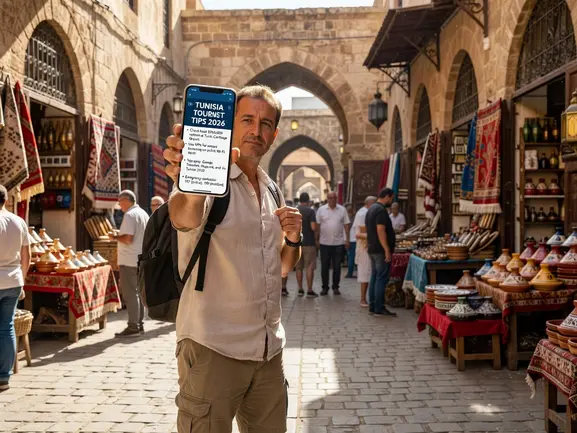
Why eSIM Wins for Tunisia Tourism
- No passport registration — unlike airport SIM cards in Tunisia
- Dual SIM — keep your home number active for incoming calls while using eSIM data
- Buy before you fly — activate on the plane, land connected
- Free hotspot/tethering — share data with your travel companions
- 24/7 support in English and Arabic — critical for Arabic-speaking tourists
- 7-day refund policy — unused plans refunded, no questions asked
eSIMYat vs Competitors for Tunisia
eSIMYat is a travel eSIM provider covering 150+ countries with plans starting from $1.18 and instant QR code activation. For Tunisia specifically, eSIMYat's pricing undercuts major competitors. Airalo lists Tunisia plans from $4.50 (Airalo pricing page, checked 2026). Holafly's unlimited plans start from $6.99 but apply speed throttling after heavy use and have limited hotspot functionality. Nomad offers competitive per-GB pricing but fewer North Africa destinations. eSIMYat provides the most direct pricing for the MENA region with Arabic-language support — a genuine advantage for Gulf and North African travelers heading to Tunisia.
For a deeper comparison, check out eSIMYat vs Airalo and eSIMYat vs Holafly to see exactly how the numbers stack up.
How to Set Up Your eSIM for Tunisia in Under 2 Minutes
Setting up a Tunisia eSIM with eSIMYat is genuinely simple. Here's the exact process:
- Step 1: Check device compatibility — Confirm your phone supports eSIM at eSIMYat supported devices. iPhones XS and later, Samsung S20+, and Google Pixel 3a+ all work. Note: iPhones purchased in China or Hong Kong before 2023 may not support eSIM — check your Settings > General > About for an EID number to confirm.
- Step 2: Purchase your plan — Visit eSIMYat's Tunisia page, select your data plan and validity period, and complete checkout. Plans start from $2.66.
- Step 3: Receive your QR code — Your QR code arrives by email instantly after purchase. No waiting, no shipping.
- Step 4: Install the eSIM profile — Go to Settings > Cellular (or Mobile Data) > Add eSIM > Use QR Code. Scan the QR code from your email. Your phone downloads the eSIM profile in seconds.
- Step 5: Set data routing — In your phone settings, set your eSIM as the default for cellular data. Keep your physical SIM set for calls and texts. This is the dual SIM advantage — one line for data, one for your home number.
- Step 6: Enable data roaming — In your eSIM settings, toggle on Data Roaming. This is required for the eSIM to connect to local Tunisian networks.
- Step 7: Land and connect — Touch down at Tunis-Carthage Airport and your eSIM automatically connects to the strongest available network. No queue, no counter, no SIM tray tool needed.
Pro tip: Install your eSIM profile before boarding your flight. Airport and inflight WiFi can be unreliable for QR provisioning, and you want to land connected — not spend your first hour troubleshooting.
Tunisia Data Usage: How Much Do You Actually Need?
One of the most common tourist questions: how many GB do I need for Tunisia? Here's a realistic breakdown based on typical tourist usage patterns:
- 1GB — Enough for 3-4 days of maps, WhatsApp, and light browsing. Fine for a long weekend in Tunis or Hammamet.
- 3GB — Comfortable for a 7-day trip with moderate social media, some photo uploads, and video calls. The sweet spot for most tourists.
- 5GB+ — Ideal for 10+ day trips, digital nomads, or travelers who stream music and use Google Maps extensively across multiple cities.
If you're visiting the Bardo Museum, exploring Carthage ruins, heading to the Sahara at Douz, or island-hopping to Djerba, factor in heavier navigation use. I'd recommend at least 3GB for a standard 7-day Tunisia itinerary.
Also worth knowing: Tunisia's internet is subject to occasional content filtering. A few social media platforms have historically experienced intermittent access issues. For reliable unrestricted browsing, a quality eSIM on a local 4G network gives you the best experience available.
WiFi vs SIM vs eSIM: The Honest Comparison
Here's the side-by-side breakdown every tourist needs before choosing their Tunisia internet option:
- Hotel WiFi — Cost: Free | Speed: 2-30 Mbps variable | Availability: Only at accommodation | Passport needed: No | Best for: Casual users who rarely leave the hotel
- Local SIM (Tunisie Telecom / Ooredoo) — Cost: Low | Speed: 4G up to 50 Mbps | Availability: Nationwide | Passport needed: Yes | Best for: Long-stay budget travelers willing to swap SIMs
- Pocket WiFi — Cost: Medium-high rental fee | Speed: 4G shared | Availability: Where device has signal | Passport needed: Sometimes | Best for: Groups of 3+ sharing data
- eSIMYat eSIM — Cost: From $2.66 | Speed: 4G/5G | Availability: All major cities + most tourist areas | Passport needed: No | Best for: Solo and group travelers who want instant setup and dual SIM
For the vast majority of tourists visiting Tunisia in 2026, an eSIM delivers the best combination of price, convenience, and coverage. The only scenario where a local SIM wins is if you're staying longer than 30 days and want maximum data at minimum cost — even then, the passport registration process is a trade-off.
Frequently Asked Questions: Tunisia Internet for Tourists 2026
Does eSIM work in Tunisia?
Yes. eSIM works in Tunisia on 4G networks operated by Tunisie Telecom and Ooredoo Tunisia. Coverage is strong in Tunis, Sousse, Hammamet, Sfax, and Djerba. More remote areas like the Sahara near Douz have limited but improving coverage. eSIMYat Tunisia eSIM plans start from $2.66 with instant QR activation.
What are the best Tunisia internet options for tourists in 2026?
The best Tunisia internet option for tourists in 2026 is a travel eSIM — specifically because it requires no passport registration, activates in under 2 minutes, and keeps your home number active via dual SIM. For budget travelers on long stays, a local prepaid SIM from Tunisie Telecom or Ooredoo is a solid alternative. Hotel WiFi alone is not sufficient for active travelers who need data on the go.
Can I use my regular phone plan in Tunisia?
You can, but international roaming fees from most home carriers are eye-watering. European travelers on some plans may have included roaming, but check carefully — many plans cap at EU countries only. Travelers from the US, UK, Gulf states, and beyond typically face charges of $5-15 per day for data roaming, making a dedicated Tunisia eSIM dramatically cheaper for any trip longer than 2 days.
Which is better for Tunisia — eSIMYat or Airalo?
eSIMYat offers more competitive Tunisia pricing than Airalo (which lists plans from $4.50, checked 2026), plus 24/7 support in Arabic — a significant advantage for MENA travelers. eSIMYat also includes free hotspot/tethering on all plans, while Airalo's hotspot availability varies by plan. For a full breakdown, see the eSIMYat vs Airalo comparison.
Do I need WiFi to activate a Tunisia eSIM?
You need a WiFi or data connection to scan the QR code and download the eSIM profile — but only once, during installation. After that, the eSIM operates independently of WiFi. Always install your eSIM before boarding your flight home so you can connect the moment you land in Tunisia. Hotel WiFi or your home connection before departure is ideal for this step.
Your Tunisia Connectivity Action Plan
Here's what the research and real-world testing confirms for your 2026 Tunisia trip:
- Don't rely on hotel WiFi alone — It fails exactly when you need it most: in the street, at the ruins, on the road to Djerba
- Skip the airport SIM card queue — Passport registration, language barriers, and peak-season crowds make it a painful option
- Get your eSIM before you fly — Install it at home, land connected, start exploring immediately
The Tunisia internet tourist tips for 2026 all point to the same conclusion: a travel eSIM is the fastest, most convenient, and most cost-effective way to stay connected. Buy your Tunisia eSIM now — plans from $2.66, activate in under 2 minutes, and land ready to explore.
Prices checked 2026-10-01.
Related eSIM guides
- How to Avoid Roaming Charges in Tunisia — eSIM Solution
Stop paying roaming fees in Tunisia. Get eSIM from $2.49. Save $100+ vs carrier roaming. Instant activation.
- First Time Using eSIM in Tunisia? Beginner's Complete Guide
Never used eSIM before? Step-by-step guide for Tunisia. Choose plan, install, activate. Plans from $2.49. Takes 2 minutes.
- eSIM in Tunisia — Is It Worth It? Honest Review 2026
Honest eSIM review for Tunisia. Speed tests, coverage map, real experience. Plans from $2.49. Verdict inside.
- Airport SIM Card vs eSIM in Tunisia — Which Is Better?
Airport SIM or eSIM for Tunisia? Compare price, wait time, registration. eSIM wins: from $2.49, instant activation, no queue.