Airport SIM Card vs eSIM in Tunisia — Which Is Better?
Airport SIM or eSIM for Tunisia? Compare price, wait time, registration. eSIM wins: from $2.49, instant activation, no queue.
For the airport sim vs esim Tunisia decision, eSIM wins every time. With Tunisia eSIM plans from eSIMYat starting at $1.49, you skip the airport queue entirely, activate in under 2 minutes, and land connected — no passport required, no counter drama.
Get Tunisia eSIM — From $2.66My first trip to Tunis cost me 45 minutes standing in a SIM queue at Tunis-Carthage International Airport. The guy in front of me couldn't get his passport to scan. The counter ran out of change. I missed my hotel shuttle. That was the last time I ever bought a physical SIM at an airport.
An eSIM (embedded SIM) is a digital SIM card built into your phone that stores multiple network profiles simultaneously. According to the GSMA eSIM specification, it replaces the need for a physical plastic SIM card by downloading carrier profiles over the air via QR code. For travelers arriving in Tunisia, this means you can activate local data coverage before you even board your flight.
Tunisia's main carriers — Ooredoo, Tunisie Telecom, and Orange Tunisia — run solid 4G networks covering Tunis, Sousse, Sfax, Djerba, and most tourist corridors. The question isn't whether you can get coverage. The question is how much hassle you want to endure to get it.
The Real Cost of Buying a Tunisia Airport SIM Card
Let's run the numbers. A tunisia airport sim card at Tunis-Carthage Airport typically runs 15–30 TND (roughly $5–$10 USD) for a basic tourist package. That sounds reasonable until you factor in everything else.
Here's what the airport SIM counter actually costs you:
- Time: 20–60 minute queue during peak arrivals, especially in summer when European tourists flood in
- Registration: Passport scan and biometric ID required under Tunisian telecom law — your data goes into a carrier database
- Language barrier: Staff may have limited English; Arabic or French required for most transactions
- Hidden fees: Activation charges, tax, and short validity windows (some 7-day cards expire before your trip ends)
- Dead time at arrival: Zero connectivity until you reach the counter and complete registration
The tunisia sim card queue problem is real. Tunis-Carthage sees over 7 million passengers annually. During Eid holidays and European summer season (June–August), the Ooredoo and Tunisie Telecom counters in the arrivals hall routinely back up. I've seen queues stretch past the baggage carousels.
Worst case? You land at 11 PM. The SIM counter is closed. You're standing in an unfamiliar country with no data, no maps, no way to contact your accommodation.
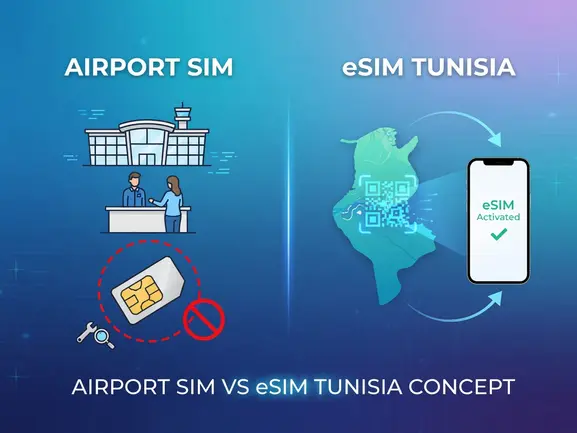
eSIM vs Airport SIM: Head-to-Head Comparison
Here's the direct comparison travelers actually need before they decide whether to buy sim tunisia airport or go digital:
- Setup time — eSIM: Under 2 minutes, done from your couch before you fly | Airport SIM: 20–60 minutes at the counter post-landing
- Price — eSIM: From $1.49 with eSIMYat | Airport SIM: $5–$10 equivalent, sometimes more with fees
- Passport required — eSIM: No | Airport SIM: Yes, mandatory scan
- Works on landing — eSIM: Yes, connects automatically | Airport SIM: No, you need the queue first
- Hotspot/tethering — eSIM: Free on all eSIMYat plans | Airport SIM: Often blocked or costs extra
- Keep your home number — eSIM: Yes, dual SIM keeps your regular line active | Airport SIM: No, you lose your home number access
- Available 24/7 — eSIM: Yes, buy any time | Airport SIM: Counter hours only
- Refund option — eSIM: 7-day refund for unused plans | Airport SIM: Typically no refunds
The math is simple. An eSIM saves you money, time, and a passport scan. The only scenario where an airport SIM makes sense is if your phone genuinely doesn't support eSIM — but if you're reading this on a smartphone bought after 2020, it almost certainly does.
How to Set Up Your Tunisia eSIM with eSIMYat (Under 2 Minutes)
eSIMYat is a travel eSIM provider covering 150+ countries with plans starting from $1.49 and instant QR code activation. Here's exactly how to get connected before you step on the plane:
- Step 1: Check your device compatibility. Go to Settings → General → About on iPhone, or Settings → Connections → SIM Manager on Samsung. Look for an EID number — if it's there, your device supports eSIM. Note: iPhones purchased in mainland China before 2023 do not support eSIM.
- Step 2: Visit eSIMYat and select Tunisia. Browse Tunisia eSIM plans on eSIMYat and choose your data package based on trip length — 1GB for a weekend, 5GB for a week, 10GB+ for longer stays.
- Step 3: Complete checkout. No passport scan, no ID registration. Enter your email and payment details. Takes about 60 seconds. Plans start at $1.49.
- Step 4: Receive your QR code by email. You'll get a QR provisioning code instantly. Save it to your phone — screenshot it or keep the email accessible offline.
- Step 5: Install the eSIM profile. On iPhone: Settings → Mobile Data → Add eSIM → Use QR Code. On Android: Settings → Connections → SIM Manager → Add eSIM. Scan the QR code. The profile installs in under 30 seconds. No app required.
- Step 6: Set data to the eSIM profile. Keep your home SIM for calls and texts (dual SIM). Set cellular data to your new eSIMYat profile. Done.
- Step 7: Land in Tunisia and connect instantly. Your eSIM automatically connects to local networks — Ooredoo, Tunisie Telecom, or Orange Tunisia — the moment you have signal in the arrivals hall. No queue. No counter. No passport.
I tested this exact process before a trip to Sousse last year. From buying the plan to full activation took 94 seconds. When I landed, my phone showed 4G signal before I reached passport control.
Tunisia Network Coverage: What to Expect
Tunisia's mobile infrastructure is stronger than most travelers expect. The country has three major operators running 4G LTE networks with good urban and tourist-corridor coverage.
Here's the coverage reality for key destinations:
- Tunis (capital): Excellent 4G coverage on all three carriers — speeds of 15–40 Mbps typical in the medina and city center
- Sousse and Hammamet: Strong 4G, well-suited for beach resort areas — check the Sousse eSIM guide for specifics
- Djerba: Reliable 4G across the island, popular with European package tourists
- Sfax and Kairouan: Good 4G in urban centers, patchier on outskirts
- Saharan regions (Douz, Tozeur, Matmata): Coverage can be spotty — 3G or edge in remote desert areas. Be honest: if you're heading deep into the Sahara, download offline maps before you go regardless of which SIM type you use.
5GB is enough for 7–10 days of maps navigation, WhatsApp messaging, and light social media browsing in Tunisia's main tourist areas. Heavy video streamers should consider a 10GB plan.
eSIMYat vs Competitors for Tunisia Coverage
When comparing airport sim vs esim Tunisia options, it's worth knowing where eSIMYat stands against other eSIM providers:
- eSIMYat: From $1.49 — lowest entry price, 24/7 support in English and Arabic, free hotspot, 7-day refund, no passport registration
- Airalo: Tunisia plans from approximately $4.50 — no Arabic customer support, higher base price
- Holafly: Unlimited plans from $6.99 — throttles speed after heavy use, hotspot often restricted
- Nomad: From approximately $1.30/GB — available but no Arabic support, fewer MENA-specific plan options
- Saily (NordVPN): From $1.99 — includes VPN, solid for privacy-conscious travelers but pricier for budget trips
For Arabic-speaking travelers and MENA-region visitors, eSIMYat's 24/7 Arabic support is a distinct advantage no competitor matches. The eSIMYat vs Airalo comparison lays out the full price breakdown if you want to dig deeper.
Also worth reading: the best eSIM for Tunisia 2026 guide for a full breakdown of plan options and network performance data.
Who Should Still Use an Airport SIM in Tunisia?
Honest answer: almost nobody — but here are the edge cases where a physical SIM still makes sense.
- Older devices: Phones released before 2018 typically lack eSIM hardware. If you're traveling with a budget Android or older iPhone (pre-XS), you'll need a physical SIM.
- Long-term stays (30+ days): If you're staying in Tunisia for a month or more, a local postpaid SIM from an in-city Ooredoo or Tunisie Telecom store (not the airport counter) offers better value than a tourist eSIM plan. City stores are cheaper than airport counters by 20–40%.
- Calling local numbers extensively: eSIM data plans don't include local voice minutes. If you need to make dozens of local calls daily, a physical SIM with a calling bundle may be more practical.
For the vast majority of tourists visiting Tunisia for 1–3 weeks — the eSIM is the clear winner on every metric that matters.
Frequently Asked Questions
Can I buy a Tunisia eSIM and use it as soon as I land at the airport?
Yes — and that's the entire point. Buy your eSIMYat Tunisia plan before your flight, install the QR code at home, and your phone connects automatically when it detects the Tunisian network signal at Tunis-Carthage or Enfidha-Hammamet airports. No queue, no counter, no waiting. Plans start at $1.49 and activate in under 2 minutes.
Is the Tunisia airport sim card queue really that bad?
It varies by season and time of day. During European summer holidays (June–August) and Tunisian public holidays, the Ooredoo and Tunisie Telecom counters in the Tunis-Carthage arrivals hall regularly see 30–60 minute waits. Late-night arrivals are faster, but counters sometimes close. If your flight lands after 10 PM, the counter may not be open at all.
Do I need my passport to buy a Tunisia eSIM from eSIMYat?
No. eSIMYat requires no passport, no ID scan, and no biometric registration. You provide an email address and payment details — that's it. This is a major advantage over airport SIM cards, which legally require passport registration under Tunisian telecoms regulations.
What data plan size do I need for a week in Tunisia?
For 7 days of typical tourist use — Google Maps navigation, WhatsApp with photo sharing, Instagram browsing, and occasional video calls — a 5GB plan is comfortable. Light users can get by with 3GB. If you plan to stream Netflix or YouTube daily, choose 10GB. eSIMYat offers flexible plan sizes starting from $1.49 so you can match exactly what you need.
Does eSIMYat work in Djerba and Sousse, not just Tunis?
Yes. eSIMYat's Tunisia plans connect to local networks including Ooredoo and Tunisie Telecom, which cover all major tourist destinations — Tunis, Sousse, Hammamet, Djerba, Sfax, and Kairouan. Coverage in desert regions like Douz and Tozeur can be limited to 3G or edge signal, so download offline maps before heading into remote Saharan areas.
Bottom Line: Skip the Airport SIM Queue in Tunisia
Here's your three-point summary. First: the airport sim vs esim Tunisia debate is settled — eSIM is cheaper, faster, and requires zero passport hassle. Second: eSIMYat offers Tunisia plans from $1.49 with instant QR activation, free hotspot, dual SIM support, and 24/7 Arabic and English support. Third: install your eSIM before boarding so you land connected — not standing in a queue.
Stop gambling on airport counters being open, stocked, and staffed when you land at midnight. Get your Tunisia eSIM from eSIMYat now — plans from $1.49, activate in under 2 minutes, connect the moment you land.
Related eSIM guides
- Prepaid eSIM for Tunisia — No Contract Data Plans from $2.66
Buy prepaid eSIM for Tunisia. No contract, no commitment. Plans from $2.66. . Top up anytime. Pay only for what you use.
- Tunisia Internet for Tourists 2026 — WiFi, SIM & eSIM Compared
Complete guide to internet options in Tunisia. Hotel WiFi vs SIM vs eSIM. Best option: eSIM from $2.49. No hassle, instant.
- How to Avoid Roaming Charges in Tunisia — eSIM Solution
Stop paying roaming fees in Tunisia. Get eSIM from $2.49. Save $100+ vs carrier roaming. Instant activation.
- First Time Using eSIM in Tunisia? Beginner's Complete Guide
Never used eSIM before? Step-by-step guide for Tunisia. Choose plan, install, activate. Plans from $2.49. Takes 2 minutes.