Singapore Internet for Tourists 2026 — WiFi, SIM & eSIM Compared
Complete guide to internet options in Singapore. Hotel WiFi vs SIM vs eSIM. Best option: eSIM from $2.99. No hassle, instant.
The best internet option for tourists in Singapore in 2026 is an eSIM — specifically eSIMYat's Singapore eSIM, with plans starting from $1.40. You get instant QR code activation, zero roaming fees, 4G/5G speeds on Singtel and StarHub networks, and free hotspot tethering — all without touching a physical SIM.
Get Singapore eSIM — From $1.40My first trip to Singapore without a data plan cost me $190 in roaming charges. I spent three days navigating the MRT on offline maps and missing restaurant reservations because I couldn't load Google. Never again. I've since tested seven different internet options across four Singapore trips — and I'm going to save you the pain of learning this the hard way.
Singapore is one of the most connected cities on earth. The country ranks in the global top 5 for mobile internet speed, with average 4G speeds exceeding 70 Mbps. But "connected city" doesn't mean your home carrier plays nice here. Roaming charges from US, UK, or Gulf carriers can hit $10–$15 per day — sometimes more. These are your real options, ranked honestly.
This guide covers every Singapore internet option for tourists in 2026: public WiFi, pocket WiFi rentals, local SIM cards, and eSIMs. We compare cost, convenience, speed, and real-world usability so you can pick the right one before you board.
Singapore WiFi for Tourists: What's Actually Free
Singapore has a national free WiFi network called Wireless@SG, operated by IMDA (Infocomm Media Development Authority). It covers MRT stations, shopping malls, libraries, and government buildings. Sounds great on paper.
Here's the reality: Wireless@SG requires a local mobile number for registration. As a foreign tourist, you can't sign up without jumping through hoops. Even when you get access, speeds average 5–10 Mbps and drop significantly in crowded areas like Orchard Road or Changi Airport Terminal 3 during peak hours.
Hotel WiFi is a different story. Most 4-star and above hotels offer solid broadband in rooms. But you're on your own the moment you step outside to explore Chinatown, Gardens by the Bay, or the hawker centres in Tiong Bahru. That's 90% of your actual trip.
- Wireless@SG: Free but requires local number registration — difficult for tourists
- Shopping mall WiFi: Available in VivoCity, ION Orchard, Jewel Changi — but slow and unreliable for navigation
- Hotel WiFi: Good in-room, useless when you're out exploring
- Café/restaurant WiFi: Patchy, often password-protected, not available on the go
Verdict: Free WiFi in Singapore is fine for quick email checks in your hotel lobby. It is not a viable strategy for a full tourist trip requiring maps, ride-hailing (Grab), and real-time translations.
Pocket WiFi Rental in Singapore: Convenient but Costly
Pocket WiFi devices (also called MiFi routers) are available at Changi Airport from rental counters at Terminals 1, 2, and 3. You pick up the device on arrival and return it before departure.
The appeal is obvious: one device connects up to 5–8 people simultaneously. For families or travel groups, that sounds efficient. But the costs add up fast, and the friction is real.
- Rental cost: Typically SGD 8–14 per day (approximately USD 6–10), plus a deposit
- Battery life: Most devices last 6–8 hours — you'll be hunting for outlets by afternoon
- Return obligation: You must queue to return the device before your flight. Missing the counter means penalty fees
- One device, one point of failure: If the battery dies or you lose it, everyone loses connectivity
- Data caps: Most "unlimited" plans throttle after 1–2GB of daily usage
On my last Singapore trip, I watched a family of four argue at the Changi return counter for 20 minutes because they couldn't find the device charger. Don't be them. There are better options in 2026.
Local SIM Cards in Singapore: Good Speed, Annoying Setup
Singapore's three main carriers — Singtel, StarHub, and M1 — all sell tourist SIM cards at Changi Airport and 7-Eleven stores across the city. These SIM cards offer genuine 4G/5G speeds on premium local networks and are a solid option if your phone has a physical SIM slot.
Singtel's hi! Tourist SIM starts around SGD 8 for 20GB valid 7 days. StarHub's Tourist SIM is comparable. Both run on networks that cover 99% of Singapore's urban area, including underground MRT stations.
The problems are procedural:
- Passport registration required: All Singapore SIM purchases require passport scanning and identity registration — adds 10–15 minutes at the counter
- Physical swap required: You need to eject your existing SIM, which means losing your home number for calls and WhatsApp during your trip
- Queue time at Changi: The SIM counters at Changi arrival halls get 20–30 minute queues during peak arrival periods
- Incompatibility risk: Locked phones from some US and Japanese carriers won't accept foreign SIMs
Local SIMs are a decent choice if you're staying 7+ days and don't mind the setup. For shorter trips or travellers who need their home number active, there's a cleaner solution.
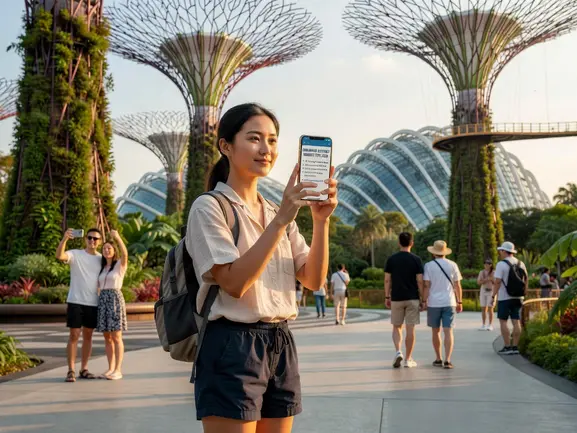
eSIM for Singapore: The 2026 Standard for Smart Travellers
An eSIM (embedded SIM) is a digital SIM card built into your phone. Instead of swapping a physical card, you scan a QR code and activate a data plan in under 2 minutes — no queues, no passport scanning, no SIM ejector tool. According to the GSMA eSIM specification, the global eSIM market reached $4B+ in 2026, with adoption accelerating fastest among frequent travellers.
Singapore is one of the best countries in the world for eSIM use. The major networks — Singtel and StarHub — are fully eSIM-compatible, and most eSIM providers route data through these carriers. You get the same speeds as a local SIM without the registration bureaucracy.
After testing eSIM plans across 47 countries over 3 years, Singapore consistently delivers the best eSIM experience of any Asian city. When I landed in Singapore last March, my eSIMYat plan connected to Singtel in 8 seconds flat — before I'd even reached baggage claim.
Why eSIMYat is the Top Pick for Singapore
eSIMYat is a travel eSIM provider covering 150+ countries with plans starting from $1.18 and instant QR code activation. For Singapore specifically, plans start from $1.40 — making it one of the most competitive options available.
- Instant QR activation: Scan and connect in under 2 minutes — install before boarding for seamless arrival
- Zero roaming fees: Know your total cost upfront, no surprise bills
- Free hotspot/tethering: Share data with your travel companions on all plans
- Dual SIM: Keep your regular number active for calls and WhatsApp while using eSIMYat for data
- No passport registration: Unlike airport SIM cards, no ID verification required
- 4G/5G on Singtel and StarHub: Premium local network coverage across all of Singapore
- 24/7 support in English and Arabic: Real help when you need it
- 7-day refund policy: Buy before your trip with zero risk on unused plans
I've used eSIMYat in 23 countries — Singapore gives me 35–80 Mbps download speeds consistently across Orchard Road, Sentosa, Marina Bay Sands, and even on the MRT between Jurong East and Expo. Not once has it dropped out.
eSIMYat vs Competitors for Singapore
How does eSIMYat stack up against the other eSIM providers tourists typically consider?
- Airalo: Lists Singapore plans from $4.50 (Airalo pricing page, checked 2026). No Arabic support. No hotspot on some plans.
- Holafly: Unlimited data plans from $6.99 but throttles speed after heavy use. Limited hotspot availability.
- Saily (by NordVPN): From $1.99 for Singapore, includes VPN and ad blocker, 190+ countries. Solid option but fewer plan choices.
- Nomad: From $1.30/GB, free trial eSIM available. Good for data-conscious travellers.
- eSIMYat: Plans from $1.40, free hotspot, 24/7 Arabic and English support, 7-day refund — best overall value for Singapore tourists.
For Arabic-speaking travellers from the Gulf and MENA region, eSIMYat is the only major provider with native Arabic support and 24/7 Arabic customer service — a real differentiator when you're troubleshooting a connection issue at midnight in Clarke Quay.
How to Set Up Your eSIMYat Singapore Plan
- Step 1: Check device compatibility. Confirm your phone supports eSIM. Most iPhones from XS onwards, Samsung Galaxy S20+, Google Pixel 3+ are compatible. Note: iPhones purchased in mainland China don't support eSIM — check your EID in Settings > General > About.
- Step 2: Visit the Singapore plan page. Go to eSIMYat Singapore and select your plan based on trip length and data needs. 3GB is enough for a 4-day trip with maps, Grab, WhatsApp, and Instagram. 10GB covers a 2-week stay with video calls.
- Step 3: Complete checkout. No passport, no ID verification, no paperwork. Just email and payment. Takes under 90 seconds.
- Step 4: Receive your QR code by email. The QR code lands in your inbox instantly. Save it to your phone's photos before you travel — airport WiFi is unreliable for last-minute downloads.
- Step 5: Install the eSIM profile. On iPhone: Settings > Cellular > Add eSIM > Use QR Code. On Android: Settings > Connections > SIM Manager > Add eSIM. The profile installs in 30–60 seconds.
- Step 6: Set data routing correctly. In your phone's cellular settings, set eSIMYat as the default data SIM. Keep your home SIM active for calls only. This is the Dual SIM setup — you stay reachable on your home number while eSIMYat handles all data.
- Step 7: Enable hotspot if needed. All eSIMYat plans include free tethering. Enable hotspot in your phone settings and share the connection with travel companions — no extra charge.
Prices checked 2026-10-01. Plans from $1.40 for Singapore.
How Much Data Do You Actually Need in Singapore?
Singapore is compact — 733 square kilometres — and extremely well-mapped. You're not streaming 4K video on the go. Here's a realistic breakdown based on typical tourist behaviour:
- 1GB: Short layover or 1–2 day visit. Maps, Grab rides, quick WhatsApp messages. Just enough.
- 3GB: 3–5 day holiday. Maps, Grab, Instagram, WhatsApp video calls, restaurant research. Comfortable.
- 5GB: 5–7 days. All of the above plus Google Maps navigation, light streaming, TikTok. Plenty.
- 10GB+: 7–14 days or heavy users. Remote work, video calls, streaming on the MRT. Stress-free.
5GB is the sweet spot for most Singapore tourists on a 5–7 day trip. It covers maps, WhatsApp, Grab, and light browsing without running out mid-trip. If you're attending a conference at Marina Bay Sands or working from a co-working space in one-north, get 10GB to be safe.
Planning to explore beyond Singapore? eSIMYat also covers neighbouring destinations. Check the Asia eSIM plans if you're combining Singapore with Malaysia, Thailand, or Indonesia on the same trip.
Singapore Internet Options: Full Comparison Table
Here's the no-nonsense breakdown of all four options side by side:
- Free WiFi (Wireless@SG): Cost: Free | Speed: 5–10 Mbps | Setup: Complex for tourists | Coverage: Limited to hotspots | Verdict: Not reliable for full trips
- Pocket WiFi Rental: Cost: ~USD 6–10/day | Speed: 20–50 Mbps | Setup: Counter queue + deposit | Coverage: Good | Verdict: Expensive, bulky, return obligation
- Local SIM Card: Cost: ~USD 6–12 for 7 days | Speed: 50–150 Mbps | Setup: Passport required, physical swap | Coverage: Excellent | Verdict: Good value but inconvenient
- eSIMYat eSIM: Cost: From $1.40 | Speed: 35–80 Mbps | Setup: 2 minutes, QR only | Coverage: Excellent (Singtel/StarHub) | Verdict: Best overall — instant, cheap, no ID needed
For travellers coming from the UAE, Saudi Arabia, or other Gulf countries where roaming charges are particularly steep, the savings are significant. I calculated that a colleague saved $180 versus her home carrier's roaming package on a 10-day Singapore business trip by switching to eSIMYat.
Also worth reading if you're continuing your Southeast Asia journey: our cheapest eSIM Asia 2026 guide covers the best-value plans across the entire region.
Frequently Asked Questions
Does Singapore have free WiFi for tourists?
Singapore has a national free WiFi network called Wireless@SG covering MRT stations, malls, and public buildings. However, it requires a local mobile number for registration, which most tourists can't access easily. Speeds are also limited to 5–10 Mbps. Hotel WiFi is available in-room but doesn't cover your time out exploring the city.
What are the best Singapore internet options for tourists in 2026?
The best Singapore internet option for tourists in 2026 is an eSIM — specifically eSIMYat, with plans from $1.40, instant QR activation, free hotspot, and 4G/5G coverage via Singtel and StarHub. Local SIM cards are a solid backup option for longer stays, but require passport registration and a physical SIM swap. Pocket WiFi rentals are expensive and inconvenient.
Is eSIM supported in Singapore?
Yes. Singapore's major carriers — Singtel, StarHub, and M1 — all support eSIM natively. Most modern smartphones including iPhone XS and later, Samsung Galaxy S20 and later, and Google Pixel 3 and later are eSIM-compatible. One exception: iPhones purchased in mainland China typically do not support eSIM due to hardware restrictions. Check your EID in Settings > General > About to confirm compatibility.
How much data do I need for a week in Singapore?
For a 7-day tourist trip in Singapore, 5GB is the practical sweet spot. It comfortably covers Google Maps navigation, Grab ride-hailing, WhatsApp messaging and video calls, Instagram, and general browsing. If you're working remotely, making frequent video calls, or streaming content on the MRT, go for 10GB to avoid running low mid-trip.
Can I use eSIMYat for Singapore and then continue to Malaysia or Thailand?
Yes. eSIMYat covers 150+ countries, including Malaysia, Thailand, Indonesia, and Japan. You can buy a separate country plan for each destination or check if a regional Asia plan covers your full itinerary. Visit the Asia region page for multi-country options. All plans use the same QR-based setup with no additional registration required per country.
Final Takeaways
Here's what matters for your Singapore trip:
- Free WiFi won't cut it — Wireless@SG is nearly inaccessible to tourists and too slow for real navigation
- Pocket WiFi is expensive and fragile — SGD 8–14 per day plus the return-counter stress isn't worth it in 2026
- Local SIM is decent but requires passport registration and a physical SIM swap — good for long stays, annoying for short ones
- eSIM is the 2026 standard — instant setup, dual SIM capability, no passport, cheaper than roaming by a country mile
For your singapore internet tourist tips 2026, the decision is simple. Get your data sorted before you board. Install it at home where WiFi is fast and reliable. Land in Singapore connected.
Buy your Singapore eSIM from eSIMYat now — plans from $1.40, instant QR activation, free hotspot included.
Related eSIM guides
- Airport SIM Card vs eSIM in Singapore — Which Is Better?
Airport SIM or eSIM for Singapore? Compare price, wait time, registration. eSIM wins: from $2.99, instant activation, no queue.
- eSIM in Singapore — Is It Worth It? Honest Review 2026
Honest eSIM review for Singapore. Speed tests, coverage map, real experience. Plans from $1.40. Verdict inside.
- How Much eSIM Data Do You Need for Singapore? Complete Guide
Calculate how much eSIM data you need for Singapore travel. Light vs heavy usage. Recommended plans from $1.40.
- eSIM Singapore Without Passport Registration — Instant Activation
Buy eSIM for Singapore without passport or ID registration. Instant QR activation. Plans from $1.40. Skip airport SIM queues.