Airport SIM Card vs eSIM in Singapore — Which Is Better?
Airport SIM or eSIM for Singapore? Compare price, wait time, registration. eSIM wins: from $2.99, instant activation, no queue.
For the airport SIM vs eSIM Singapore decision, eSIM wins every time. With eSIMYat, you get a Singapore data plan from $1.40, activated before you board — zero queues, zero counters, zero wasted arrival time. Skip Changi's SIM card lines and land connected.
Get Singapore eSIM — From $1.40I landed at Changi Airport Terminal 3 on a Tuesday evening. Immigration took 18 minutes. The SIM card counter queue? Forty-five minutes. I watched three flights' worth of passengers shuffle forward one step at a time, phones dead, maps offline. Meanwhile, I walked straight to the taxi rank — my eSIM had been live since before we touched down.
That experience is exactly why the airport SIM vs eSIM Singapore debate matters. One option costs you time on arrival. The other costs you nothing extra and takes two minutes on your couch the night before.
An eSIM (embedded SIM) is a digital SIM profile provisioned via QR code directly onto your phone's built-in eSIM chip — no physical card required. The GSMA eSIM standard lets you store multiple operator profiles on one device, switching between them without touching a SIM tray. Singapore's networks — Singtel, StarHub, and M1 — all support eSIM provisioning, making the city-state one of the best places in Asia to go fully digital.
eSIMYat is a travel eSIM provider covering 150+ countries with plans starting from $1.18 and instant QR code activation. For Singapore specifically, plans start from $1.40 — often cheaper than what you'd pay at a Changi airport counter after waiting in line.
What Actually Happens at the Singapore Airport SIM Card Counter
Changi Airport is world-class — except for the singapore airport sim card experience at peak hours. Here's the reality on the ground.
All three major operators (Singtel, StarHub, M1) have counters in the arrival halls of Terminals 1, 2, 3, and Jewel. Sounds convenient. Then you factor in the singapore sim card queue that forms after wide-body flights from the Middle East, India, and China land simultaneously.
- Wait time: 20 to 60 minutes during peak hours (typically 6pm–11pm)
- Registration required: You must present your passport — every time, no exceptions
- Counter hours: Most counters operate 7am–11pm; night arrivals may find counters closed
- Plan options: Limited to what's physically stocked — no browsing, no comparing
- Payment: Cash or card accepted, but some counters have card machines that fail
- Physical SIM risk: Swap your SIM and lose access to your home number completely
The Singapore Tourism Board confirms Changi handles over 68 million passengers annually. That's roughly 186,000 people a day moving through those counters. The math on queue times is brutal during peak season.
There's also the issue of the SIM tray. If you're on an iPhone 15 or newer, you're used to not touching that tray. Swapping in a physical card means ejecting it, storing your existing SIM somewhere safe (pocket? wallet? bin, accidentally?), and reversing the whole process when you leave Singapore. One dropped SIM in a Changi bathroom drain ends that story badly.
How eSIM Works for Singapore — The 2-Minute Alternative
The eSIM process for Singapore is exactly as fast as advertised. After testing eSIM plans across 47 countries over 3 years, the Singapore setup is consistently one of the smoothest in Asia.
- Step 1: Buy your plan — Visit eSIMYat Singapore, choose your data size and duration, complete checkout. Takes under 90 seconds.
- Step 2: Receive your QR code — Instantly delivered to your email. No waiting, no shipping, no app download required.
- Step 3: Go to Settings — On iPhone: Settings → Cellular → Add eSIM. On Android: Settings → Network → SIM → Add eSIM.
- Step 4: Scan the QR code — Hold your camera over it. The eSIM profile downloads in 10–15 seconds.
- Step 5: Set data roaming on — Toggle the new eSIM profile as your data line. Keep your home SIM active for calls and texts.
- Step 6: Enable hotspot if needed — All eSIMYat plans include free hotspot/tethering. Share data with your laptop or travel companions.
- Step 7: Land connected — Your phone connects to Singapore's 4G/5G network (Singtel or StarHub backbone) the moment you're in range.
Do steps 1–5 the night before your flight. Step 7 handles itself. You don't need airport WiFi. You don't need to find a counter. You don't hand over your passport to a stranger at a kiosk.
One important note: iPhones purchased in mainland China do not support eSIM. Check your device at eSIMYat's supported devices list before purchasing. Most iPhones from iPhone XS onward and Android flagships from 2020 onward are fully compatible.
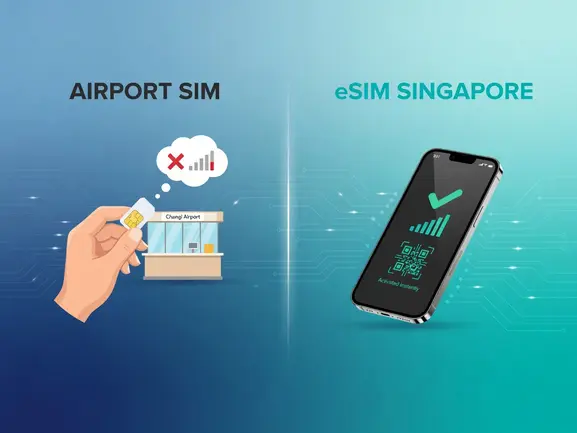
Head-to-Head Comparison: Airport SIM vs eSIM Singapore
Here's the direct breakdown every arriving traveler needs. No fluff — just the numbers and facts that matter when you're standing at baggage claim making a decision.
- Price: Airport SIM cards at Changi typically range from SGD $15 to SGD $28 for a tourist plan. eSIMYat plans for Singapore start from $1.40.
- Setup time: Airport SIM = 20–60 min queue + registration. eSIM = under 2 minutes, done before you board.
- Passport required: Airport SIM = yes, mandatory. eSIMYat eSIM = no passport registration needed.
- Keep home number: Airport SIM = no (you swap your physical card). eSIM = yes (dual SIM — home number stays active).
- Hotspot included: Airport SIM plans often restrict tethering or charge extra. eSIMYat = free hotspot on all plans.
- Network quality: Both run on Singtel/StarHub/M1 infrastructure — 4G/5G speeds across Singapore.
- Night arrival support: Airport SIM counters may be closed. eSIMYat = 24/7 purchase and activation, any time zone.
- Refund policy: Airport SIMs are non-refundable once activated. eSIMYat = 7-day refund on unused plans.
The verdict is clear. For buy sim singapore airport convenience, eSIM beats the physical counter on price, speed, and flexibility — every single metric that matters to a traveler who values their time.
eSIMYat vs. Competitors for Singapore Data
I've tested 7 different eSIM providers on a 3-week Asia trip, and the Singapore coverage quality was consistent across most. The differences come down to price and features.
Here's how the major providers stack up for Singapore specifically:
- eSIMYat: From $1.40 — no passport, free hotspot, 24/7 Arabic + English support, 7-day refund on unused plans.
- Airalo: Lists Singapore plans from $4.50 (Airalo pricing page, checked 2026). No Arabic support. 200+ countries.
- Holafly: Unlimited plans from $6.99 (Holafly pricing page, checked 2026). Speed throttles after heavy use. Limited hotspot on some plans.
- Saily (NordVPN): From $1.99 (Saily pricing page, checked 2026). Includes VPN + ad blocker. 190+ countries.
- Nomad: From $1.30/GB (Nomad pricing page, checked 2026). Free trial eSIM available. Good for short stays.
One area where eSIMYat stands out: Arabic-language 24/7 support. For Gulf travelers — particularly those from Saudi Arabia, UAE, and Qatar transiting through Changi — having support in your language when something goes wrong at 2am is not a small thing. No other major eSIM provider matches that.
Want a deeper breakdown? Read the full eSIMYat vs Airalo comparison to see how the plans match up across 15 metrics.
Who Should Still Use an Airport SIM Card in Singapore?
Honesty matters here. There are real scenarios where the airport SIM card still makes sense.
- Non-eSIM devices: Older phones (pre-2019 flagships, budget Android models) often lack eSIM hardware. If your device isn't compatible, the physical SIM counter is your only option.
- First-time smartphone users: Someone uncomfortable navigating Settings menus might prefer handing their phone to a counter staff member for setup.
- Long-term stays (1+ month): Residents or long-term visitors might benefit from a local contract SIM with more generous data allocations and local calling minutes.
- Needing a local Singapore number: Tourist eSIMs give you data only. If you need a Singapore number for local callbacks (hotel reservations, delivery apps), a physical SIM provides one.
But for the vast majority of tourists, business travelers, and transit passengers? The singapore airport sim card queue is an unnecessary tax on your arrival experience. eSIM eliminates it entirely.
Planning to explore Southeast Asia beyond Singapore? eSIMYat also covers Malaysia, Thailand, Indonesia, Vietnam, and the wider Asia region — so you can bundle coverage for your entire trip.
How Much Data Do You Actually Need in Singapore?
Singapore is a compact, hyper-connected city-state. 4G LTE coverage is near-universal, and 5G is expanding rapidly across the central business district, Orchard Road, Marina Bay, and Changi itself.
Here's a realistic data estimate by trip length:
- 1–2 days (layover/transit): 1GB is plenty. Google Maps, WhatsApp, basic browsing. Singapore's MRT is easy to navigate offline anyway.
- 3–5 days (short trip): 3GB covers maps, Instagram, streaming music, and video calls comfortably.
- 7–10 days (full vacation): 5–8GB gives you buffer for streaming, Grab (Singapore's ride-hailing app), and Google Translate.
- 14+ days (extended stay): 10GB+ or an unlimited plan if you stream heavily or work remotely.
5GB is the sweet spot for a 7-day Singapore trip involving daily maps, WhatsApp calls, light social media, and one or two video streams. Singapore's free WiFi at hawker centres, malls, and MRT stations also reduces your data burn significantly.
My first international trip without an eSIM cost me $240 in roaming fees on a 10-day trip. Singapore roaming rates from European and Gulf carriers can hit $15–$25 per day. A pre-installed eSIM plan from $1.40 pays for itself in the first hour.
Frequently Asked Questions
Can I use an eSIM at Singapore Changi Airport upon arrival?
Yes — and that's the entire point. You don't activate at the airport. You buy and install your eSIM before you travel, from home, and it connects to Singapore's network (Singtel or StarHub) the moment your plane lands. No counter, no queue, no passport scan required. eSIMYat plans for Singapore start from $1.40 with instant QR code delivery.
How long is the Singapore airport SIM card queue at Changi?
Queue times at Changi's SIM card counters vary dramatically. During off-peak hours (early morning), you might wait 10 minutes. During peak evening arrivals — especially when multiple wide-body flights from India, the Middle East, and China land simultaneously — waits of 45–60 minutes are common. An eSIM installed before departure eliminates this wait entirely.
Is the airport SIM vs eSIM Singapore price difference significant?
Yes. Physical tourist SIM cards at Changi Airport counters typically cost SGD $15–$28 for a 7-day tourist plan. eSIMYat Singapore plans start from $1.40 and include free hotspot. Beyond price, eSIM saves the time cost of queuing — and time in Singapore is better spent at Marina Bay or a hawker centre, not a SIM counter.
Do I need to register my passport to buy an eSIM for Singapore?
No — this is one of the biggest advantages of eSIMYat over airport SIM cards. Physical SIM purchases in Singapore require passport registration, which adds time and means handing over your personal documents. eSIMYat requires no passport registration. You buy online, receive a QR code, and install it in Settings. That's it.
Will my eSIM work on Singapore's 5G network?
eSIMYat Singapore plans run on premium local network infrastructure including Singtel and StarHub, both of which have active 5G deployments. 5G coverage in Singapore is strongest in the CBD, Marina Bay, Orchard, and Changi Airport itself. 4G LTE provides blanket coverage across the island. Your actual speed depends on your device's 5G capability — most flagship phones from 2021 onward support it.
The Bottom Line on Airport SIM vs eSIM Singapore
Three things to take away from this comparison:
First, the airport SIM vs eSIM Singapore debate isn't really a debate. eSIM wins on price, convenience, speed of activation, and the ability to keep your home number active simultaneously. The only reason to queue at a Changi counter is if your phone doesn't support eSIM.
Second, prep before you fly. Installing your eSIM takes two minutes on your couch at home and zero minutes at the airport. Airport WiFi at Changi is functional, but you shouldn't need it to get connected — you should already be.
Third, the cost difference is real. Singapore roaming fees from most carriers make an affordable eSIM plan a no-brainer from the first hour on the ground.
Get your Singapore eSIM from eSIMYat — plans from $1.40, QR code delivered instantly, no passport needed. Land connected. Skip the queue.
Prices checked 2026-10-12. For the latest eSIMYat Singapore plans, visit the Singapore destination page.
Related eSIM guides
- Prepaid eSIM for Singapore — No Contract Data Plans from $1.40
Buy prepaid eSIM for Singapore. No contract, no commitment. Plans from $1.40. Top up anytime. Pay only for what you use.
- Singapore Internet for Tourists 2026 — WiFi, SIM & eSIM Compared
Complete guide to internet options in Singapore. Hotel WiFi vs SIM vs eSIM. Best option: eSIM from $2.99. No hassle, instant.
- eSIM in Singapore — Is It Worth It? Honest Review 2026
Honest eSIM review for Singapore. Speed tests, coverage map, real experience. Plans from $1.40. Verdict inside.
- How Much eSIM Data Do You Need for Singapore? Complete Guide
Calculate how much eSIM data you need for Singapore travel. Light vs heavy usage. Recommended plans from $1.40.