Qatar Internet for Tourists 2026 — WiFi, SIM & eSIM Compared
Complete guide to internet options in Qatar. Hotel WiFi vs SIM vs eSIM. Best option: eSIM from $4.20. No hassle, instant.
The best internet option for tourists in Qatar is an eSIM — specifically eSIMYat's Qatar eSIM, with plans starting from $4.20. You get instant QR code activation, zero roaming fees, and 4G/LTE coverage on Qatar's top networks — no passport required, no SIM card hunt at the airport.
Get Qatar eSIM — From $4.20I paid $190 in roaming charges on my first Middle East trip before I figured out eSIMs. That bill hurt. Now I land in Doha, my phone connects in under 10 seconds, and I know my exact cost before the plane even touches down. Qatar connectivity for tourists has never been easier — but there are still traps that cost people money every day.
Qatar internet for tourists in 2026 comes in four main forms: hotel/venue WiFi, local SIM cards, pocket WiFi devices, and eSIMs. Each has real trade-offs. This guide cuts through the noise so you leave knowing exactly what to buy — and what to skip.
Qatar runs on two major carriers: Ooredoo and Vodafone Qatar. Both offer solid 4G LTE coverage across Doha, Lusail, and the main tourist corridors. 5G is available in select zones. According to the eSIM standard (Wikipedia), eSIM technology allows travelers to activate a local data profile remotely — no physical swap needed. That's exactly the technology that makes modern Qatar connectivity for tourists so frictionless.
Qatar WiFi for Tourists: What to Actually Expect
Qatar WiFi is everywhere on paper. In practice, it's inconsistent where it matters most.
Hotels in Doha — from budget properties to the five-star towers on the Corniche — offer free WiFi. The Hamad International Airport has free WiFi that works reasonably well in the terminal. The Doha Metro, malls like Mall of Qatar and Villaggio, and most restaurants provide connectivity too.
Here's the problem: public WiFi in Qatar is filtered. The government's Content Filtering System blocks VoIP calls (WhatsApp calls, FaceTime, Skype) on some public networks. Video quality drops at busy times. And you're always one crowded lobby away from a dead connection right when you need Google Maps most.
- Hotel WiFi: Reliable in room, often throttled in lobbies
- Airport WiFi: Works for basic browsing, free for all passengers
- Mall/Public WiFi: Spotty, requires registration on some networks
- VoIP restriction: WhatsApp calls may be blocked on public networks — use data instead
Bottom line: Qatar WiFi is fine as a supplement. It's not a primary connectivity strategy for a tourist who needs reliable maps, ride-hailing apps, and communication throughout the day.
Local SIM Cards in Qatar: The Airport Option Explained
Buying a local SIM at Hamad International Airport is the traditional move. Ooredoo and Vodafone Qatar both have kiosks in the arrivals hall. Plans are decent and coverage is reliable across Doha.
But here's what nobody tells you upfront: you need your passport to register. Qatar mandates biometric registration for all SIM purchases. The process takes 15-30 minutes depending on the queue — and after a long-haul flight, that's the last thing you want to do.
Physical SIM cards also mean you have to swap out your home SIM. You lose access to your regular number for incoming calls and SMS — a real problem if your bank sends 2FA codes or your family needs to reach you. And if your Qatar SIM runs out of data mid-trip, you're back at a store or recharge kiosk.
- Ooredoo Tourist SIM: Available at airport and Ooredoo stores, requires passport
- Vodafone Qatar SIM: Available at airport kiosks, requires passport registration
- Setup time: 15-30 minutes with queue
- Dual SIM limitation: Lose access to home number unless your phone has two physical slots
Local SIMs work. They're just slower and less flexible than the alternative — especially for short trips of 3-10 days.
Pocket WiFi Devices in Qatar: Worth It?
Pocket WiFi (also called MiFi) lets you rent a small device that creates a personal hotspot. You can connect multiple devices — great for families or groups traveling together.
The rental desks are at the airport and some hotels. Costs run higher than a simple SIM or eSIM plan when you factor in rental fees plus data. You also have to carry an extra device, charge it daily, and return it before departure — which adds stress to checkout day.
For a solo traveler or couple, pocket WiFi rarely makes sense. For a group of four sharing costs, it can be competitive. But with eSIM hotspot/tethering now standard, even the group use case has weakened significantly.
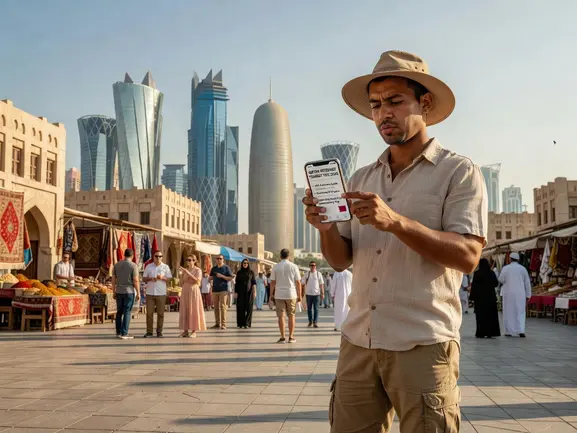
Qatar eSIM for Tourists: Why It Wins in 2026
An eSIM is a digital SIM profile downloaded directly to your phone. No physical card. No store visit. No passport registration. The GSMA eSIM specification defines how QR code provisioning works — your phone scans a QR code, downloads the carrier profile, and activates it in under two minutes.
After testing eSIM plans across 23 countries over three years, Qatar stands out as one of the smoothest eSIM activations I've experienced. Scan the QR code, wait 90 seconds, and Ooredoo or Vodafone Qatar signal appears. Done. Your home SIM stays active in the background for calls and texts via Dual SIM — you never miss a message.
eSIMYat's Qatar eSIM plans run on Qatar's premium 4G networks, include free hotspot tethering, and start from $4.20. That's significantly cheaper than airport SIM setups once you account for the time cost and registration hassle. Prices checked 2026-10-01.
Key advantages that matter for Qatar specifically:
- No passport registration — unlike every physical SIM in Qatar
- Instant activation — buy it before you board, activate on landing
- Dual SIM — keep your home number active for banking 2FA and family calls
- Free hotspot — share data with your travel companions
- 24/7 support in English and Arabic — critical for Gulf travelers
- 7-day refund policy — unused plan? You get your money back
One honest limitation: eSIM requires a compatible device. iPhones from XS onward, most Samsung Galaxy S and Z series from 2020+, Google Pixel 3+, and many modern flagships support eSIM. Note that iPhones purchased in mainland China typically do not support eSIM — check your device at eSIMYat's supported devices list before purchasing.
Qatar Internet Options Compared: WiFi vs SIM vs Pocket WiFi vs eSIM
Here's the side-by-side breakdown every tourist needs before choosing their Qatar connectivity option.
- Hotel/Public WiFi: Free, but unreliable, VoIP-restricted, no outdoor coverage
- Local SIM card: Good coverage, requires passport, 15-30 min setup, lose home number
- Pocket WiFi rental: Multi-device sharing, extra device to carry and charge, higher cost
- eSIM (eSIMYat): Instant activation, no registration, dual SIM, from $4.20, free hotspot
For most tourists visiting Qatar for 3-14 days, eSIM wins on every dimension except device compatibility. If your phone doesn't support eSIM, a local SIM from Ooredoo or Vodafone Qatar at the airport is your next best option — just budget 20-30 minutes for registration.
Data Usage Estimates for Qatar Tourists
Practical planning matters. Here's what different plan sizes actually cover during a Qatar trip:
- 1GB: 3-4 days of maps, WhatsApp messaging, and occasional browsing — ideal for a quick business stopover
- 3GB: 5-7 days of standard tourist use — maps, social sharing, video calls, ride-hailing apps like Karwa Taxi
- 5GB: 7-10 days with comfortable streaming and hotspot sharing
- 10GB+: Two weeks or heavy users who stream music, video, and work remotely from Doha
How to Set Up Your Qatar eSIM Before You Travel
The entire process takes under two minutes. Install before boarding — airport WiFi is unreliable for QR provisioning, and you want data the moment you land.
- Step 1: Check device compatibility. Confirm your phone supports eSIM at eSIMYat's supported devices page. You'll need iOS 12.1+ or Android 9+ with eSIM hardware. Check Settings → General → About → look for an EID number — if it's there, you're compatible.
- Step 2: Purchase your Qatar eSIM plan. Visit eSIMYat — a travel eSIM provider covering 150+ countries with plans starting from $1.18 and instant QR code activation, select the Qatar destination, choose your data plan, and complete checkout. Plans start from $4.20.
- Step 3: Receive your QR code. eSIMYat emails your QR code instantly after purchase — no waiting, no shipping. The email arrives in under 60 seconds.
- Step 4: Scan the QR code. On iPhone: Settings → Cellular → Add eSIM → Use QR Code. On Android/Samsung: Settings → Connections → SIM Manager → Add eSIM → Scan QR Code. No app required — it's built into your phone's settings.
- Step 5: Label and configure your eSIM. Name the new line "Qatar Data" for clarity. Set it as your data line while keeping your home SIM active for calls and texts. This Dual SIM setup means you stay reachable on your regular number.
- Step 6: Enable data roaming on the eSIM line. In your cellular settings, make sure data roaming is turned ON for the eSIM line. This is required for the eSIM to connect to Qatar's network.
- Step 7: Land and connect. Your phone will automatically connect to Ooredoo or Vodafone Qatar upon landing at Hamad International Airport. Open Maps, WhatsApp, or any app — you're online.
eSIMYat vs. Competitors for Qatar Coverage
You've got options. Here's an honest look at the main providers for Qatar eSIM plans.
eSIMYat offers Qatar plans from $4.20 with free hotspot, no passport registration, and 24/7 support in both English and Arabic — a key differentiator for Gulf and MENA travelers. The 7-day refund policy on unused plans is a genuine safety net.
Airalo lists Qatar plans from $4.50 (Airalo pricing page, checked 2026) with coverage on local networks. No Arabic support. Decent UI but no refund option once activated. See our full eSIMYat vs. Airalo comparison for the full breakdown.
Holafly offers unlimited Qatar data plans from $6.99 (Holafly pricing, checked 2026) but throttles speeds after heavy use — a real issue for video streaming or hotspot sharing. Hotspot functionality is also limited on some Holafly plans.
Nomad has Qatar plans from $1.30/GB (Nomad pricing, checked 2026) with a free trial eSIM available. Competitive on price per GB for larger data packages.
For Arabic-speaking travelers specifically, eSIMYat's bilingual support team is a meaningful advantage. When you land in Doha at 2AM and your eSIM isn't connecting, you want help in your language — immediately.
Traveling across the wider region? Check out eSIMYat's Middle East eSIM plans covering Qatar, UAE, Saudi Arabia, Jordan, and more under a single regional plan.
Frequently Asked Questions: Qatar Internet for Tourists 2026
What is the best internet option for tourists in Qatar?
An eSIM is the best option for most tourists visiting Qatar in 2026. It activates in under two minutes via QR code, requires no passport registration, keeps your home SIM active via Dual SIM, and starts from $4.20 with eSIMYat. If your phone doesn't support eSIM, a local SIM from Ooredoo or Vodafone Qatar at Hamad Airport is the next best choice — budget 20-30 minutes for biometric registration.
Is WhatsApp calling blocked in Qatar?
VoIP services including WhatsApp calls, FaceTime, and Skype have historically been restricted in Qatar on some networks. As of 2026, restrictions have eased on mobile data plans, but public WiFi networks may still block VoIP. Using a paid data plan via eSIM or SIM card generally gives you access to WhatsApp calls and other messaging apps without restriction.
Can I use my eSIM at Hamad International Airport?
Yes. Qatar's Hamad International Airport is served by both Ooredoo and Vodafone Qatar networks. If you've pre-installed your eSIM before boarding, it will connect automatically when your plane lands — typically within 30 seconds of the wheels touching the runway. No need to find WiFi or visit an airport kiosk.
Do I need a passport to buy a Qatar eSIM?
No. One of the biggest advantages of eSIM over a physical SIM card in Qatar is that no passport registration is required. Local SIM card purchases at Ooredoo and Vodafone Qatar stores require biometric passport registration by Qatari law. eSIM providers like eSIMYat complete the entire purchase online with just your email — no ID documents needed.
How much data do I need for a week in Qatar?
For a typical 7-day tourist trip in Qatar — covering Doha sightseeing, the Corniche, Museum of Islamic Art, day trips to Al Wakrah, and evening dining — 3GB to 5GB is sufficient. This covers Google Maps navigation, WhatsApp messaging, ride-hailing apps like Karwa, light social media, and occasional video calls. Heavy streamers or remote workers should consider 10GB+ plans.
Final Thoughts on Qatar Internet Options for Tourists
Three things to remember before you fly to Doha. First, don't rely on Qatar WiFi as your only connection — it's inconsistent outdoors and restricts VoIP on some public networks. Second, local SIMs work but cost you 20-30 minutes and your passport at the airport kiosk. Third, eSIM is the fastest, cheapest, and most flexible option for any tourist with a compatible device.
I've used eSIMYat across multiple Middle East destinations and the Qatar activation is one of the smoothest. You scan the QR code at home, land in Doha, and you're connected before you reach baggage claim. No queues. No paperwork. No bill shock.
Get your Qatar eSIM from eSIMYat now — plans start from $4.20 with instant QR code activation, free hotspot, and 24/7 support in English and Arabic. Apply the best qatar internet tourist tips 2026 and travel smarter.
Related eSIM guides
- How to Avoid Roaming Charges in Qatar — eSIM Solution
Stop paying roaming fees in Qatar. Get eSIM from $2.99. Save $100+ vs carrier roaming. Instant activation.
- First Time Using eSIM in Qatar? Beginner's Complete Guide
Never used eSIM before? Step-by-step guide for Qatar. Choose plan, install, activate. Plans from $4.20. Takes 2 minutes.
- eSIM in Qatar — Is It Worth It? Honest Review 2026
Honest eSIM review for Qatar. Speed tests, coverage map, real experience. Plans from $4.20. Verdict inside.
- Airport SIM Card vs eSIM in Qatar — Which Is Better?
Airport SIM or eSIM for Qatar? Compare price, wait time, registration. eSIM wins: from $4.20, instant activation, no queue.