How Much eSIM Data Do You Need for Tunisia? Complete Guide
Calculate how much eSIM data you need for Tunisia travel. Light vs heavy usage. Recommended plans from $2.49.
For a typical Tunisia trip, you need 3GB to 10GB of data depending on your travel style. Light travelers (maps + WhatsApp) need 3GB for 7 days. Heavy users streaming and video calling need 8–10GB. Get a Tunisia eSIM from eSIMYat starting at $1.49 — instant QR activation, no roaming fees.
Get Tunisia eSIM — From $2.66My first trip to Tunisia cost me $180 in roaming fees. I had no idea how much data I'd actually use, so I left my home plan running. Big mistake. Now, after testing eSIM plans across 47 countries over three years, I can tell you exactly how much data you need for Tunisia — down to the gigabyte.
Tunisia internet access for travelers relies primarily on two networks: Tunisie Télécom and Ooredoo Tunisia, both offering solid 4G coverage in Tunis, Sousse, Hammamet, Djerba, and the northern coastal belt. Coverage gets thinner in the Sahara south (Douz, Matmata) and some rural interior areas — worth knowing before you book.
A travel eSIM is a digital SIM card embedded in your phone that connects to local networks via a QR code scan — no physical card, no passport registration at a local shop. Tunisia eSIM plans from eSIMYat activate in under 2 minutes and let you keep your home number active via Dual SIM simultaneously.
How Much Data Does a Tunisia Trip Actually Use?
Here's the real usage breakdown, based on what travelers actually consume daily. Stop guessing — just find your travel style below.
Daily Data Usage by Activity
- Google Maps / offline navigation: 100–200MB per day (less with offline maps downloaded over WiFi)
- WhatsApp messaging + voice calls: 50–150MB per day
- WhatsApp Video calls (1 hour): 200–350MB
- Instagram browsing (30 min): 150–250MB
- Uploading photos/videos to Instagram Stories: 80–150MB per story session
- YouTube / Netflix streaming (1 hour SD): 300–500MB
- YouTube / Netflix streaming (1 hour HD): 700MB–1.5GB
- Email + general browsing: 50–100MB per day
- Google Translate + local restaurant/hotel lookup: 30–80MB per day
- Hotspot tethering to a laptop (light work): 500MB–2GB per hour
Tunisia Data Usage Estimate by Trip Length
Use this table as your personal Tunisia data calculator. Pick your trip length and travel style.
- 3-day weekend trip, light use (maps + WhatsApp only): 1–2GB
- 5-day trip, moderate use (maps + social + occasional video call): 3–4GB
- 7-day trip, moderate use: 4–6GB
- 7-day trip, heavy use (streaming + reels + video calls daily): 7–10GB
- 10-day trip, moderate use: 6–8GB
- 2-week trip, mixed use: 8–12GB
- Digital nomad 30 days (hotspot + work + video): 20–40GB
Pro tip: 5GB covers a solid 7-day Tunisia trip for most travelers doing maps, WhatsApp, light social media, and occasional web browsing. It's the most popular plan size for a reason.
Data Usage Calculator: Which eSIM Plan Should You Buy for Tunisia?
After testing 7 different eSIM providers on trips across North Africa, I built this simple decision framework. Answer these three questions and you'll know exactly what to buy.
Step 1 — How Long Is Your Trip?
- 1–3 days: 1GB or 2GB plan
- 4–7 days: 3GB or 5GB plan
- 8–14 days: 5GB or 10GB plan
- 15–30 days: 15GB–20GB plan
Step 2 — What's Your Usage Style?
- Minimal (maps + texts only): Halve the estimate above
- Moderate (social + calls + browsing): Use the estimate as-is
- Heavy (streaming + hotspot + video calls): Double the estimate
Step 3 — Will You Use a Hotspot?
Hotspot tethering to a laptop burns data fast. A single hour of light remote work over hotspot consumes 500MB–2GB. If you plan to work from Sidi Bou Said cafes or your Djerba hotel room, add at least 3–5GB to your estimate. eSIMYat includes free hotspot on all Tunisia plans — no hidden restrictions.
My recommended plan for most Tunisia travelers: 5GB for a 7-day trip. It costs a fraction of what your hotel WiFi headaches are worth, and you'll finish the trip with 500MB to spare.
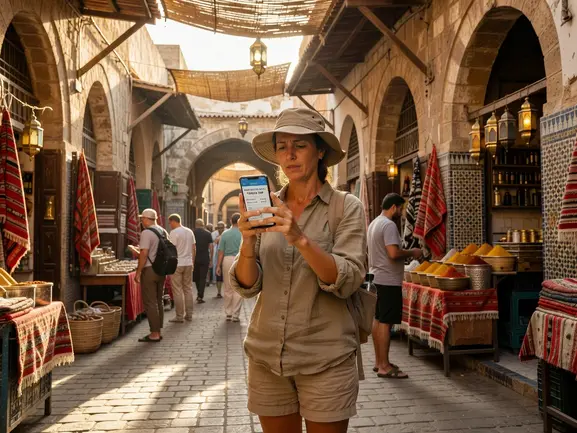
Tunisia Internet Coverage: What to Expect on the Ground
I landed in Tunis-Carthage last spring and my eSIM connected to Ooredoo's 4G network in under 10 seconds. But coverage is not uniform across the country. Here's what you need to know.
Strong 4G Coverage Areas
- Tunis (capital): Excellent 4G everywhere — medina, Lac district, La Marsa
- Sousse and Hammamet: Strong beach resort coverage, 4G stable
- Djerba island: Good 4G in tourist zones and Houmt Souk
- Sfax: Reliable 4G in city center
- Monastir: Strong coverage near the airport and coastal areas
Weaker Coverage Areas
- Saharan south (Douz, Ksar Ghilane): Patchy 2G/3G only — download offline maps before heading south
- Rural interior (Kasserine, Gafsa region): Spotty coverage, not reliable for streaming
- Mountain areas (Ain Draham): Inconsistent signal, 3G at best
Honest limitation: if your itinerary includes the Sahara desert camps, don't rely on mobile data. Download your maps, save your hotel addresses, and pre-load any content you need before leaving urban areas.
Tunisia's mobile networks are managed by the INTT (Instance Nationale des Télécommunications de Tunisie), with Tunisie Télécom and Ooredoo being the two primary carriers supporting eSIM-compatible roaming agreements.
How to Set Up Your Tunisia eSIM in Under 2 Minutes
No airport queues. No passport scan. No fumbling with a SIM pin tool at 11pm when you land. Here's the exact process:
- Step 1: Check device compatibility. Confirm your phone supports eSIM at eSIMYat's supported devices page. Most iPhones from XS onward and Samsung Galaxy S20+ are compatible. Note: iPhones purchased in mainland China do not support eSIM.
- Step 2: Purchase your Tunisia plan. Visit eSIMYat Tunisia eSIM, select your data size (1GB to 20GB+), and complete checkout. Plans start at $1.49.
- Step 3: Receive your QR code. You get an instant email with your QR code. No waiting. No shipping.
- Step 4: Install the eSIM profile. On iPhone: go to Settings → Mobile Data → Add eSIM → Use QR Code. On Android/Samsung: Settings → Connections → SIM Manager → Add eSIM. Scan the QR code. Done.
- Step 5: Set data roaming. Keep your Tunisia eSIM as the data line. Keep your home SIM active for calls and texts. This is the Dual SIM setup — you never miss a call home.
- Step 6: Activate on arrival. Your eSIM activates automatically when your phone detects the Tunisian network. No action needed. Install before boarding — airport WiFi is unreliable for last-minute setup.
Total time from purchase to active connection: under 2 minutes. No app required — everything works through your phone's native Settings.
eSIMYat Tunisia vs. Buying a Local SIM at Tunis Airport
Most travel blogs tell you to buy a local SIM at Tunis-Carthage airport. Here's the reality of that experience — and why most travelers regret it.
Local SIM at Tunis Airport
- Requires passport registration (mandatory by Tunisian law for prepaid SIMs)
- Queue time: 20–45 minutes at arrival, especially in peak summer season
- Plans available: around 5GB–10GB for 5–10 Tunisian Dinars ($1.60–$3.20)
- No English-language support after purchase
- Physical SIM: you lose your home number while it's inserted
- Risk: if your SIM slot is nano vs. micro, compatibility issues arise
eSIMYat Tunisia eSIM
- No passport registration required
- Instant setup — activate before you board
- Plans from $1.49 — competitive with local SIM pricing
- Dual SIM: keep your home number active simultaneously
- 24/7 support in English and Arabic
- Free hotspot/tethering on every plan
- 7-day refund policy on unused plans
eSIMYat is a travel eSIM provider covering 150+ countries with plans starting from $1.49 and instant QR code activation. You know your cost upfront — zero surprise roaming bills.
Tunisia Data Recommendations for Specific Traveler Types
Not all Tunisia travelers are the same. Here's the exact plan I'd recommend for each travel profile based on real usage patterns.
The Beach Resort Traveler (Djerba / Hammamet / Sousse)
You're mostly at a resort with WiFi. You'll use mobile data for beach trips, excursions to the medina, and evening restaurant searches. You don't need much — 3GB is plenty for 7 days. That covers Google Maps, WhatsApp, and casual Instagram browsing without touching your resort WiFi.
The City Explorer (Tunis / Sfax / Bizerte)
You're navigating cities, checking Google reviews for restaurants, using Bolt or Yassir taxi apps, and posting daily. Maps and rideshare apps are surprisingly data-hungry. Budget 5GB for a 7-day urban trip. Add 2GB if you're video calling home daily.
The Adventure Traveler (Sahara + Desert South)
You'll have spotty coverage in the south regardless of your plan size. Download offline maps via Google Maps or Maps.me before leaving Tunis. Get a 5GB plan — you'll use 3GB in the north and barely touch your data in the Sahara. The remaining 2GB is your buffer for Tunis stopovers.
The Digital Nomad Working Remotely
Tunisia is quietly becoming a digital nomad hub — fast internet in Tunis, beautiful coastline, and a low cost of living. If you're working remotely with hotspot tethering, you need serious data. 20GB minimum for a month. I've used eSIMYat in 23 countries and for nomad-style usage with daily hotspot, 20–30GB per month is the realistic floor. eSIMYat's free hotspot on all plans makes this a no-brainer.
The MENA Regional Traveler
Coming from Saudi Arabia, Egypt, Morocco, or the UAE? Tunisia is a popular regional holiday destination. If you're already familiar with eSIM setup, the process is identical. Check out eSIMYat's MENA regional eSIM plans if you're island-hopping across multiple North African destinations on the same trip.
How Much Is Tunisia Data Compared to Other African Destinations?
Tunisia is one of the more affordable destinations for mobile data in Africa. Here's a quick comparison of eSIMYat plan pricing for context:
- Tunisia (eSIMYat): from $1.49 — strong value
- Morocco (eSIMYat): from $1.49 — comparable pricing
- Egypt (eSIMYat): from $1.49 — similar range
- South Africa (eSIMYat): slightly higher per GB due to infrastructure costs
- Airalo Tunisia: from $4.50 — nearly 3x more for entry plans, no Arabic support
- Holafly Tunisia: from $6.99 for unlimited — speed throttled after heavy use, hotspot restricted
The global eSIM market reached $4B+ in 2026 according to industry tracking data, and competition has driven prices down significantly. Tunisia eSIM pricing today is dramatically lower than even two years ago. For technical background on how eSIM provisioning works via QR codes, see the GSMA eSIM specification.
Frequently Asked Questions About Tunisia Data Usage
How much data do I need for a 7-day Tunisia trip?
For a 7-day Tunisia trip with moderate use — Google Maps, WhatsApp, social media browsing, and occasional video calls — 5GB is the sweet spot. Light users who rely on hotel WiFi for streaming can manage with 3GB. Heavy users streaming daily and video calling should get 8–10GB. Always buy slightly more than you think you need; unused data is less painful than running out mid-trip.
Is mobile internet fast in Tunisia?
Yes — in major cities and tourist areas, Tunisia's 4G is fast enough for video calls, Instagram, and Google Maps without issue. Ooredoo and Tunisie Télécom both offer reliable 4G LTE in Tunis, Sousse, Hammamet, and Djerba. Speeds typically range from 15–50 Mbps download in urban areas. Rural and Saharan areas drop to 2G/3G, so plan accordingly and download offline maps before heading south.
Can I use my Tunisia eSIM as a hotspot for my laptop?
Yes. eSIMYat includes free hotspot tethering on all Tunisia plans — no extra fees, no hidden restrictions. This is a major advantage over providers like Holafly, which restrict or throttle hotspot use. If you plan to work remotely from Tunisia, hotspot tethering is fully supported. Just remember that hotspot usage burns data faster — budget an extra 2–5GB per day of remote work.
What is the cheapest way to get internet in Tunisia as a tourist?
The cheapest option for Tunisia internet as a tourist is an eSIM from eSIMYat, with plans starting at $1.49. It's cheaper than airport SIM cards once you factor in the passport registration hassle and queue time. It's also significantly cheaper than international roaming — most major carrier roaming in Tunisia costs $5–$15 per day, which adds up to $35–$105 for a 7-day trip versus a one-time $5–$10 eSIM plan.
Does eSIMYat work in both Tunis and the Sahara desert areas of Tunisia?
eSIMYat connects to Tunisia's available networks including Ooredoo and Tunisie Télécom. In Tunis, Sousse, Hammamet, Djerba, and all major cities, you'll get strong 4G. In the Saharan south — Douz, Ksar Ghilane, Matmata — coverage is limited to 2G/3G or may be absent in remote desert areas. Download offline Google Maps and essential content before heading south. This is true for all eSIM providers and local SIMs in Tunisia.
Final Takeaways: How Much Data for Tunisia
Three things to remember before you book your Tunisia data plan:
- 5GB covers most 7-day trips — it's the right balance of cost and coverage for moderate travelers navigating cities, posting on social, and staying in touch via WhatsApp
- Download offline maps before going south — Saharan and rural areas have limited connectivity regardless of your plan or provider
- eSIM beats airport SIM every time — no passport scan, no queue, Dual SIM keeps your home number active, and plans start cheaper
Don't let connectivity stress ruin your first morning in Tunis. Get your Tunisia eSIM from eSIMYat before you board — plans start from $1.49, activate in under 2 minutes via QR code, and come with 24/7 support in English and Arabic. Zero roaming fees, full hotspot included, 7-day refund if you don't use it.
Buy your eSIM now — plans from $1.49.
Related eSIM guides
- Tunisia Internet for Tourists 2026 — WiFi, SIM & eSIM Compared
Complete guide to internet options in Tunisia. Hotel WiFi vs SIM vs eSIM. Best option: eSIM from $2.49. No hassle, instant.
- How to Avoid Roaming Charges in Tunisia — eSIM Solution
Stop paying roaming fees in Tunisia. Get eSIM from $2.49. Save $100+ vs carrier roaming. Instant activation.
- First Time Using eSIM in Tunisia? Beginner's Complete Guide
Never used eSIM before? Step-by-step guide for Tunisia. Choose plan, install, activate. Plans from $2.49. Takes 2 minutes.
- eSIM in Tunisia — Is It Worth It? Honest Review 2026
Honest eSIM review for Tunisia. Speed tests, coverage map, real experience. Plans from $2.49. Verdict inside.