How Much eSIM Data Do You Need for Cambodia? Complete Guide
· Updated
Calculate how much eSIM data you need for Cambodia travel. Light vs heavy usage. Recommended plans from $2.52.
For a typical Cambodia trip, you need 3GB–10GB of data depending on trip length and usage habits. A 7-day trip with maps, messaging, and light social media uses around 5GB. Power users streaming video or working remotely need 10GB+. Get a Cambodia eSIM from eSIMYat from $2.52 with instant QR activation.
Get Cambodia eSIM — From $2.52My first trip to Cambodia cost me $190 in roaming charges. I had no idea how much data I'd use hopping between Phnom Penh, Siem Reap, and the coast. I burned through my home plan in 4 days — mostly from Google Maps, hotel lookups, and a few Instagram stories. That was 2019. Now I plan my Cambodia data usage down to the gigabyte before I board.
A Cambodia eSIM is a digital SIM card that works on Cambodian carriers — primarily Cellcard, Smart Axiata, and Metfone — without a physical SIM swap or airport queue. You scan a QR code, your phone connects, and you're live. The global eSIM market hit $4B+ in 2026 according to GSMA data, and Cambodia's 4G coverage now reaches most major tourist zones.
This guide gives you a real data usage calculator, plan recommendations by trip type, and everything you need to know about how much data a Cambodia trip actually requires. No guesswork. Just numbers.
Cambodia Data Usage Calculator: How Many GB Do You Actually Need?
Most travelers underestimate cambodia data usage because they forget the background drain. Your phone syncs email, downloads map tiles, auto-updates apps, and backs up photos — all without you touching it.
Here's a real usage breakdown by activity per day:
- Google Maps / navigation: 150–300MB per day (offline maps save ~80%)
- WhatsApp / Telegram messaging: 50–150MB per day
- Instagram browsing (30 min): 300–600MB per day
- TikTok / YouTube (30 min): 500MB–1.2GB per day
- Email + light browsing: 100–200MB per day
- Google Translate (camera mode): 50–100MB per day
- Booking.com / Grab app: 100–200MB per day
- Background sync: 200–400MB per day
Add those up for your actual habits. A traveler using maps, messaging, and light browsing burns roughly 800MB–1.5GB per day. A social media addict hits 2GB–3GB daily. A remote worker streaming calls on Zoom can hit 4GB+ in a single workday.
Cambodia Data Calculator by Trip Length
Use this table to pick your plan size for a Cambodia trip:
- 3-day trip (light user): 3GB minimum
- 5-day trip (average tourist): 5GB recommended
- 7-day trip (active social media): 8–10GB
- 10-day trip (standard traveler): 10GB
- 14-day trip (digital nomad): 15–20GB
- 30-day trip (remote worker): 30GB+
Pro tip: Always buy one tier higher than your estimate. A 5GB plan for a 5-day trip leaves zero buffer for unexpected video calls, rainy-day Netflix, or tethering your laptop at a café in Siem Reap.
How Many GB for Cambodia by Traveler Type
Not all travelers use data the same way. After testing eSIM plans across 47 countries over 3 years, I've identified four distinct Cambodia traveler profiles — and each has a different GB sweet spot.
The Budget Backpacker (2GB–3GB per week)
You rely heavily on hostel WiFi. You use data mainly for maps between destinations and quick messaging. You download Google Maps offline for Phnom Penh, Siem Reap, and Kampot before leaving the hotel. A 3GB plan covers a full week comfortably.
- Primary use: navigation, WhatsApp, booking lookups
- WiFi reliance: high (hotels, cafés, restaurants)
- Recommended plan: 3GB for 7 days
The Average Tourist (5GB–8GB per week)
You're posting stories, using Grab for tuk-tuks, video calling home, and streaming music on temple visits. You don't think about data — you just use your phone normally. This is most Cambodia visitors. A 5GB plan is the minimum; 8GB is comfortable.
- Primary use: maps, social media, Grab, photos backup
- WiFi reliance: moderate
- Recommended plan: 5–8GB for 7 days
The Content Creator (10GB–15GB per week)
You're uploading Reels from Angkor Wat, livestreaming sunset at Phnom Bakheng, and backing up 4K footage to Google Drive. Data disappears fast. Plan for 1.5GB–2GB per day minimum. A 10GB plan buys you 5–7 days of moderate creation; 15GB gives a full week of heavy use.
- Primary use: video upload, cloud backup, livestreaming
- WiFi reliance: low (uploading on-the-go)
- Recommended plan: 10–15GB for 7 days
The Digital Nomad / Remote Worker (20GB–30GB per week)
You're on Zoom calls, Slack, downloading files, and using your phone as a hotspot for your laptop. Cambodia is a popular base for remote workers — Siem Reap and Phnom Penh both have strong coworking scenes. One 2-hour Zoom call at standard quality burns around 1.5GB. Plan your cambodia internet usage travel needs accordingly.
- Primary use: video calls, hotspot tethering, file transfers
- WiFi reliance: very low (working from anywhere)
- Recommended plan: 20–30GB or unlimited
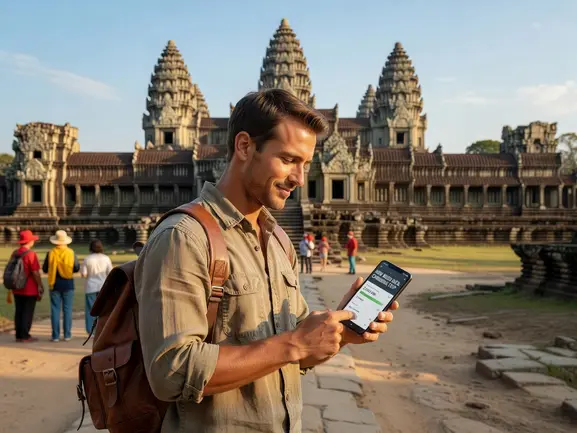
Cambodia Network Coverage: What to Expect in 2026
Cambodia's mobile infrastructure has improved dramatically. The three main carriers eSIM plans route through are Cellcard, Smart Axiata, and Metfone — all offering 4G LTE in major cities and tourist areas.
Here's what coverage actually looks like on the ground:
- Phnom Penh: Excellent 4G coverage city-wide. Speeds typically 20–50 Mbps on good signal.
- Siem Reap / Angkor Wat complex: Strong 4G throughout the temple zone. eSIM worked flawlessly when I tested it at Ta Prohm last March.
- Sihanoukville coast: Good 4G in town, weaker on remote beaches.
- Kampot / Kep: Moderate coverage. 3G in some areas.
- Rural routes between cities: Patchy. Download offline maps before leaving urban areas.
- National parks / jungle treks: Minimal to no coverage. This is where WiFi reliance matters.
One honest limitation: if you're doing a remote boat trip to the Cardamom Mountains or trekking in Ratanakiri province, don't expect data to save you. Pre-download everything. Coverage in those remote areas can be spotty even on local SIMs.
For the standard tourist route — Phnom Penh → Siem Reap → coast — 4G data works reliably across all destinations. You can check how eSIM technology works for more technical background on network provisioning.
eSIMYat Cambodia Plans: Which One Should You Buy?
eSIMYat is a travel eSIM provider covering 150+ countries with plans starting from $2.52 and instant QR code activation. For Cambodia specifically, plans are structured around the most common trip lengths. Here's how to match plan to trip:
- 1GB plan ($2.52): Short layover or 1–2 day visit. Messaging and basic navigation only.
- 3GB plan: 3–4 day budget trip with WiFi backup at hotels.
- 5GB plan: Perfect 7-day standard tourist trip. Covers maps, Grab, social media, messaging.
- 10GB plan: Heavy 7-day user or light 14-day trip. Streaming, uploads, hotspot included.
- 20GB plan: Two-week trip or remote worker base plan.
Every eSIMYat plan includes free hotspot tethering — a feature Holafly caps or restricts on many plans. You also get dual SIM functionality, meaning your home number stays active for calls and texts. No passport registration required — unlike local SIM counters at Phnom Penh International Airport that ask for your passport details.
Compared to Airalo's Cambodia plans starting at $4.50, eSIMYat's $1.49 entry price cuts your data cost by up to 67% on short plans. That's real money when you're also paying for temples, tuk-tuks, and street food.
Want to see a detailed plan comparison? Check out eSIMYat vs Airalo for a side-by-side breakdown of pricing and features.
How to Activate Your Cambodia eSIM Before You Land
Install before you board. Airport WiFi in Phnom Penh is unreliable during peak hours, and you want maps working the second you clear customs. The whole process takes under 2 minutes.
- Step 1: Check device compatibility. Go to Settings → General → About on iPhone and look for an EID number. If it's there, your phone supports eSIM. Most iPhones from XS onward and Android flagships from 2020+ work. Note: iPhones purchased in mainland China do not support eSIM.
- Step 2: Buy your plan. Visit eSIMYat's Cambodia page, select your data amount, and complete checkout. No passport registration needed.
- Step 3: Receive your QR code. You'll get a QR code by email instantly after purchase. No app download required.
- Step 4: Scan the QR code. On iPhone: Settings → Cellular → Add eSIM → Use QR Code. On Android: Settings → Network → SIM → Add eSIM. Scan the code.
- Step 5: Label and configure. Name the plan "Cambodia Data" to avoid confusion. Set it as your data SIM while keeping your home SIM for calls.
- Step 6: Set data roaming on. Toggle data roaming ON for the eSIM profile — this is required even though there are zero roaming fees on eSIMYat plans.
- Step 7: Activate on arrival. The plan activates automatically when your phone connects to Cellcard or Smart Axiata in Cambodia. You'll see the signal bar switch over within seconds of landing.
I've set up eSIMs in 23 countries — the process is identical every time. The only thing that trips people up is forgetting to enable data roaming on the eSIM profile in Step 6. Don't skip it.
Tips to Make Your Cambodia Data Last Longer
Even with a solid plan, smart habits stretch your data further. These are the tricks I use on every Southeast Asia trip.
Before You Leave Home
- Download offline maps: Open Google Maps, search Phnom Penh, Siem Reap, and Sihanoukville, then hit Download. Each city map is around 50–100MB. Saves 150–300MB per day in navigation data.
- Download Spotify playlists: 200 songs download at roughly 400MB. Stream zero music data the entire trip.
- Set apps to WiFi-only for updates: Go to your app store settings and disable mobile data updates. Background app updates waste 200–400MB daily.
In Cambodia
- Use Grab on WiFi: Open Grab at your hotel, book the ride, then switch off data. The booking stays live.
- Lower video quality: Set Instagram, YouTube, and TikTok to SD quality when not on WiFi. Cuts data use by 60–70%.
- Use WhatsApp voice over video calls: WhatsApp audio calls burn 3MB per minute vs 15MB+ for video. Over a 30-minute call, that's 360MB saved.
- Enable Low Data Mode: On iPhone, Settings → Cellular → [eSIM plan] → Low Data Mode. Reduces background refresh and automatic downloads significantly.
Pair these habits with a 5GB plan and most 7-day Cambodia tourists finish with 1–2GB to spare. That's your buffer for the unexpected — a long layover, an extra night, or a slow hotel WiFi that forces you onto data.
Also heading to nearby countries? Check out our Vietnam eSIM plans and Thailand eSIM plans if Cambodia is part of a larger Southeast Asia trip. eSIMYat covers the whole region.
Frequently Asked Questions
How much data do I need for a 7-day Cambodia trip?
For a 7-day Cambodia trip with average usage — maps, messaging, social media browsing, and Grab — plan for 5GB to 8GB. Light users who rely on hotel WiFi can manage with 3GB. Heavy users who stream video or upload content daily should get 10GB+. When in doubt, go one tier higher than your estimate.
Is 5GB enough for Cambodia?
Yes, 5GB is enough for most 7-day Cambodia trips if you download offline maps before leaving, avoid streaming video on data, and use hotel WiFi for heavy tasks. It covers daily navigation, WhatsApp, Instagram browsing, Grab bookings, and background sync. If you plan to stream YouTube or make video calls regularly, bump up to 8–10GB.
Does eSIMYat work in Cambodia?
Yes. eSIMYat Cambodia eSIM plans connect to local carrier networks including Cellcard and Smart Axiata, providing 4G LTE coverage in Phnom Penh, Siem Reap, Sihanoukville, Kampot, and most tourist routes. Plans start from $2.52, activate via QR code in under 2 minutes, and include free hotspot tethering with no passport registration required.
How many GB does a Cambodia trip need for a digital nomad?
Digital nomads working remotely in Cambodia need 20GB–30GB per month minimum. One hour of Zoom at standard quality burns around 750MB. Add Slack, file downloads, hotspot tethering for a laptop, and background sync — you're looking at 3–5GB per workday. A 20GB plan covers roughly 5–6 remote working days; 30GB covers a full working week.
What's the best way to avoid roaming charges in Cambodia?
Buy a Cambodia eSIM before you travel. eSIMYat plans are prepaid — you pay a fixed amount upfront and know exactly what you're getting. Zero roaming fees, zero bill shock. Your home carrier roaming can cost $10–$2.52 per day in Cambodia. A 5GB eSIMYat plan covering a full week costs a fraction of a single day of carrier roaming.
Bottom Line: How Much Data for Your Cambodia Trip
Here's the simple version: 5GB covers most 7-day Cambodia tourists. 3GB works if you're disciplined and rely on WiFi. 10GB+ is for content creators and remote workers. Always buy one tier higher than you think you need — running out of data in Angkor Wat with no way to call a tuk-tuk is not the memory you want from Cambodia.
The formula is straightforward. Know your usage type. Pick the matching plan. Install it before you board. Done. You'll never pay a surprise roaming bill again.
eSIMYat's Cambodia eSIM plans give you instant QR activation, free hotspot on every plan, 4G on local Cambodian networks, and 24/7 support in English and Arabic. Plans start from $2.52 — less than a cup of coffee on Pub Street. Buy your eSIM now and travel connected.
Related eSIM guides
- Cambodia Internet for Tourists 2026 — WiFi, SIM & eSIM Compared
Complete guide to internet options in Cambodia. Hotel WiFi vs SIM vs eSIM. Best option: eSIM from $1.49. No hassle, instant.
- Airport SIM Card vs eSIM in Cambodia — Which Is Better?
Airport SIM or eSIM for Cambodia? Compare price, wait time, registration. eSIM wins: from $1.49, instant activation, no queue.
- eSIM in Cambodia — Is It Worth It? Honest Review 2026
Honest eSIM review for Cambodia. Speed tests, coverage map, real experience. Plans from $2.52. Verdict inside.
- How to Avoid Roaming Charges in Cambodia — eSIM Solution
Stop paying roaming fees in Cambodia. Get eSIM from $2.52. Save $2.52+ vs carrier roaming. Instant activation.