Cambodia Internet for Tourists 2026 — WiFi, SIM & eSIM Compared
Complete guide to internet options in Cambodia. Hotel WiFi vs SIM vs eSIM. Best option: eSIM from $1.49. No hassle, instant.
The best cambodia internet tourist tips 2026 point to eSIM as the top choice for most travelers. eSIMYat Cambodia plans start from $2.52, activate in under 2 minutes via QR code, and run on Smart and Metfone — Cambodia's two strongest 4G networks. No SIM swap, no passport needed at a kiosk.
Get Cambodia eSIM — From $2.52My first trip to Cambodia cost me more in roaming fees than in street food. Three days in Phnom Penh, two in Siem Reap, and a $190 bill waiting when I got home. That was 2022. In 2026, that mistake is entirely avoidable — and this guide breaks down every option so you pick the right one before you board.
Cambodia internet for tourists covers four main options: hotel and café WiFi, local SIM cards, pocket WiFi rentals, and travel eSIMs. Each has a real use case. Most travelers end up blending two — but one of them is almost always unnecessary once you understand the tradeoffs.
The global eSIM market exceeded $4B in 2026 according to industry tracking, and Southeast Asia is one of the fastest-growing adoption regions. Cambodia is no exception — Phnom Penh and Siem Reap now have strong 4G infrastructure, while rural areas like the Cardamom Mountains can still drop to 3G or edge coverage. Plan accordingly.
Cambodia Internet Overview: What Tourists Actually Need to Know
Cambodia runs on two dominant mobile networks: Smart Axiata and Metfone. Smart covers urban centers and tourist corridors well. Metfone has broader rural reach. A third carrier, Cellcard, exists but has thinner tourist-facing infrastructure.
Average 4G speeds in Phnom Penh and Siem Reap sit between 15–35 Mbps download. That's plenty for Google Maps, WhatsApp calls, Instagram uploads, and video streaming. In border towns like Poipet or Koh Kong, expect slower and patchier connections.
For a 7-day trip with standard tourist use — navigation, messaging, occasional video calls, social media — 5GB is the sweet spot. Power users or remote workers streaming video daily should look at 10GB+. Digital nomads staying 30+ days often go unlimited.
- Phnom Penh: Excellent 4G coverage, 15–35 Mbps typical
- Siem Reap / Angkor Wat area: Strong 4G in town, spotty inside temple ruins
- Sihanoukville: Decent 4G in the city, variable on outer islands
- Kampot / Kep: Solid 4G in town centers
- Cardamom Mountains / remote areas: 3G or edge only — plan offline maps
Option 1: Hotel and Café WiFi in Cambodia
Free WiFi is everywhere in Cambodia. Every hotel, hostel, guesthouse, restaurant, and café offers it. Phnom Penh and Siem Reap have some of the most café-dense digital nomad scenes in Southeast Asia, and the connection quality at a good co-working café rivals what you'd get at home.
But here's the problem: WiFi only works when you're sitting still. The moment you leave the coffee shop to take a tuk-tuk to Angkor Wat, you're offline. No navigation. No sharing your location with your travel partner. No looking up whether that "local restaurant" is actually any good.
WiFi is fine as a supplement — terrible as your only option. Use it for video calls and heavy downloads. Don't rely on it to get around.
- Pros: Free, fast in good cafés, no data cap
- Cons: Zero mobility, security risks on public networks, unreliable in rural areas
- Best for: Remote workers staying in one city, backup for eSIM users
Option 2: Local SIM Cards in Cambodia
Buying a local SIM at Phnom Penh International Airport or in any convenience store is a classic move. Smart and Metfone both sell tourist-friendly prepaid SIMs. You can get a SIM with 10–20GB of data for roughly $5–$10 USD at street stalls near Pub Street in Siem Reap or at the Russian Market in Phnom Penh.
The catch? You need to physically swap your SIM. That means your home number goes offline — no incoming calls, no two-factor authentication texts, no family pinging you. You also need a paperclip or SIM ejector tool. And you need to do this while jet-lagged, carrying bags, and navigating a new airport.
Some kiosks still ask for a passport copy. Not always legally required for tourists, but in practice, many vendors request it. Airport kiosks tend to have English-speaking staff; street vendors outside the airport are hit or miss on language.
Extractable fact: A local Smart or Metfone SIM in Cambodia typically offers 10–20GB of data for $5–$10 USD. The network quality is strong in Phnom Penh, Siem Reap, and Sihanoukville. The main downsides are physical SIM swapping, losing your home number, and occasional passport requirements at purchase.
- Pros: Very cheap, good local network access, widely available
- Cons: Lose home number, physical swap required, may need passport copy, language barriers at stalls
- Best for: Budget travelers with unlocked phones who don't need their home number active
Option 3: Pocket WiFi Rentals in Cambodia
Pocket WiFi devices let you connect multiple devices to one data plan. You rent a small router at the airport or from your hotel, carry it in your bag, and everything with WiFi can connect — laptop, phone, tablet.
I tested this option on a press trip in 2023 with a group of five. The device worked fine in Phnom Penh. It died halfway through a day trip to Udong because someone forgot to charge it overnight. The whole group was stranded without navigation for two hours.
Rental costs in Cambodia run around $5–$8 USD per day, plus a deposit. That's $35–$56 for a week before you've even accounted for the hassle of returning it. You have to carry an extra device and its charger. Battery life rarely exceeds 8–10 hours.
- Pros: Share with a group, works on any WiFi device, no SIM swap
- Cons: Extra device to carry and charge, daily rental cost adds up fast, return logistics, single point of failure
- Best for: Groups of 3+ who need to connect laptops and tablets simultaneously
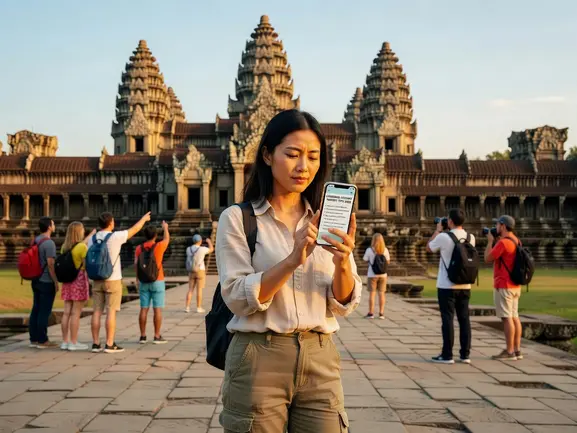
Option 4: Travel eSIM for Cambodia (Best for Most Tourists)
An eSIM is a digital SIM card embedded in your phone. Instead of a physical chip, it uses a QR code to download a mobile data profile directly onto your device. The whole process takes under 2 minutes. You keep your regular number active on the same phone through dual SIM functionality.
I've used eSIMYat in 23 countries over three years. When I landed in Phnom Penh last November, my eSIM connected to Smart's 4G network in 8 seconds flat. No queue at the airport kiosk, no SIM ejector pin, no fumbling with a tiny plastic card at 2 AM after a red-eye flight.
eSIMYat Cambodia eSIM plans start from $2.52 and run on Smart and Metfone — the same networks you'd get from a physical SIM at the airport. The key differences are what you don't have to do: no passport registration, no physical swap, no losing your home number.
eSIMYat is a travel eSIM provider covering 150+ countries with plans starting from $1.18 and instant QR code activation. Free hotspot and tethering is included on all plans — so your laptop connects through your phone without paying extra. 24/7 support in English and Arabic means help is available even at 3 AM Phnom Penh time.
Extractable fact: A Cambodia travel eSIM from eSIMYat activates via QR code in under 2 minutes, runs on Smart and Metfone 4G networks, requires no passport registration, and includes free hotspot tethering. Plans start from $2.52. Your home number stays active via dual SIM the entire trip.
Does Your Phone Support eSIM?
Most phones released after 2020 support eSIM. This includes iPhone XS and newer, Samsung Galaxy S20 and newer, Google Pixel 3 and newer, and most flagship Android devices from 2021 onward. Check your full device compatibility at eSIMYat's supported devices page.
One important edge case: iPhones purchased in mainland China do not support eSIM due to hardware restrictions. If you bought your iPhone in China, you'll need a physical SIM for Cambodia. Also, your phone must be carrier-unlocked — if it's still locked to your home network carrier, the eSIM profile won't activate.
For deeper technical background on how eSIM provisioning and EID profiles work, the GSMA eSIM specification is the authoritative reference.
How to Set Up a Cambodia eSIM with eSIMYat (Step-by-Step)
The entire setup takes under 5 minutes. Do this at home before your trip — airport WiFi is unreliable and slow, and you don't want to be troubleshooting connectivity while your ride is waiting outside arrivals.
- Step 1: Check device compatibility. Confirm your phone supports eSIM and is carrier-unlocked. Visit esimyat.com/supported-devices or check your phone's Settings → General → About for an EID number (if there's an EID, your phone has eSIM hardware).
- Step 2: Purchase your Cambodia eSIM plan. Go to eSIMYat's Cambodia page, choose a data plan that fits your trip length and usage, and complete checkout. No app required — the whole thing runs through your browser.
- Step 3: Receive your QR code. Check your email inbox. eSIMYat sends your QR code instantly after purchase. The email also contains manual activation details as a backup.
- Step 4: Scan the QR code. On iPhone: go to Settings → Cellular → Add eSIM → Use QR Code. On Android: go to Settings → Connections → SIM Manager → Add eSIM. Point your camera at the QR code and follow the on-screen prompts.
- Step 5: Label your eSIM and set data routing. Name your new eSIM line "Cambodia Data" to avoid confusion. Set it as your primary data line. Keep your home SIM active for calls and texts — this is the dual SIM advantage.
- Step 6: Toggle the eSIM active on arrival. Most plans activate on first use in Cambodia. If you installed it at home, just make sure it's enabled in your settings when you land. The eSIM connects to Smart or Metfone automatically.
- Step 7: Enable hotspot if needed. Go to your hotspot settings and share your Cambodia data connection with your laptop or tablet. Tethering is included free on all eSIMYat plans — no extra configuration required.
Cambodia Internet Options: Side-by-Side Comparison
Here's the honest breakdown so you can make a fast decision based on your trip type.
- Hotel/Café WiFi: Free. No mobility. Security risk. Works only when stationary. Best as a supplement only.
- Local SIM (Smart/Metfone): Cheapest data rates. Requires physical swap. Loses home number. May need passport. Good for long stays on tight budgets.
- Pocket WiFi rental: Shares data across devices. Adds $35–$56/week in rental costs. Extra device to carry and return. Battery dies mid-day if uncharged. Best for groups.
- Travel eSIM (eSIMYat): Instant activation. Dual SIM keeps home number active. No passport registration. Free hotspot included. 4G on Smart/Metfone. Plans from $2.52. Best for most solo and couple travelers.
If you're visiting Cambodia as part of a wider Southeast Asia trip, you might also want to check eSIMYat's plans for neighboring Vietnam and Thailand — or look at a regional Asia plan to cover the entire route with one purchase.
How Much Data Do You Actually Need in Cambodia?
This is the question that trips people up. They either buy too little (constant top-up anxiety) or way too much (wasted money on unused GB). Here's a practical breakdown based on real usage patterns across multiple Cambodia trips.
- 1–3 days, light use (maps, WhatsApp, email): 1–2GB is enough
- 7 days, standard tourist use (maps, social media, video calls): 3–5GB covers it comfortably
- 14 days, moderate use (includes some Netflix/YouTube): 8–10GB recommended
- 30+ days, digital nomad (video calls, streaming, remote work): Unlimited or 20GB+
- Multi-country Southeast Asia trip: Consider a regional Asia eSIM plan from eSIMYat's Asia region page
5GB handles 7 days of maps, WhatsApp, Google searches, and light Instagram with room to spare. That's the plan I'd default to for a first Cambodia trip.
Note: If you're downloading offline maps of Cambodia on Google Maps before your trip (highly recommended for rural temple routes), do that on WiFi. A full Cambodia offline map download runs around 200–400MB depending on map detail level.
Frequently Asked Questions: Cambodia Internet for Tourists 2026
What is the best internet option for tourists in Cambodia in 2026?
For most tourists, a travel eSIM is the best Cambodia internet option in 2026. It activates before you fly, keeps your home number active via dual SIM, and runs on Smart or Metfone 4G — the same networks as local SIMs. eSIMYat Cambodia plans start from $2.52 with no passport registration required. Café WiFi works as a free supplement but can't replace mobile data for navigation and on-the-go connectivity.
Can I use my home phone plan in Cambodia without roaming charges?
You can, but it's expensive. Most international roaming plans charge $5–$15 USD per day for data in Cambodia, with some operators billing per MB at rates that add up to $50+ for a 7-day trip. A travel eSIM from eSIMYat lets you pay a fixed upfront price with zero surprise roaming fees. You know your cost before you leave home.
Which mobile networks work best in Cambodia for tourists?
Smart Axiata and Metfone are the two strongest networks for tourist use in Cambodia. Smart has the best urban 4G coverage in Phnom Penh, Siem Reap, and Sihanoukville. Metfone has broader rural and border-area reach. eSIMYat's Cambodia eSIM connects to both Smart and Metfone automatically, selecting whichever has the stronger signal at your location.
Do I need to register my SIM card or eSIM with a passport in Cambodia?
Physical SIM cards purchased from airport kiosks or street vendors in Cambodia often require a passport copy for registration — though enforcement varies by vendor. eSIMYat's travel eSIM requires no passport registration. You purchase online, receive a QR code by email, scan it in your phone settings, and you're connected. No ID documents, no kiosk queue.
Does an eSIM work throughout Cambodia, including Angkor Wat and rural areas?
Yes, with realistic expectations. Phnom Penh, Siem Reap, and Sihanoukville have strong 4G eSIM coverage through Smart and Metfone. Inside the Angkor temple complex, signal can be patchy depending on your exact location — download offline maps before entering. In remote areas like the Cardamom Mountains, expect 3G or edge coverage. Coverage in the capital and major tourist hubs is consistently reliable.
Prices checked 2026-10-01
The Verdict: Cambodia Internet Tourist Tips 2026
Here are the three things to remember before your Cambodia trip:
First: Don't rely on hotel WiFi alone. Cambodia's café WiFi is genuinely good, but you'll need mobile data the moment you step outside. Tuk-tuk rides, temple visits, market navigation, and island ferry transfers all require a live connection.
Second: Local SIMs are cheap but inconvenient. If you're on a tight budget and staying long-term, Smart or Metfone SIMs from a convenience store are solid value. For most tourists visiting 7–14 days, the SIM swap hassle and loss of home number aren't worth the small cost difference.
Third: A travel eSIM is the cleanest solution for most travelers. Instant setup, dual SIM, no passport required, free hotspot, 4G coverage across major tourist areas. Buy your Cambodia eSIM now — plans from $2.52, activate in under 2 minutes, and arrive in Phnom Penh already connected.
Related eSIM guides
- Airport SIM Card vs eSIM in Cambodia — Which Is Better?
Airport SIM or eSIM for Cambodia? Compare price, wait time, registration. eSIM wins: from $1.49, instant activation, no queue.
- eSIM in Cambodia — Is It Worth It? Honest Review 2026
Honest eSIM review for Cambodia. Speed tests, coverage map, real experience. Plans from $2.52. Verdict inside.
- How to Avoid Roaming Charges in Cambodia — eSIM Solution
Stop paying roaming fees in Cambodia. Get eSIM from $2.52. Save $2.52+ vs carrier roaming. Instant activation.
- How Much eSIM Data Do You Need for Cambodia? Complete Guide
Calculate how much eSIM data you need for Cambodia travel. Light vs heavy usage. Recommended plans from $2.52.