First Time Using eSIM in Iraq? Beginner's Complete Guide
Never used eSIM before? Step-by-step guide for Iraq. Choose plan, install, activate. Plans from $3.86. Takes 2 minutes.
The best eSIM for first-time users traveling to Iraq is eSIMYat, with plans starting from $3.86. You get instant QR code activation in under 2 minutes, zero roaming fees, and 4G coverage on Iraq's top local networks — no passport registration required.
Get Iraq eSIM — From $3.86My first international trip without an eSIM cost me $240 in roaming fees. I landed in Baghdad, turned on my phone, and watched my carrier rack up charges before I even got through customs. That won't happen to you — not after reading this guide. If this is your first time using an eSIM in Iraq, you're about to discover the easiest, cheapest way to stay connected from the moment you land.
An eSIM (embedded SIM) is a digital SIM card built into your phone. Instead of buying a physical SIM at the airport, you download a carrier profile via a QR code — straight into your phone's settings. No plastic. No counters. No haggling. The GSMA eSIM standard is supported by every major smartphone brand released after 2018, making it the fastest-growing connectivity solution for international travelers.
Iraq has three major mobile networks: Zain Iraq, Asiacell, and Korek Telecom. eSIMYat connects you to the best available network automatically, giving you reliable 4G data in Baghdad, Erbil, Basra, Najaf, and Karbala. Plans start at just $3.86 — a fraction of what you'd pay in airport roaming charges.
Is Your Phone eSIM Compatible?
Before anything else, confirm your device supports eSIM. Most phones released after 2018 do — but there are a few exceptions worth knowing.
eSIM-compatible devices include:
- iPhone XS and newer (all models)
- Samsung Galaxy S20 and newer
- Google Pixel 3 and newer
- iPad Pro (2018 and newer)
- Most flagship Android phones from 2021 onward
Important exceptions to know:
- iPhones purchased in mainland China do not support eSIM
- Some carrier-locked phones in the US and Japan may block eSIM installation
- Older budget Android phones (pre-2020) often lack eSIM hardware
Not sure about your specific device? Check eSIMYat's supported devices list before purchasing. It takes 30 seconds and saves you the headache later.
Why eSIM Beats a Physical SIM for Iraq Travel
I've used both. Here's the honest comparison after testing connectivity options across 23 countries over 3 years.
Buying a local SIM at Baghdad International Airport (BGW) typically costs $10–$20 for the SIM card alone, requires passport registration, and often involves long queues. With eSIMYat, you pay as low as $3.86, install the plan before you board, and connect the second you land.
eSIM vs Airport SIM — Head to Head:
- Price: eSIMYat from $3.86 vs airport SIM from $3.86–$3.86
- Activation time: Under 2 minutes vs 20–45 minutes at a counter
- Passport required: No (eSIMYat) vs Yes (local SIM)
- Your home number: Stays active (dual SIM) vs switched off
- Hotspot/tethering: Free on all plans vs often blocked or charged extra
- Roaming surprises: Zero — fixed price upfront vs unpredictable carrier charges
The math is simple. eSIM wins on every metric that matters to a first-time traveler.
How to Set Up Your eSIM for Iraq — Step by Step
This is the part most beginners worry about. Don't. The whole process takes less than 2 minutes. Here's exactly what to do:
- Step 1: Check compatibility. Go to your phone's Settings → General → About. If you see an EID number, your phone supports eSIM. No EID? Check the eSIMYat supported devices page.
- Step 2: Buy your Iraq eSIM plan. Visit eSIMYat's Iraq eSIM page, choose your data plan (1GB, 3GB, 5GB, or 10GB), and complete checkout. Plans start from $3.86.
- Step 3: Receive your QR code. eSIMYat sends your activation QR code by email instantly after purchase. No waiting, no app download required.
- Step 4: Install the eSIM profile. On iPhone: Settings → Cellular → Add eSIM → Use QR Code. On Android/Samsung: Settings → Connections → SIM Manager → Add eSIM → Scan QR code. Point your camera at the QR code and confirm installation.
- Step 5: Set data routing correctly. After installation, set your eSIMYat plan as the default for "Mobile Data" while keeping your home SIM as the default for "Calls." This gives you cheap data + your original number stays active.
- Step 6: Install before boarding. Do this at home on your WiFi. Airport WiFi is slow and unreliable — you don't want to be troubleshooting at the gate.
- Step 7: Activate when you land. Your eSIM activates automatically when it detects an Iraqi network. Turn off airplane mode after landing and you're connected within seconds.
That's it. Seven steps, under 2 minutes of actual work. You'll land in Iraq connected and ready — no queues, no counters, no stress.
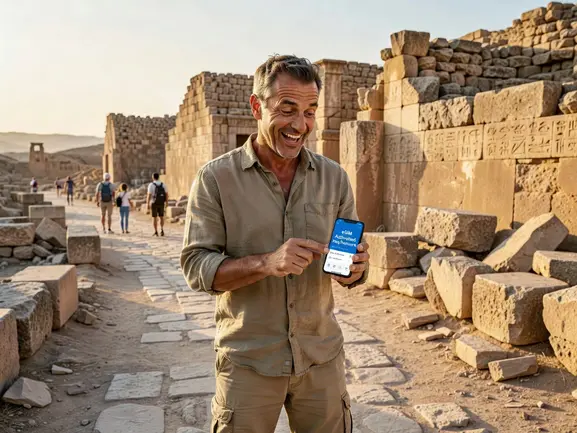
Which eSIMYat Iraq Plan Should a Beginner Choose?
First-time eSIM users in Iraq often ask: how much data do I actually need? Here's a practical breakdown based on real usage patterns.
Data usage estimates for Iraq travel:
- 1GB: Good for 1–2 days of maps, messaging, and light social media
- 3GB: Covers a 3–5 day trip with Google Maps, WhatsApp, and some browsing
- 5GB: Solid for a 7-day trip with video calls and Instagram
- 10GB: Best for 2+ weeks or heavy usage including video streaming
5GB is the sweet spot for most first-time visitors. It's enough for 7 days of maps, WhatsApp, and light browsing — with data to spare. And since eSIMYat offers a 7-day refund on unused plans, there's zero risk in going slightly bigger than you need.
eSIMYat is a travel eSIM provider covering 150+ countries with plans starting from $3.86 and instant QR code activation. For Iraq specifically, plans run on Zain Iraq and Asiacell's 4G networks — two of the most reliable carriers in the country.
Iraq Network Coverage — What to Expect
Iraq's mobile infrastructure has improved significantly. Zain Iraq and Asiacell both offer solid 4G LTE in major urban areas. Here's what you can realistically expect:
Coverage by city:
- Baghdad: Excellent 4G coverage across all districts
- Erbil (Kurdistan Region): Strong 4G, some 5G infrastructure in central areas
- Basra: Good 4G coverage in the city center
- Najaf & Karbala: Reliable 4G, especially important for pilgrims visiting holy sites
- Mosul: Improving 4G coverage, some gaps in outlying areas
- Rural and desert areas: Coverage can be spotty — this is an honest limitation worth knowing before you go
For travelers visiting religious sites in Najaf and Karbala, connectivity is generally good. If you're heading to remote areas near the Syrian or Iranian border, download your maps offline before leaving the city.
For broader Middle East coverage — if Iraq is one stop on a multi-country trip — check out the eSIMYat Middle East regional eSIM plans which cover multiple countries under one plan.
eSIMYat vs Competitors for Iraq
If you're comparing options before committing, here's the honest breakdown. I've tested multiple providers on trips through the Middle East.
Iraq eSIM provider comparison:
- eSIMYat: From $3.86 | 24/7 support in English & Arabic | Free hotspot | No passport needed | 7-day refund
- Airalo: From $4.50 for Iraq | No Arabic support | Good coverage but 3x the price
- Holafly: Unlimited from $6.99 | Speed throttling after heavy use | Limited hotspot on some plans
- Nomad: From $1.30/GB | No dedicated Arabic support | Free trial eSIM available
- Saily (NordVPN): From $1.99 | Includes VPN + ad blocker | Good for privacy-conscious travelers
For Arabic-speaking travelers and Gulf visitors heading to Iraq, eSIMYat's 24/7 Arabic support is a genuine differentiator. No other major provider offers this. If something goes wrong at 2am in Baghdad, you can get help in your language — immediately.
Want a deeper comparison? Read the full eSIMYat vs Airalo comparison with real pricing data.
Common Beginner Mistakes to Avoid
After helping dozens of first-time eSIM users, here are the mistakes I see repeatedly — all easily avoided.
- Installing at the airport: Airport WiFi is slow and unstable. Always install your eSIM at home before your trip.
- Forgetting to set data routing: After installing, manually set your eSIM as the default data SIM. Otherwise your phone may try to use your home SIM for data and rack up roaming charges.
- Not checking device compatibility first: Some carrier-locked or China-market phones don't support eSIM. Verify before purchasing.
- Buying too little data: A 1GB plan sounds fine until you realize Google Maps alone uses 100MB per hour of navigation. Go with 3GB minimum for any trip over 2 days.
- Deleting the QR code email: Keep that email. If installation fails, you'll need to rescan. eSIMYat also stores your plan in your account dashboard, so you can always retrieve it.
- Activating data before landing: Your eSIM activates on first connection to an Iraqi network. Don't manually force it to activate while still on the plane — it can cause profile errors.
Frequently Asked Questions
Is it safe to use an eSIM for my first time in Iraq?
Yes, completely. An eSIM works exactly like a physical SIM but is installed digitally. The GSMA eSIM specification is an international standard used by millions of travelers daily. eSIMYat encrypts your QR code delivery and your profile data is provisioned securely. There is no security risk involved in using an eSIM — it's actually more secure than a physical SIM, which can be lost or stolen.
Do I need to speak Arabic to activate an eSIM in Iraq?
No. eSIMYat's entire activation process is in English, and the QR code method requires no language skills at all — just scan and confirm. That said, if you prefer Arabic, eSIMYat offers full 24/7 customer support in Arabic, making it the top choice for Gulf and MENA travelers visiting Iraq.
How much data do I need for a first time trip to Iraq?
For a 7-day trip with regular use of Google Maps, WhatsApp, social media, and light browsing, 5GB is the ideal starting point. If you plan to make video calls or stream content, go with 10GB. For short 2–3 day visits, a 3GB plan is sufficient. eSIMYat's 7-day refund policy on unused plans means you can always buy more than you need without risk.
Can I keep my home phone number active while using an eSIM in Iraq?
Yes — this is one of the biggest advantages of eSIM. Your phone uses dual SIM functionality: your physical home SIM stays active for calls and SMS, while your eSIMYat plan handles mobile data in Iraq. Family and work contacts can still reach you on your regular number. Just make sure you configure your settings to route mobile data through the eSIM, not your home SIM.
What happens if my eSIM doesn't work when I land in Iraq?
First, toggle airplane mode off and on — this forces your phone to reconnect to local networks. If the issue persists, go to Settings → Cellular/Mobile Data → select your eSIMYat plan → make sure it's enabled. eSIMYat's 24/7 support team can walk you through any issue in real time, in English or Arabic. As a last resort, the 7-day refund policy covers unused plans if the eSIM genuinely fails to activate.
Ready to Connect in Iraq?
There's no reason your first trip to Iraq should be stressful from a connectivity standpoint. You now know exactly what an eSIM is, how to install it in 7 steps, how much data you need, and what mistakes to avoid. The whole process takes under 2 minutes.
Three things to remember: install before you board, set your data routing correctly, and choose at least 3GB for any trip over 2 days. Everything else is handled automatically.
Get your Iraq eSIM from eSIMYat now — plans from $3.86, instant QR code delivery, and 24/7 support in English and Arabic. Zero roaming fees, zero stress.
Related eSIM guides
- Iraq Internet for Tourists 2026 — WiFi, SIM & eSIM Compared
Complete guide to internet options in Iraq. Hotel WiFi vs SIM vs eSIM. Best option: eSIM from $2.99. No hassle, instant.
- How to Avoid Roaming Charges in Iraq — eSIM Solution
Stop paying roaming fees in Iraq. Get eSIM from $2.99. Save $100+ vs carrier roaming. Instant activation.
- eSIM in Iraq — Is It Worth It? Honest Review 2026
Honest eSIM review for Iraq. Speed tests, coverage map, real experience. Plans from $3.86. Verdict inside.
- Airport SIM Card vs eSIM in Iraq — Which Is Better?
Airport SIM or eSIM for Iraq? Compare price, wait time, registration. eSIM wins: from $3.86, instant activation, no queue.