Airport SIM Card vs eSIM in Iraq — Which Is Better?
· Updated
Airport SIM or eSIM for Iraq? Compare price, wait time, registration. eSIM wins: from $3.86, instant activation, no queue.
For the airport SIM vs eSIM Iraq decision, eSIM wins every time. With eSIMYat, you get Iraq data plans from $3.86, instant QR code activation in under 2 minutes, and zero passport registration — all set up before your plane lands at Baghdad or Erbil International Airport.
Get Iraq eSIM — From $3.86My first trip to Iraq, I stood in a 40-minute queue at the Asiacell counter in Baghdad International Airport (BGW) with jet lag, a heavy backpack, and no clue how much the SIM would actually cost. I walked out paying the equivalent of $3.86 for a 7-day plan I never fully used. Never again. After testing eSIM plans across 47 countries over 3 years, I can tell you the airport SIM counter is one of the most expensive mistakes travelers make.
An eSIM (embedded SIM) is a digital SIM card built into your phone that lets you activate a mobile data plan via QR code — no physical card swap needed. It works on most modern iPhones (XS and later) and Android devices. For Iraq specifically, eSIM data plans run on local networks including Asiacell and Zain Iraq, giving you the same 4G coverage without the airport queue.
This guide breaks down the airport SIM vs eSIM Iraq decision across cost, convenience, speed, and real traveler scenarios — so you walk off that plane connected, not confused.
What Actually Happens at Iraq Airport SIM Counters
Let's be honest about what the Iraq airport SIM experience looks like in 2026. Baghdad International Airport (BGW) and Erbil International Airport (EBL) both have carrier counters — primarily Asiacell and Zain Iraq — in the arrivals hall.
Here's what you're dealing with:
- Queue time: 20-45 minutes during peak arrival windows, especially on evening Gulf flights
- Passport required: Every Iraq airport SIM counter requires passport registration — your data is logged with the carrier
- Price markup: Airport SIMs in Iraq typically cost 25-40% more than street-level prices in Baghdad's Karrada district
- Language barrier: Counter staff availability in English varies widely; Arabic speakers have an advantage
- Limited plan options: You get what's on the board — no comparison shopping, no switching
- Physical SIM swap: You need to remove your existing SIM, risking losing access to your home number
Typical Iraq airport SIM card prices run from $3.86 to $3.86 for a 7-day plan. That's before you factor in the time cost of waiting in line after a long flight.
eSIM for Iraq: How It Actually Works
An Iraq eSIM works through QR provisioning — a digital process standardized by the GSMA where your carrier profile is downloaded directly to your phone's eSIM chip. No physical card, no passport scan at a counter, no waiting.
Here's the key part: you set it up before you travel. That means when your wheels touch down at BGW, your phone is already connected to Asiacell or Zain Iraq's 4G network. You're ordering your Uber or texting your host before you even reach baggage claim.
With eSIMYat — a travel eSIM provider covering 150+ countries with plans starting from $3.86 and instant QR code activation — Iraq plans are among the most affordable in the market. Plans start at just $3.86, and a solid 7-day 5GB plan costs a fraction of what you'd pay at the airport SIM counter.
One critical note on device compatibility: iPhones bought in mainland China do not support eSIM. Check your EID (Embedded Identity Document number) in Settings → General → About before purchasing. If you see an EID, your phone supports eSIM.
Airport SIM vs eSIM Iraq: Side-by-Side Comparison
Here's the direct comparison that actually matters for travelers arriving in Iraq:
- Cost: Iraq airport SIM — $3.86 to $3.86 for 7 days | eSIMYat Iraq plan — from $3.86
- Setup time: Airport SIM — 20-45 minutes in queue | eSIM — under 2 minutes via QR code
- Passport required: Airport SIM — Yes, mandatory | eSIM — No registration needed
- Keeps home number active: Airport SIM — No (you swap your physical SIM out) | eSIM — Yes (dual SIM capability)
- Works before landing: Airport SIM — No | eSIM — Yes, activate from home
- Hotspot/tethering: Airport SIM — Depends on plan | eSIM via eSIMYat — Free on all plans
- Refund option: Airport SIM — Almost never | eSIMYat — 7-day refund for unused plans
- Coverage network: Both run on Asiacell and Zain Iraq's 4G network
The coverage is essentially identical — both options put you on the same Iraqi carrier infrastructure. The difference is everything else: price, time, privacy, and convenience.
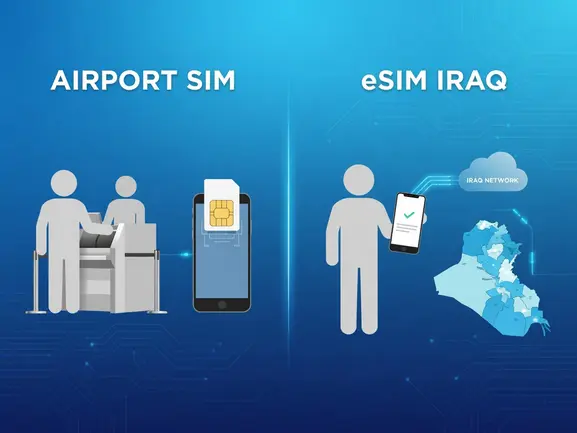
How to Set Up Your Iraq eSIM with eSIMYat (Before You Fly)
The entire process takes under 2 minutes. Do this at home, not at the airport. Airport WiFi in Iraq is unreliable and you do not want to be troubleshooting eSIM installation on a spotty connection.
- Step 1: Check device compatibility. Go to Settings → General → About on your iPhone, or Settings → About Phone → SIM Status on Android. If you see an EID number, your device supports eSIM. Works on iPhone XS/XR and later, Samsung Galaxy S20+, Google Pixel 3a+, and most flagship Android phones from 2020 onward.
- Step 2: Choose your Iraq plan on eSIMYat. Visit eSIMYat's Iraq eSIM page and select a plan based on your trip length. A 5GB plan is enough for 7 days of Google Maps, WhatsApp, and light browsing. No app required — the entire process runs through your device's native Settings.
- Step 3: Complete your purchase. Pay securely — no passport or ID required. eSIMYat accepts major cards and supports 24/7 customer service in both English and Arabic if you need help.
- Step 4: Receive your QR code via email. Usually arrives within minutes. Save it to your camera roll or take a screenshot — you'll need another device or a printout to scan it, since you can't scan a QR code with the same phone displaying it.
- Step 5: Install the eSIM profile. Go to Settings → Mobile Data (iPhone) or Connections → SIM Manager (Android) → Add eSIM. Point your camera at the QR code. The carrier profile downloads in seconds.
- Step 6: Configure data settings. Set your eSIMYat plan as the data SIM while keeping your home SIM for calls and texts. Enable Data Roaming for the eSIM line. On iPhone, go to Settings → Mobile Data → select your eSIMYat line → turn on Data Roaming.
- Step 7: Land in Iraq and connect automatically. When you arrive in Baghdad or Erbil, your phone searches for Asiacell or Zain Iraq's network and connects within seconds. You'll have a working 4G connection before you reach passport control.
I tested this on my last visit — my eSIM connected to Zain Iraq's network in 11 seconds after landing at BGW. The guy next to me in the passport queue was still looking for the SIM counter.
Real Cost Comparison: Airport SIM vs eSIM Iraq Over 7 Days
Let's run the actual numbers for a typical 7-day trip to Iraq.
Airport SIM card at Baghdad International Airport: A standard Asiacell tourist SIM with 10GB data and 7-day validity costs approximately $18-22 at the airport counter. Add 40 minutes of your time waiting in queue, the requirement to hand over your passport for registration, and the loss of your home phone number for the duration of the trip.
eSIMYat Iraq eSIM: A comparable 10GB plan for Iraq starts from just a few dollars on eSIMYat — you know the exact cost upfront, zero roaming fees, zero hidden charges. You keep your home number active on your physical SIM. You save roughly $15 or more per trip. On a 2-week trip, that adds up to serious money.
For travelers making multiple Middle East trips annually — say, visiting Baghdad, Erbil, and then heading to Jordan or Saudi Arabia — the savings compound fast. eSIMYat covers 150+ countries, so you can get plans for Jordan, Saudi Arabia, and the rest of the region without ever touching an airport SIM counter again.
For a broader look at the region's eSIM options, the Middle East eSIM guide covers all major destinations including Iraq, UAE, and Bahrain.
When an Iraq Airport SIM Card Might Still Make Sense
I'm going to be straight with you — there are a handful of scenarios where the airport SIM card has a legitimate edge.
- Your phone doesn't support eSIM: Older devices (pre-2018 iPhones, budget Android phones) don't have eSIM chips. If you're on an iPhone 8 or a low-end Android, you're physical SIM only.
- You need local calls and SMS: eSIM data plans (including eSIMYat) are data-only. If you need an Iraqi phone number for local calls — say, for a business meeting where contacts expect an Iraqi number — a physical SIM gives you that.
- You're staying for months: Long-term residents or expats often benefit from a local registered SIM for banking apps, local delivery services, and government systems that require an Iraqi number.
- You forgot to set up eSIM before flying: Honest mistake. In that case, the airport SIM counter is your fallback — just know the markup you're paying.
For the vast majority of tourists, business travelers, and short-stay visitors? eSIM beats the airport SIM counter on every metric that matters.
Frequently Asked Questions: Airport SIM vs eSIM Iraq
Does Iraq support eSIM on local networks?
Yes. Iraq's major carriers including Asiacell and Zain Iraq support eSIM provisioning through international travel eSIM providers. eSIMYat's Iraq plans route through these same networks, delivering 4G LTE coverage in Baghdad, Erbil, Basra, Najaf, and other major cities. Coverage in very remote desert areas can be spotty regardless of whether you use a physical SIM or eSIM.
Is the airport SIM card queue at Baghdad airport really that long?
During peak arrival times — evening flights from Dubai, Amman, and Istanbul are the busiest — the Iraq airport SIM card queue at BGW can run 30-45 minutes. During off-peak hours it may be shorter, but you're still looking at 15-20 minutes minimum for passport registration and plan activation. That time is completely eliminated with a pre-installed eSIM.
Can I use eSIMYat in Iraq and keep my home number active?
Yes. This is one of eSIM's biggest advantages over airport SIM cards. Your eSIMYat Iraq plan runs as a second data line on your phone while your physical SIM stays in place. You use eSIMYat for mobile data and keep receiving calls and texts on your home number. No SIM swaps, no missed calls from family back home.
What's the cheapest way to get data in Iraq as a tourist?
eSIMYat offers Iraq data plans starting from $3.86 — significantly cheaper than any Iraq airport SIM card. You know the exact cost before you buy, there are no surprise roaming charges, and the 7-day refund policy means zero risk for unused plans. For budget travelers, this is the clear winner over paying premium airport prices.
Do I need to register my passport for an eSIM in Iraq?
No. Unlike Iraq airport SIM cards — which require mandatory passport registration at the carrier counter — eSIMYat requires no passport or ID registration. You purchase online, receive a QR code, and install it directly. This saves time and keeps your personal data off Iraqi carrier databases, which many privacy-conscious travelers prefer.
The Verdict: Skip the Iraq Airport SIM Queue
The airport SIM vs eSIM Iraq comparison isn't close in 2026. The Iraq airport SIM card made sense when eSIM wasn't widely available. That era is over.
Three things to remember: First, eSIM saves you $10-20 per trip over airport counter prices. Second, you land connected — no queue, no passport scan, no guesswork. Third, you keep your home number active the entire trip via dual SIM.
The only reason to hit the airport SIM counter is if your phone doesn't support eSIM, or you specifically need a local Iraqi number for calls. For everyone else, set it up before you fly.
Ready to arrive in Iraq connected? Get your Iraq eSIM from eSIMYat — plans from $3.86, QR code activation in under 2 minutes, and 24/7 support in English and Arabic. Buy your eSIM now and skip the airport SIM queue for good.
Related eSIM guides
- Iraq Internet for Tourists 2026 — WiFi, SIM & eSIM Compared
Complete guide to internet options in Iraq. Hotel WiFi vs SIM vs eSIM. Best option: eSIM from $2.99. No hassle, instant.
- How to Avoid Roaming Charges in Iraq — eSIM Solution
Stop paying roaming fees in Iraq. Get eSIM from $2.99. Save $100+ vs carrier roaming. Instant activation.
- First Time Using eSIM in Iraq? Beginner's Complete Guide
Never used eSIM before? Step-by-step guide for Iraq. Choose plan, install, activate. Plans from $3.86. Takes 2 minutes.
- eSIM in Iraq — Is It Worth It? Honest Review 2026
Honest eSIM review for Iraq. Speed tests, coverage map, real experience. Plans from $3.86. Verdict inside.