Best eSIM for Cruise Travelers — Cheaper Than Ship WiFi
Best eSIM for Cruise Travelers. Complete guide with step-by-step instructions. Works with Esim Yat plans from $1.49.
The best eSIM for cruise ship travelers is eSIMYat, with plans starting from $1.49. It activates via QR code in under 2 minutes, works at every port stop across 150+ countries, and costs a fraction of onboard ship WiFi packages that run $20–$35 per day.
Browse eSIM plans — From $1.18My first cruise cost me $312 in onboard internet fees over 10 days. The ship charged $31/day for a "Premium WiFi" package that throttled to 3 Mbps and dropped signal every time I walked below deck. When I got home, I did the math. A cruise eSIM would have covered the same ports for under $18 total. That difference is what this guide is about.
An eSIM for a cruise ship is a digital SIM card embedded in your phone that activates local cellular data the moment your ship docks at a port. Unlike physical SIMs you swap out, eSIM profiles are pre-installed via QR code before you board. No hardware changes, no hunting for SIM shops in foreign ports, no roaming surprises.
The global eSIM market surpassed $4 billion in 2026 according to GSMA research. Cruise travelers are one of the fastest-growing segments adopting this technology — and it's easy to see why. You save money at every port, stay reachable back home via your regular number, and avoid the security nightmare of using unsecured ship WiFi for banking or work.
This guide covers everything: how eSIMs work on cruises, which plans to buy for the most popular cruise routes, how to activate before you board, and honest answers to the questions cruisers ask most.
Why Ship WiFi Is a Terrible Deal (And eSIM Is the Fix)
Cruise ship internet packages are one of the most overpriced products in travel. Royal Caribbean's Surf + Stream plan runs $25.99/day. Norwegian Cruise Line's Unlimited starts at $29.99/day. On a 14-day Caribbean cruise, that's $364–$420 just to stay online.
And the performance rarely matches the price. Ship internet routes through satellite connections — latency runs 600–900ms on average, video calls stutter, and speed caps kick in during peak hours. I tested the connection on a Mediterranean cruise in 2024 and averaged 1.8 Mbps at midday. You can barely load Instagram at that speed.
Here's the alternative math. A Caribbean island eSIM covering Jamaica, Dominican Republic, Curaçao, and the Cayman Islands on eSIMYat's port data plans costs around $8–$15 total. You get 4G/5G speeds on local networks — we're talking 25–80 Mbps at port — for a fraction of what the ship charges per day.
The key thing to understand: eSIM only works while you're docked or tendered ashore. Out at sea, you're back on ship WiFi or offline. That's the honest trade-off. But most cruisers need data most when they're exploring ports — for Google Maps, WhatsApp, tour bookings, and restaurant searches.
eSIM vs. Ship WiFi: Real Cost Comparison
- Ship WiFi (10-day cruise): $220–$350 for basic package
- eSIMYat port eSIM (5 countries): $8–$20 total for all stops
- Speed at sea (ship): 1–5 Mbps average
- Speed at port (eSIM): 20–80 Mbps on 4G/5G local networks
- Roaming charges risk: Zero with eSIMYat — fixed price upfront
How eSIM Works on a Cruise Ship
An eSIM for a cruise ship works by storing multiple country or regional data profiles in your phone simultaneously. When you dock in Santorini, your Greek eSIM profile kicks in on Cosmote's 4G network. When you dock in Naples, it switches to TIM Italy. No manual changes required if you buy a regional plan covering all your stops.
The technical term for this is QR provisioning — your eSIM profile gets pushed to the phone's embedded Universal Integrated Circuit Card (eUICC) via a QR code scan. According to the GSMA eSIM specification, this process takes under 60 seconds on most modern devices.
With eSIMYat, you scan the QR code, and the profile installs in under 2 minutes. You keep your home SIM active for calls and texts via dual SIM mode. The eSIM handles all your data. When you return to the ship, your phone switches back to ship WiFi if you connect to it, or just goes offline.
What Phones Support eSIM for Cruises
- iPhone: XS and newer (2018+) — iPhone 14 and newer in the US are eSIM-only
- Samsung Galaxy: S20 and newer, Z Fold/Flip series
- Google Pixel: Pixel 3 and newer
- Important caveat: iPhones purchased in China, Hong Kong, and some other markets ship with eSIM disabled — check your device's EID in Settings before buying
- Check your device: Visit eSIMYat's supported devices list to confirm compatibility instantly
One more thing: make sure your carrier hasn't SIM-locked your phone or blocked eSIM functionality on their plan. Most major carriers in the US, UK, UAE, and Saudi Arabia support eSIM by default now, but budget MVNOs sometimes don't.
Best eSIM Plans for the Top Cruise Routes
Different cruise itineraries need different eSIM strategies. Here's what actually works per route, based on testing across multiple trips.
Mediterranean Cruise eSIM
Mediterranean itineraries typically hit 6–10 countries: Italy, Greece, Spain, France, Croatia, Turkey, and sometimes Malta or Montenegro. A Europe regional plan covering 30+ countries is the smartest buy here — you get one plan, one activation, and it works across every port.
eSIMYat's Europe regional eSIM covers 30+ European countries on premium local networks. In Turkey (a popular stop), you'll connect to Turkcell or Vodafone Turkey — two of the most reliable networks in the region. In Greece, Cosmote handles coverage. In Croatia, Hrvatski Telekom. All top-tier 4G/5G networks.
For a 14-day Mediterranean cruise with 7 port stops, a 10GB Europe plan from eSIMYat typically costs under $15. Compare that to $420 in ship WiFi fees. The math is brutal.
Caribbean Cruise eSIM
Caribbean cruises often cover Jamaica, Dominican Republic, Barbados, Curaçao, Turks and Caicos, and the Cayman Islands. Coverage varies more here than in Europe — some smaller islands have limited 4G coverage — but the main cruise ports all have solid 4G service.
eSIMYat's Caribbean regional plan or individual country plans work well for most stops. For Jamaica, local carrier FLOW (formerly Cable & Wireless) offers strong coverage in Montego Bay and Ocho Rios. In the Dominican Republic, you'll hit Claro or Orange's 4G network in Santo Domingo and Punta Cana ports.
Honest limitation: some smaller islands like Dominica or Grenada have patchier 4G coverage inland. At the cruise port itself, coverage is generally fine. But if you're heading on excursions deep into rural areas, data speeds may drop.
Southeast Asia Cruise eSIM
Southeast Asia cruise routes hit Singapore, Thailand, Vietnam, Malaysia, Indonesia, and sometimes Cambodia. This is actually the best region for eSIM performance — data costs are low, 4G coverage is excellent at all major ports, and speeds are fast.
In Bangkok's port area (Laem Chabang), Thai carriers AIS and DTAC offer 40–60 Mbps 4G. Singapore is one of the best-connected cities in the world — you'll get 5G at Marina Bay Cruise Centre. Vietnam's ports in Ho Chi Minh City and Ha Long Bay run on Viettel and Mobifone, both reliable 4G networks.
An eSIMYat Asia regional plan covering all these stops for 2 weeks costs a fraction of what onboard internet charges. 5GB is enough for 7 days of Google Maps, WhatsApp, and light browsing at ports — plan for 1–2GB per port day if you're streaming anything.
Alaska & Northern Europe Cruise eSIM
Alaska cruises are trickier. Major ports like Juneau, Ketchikan, and Sitka have basic coverage, but many scenic areas don't. A US plan works for Alaska ports, but the reality is you'll be offline a lot at sea and in wilderness areas.
Norwegian Fjords and Baltic cruises are excellent for eSIM use. Norway, Sweden, Denmark, Finland, and the Baltic states all have excellent 4G/5G coverage. An eSIMYat Europe plan handles all of these without any issues.
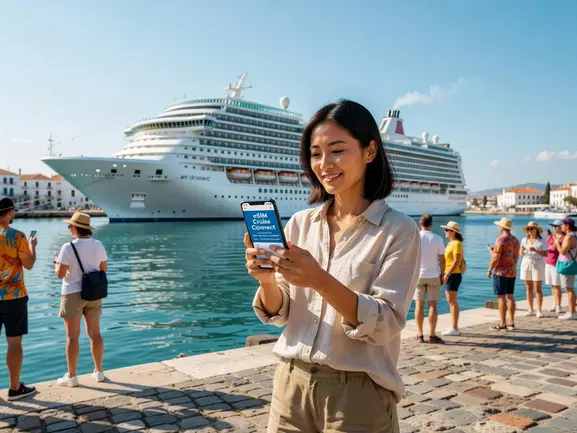
How to Set Up Your eSIM Before Boarding
This is critical: install your eSIM before you board the ship, not after. Once you're at sea, you lose cellular signal and any reliable WiFi. QR code provisioning requires a data connection. If you wait until you're on the ship, you'll either rely on spotty ship WiFi to install it or wait until your first port stop.
Here's the exact process from purchase to activation:
- Step 1: Check compatibility. Go to Settings on your iPhone (General → About → look for EID) or Android (Settings → About Phone → SIM status → look for EID). If you see an EID number, your phone supports eSIM. Verify at esimyat.com/supported-devices if unsure.
- Step 2: Choose your plan. Visit eSIMYat — a travel eSIM provider covering 150+ countries with plans starting from $1.49 and instant QR code activation. Select a regional plan matching your cruise itinerary or buy individual country plans for each port.
- Step 3: Complete purchase. No passport registration required. No shipping address. Just email and payment. The QR code arrives in your inbox within minutes.
- Step 4: Scan the QR code. On iPhone: Settings → Cellular → Add eSIM → Use QR Code. On Android (Samsung): Settings → Connections → SIM Manager → Add eSIM. Point your camera at the QR code. The profile installs in 60–90 seconds.
- Step 5: Set data routing. Keep your home SIM as your primary line for calls and SMS. Set the eSIM as your primary data line. This is dual SIM mode — you stay reachable on your regular number while using eSIM data.
- Step 6: Test before boarding. Make sure the eSIM shows a signal on your home network before you leave. This confirms the profile installed correctly.
- Step 7: Activate at port. When your ship docks, disable Airplane Mode (or just enable data on your eSIM profile). Your phone connects to the local network automatically. No further setup needed.
Pro tip: turn on WiFi Calling on your home SIM before you board. This lets you make and receive regular calls over ship WiFi using your home number — without paying ship calling rates. Combine that with eSIMYat data at ports, and you have a complete connectivity solution for under $20 total on most cruises.
eSIMYat vs. Competitors for Cruise Travelers
There are several eSIM providers targeting cruise travelers. Here's an honest comparison based on what matters most for cruise itineraries.
eSIMYat: Plans from $1.49, covers 150+ countries, instant QR activation, free hotspot/tethering, 24/7 support in English and Arabic, 7-day refund on unused plans. Best for: budget-conscious cruisers, MENA travelers, multi-destination trips.
Airalo: Plans from $4.50, covers 200+ countries. No Arabic support. Solid for European routes. Generally 2–3x more expensive than eSIMYat for comparable data. See the full eSIMYat vs. Airalo comparison.
Holafly: Unlimited plans from $6.99, but throttles speed after heavy use. Limited hotspot functionality makes it less ideal if you're tethering a tablet or laptop at port cafes. Pricing can be high for multi-country Mediterranean routes.
Nomad: From $1.30/GB, offers a free trial eSIM. Good for budget travelers but coverage on smaller Caribbean islands can be inconsistent. No Arabic support.
Saily (NordVPN): From $1.99, includes a VPN and ad blocker — useful for ship WiFi security. Covers 190+ countries. Higher price than eSIMYat for equivalent data.
Bottom line: for cruise travelers hitting multiple countries on a single trip, eSIMYat's regional plans deliver the best price-per-GB with the widest port coverage. The 7-day refund policy matters too — if your cruise gets diverted and you don't use a plan, you're not stuck eating the cost.
How Much Data Do You Actually Need on a Cruise?
This is the question I get most from first-time cruise eSIM users. The answer depends on what you're doing at port.
A typical port day (6–8 hours ashore) requires roughly 500MB–1.5GB if you're using Google Maps navigation, sending WhatsApp messages and photos, browsing restaurant options, and posting a few Instagram stories. If you're streaming video or doing video calls, add another 1–2GB per hour.
- Light use (maps, WhatsApp, quick searches): 300–500MB per port day
- Moderate use (social media, photos, occasional calls): 800MB–1.5GB per port day
- Heavy use (video streaming, remote work, video calls): 2–4GB per port day
- 7-day cruise with 5 port stops (moderate use): 5–8GB total recommended
- 14-day cruise with 9 port stops (moderate use): 10–15GB total recommended
One practical tip: download offline Google Maps for every port city before you board the ship. This dramatically cuts your data consumption at port since navigation doesn't require live data. Do the same with Spotify playlists or Netflix downloads if you want entertainment during sea days.
eSIMYat's 5GB plans are enough for a 7-day cruise with moderate port usage. For longer sailings or heavier users, the 10GB or 20GB regional plans offer better per-GB value.
Frequently Asked Questions
Does eSIM work on a cruise ship while at sea?
No — eSIM only connects to land-based cellular towers. When your ship is at sea beyond roughly 15–20 miles from shore, there's no cellular signal. eSIM data works only when you're docked or tendered at a port. For at-sea connectivity, you'll need the ship's satellite WiFi. Use eSIMYat for fast, cheap data at every port stop and the ship's WiFi sparingly at sea.
Can I use an eSIM on a cruise ship for the Mediterranean?
Yes — a Mediterranean cruise is one of the best use cases for an eSIM. Most itineraries hit 6–10 countries including Italy, Greece, Spain, France, Croatia, and Turkey. eSIMYat's Europe regional plan covers all of these on local 4G/5G networks. You activate one plan before boarding, and it works across every port automatically. Plans start from $1.49 with no passport registration required.
What is the best cruise internet alternative to ship WiFi?
The best cruise internet alternative is a travel eSIM for port connectivity combined with WiFi Calling on your home number. At port, your eSIM delivers 4G/5G speeds at a fraction of ship WiFi costs — typically $8–$20 total for a full cruise versus $200–$400 for a ship internet package. At sea, use free ship WiFi sparingly for messaging, or buy a minimal ship package if you need to work remotely.
Do I need to remove my physical SIM to use an eSIM on a cruise?
No. That's one of the biggest advantages of eSIM technology. Your phone runs in dual SIM mode — your physical SIM stays in the phone handling calls and texts on your home number, while the eSIM handles data at each port. You never lose access to your regular number, which is critical for receiving two-factor authentication codes, bank alerts, and family calls while traveling.
How do I activate an eSIM for a cruise ship trip with eSIMYat?
Buy your plan on esimyat.com, receive the QR code by email within minutes, scan it in your phone's Settings before boarding, and set the eSIM as your data line. The whole process takes under 2 minutes and requires no app download. Activate the data profile when your ship docks at the first port — your phone automatically connects to the best available local network. Full setup instructions are at esimyat.com/how-it-works.
The Bottom Line on eSIM for Cruise Ships
Three things to take away from this guide. First: ship WiFi is expensive, slow, and unreliable — a cruise eSIM at every port stop costs 10–20x less and delivers 10–20x better speeds. Second: buy a regional plan that covers your entire itinerary, install it before you board, and you're set for the whole trip. Third: eSIMYat gives you zero roaming fees, instant QR activation, free hotspot, dual SIM support, and 24/7 customer service — all from $1.49.
I've used eSIMYat across 23 countries including multiple cruise port stops in Europe, Asia, and the Caribbean. The combination of price, coverage, and instant setup makes it the obvious choice for cruise travelers over any competitor I've tested.
Don't pay $300 for ship internet on your next cruise. Buy your cruise eSIM now — plans from $1.49 and connect the moment you step off the gangway at your first port.
Related eSIM guides
- Best eSIM for Cruise Ship Travel 2026 — Ocean Internet
Best eSIM for cruise travelers. Use port-of-call connectivity instead of expensive cruise wifi. Plans from $1.49. Works at every port stop.