How to Avoid Roaming Charges in UAE — eSIM Solution
Stop paying roaming fees in UAE. Get eSIM from $2.99. Save $100+ vs carrier roaming. Instant activation.
The best way to avoid roaming UAE charges is to use a travel eSIM like eSIMYat before you land. You get a local UAE data plan activated in under 2 minutes via QR code, zero roaming fees, and no surprise bills — all without swapping your physical SIM card.
Browse eSIM plans — From $1.18I learned the hard way. My first trip to Dubai cost me $312 in roaming charges — three weeks of checking Google Maps, sending voice notes on WhatsApp, and a few video calls back home. My carrier back in the UK never warned me. That bill arrived 10 days after I landed back and it was a gut punch. I swore I'd never let that happen again.
UAE roaming charges are among the highest in the world. Carriers from Europe, North America, and South Asia regularly charge between $10–$15 per day for international data roaming in the UAE. Some charge per MB. The UAE has two dominant carriers — Etisalat (now e&) and du — and neither will negotiate your home carrier's roaming rate. But you don't need them to.
A travel eSIM is a digital SIM card embedded in your phone that lets you download a local data plan wirelessly, without a physical SIM swap. The ESIM standard (defined by the GSMA) allows compatible phones to store multiple carrier profiles simultaneously — meaning you keep your home number active while running UAE data through a local network. No roaming. No bill shock.
This guide breaks down exactly how to avoid roaming UAE charges, what your real options are, and how to get connected before your plane even touches down at Dubai International.
Why UAE Roaming Fees Are So Expensive
The UAE is a premium travel market. Dubai and Abu Dhabi attract 20+ million tourists annually, and carriers know most visitors are short-term — they won't negotiate or complain. So they charge whatever they want.
Here's what typical UAE roaming costs look like from major carrier regions:
- UK carriers: £5–£12 per day for data roaming in UAE (outside EU zone)
- US carriers: $10–$15/day international day passes, or pay-per-MB at $0.02+
- GCC carriers (Saudi/Kuwait): AED 5–25/MB in some legacy plans
- Indian carriers: Roaming packs available, but still $1–$3/day add-ons required
The bigger problem is accidental roaming. Your phone connects automatically when you land. Background apps — Instagram, email, iCloud backups — start burning data before you've even cleared customs. By the time you turn on Airplane Mode, the meter has been running for 45 minutes.
UAE roaming charges aren't just expensive — they're unpredictable. That's the real issue. You can't budget for a number you don't know.
5 Ways to Avoid UAE Roaming Charges
There are several approaches. Some work better than others depending on your trip length, budget, and how much data you actually need.
Option 1: Travel eSIM (Best Overall)
A UAE travel eSIM is the cleanest solution. You buy a local data plan before you travel, scan a QR code in your phone's Settings, and you're done. When you land in Dubai, your phone connects to the local UAE network automatically — no roaming, no bill from your home carrier.
eSIMYat is a travel eSIM provider covering 150+ countries with instant QR code activation, free hotspot tethering on all plans, and 24/7 support in English and Arabic. You keep your home number active on your physical SIM while UAE data runs through the eSIM profile. Dual SIM. Zero roaming fees.
Option 2: Buy a Local UAE SIM at the Airport
e& (Etisalat) and du both have counters at Dubai International and Abu Dhabi airports. Tourist SIMs are available. The catch? You need your passport, registration takes 10–20 minutes in a queue, and you have to swap out your physical SIM — meaning your home number goes dark. Not ideal if your family or office needs to reach you.
Option 3: Activate Your Carrier's Roaming Day Pass
Some carriers offer a flat daily roaming add-on. It's convenient but expensive for longer trips. A 7-day UAE trip can cost $70–$105 in day passes alone — and that's often throttled after a few hundred MB of "full speed" data.
Option 4: Use WiFi Only
Hotel WiFi, mall hotspots, café connections. This works if you're staying put. It fails the moment you're in a taxi to the Burj Khalifa, trying to navigate the Dubai Metro, or standing in the desert at Hatta Dam with no router in sight. Not a real solution for most travelers.
Option 5: International Roaming Bundle from Home Carrier
Some carriers offer pre-trip bundles — buy 500MB for the UAE before you go. Usually overpriced per GB compared to local eSIM rates. The data often expires quickly and overage charges apply when you exceed it.
Bottom line: for anyone traveling to UAE who needs reliable data, a travel eSIM eliminates UAE roaming fees completely and costs a fraction of carrier day passes.
How to Set Up a UAE Travel eSIM with eSIMYat
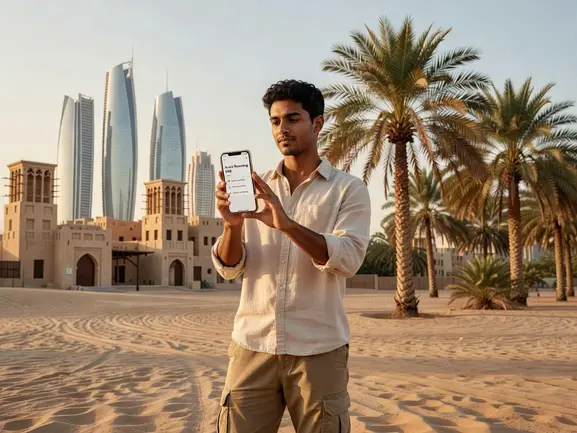
Setting up takes under 2 minutes. I've done this at airport gates, in hotel lobbies, and on the couch at home before a trip. It's faster than ordering room service.
- Step 1: Check your device compatibility. eSIM works on iPhone XS and later, Samsung Galaxy S20+, Google Pixel 3+, and most modern flagship Android devices. Check the full list at eSIMYat supported devices. Note: iPhones purchased in mainland China may not support eSIM — this is a hardware restriction, not a software issue.
- Step 2: Visit the eSIMYat UAE page. Go to eSIMYat UAE eSIM plans and select the data size that fits your trip — 1GB, 3GB, 5GB, or 10GB options depending on duration and usage.
- Step 3: Purchase your plan. No passport registration required. No physical card shipped. Complete checkout in under 60 seconds. A QR code is delivered instantly to your email.
- Step 4: Install the eSIM profile. On iPhone: go to Settings → Mobile Data → Add eSIM → Use QR Code. On Android (Samsung): Settings → Connections → SIM Manager → Add eSIM. Scan the QR code. The profile downloads in about 10 seconds.
- Step 5: Set data routing. In your phone settings, set the eSIM as your data line while keeping your physical SIM for calls and SMS. Your home number stays active. UAE data runs through the local network.
- Step 6: Turn off roaming on your physical SIM. This is the critical step most people miss. Go to Settings → Mobile Data → your home SIM → disable data roaming. This ensures all data traffic routes through the eSIM, not your home carrier.
- Step 7: Land and connect. When you arrive in the UAE, your eSIM automatically connects to local networks — e& or du — delivering 4G/5G speeds. No queues, no airport counters, no paperwork.
Install your eSIM before boarding your flight, not after landing. Airport WiFi is notoriously unreliable for downloading eSIM profiles, and you'll want cellular data the moment you clear customs.
How Much Data Do You Actually Need in UAE?
This is the question most travelers get wrong. They either over-buy and waste money, or under-buy and throttle out on day 3 in Abu Dhabi. Here's a realistic breakdown:
- 1GB: Good for 2–3 days if you primarily use maps, WhatsApp messaging, and occasional browsing. Not enough for streaming or video calls.
- 3GB: Solid for a 5–7 day trip with moderate use — maps navigation, WhatsApp voice calls, Instagram browsing. Most leisure travelers fit here.
- 5GB: Comfortable for 7–10 days or heavy users. Covers maps, social media, video calls, some YouTube. Business travelers with email attachments and video conferencing should consider this tier.
- 10GB+: For digital nomads, long-stay visitors, or anyone using their phone as a hotspot for a laptop.
A practical tip: turn off auto-play videos on Instagram, Facebook, and Twitter. Auto-play alone can drain 200–300MB per day without you realizing it. Also disable iCloud backups over cellular — that can hit 1GB+ in the background on a photo-heavy trip.
5GB is enough for a standard 7-day UAE visit covering maps, WhatsApp, light browsing, and a few video calls home. That's the sweet spot for most tourists.
eSIMYat vs. Competitors for UAE Travel
The travel eSIM market has several players. Here's how they compare for UAE specifically:
- eSIMYat: UAE coverage on local networks (e& / du), instant QR activation, free hotspot, 24/7 support in English and Arabic, no passport registration, 7-day refund policy for unused plans. Dual SIM keeps your home number active.
- Airalo: Lists UAE plans starting from $4.50 (Airalo pricing page, checked 2026). No Arabic customer support. No hotspot guarantee on all plans. Good coverage but limited regional language support — a real gap for Arabic-speaking travelers from the GCC or MENA region.
- Holafly: Offers unlimited data plans from $6.99 (Holafly pricing page, checked 2026) but throttles speeds after heavy use and has historically limited hotspot availability. Read the fine print on UAE plans.
- Nomad: Competitive per-GB pricing from $1.30/GB (Nomad pricing page, checked 2026) and offers a free trial eSIM. Coverage in UAE is solid but support options are limited compared to eSIMYat's 24/7 bilingual service.
- Saily (by NordVPN): Plans from $1.99 (Saily pricing page, checked 2026) with a VPN and ad blocker bundled. The VPN feature is genuinely useful in the UAE given some content restrictions. Worth considering if privacy is a priority.
For GCC and MENA travelers specifically — Saudis visiting Dubai for Expo events or shopping, Egyptians on business trips, Moroccans transiting Abu Dhabi — eSIMYat's Arabic support is a major differentiator. When something goes wrong at midnight in a hotel room, you want support in your language. See also our eSIMYat vs Airalo comparison for a full breakdown.
What About Travelers from Saudi Arabia and GCC?
The UAE is the most visited destination for Saudi, Kuwaiti, Bahraini, and Qatari travelers. The proximity means short trips — weekend getaways to Dubai, shopping runs to Mall of the Emirates, medical tourism in Abu Dhabi. These are frequent, short-duration trips where buying a local SIM at the airport every single time is genuinely annoying.
GCC carriers typically have roaming agreements with UAE operators, but the rates are still meaningful for data-heavy usage. A Saudi traveler on a 3-day Dubai trip who streams maps, sends family videos on WhatsApp, and checks in on work email can easily rack up AED 100+ in roaming charges on a legacy plan.
An eSIM solves this completely. You buy the plan before you leave Riyadh or Jeddah, install it in 2 minutes, and arrive in Dubai with full local data already running. If you're also planning a side trip, check out our Middle East eSIM plans that cover multiple countries in one plan.
After testing eSIM plans across 47 countries over 3 years, I can tell you GCC-to-UAE travel is one of the clearest use cases for travel eSIM. The frequency of travel, the cost of roaming, and the convenience of not touching your SIM tray makes it a no-brainer.
Frequently Asked Questions
Can I avoid roaming charges in UAE without changing my SIM?
Yes. A travel eSIM lets you add a UAE local data plan digitally, without removing your physical SIM. Your home number stays active for calls and SMS while all data routes through the local UAE network on the eSIM profile. No SIM swap required. This is the cleanest way to avoid roaming UAE charges without losing access to your regular number.
Does eSIM work in Dubai and Abu Dhabi?
Yes. eSIMYat's UAE plans run on local networks including e& (formerly Etisalat) and du, which together provide 4G/5G coverage across Dubai, Abu Dhabi, Sharjah, and the other emirates. Coverage is strong in urban areas, malls, airports, and most tourist zones. Remote desert areas may see reduced signal, which is standard for any carrier in the region.
How do I know if my phone supports eSIM for UAE travel?
Most phones launched after 2018 support eSIM: iPhone XS and newer, Samsung Galaxy S20 and newer, Google Pixel 3 and newer, and many recent Huawei and OnePlus models. The key exception: iPhones sold in mainland China typically do not support eSIM due to regional hardware differences. Check the complete compatibility list at eSIMYat supported devices before purchasing.
What are UAE roaming charges and why are they so high?
UAE roaming charges are the fees your home carrier applies when your phone connects to UAE networks abroad. They're high because the UAE is outside most carriers' domestic or regional zones, inter-carrier wholesale rates are elevated for Gulf markets, and short-term visitors rarely compare or negotiate. Typical rates range from $10–$15/day for international day passes, or per-MB charges that accumulate rapidly from background app activity.
Can I use my eSIM as a hotspot in the UAE?
Yes. eSIMYat includes free hotspot and tethering on all plans. You can share your UAE data connection with a laptop, tablet, or travel companion's device. This is particularly useful for business travelers who need to work from a laptop in transit or at a café in Dubai Marina. Be mindful of your data budget — laptop usage burns through data significantly faster than phone-only browsing.
The Bottom Line on UAE Roaming Charges
UAE roaming fees are expensive, unpredictable, and completely avoidable. You have no reason to let your carrier charge you $10–$15 a day for something you can solve in 2 minutes with a QR code.
Here are the three things to remember:
- Turn off data roaming on your physical SIM the moment you have an eSIM installed — background apps will use your home carrier's data otherwise.
- Install your eSIM before you board — not after landing. Airport WiFi is unreliable and you want data from the second you hit the arrivals hall.
- Match your data plan to your trip length — 3GB for a 5-day leisure trip, 5GB for a week of business travel with video calls.
I've used eSIMYat in 23 countries and the UAE setup was one of the smoothest — connected on e& within 8 seconds of landing at DXB. No queues, no passport registration, no bill shock two weeks later.
Stop paying roaming fees. Get your UAE eSIM from eSIMYat and land in Dubai already connected. For more on how eSIMs work before you buy, visit what is eSIM — it covers everything from QR provisioning to EID profiles in plain language.
Related eSIM guides
- UAE Internet for Tourists 2026 — WiFi, SIM & eSIM Compared
Complete guide to internet options in UAE. Hotel WiFi vs SIM vs eSIM. Best option: eSIM from $2.99. No hassle, instant.
- First Time Using eSIM in UAE? Beginner's Complete Guide
Never used eSIM before? Step-by-step guide for UAE. Choose plan, install, activate. Plans from $2.99. Takes 2 minutes.
- eSIM in UAE — Is It Worth It? Honest Review 2026
Honest eSIM review for UAE. Speed tests, coverage map, real experience. Plans from $2.99. Verdict inside.
- Airport SIM Card vs eSIM in UAE — Which Is Better?
Airport SIM or eSIM for UAE? Compare price, wait time, registration. eSIM wins: from $2.99, instant activation, no queue.