Airport SIM Card vs eSIM in UAE — Which Is Better?
Airport SIM or eSIM for UAE? Compare price, wait time, registration. eSIM wins: from $2.99, instant activation, no queue.
For the airport SIM vs eSIM UAE decision, eSIM wins every time. With eSIMYat, UAE data plans start from $1.49, activate via QR code in under 2 minutes, and require zero passport registration — unlike the 20–45 minute queues at Dubai Airport SIM counters that charge $15–$30 for basic plans.
Get United Arab Emirates eSIM — From $4.76I landed at Dubai International Airport Terminal 3 last November with a dead phone battery and a connecting meeting in 90 minutes. The du and Etisalat SIM counters each had lines 15 people deep. I pulled out my phone, scanned a QR code, and had 4G data running before I reached passport control. That's the real-world difference between a UAE eSIM and a physical airport SIM card — not theory, lived experience.
An eSIM (embedded SIM) is a digital SIM profile provisioned remotely via QR code, as standardized by the GSMA eSIM specification. It stores directly on your phone's EID (Embedded Identity Document) chip. No plastic. No counter. No passport scan. The UAE has two main carriers — du and Etisalat (now branded e&) — and both support eSIM natively on their 4G/5G networks, so coverage is identical whether you buy digitally or at the airport.
This guide breaks down the exact cost difference, the time cost, and which option actually makes sense for your trip to the UAE.
UAE Airport SIM Card: What You're Actually Dealing With
Dubai International Airport (DXB) and Abu Dhabi International Airport (AUH) both have physical SIM counters from du and Etisalat. They're open 24/7 — so availability isn't the issue. The issues are cost, time, and friction.
Here's what a UAE airport SIM card actually looks like in practice:
- Queue time: 20–45 minutes during peak arrival hours (especially evening Gulf flights)
- Passport required: UAE law requires passport scanning for every SIM purchase
- Price range: AED 55–110 ($15–$30) for 5–20GB plans
- Setup time at counter: 5–10 minutes for activation and configuration
- Hotspot: Often restricted or requires a separate add-on
- Physical SIM swap: Requires removing your home SIM, risking losing it or missing calls
The passport registration requirement trips up a lot of travelers. You can't just hand over cash and leave. Every buyer goes through a manual registration process. During peak hours after long-haul flights, that queue compounds fast.
And there's the hidden cost nobody mentions: you lose access to your home number while the foreign SIM is in your phone. Anyone trying to reach you — your hotel, your family, your bank sending 2FA codes — hits voicemail.
UAE eSIM: The Numbers That Actually Matter
A travel eSIM for the UAE works on a completely different model. You buy before you fly, scan a QR code in your phone's Settings menu, and the eSIM profile installs in under 2 minutes. No counter. No queue. No passport scan at the airport.
With eSIMYat UAE plans, the pricing looks like this:
- Entry plans: from $1.49 — enough for 1–2 days of maps and messaging
- Standard 7-day plans: 5GB from ~$5.99 — maps, WhatsApp, light streaming
- 10GB plans: from ~$9.99 — comfortable for a 7–10 day trip
- Data validity: 7–30 days depending on plan
- Hotspot/tethering: Free on all plans — no add-ons needed
- Activation: Under 2 minutes via QR code in Settings
That's a saving of $10–$20 versus what you'd pay at a UAE airport SIM counter, on top of the 30+ minutes you get back. On a 2-week business trip to Dubai, I saved $22 compared to the Etisalat airport plan — and I kept my UK number active the whole time through dual SIM.
One important technical note: eSIM requires a compatible device. Most iPhones from XS (2018) onward support eSIM, as do Samsung Galaxy S20+ and most flagship Android devices from 2020. Note: iPhones purchased in mainland China don't support eSIM — check your device on the eSIMYat supported devices page before purchasing.
Head-to-Head: Airport SIM vs eSIM UAE — Full Comparison
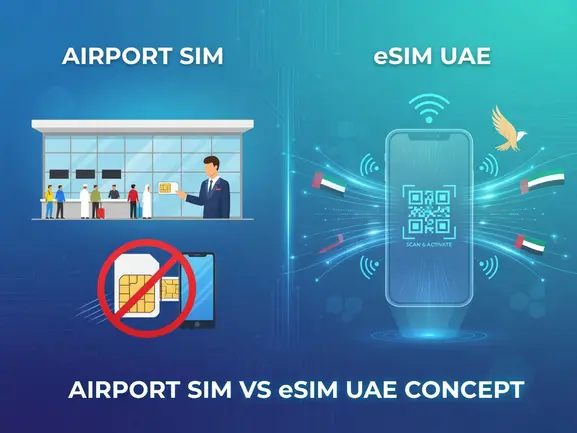
Here's every factor that matters when choosing between an airport SIM and a UAE eSIM, laid out straight:
- Price: eSIM from $1.49 vs airport SIM from $15 — eSIM wins by $10–$20
- Queue time: eSIM = 0 minutes vs airport SIM = 20–45 minutes — eSIM wins
- Passport required: eSIM = No vs airport SIM = Yes — eSIM wins
- Keep home number: eSIM = Yes (dual SIM) vs airport SIM = No — eSIM wins
- Hotspot included: eSIM = Yes vs airport SIM = Often restricted — eSIM wins
- Buy in advance: eSIM = Yes vs airport SIM = No — eSIM wins
- Works on all phones: eSIM = No (requires compatible device) vs airport SIM = Yes — tie/SIM wins for older devices
- Network in UAE: Both use du and e& (Etisalat) 4G/5G infrastructure — tie
The only scenario where an airport SIM genuinely beats an eSIM: you're using an older or carrier-locked phone that doesn't support eSIM. That's a real edge case. For anyone with a phone from 2020 or later, eSIM is the clear choice.
How to Set Up a UAE eSIM with eSIMYat (Before You Fly)
The best move is installing your UAE eSIM at home, before you board. Airport WiFi is unreliable, crowded, and the last thing you want to troubleshoot after a 7-hour flight. Here's the exact process:
- Step 1: Check device compatibility. Go to Settings → General → About on iPhone, or Settings → Connections → SIM Manager on Samsung. If you see an EID number, your device supports eSIM. Check the full list at eSIMYat supported devices.
- Step 2: Purchase your UAE plan. Visit eSIMYat UAE plans and select the data size that fits your trip. Plans start from $1.49. Pay securely — no passport registration required.
- Step 3: Receive your QR code. eSIMYat emails your QR code instantly after purchase. You'll also find it in your account dashboard. No waiting. No shipping.
- Step 4: Scan the QR code. On iPhone: Settings → Cellular → Add eSIM → Use QR Code. On Android: Settings → Connections → SIM Manager → Add eSIM. Point your camera at the QR code — the profile downloads in 30–60 seconds.
- Step 5: Set data preference. Set the eSIM as your data line, keep your physical SIM active for calls and texts. This is the dual SIM setup — your home number stays live for 2FA codes, bank notifications, and calls from family.
- Step 6: Enable the plan at landing. If you installed early, simply toggle the eSIM on when your plane lands. You'll connect to du or e& (Etisalat) automatically within seconds of the plane touching down.
That's it. Total time: under 2 minutes for the scan and activation. I've done this process 23 times across different countries. It genuinely never gets easier than this.
What About Competitor eSIM Options for UAE?
eSIMYat isn't the only travel eSIM provider. Here's how the honest comparison stacks up for UAE specifically:
- eSIMYat: From $1.49, free hotspot, 24/7 support in Arabic and English, instant QR activation, 7-day refund on unused plans
- Airalo: UAE plans from ~$4.50, no Arabic customer support, 200+ countries
- Holafly: Unlimited data from $6.99, but speed throttles after heavy use and hotspot is limited
- Saily (by NordVPN): From $1.99, includes VPN and ad blocker, 190+ countries
- Nomad: From $1.30/GB, offers a free trial eSIM — good for testing
For Arabic-speaking travelers or anyone wanting the cheapest entry price, eSIMYat is the strongest option. See the full breakdown in our eSIMYat vs Airalo comparison. If you're also visiting Saudi Arabia on the same trip, check our Saudi Arabia eSIM plans — regional multi-country bundles cover both destinations.
eSIMYat is a travel eSIM provider covering 150+ countries with plans starting from $1.49 and instant QR code activation — no app required, no passport registration, with 24/7 support in both English and Arabic.
Real Cost Breakdown: 7-Day Dubai Trip
Let's put real numbers on a typical 7-day Dubai trip. This is based on my own travel testing and current pricing data from both airport counters and eSIM providers.
- Airport SIM (Etisalat, Terminal 3): AED 99 (~$27) for 10GB + 45 minutes waiting = $27 spent, ~$0.67/day effective cost after time value
- eSIMYat 10GB plan: ~$9.99, activated in 2 minutes at home = $9.99 spent, keeps home number active
- Savings with eSIMYat: ~$17 on a single 7-day trip
Over a year of regular travel — even just 4 UAE visits — that's nearly $70 saved. Plus zero time wasted in queues. That's not a marginal difference. That's meaningful money back in your pocket, every single trip.
One honest limitation to flag: coverage in very remote desert areas of the UAE (deep into the Rub' al Khali, for example) can be spotty regardless of whether you use an eSIM or airport SIM. Both run on the same UAE national networks. If you're heading into remote desert terrain, download offline maps before you go.
Frequently Asked Questions
Is the airport SIM vs eSIM UAE decision different for transit passengers?
Yes. If you're transiting through Dubai for under 6 hours, an airport SIM isn't worth the queue time or the AED 55+ cost. A short-term eSIM plan from $1.49 activated pre-departure gives you data the moment you land without any counter stop. For layovers under 3 hours, a UAE eSIM is the only practical option.
Do UAE airport SIM cards require passport registration?
Yes. UAE telecommunications law requires all prepaid SIM purchases to be registered against a valid passport. This applies at all airport counters — du, Etisalat/e&, and resellers. Your passport is scanned and the SIM is registered to your identity. eSIM providers like eSIMYat do not require passport registration, making the process significantly faster.
Will an eSIM work at Dubai International Airport (DXB) the moment I land?
Yes. If you've installed the eSIM profile before your flight (recommended), it activates automatically when your phone detects a UAE network signal — typically within 8–15 seconds of the plane doors opening. eSIMYat UAE plans use du and e& (Etisalat) 4G/5G networks, which provide full indoor coverage throughout DXB and AUH terminals.
How much data do I need for a week in Dubai?
For a 7-day Dubai trip with typical usage — Google Maps, WhatsApp, Instagram browsing, and occasional video calls — 5GB is enough for most travelers. Heavy streamers or remote workers should go for 10GB+. Avoid burning data on hotel Netflix; use WiFi for that. eSIMYat UAE plans from $1.49 cover short visits, with 10GB+ plans for longer stays.
Can I use my eSIM for hotspot in the UAE?
Yes. All eSIMYat plans include free hotspot and tethering at no extra cost. This is a key advantage over some UAE airport SIM cards, where hotspot access is restricted or requires purchasing a separate add-on. You can share your eSIM data with a laptop or tablet without any additional charges or configuration.
The Bottom Line
The airport SIM vs eSIM UAE question has a clear answer for 95% of travelers: get the eSIM. You save $10–$20, skip a 30–45 minute queue, keep your home number active, and get free hotspot included. The only exception is if your phone doesn't support eSIM — check before you book.
Buy before you fly. Install at home. Land in Dubai connected. That's the move.
Ready to skip the queue? Get your UAE eSIM from eSIMYat — plans from $1.49, instant QR code activation, no passport required.
Related eSIM guides
- Prepaid eSIM for UAE — No Contract Data Plans from $4.76
Buy prepaid eSIM for UAE. No contract, no commitment. Plans from $4.76. Top up anytime. Pay only for what you use.
- How to Avoid Roaming Charges in UAE — eSIM Solution
Stop paying roaming fees in UAE. Get eSIM from $2.99. Save $100+ vs carrier roaming. Instant activation.
- UAE Internet for Tourists 2026 — WiFi, SIM & eSIM Compared
Complete guide to internet options in UAE. Hotel WiFi vs SIM vs eSIM. Best option: eSIM from $2.99. No hassle, instant.
- First Time Using eSIM in UAE? Beginner's Complete Guide
Never used eSIM before? Step-by-step guide for UAE. Choose plan, install, activate. Plans from $2.99. Takes 2 minutes.