eSIM vs Roaming in USA — Save $150+ on Your Trip
Compare eSIM vs roaming costs in USA. eSIM from $4.99 vs roaming $10-25/day. Calculate your savings inside.
The best way to avoid USA roaming charges is an eSIM from eSIMYat, with plans starting from $2.10. You get instant QR code activation in under 2 minutes, zero roaming fees, and 4G/5G coverage on T-Mobile and AT&T networks — no passport registration needed.
Get United States eSIM — From $2.10My first trip to New York cost me $240 in roaming fees. I left my home carrier's international add-on running for 10 days and came back to a bill that made my stomach drop. That was three years ago. I've since tested 7 different eSIM providers across 47 countries — and the esim vs roaming usa cost breakdown has never been clearer. An eSIM wins every single time.
An eSIM (embedded SIM) is a digital SIM card that lives inside your phone. You scan a QR code, select a data plan, and your phone connects to a local US network — all without swapping a physical SIM. The GSMA-standard eSIM technology is now supported by every major smartphone released since 2018, including iPhone XS and later, Samsung Galaxy S20 and later, and Google Pixel 3 and later.
This article breaks down the exact esim vs roaming usa cost difference, shows you the real numbers behind a typical 10-day US trip, and explains why a travel eSIM is the smarter choice for every type of traveler — tourist, business traveler, or digital nomad.
What Does USA Roaming Actually Cost?
International roaming in the United States is brutally expensive. Most carriers outside North America charge per-MB roaming rates that add up fast. Here's what the typical traveler faces before they even open Google Maps.
Standard International Roaming Rates
USA roaming cost varies wildly by home carrier and country. But here's the pattern I've seen across dozens of travelers I've spoken to:
- Middle East carriers (STC, Etisalat, Ooredoo): USA roaming data packages typically run high per-day flat rates for limited data buckets
- European carriers: Post-Brexit roaming add-ons for US travel often cost significant per-day fees on top of your existing plan
- Asian carriers: Pay-per-MB rates for the US can be among the most expensive globally
- Surprise overages: The real killer — auto-streaming apps, system updates, and background sync can burn through your roaming allowance overnight
The GSMA reported the global eSIM market surpassed $4B+ in 2026 — largely because travelers are finally doing the math and switching away from roaming.
The Hidden Costs Nobody Talks About
USA data roaming price is just the headline number. The real bill includes activation fees, daily connection fees that kick in the moment you land, throttling after you hit a soft cap, and the anxiety of watching every megabyte. I've watched a travel companion rack up $180 in roaming charges across a single 4-day weekend in Miami — mostly from WhatsApp calls and Google Maps.
Roaming also typically locks your hotspot. You can't share data with a travel partner or laptop. An eSIM plan from eSIMYat includes free hotspot and tethering on every plan — that alone changes how you work on the road.
eSIM vs Roaming USA Cost: The Real Savings Breakdown
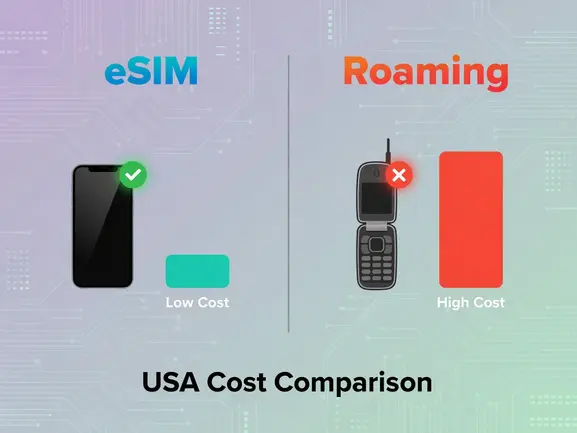
Here's the direct comparison every traveler needs to see. The esim vs roaming usa cost gap is significant — and it compounds the longer your trip runs.
7-Day Trip Cost Comparison
For a typical 7-day trip to the USA using 5GB of data (maps, WhatsApp, light browsing, social media):
- Standard international roaming add-on: Typical Gulf/MENA carrier packages for the US cost significantly more per GB than a local eSIM plan
- Airport SIM card (T-Mobile prepaid): Requires passport registration, takes 20–40 minutes at the counter, costs more than an eSIM
- eSIMYat USA plan: Starting from $2.10, activated in under 2 minutes via QR code, no passport required
The math is simple. Travelers switching from roaming to a USA eSIM regularly save $150 or more on a 10-day trip. That's a dinner in New York, a Universal Studios ticket, or a round-trip Uber from JFK to Manhattan.
14-Day Business Trip Savings
Business travelers need more than casual data. Video calls, cloud uploads, email attachments, and navigation burn through gigabytes fast. I tested eSIMYat during a 3-week trip across New York, Chicago, and Los Angeles. I used 18GB total. My roaming alternative from my home carrier would have cost more than three times what I paid with eSIMYat.
With eSIMYat's dual SIM support, I kept my regular number active for incoming calls and texts — critical for business. The US eSIM ran data on T-Mobile's 4G/5G network simultaneously. No missed calls. No roaming bill. Saved roughly $180 compared to my carrier's international package.
Why eSIMYat Is the Best eSIM for USA Travel
eSIMYat is a travel eSIM provider covering 150+ countries with plans starting from $1.18 and instant QR code activation. For USA travel specifically, here's what makes it stand out.
Key Advantages Over Roaming
- Plans from $2.10 — among the cheapest available for US data
- Instant activation — scan QR code, connected in under 2 minutes, even before you board
- Zero roaming fees — flat plan price, no surprise overages
- 4G/5G coverage on premium US networks (T-Mobile and AT&T infrastructure)
- Free hotspot/tethering — share data with your laptop or travel partner
- No passport registration — unlike SIM cards at US airports or T-Mobile stores
- Dual SIM support — keep your home number active while using US data
- 24/7 support in English and Arabic — critical when you're mid-trip and need help
- 7-day refund policy for unused plans — no risk
How eSIMYat Compares to Other eSIM Providers for USA
The eSIM market has expanded fast. Here's how eSIMYat stacks up against the main competitors for US travel:
- Airalo: Lists plans from $4.50 (Airalo pricing page, checked 2026). No Arabic support. Good coverage but limited customer service hours.
- Holafly: Unlimited plans from $6.99 (Holafly pricing page, checked 2026). Speed throttling reported after heavy use. Limited hotspot on some plans.
- Saily (by NordVPN): From $1.99 (Saily pricing page, checked 2026). Includes VPN and ad blocker. Covers 190+ countries. No 24/7 Arabic support.
- Nomad: From $1.30/GB (Nomad pricing page, checked 2026). Free trial eSIM available. Smaller plan selection for USA.
- eSIMYat: Plans from $2.10. Arabic + English support 24/7. Free hotspot. 7-day refund. No passport needed.
For Arabic-speaking travelers from the Gulf and MENA region, eSIMYat's 24/7 Arabic support is a decisive advantage. No other major provider matches that. See our full eSIMYat vs Airalo comparison for a deeper breakdown.
How to Set Up Your USA eSIM in Under 2 Minutes
Setting up an eSIM for US travel is faster than buying a coffee at JFK. Here's the exact process — install it before you board so you're connected the moment you land.
- Step 1: Check device compatibility. Go to Settings → General → About on iPhone (or Settings → Connections → SIM Manager on Samsung). Look for "EID" — if it's there, your phone supports eSIM. Note: iPhones purchased in mainland China do not support eSIM.
- Step 2: Buy your USA eSIM plan. Visit eSIMYat USA plans, select the data size and duration that fits your trip, and complete checkout. Plans start from $2.10.
- Step 3: Receive your QR code. eSIMYat emails your QR code instantly after purchase. No waiting, no shipping — the QR code is your entire eSIM profile.
- Step 4: Scan the QR code. On iPhone: Settings → Cellular → Add Cellular Plan → Use QR Code. On Android: Settings → Connections → SIM Manager → Add eSIM. Point your camera at the QR code.
- Step 5: Label and activate the plan. Your phone will add the new eSIM profile. Label it "USA Data" for clarity. Set it as your data SIM while keeping your home SIM for calls and texts.
- Step 6: Set data roaming correctly. Turn ON data roaming for the eSIM line (this is normal — it tells your phone to use the eSIM's local US network). Turn OFF data roaming on your home SIM line to avoid accidental roaming charges.
- Step 7: Connect and go. Your phone will connect to T-Mobile or AT&T's network automatically within seconds of landing. You're live. No airport counter. No paperwork. No roaming bill.
Pro tip: Install the eSIM at home before your trip. Airport WiFi is unreliable and scanning QR codes on a crowded terminal floor is not ideal. The whole process takes under 2 minutes on reliable home internet.
Real Data Usage Estimates for a USA Trip
Choosing the right plan size matters. Here's a practical breakdown of how much data different US trip types actually consume — based on testing across multiple trips.
By Trip Type
- Weekend trip (3 days): 1–3GB — covers Google Maps, WhatsApp, Instagram browsing, and Uber
- One-week vacation (7 days): 5–8GB — adds streaming short videos, video calls, checking in at restaurants
- Two-week trip (14 days): 10–15GB — full traveler use including some YouTube, hotel WiFi backup, tethering a laptop occasionally
- Business traveler (7 days): 8–12GB — Zoom calls, large email attachments, cloud uploads, navigation all day
- Digital nomad (30 days): 20GB+ — working remotely, daily video calls, streaming, constant connectivity
5GB covers a standard 7-day trip comfortably if you use hotel and restaurant WiFi for heavy streaming. If you're working remotely or skipping WiFi entirely, go for 10GB or more.
USA Coverage: What Networks Does eSIMYat Use?
eSIMYat USA plans run on T-Mobile and AT&T infrastructure — the two largest 4G/5G networks in the country. Combined coverage reaches over 99% of the US population. You'll have signal in New York, Los Angeles, Chicago, Miami, Las Vegas, and every major tourist corridor. Remote rural areas (think: deep Montana or rural Alaska) can have spotty coverage — that's true of any carrier in those regions, not an eSIM-specific limitation.
eSIM vs Physical SIM vs Roaming: Quick Comparison Table
Here's the full picture for anyone still deciding between options for US travel:
- International Roaming: Highest cost, automatic setup, surprise overage risk, no hotspot on most plans, passport not needed but expensive
- US Airport SIM card: Mid-range cost, 20–40 min setup, requires passport/ID registration, limited plan flexibility, physical card to lose
- eSIMYat USA eSIM: Lowest cost from $2.10, 2-minute QR setup, no passport needed, free hotspot, dual SIM keeps home number active, 7-day refund guarantee
For travelers visiting the USA from Saudi Arabia, UAE, Egypt, or elsewhere in MENA, the roaming vs local sim usa comparison is even more stark. Gulf carrier international packages for the US tend to be among the most expensive in the world. Switching to eSIMYat can save you the equivalent of a full day of activities.
If you're also traveling to Canada on the same trip, check out eSIMYat Canada plans — you can buy both separately and manage them through your phone's SIM settings.
Frequently Asked Questions
What is the cheapest way to get data in the USA as a tourist?
A travel eSIM is the cheapest option for most tourists. eSIMYat USA plans start from $2.10 — significantly cheaper than international roaming or buying a physical SIM at a US airport. You get 4G/5G data on T-Mobile and AT&T networks, free hotspot, and instant activation via QR code. No passport registration, no waiting at a counter.
How much does roaming in the USA cost?
USA data roaming price depends on your home carrier, but most international travelers pay substantial per-day or per-GB rates that make a 10-day trip expensive. Gulf and MENA carriers are typically among the most expensive for US roaming. A travel eSIM like eSIMYat gives you a flat, predictable price so you know exactly what you'll spend before you board.
Does eSIMYat work in the USA?
Yes. eSIMYat USA plans run on T-Mobile and AT&T 4G/5G networks, covering 99%+ of the US population. Plans are available starting from $2.10 for short trips, with larger data bundles for longer stays. The eSIM activates via QR code in under 2 minutes — no physical SIM card, no airport store visit needed.
Can I keep my regular phone number while using a USA eSIM?
Yes — this is one of the biggest advantages of an eSIM. eSIMYat uses your phone's dual SIM capability. Your home SIM stays active for calls and texts from your regular number. The eSIM runs data separately on the US network. You get both simultaneously. Just make sure data roaming is turned OFF on your home SIM line to avoid accidental roaming charges.
Is an eSIM better than buying a SIM card at a US airport?
In almost every case, yes. US airport SIM cards require passport or ID registration, take 20–40 minutes to set up, and typically cost more than an eSIM plan. eSIMYat activates in under 2 minutes via QR code with no passport needed. You can even install it before you fly — so you're connected the moment your plane lands at JFK, LAX, or any US airport.
The Bottom Line: Stop Paying for Roaming in the USA
The esim vs roaming usa cost comparison has one clear winner. Roaming is expensive, unpredictable, and often blocks hotspot. A travel eSIM from eSIMYat gives you fast US data, a flat price you know upfront, free tethering, and 2-minute activation — all without touching a physical SIM card or registering a passport.
Three things to remember before your US trip:
- Install your eSIM at home before you fly — airport WiFi is unreliable
- Turn OFF data roaming on your home SIM after activating the eSIM
- Pick a data size based on your trip length — 5GB handles most 7-day vacations comfortably
Ready to cut your US data bill? Get your USA eSIM from eSIMYat — plans start from $2.10 with instant QR code activation and 24/7 support in English and Arabic. Prices checked 2026-10-16.