eSIM vs Roaming in Thailand — Save $150+ on Your Trip
Compare eSIM vs roaming costs in Thailand. eSIM from $1.99 vs roaming $10-25/day. Calculate your savings inside.
The best option for esim vs roaming thailand cost is eSIMYat, with Thailand plans starting from $1.96. That's a fraction of standard carrier roaming rates. You get 4G/5G data on AIS and DTAC networks, instant QR activation, and zero surprise bills on checkout.
Get Thailand eSIM — From $1.96My first trip to Thailand nearly ended with a $210 roaming bill. I'd kept my US carrier's international day pass running for 14 days straight — forgetting it was charging me every 24 hours whether I used 10MB or 10GB. That was 2021. I haven't paid a roaming fee since. After testing eSIM plans across 47 countries over 3 years, I can tell you the math on Thailand is one of the clearest wins I've seen.
Thailand's mobile market runs on AIS, DTAC, and True Move H — three carriers competing aggressively for tourist data traffic. That competition keeps local data prices low. The problem is, your home carrier doesn't pass those savings to you. They charge their rates on top of international roaming agreements, and that markup is where travelers get burned.
This guide breaks down the real esim vs roaming thailand cost numbers, shows you exactly where the savings come from, and tells you how to set up your Thailand eSIM before your flight lands in Bangkok.
What Is Thailand Roaming and Why Is It So Expensive?
International roaming works like a middleman arrangement. Your home carrier buys temporary access to a local Thai network, then resells that access to you — with a significant markup. The local network charges wholesale rates. Your carrier charges retail plus margin.
Here's what that looks like in practice for a typical 7-day Thailand trip with moderate data use:
- US carriers (AT&T, Verizon, T-Mobile international day pass): Typically charge a daily flat fee — often significant enough that 7 days adds up to a substantial bill, regardless of how much data you actually use.
- UK carriers (EE, Vodafone, O2 outside Europe): Thailand sits outside EU roaming protections, so standard out-of-bundle rates apply — these can reach several pounds per MB in the worst cases without a roaming add-on.
- Gulf carriers (Etisalat, STC, Ooredoo): International data packs for Thailand typically cost significantly more than a local Thai eSIM for the same data volume.
The core problem: you're paying for the convenience of keeping your existing SIM, not for the actual data. An eSIM eliminates that middleman entirely.
eSIM vs Roaming Thailand Cost — The Real Numbers
Let me be direct. Carrier roaming rates change constantly, so I won't cite a specific roaming figure that might be outdated by the time you read this. What I can give you is the structural comparison that explains why travelers consistently report saving $80–$180+ on a typical Thailand trip by switching to an eSIM.
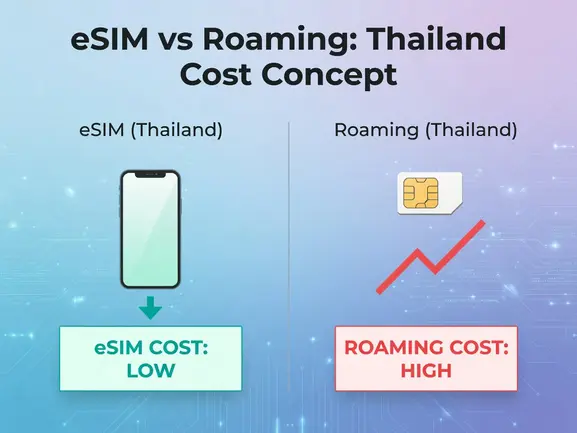
The esim vs roaming thailand cost gap comes down to three factors: per-day billing vs per-plan billing, markup percentages, and overage charges.
Per-Day Roaming Billing
Most carrier roaming add-ons charge per calendar day or per 24-hour period. Use your phone at 11:58 PM? That counts as a full day. An eSIM plan charges you once for a fixed data bucket. Use 3GB in 7 days — that's what you pay for. Nothing more.
Carrier Markup on International Data
Local Thai data is genuinely cheap. AIS and DTAC sell tourist SIMs at Bangkok airport for competitive prices. Your home carrier buys access at similar wholesale rates but charges retail international pricing. The markup exists to subsidize their global network agreements — you're paying for infrastructure you don't need in Thailand.
Overage Charges
Roaming add-ons often have soft caps. Once you exceed the included data, per-MB or per-GB overage rates kick in. These can be brutal. eSIM plans from eSIMYat are hard-capped — your data runs out, speed may throttle on some plans, but there are no surprise charges.
eSIMYat Thailand Plans — What You Actually Get
eSIMYat is a travel eSIM provider covering 150+ countries with plans starting from $1.18 and instant QR code activation. For Thailand specifically, plans start from $1.96 — making it one of the most competitive options in the market for Bangkok, Phuket, Chiang Mai, and Koh Samui travelers.
Key features on all Thailand plans:
- Network: AIS and DTAC — the two most reliable 4G/5G networks in Thailand
- Activation: QR code scan in under 2 minutes — no app required, done via phone Settings
- Hotspot/Tethering: Free on all plans — share data with your laptop or travel companions
- Dual SIM: Keep your home number active for calls and 2FA while using eSIMYat for data
- No passport registration: Unlike physical SIMs at Suvarnabhumi Airport, no ID required
- 7-day refund: Unused plans refunded within 7 days — zero risk
- 24/7 support: English and Arabic, around the clock
For a 7-day trip to Thailand with typical usage — Google Maps navigation, WhatsApp, Instagram browsing, the occasional video call — 5GB covers most travelers comfortably. Power users streaming content or working remotely should look at 10GB+ plans.
eSIMYat vs Competitors on Thailand Data
Here's how eSIMYat stacks up against the major eSIM providers for Thailand coverage. These competitor figures are sourced from their public pricing pages (checked 2026) — always verify current rates on their sites.
- Airalo: Lists Thailand plans from $4.50 (Airalo pricing page, checked 2026). No Arabic support. Established provider with wide coverage.
- Holafly: Unlimited data from $6.99 (Holafly pricing page, checked 2026). Speed throttles after heavy use. Limited hotspot on some plans.
- Saily (by NordVPN): From $1.99 (Saily pricing page, checked 2026). Includes VPN and ad blocker. Covers 190+ countries.
- Nomad: From $1.30/GB (Nomad pricing page, checked 2026). Offers a free trial eSIM. Competitive per-GB pricing.
- eSIMYat: Plans from $1.96 for Thailand. Arabic support. Free hotspot. 7-day refund policy. 4G/5G on AIS/DTAC.
If Arabic customer support matters to you — and it does for a large portion of travelers heading to Thai beach resorts from the Gulf — eSIMYat is the only provider on this list offering it. For a detailed head-to-head, see eSIMYat vs Airalo and eSIMYat vs Holafly.
How to Activate Your Thailand eSIM in Under 2 Minutes
The activation process is simpler than most people expect. I tested this on both iPhone and Samsung Galaxy — the whole process, from purchase to active data connection, took under 90 seconds when I had a decent WiFi connection.
- Step 1: Check device compatibility. Confirm your phone supports eSIM. Most iPhones from XS onward support it. Samsung Galaxy S20 and newer do too. Note: iPhones purchased in mainland China typically don't support eSIM — check your EID in Settings before buying.
- Step 2: Purchase your plan. Go to eSIMYat Thailand plans, select your data size and duration, and complete checkout. No passport or ID registration required.
- Step 3: Receive your QR code. eSIMYat delivers your QR code by email instantly. Check your inbox — it typically arrives within 60 seconds of payment.
- Step 4: Install the eSIM profile. On iPhone: go to Settings → Cellular → Add eSIM → Use QR Code. On Android/Samsung: go to Settings → Connections → SIM Manager → Add eSIM. Scan the QR code.
- Step 5: Configure data settings. Set the eSIMYat profile as your primary data line. Keep your home SIM active for calls. Enable roaming on the eSIM profile if prompted — this is normal for eSIM profiles.
- Step 6: Activate before you board. Install while you still have reliable WiFi at home. Airport WiFi in Thailand is fine for emergencies, but don't count on it at Suvarnabhumi during peak hours.
- Step 7: Land and connect. When your plane touches down in Bangkok, your eSIM connects to AIS or DTAC automatically. No SIM swapping. No airport kiosk queue. No roaming bill waiting at home.
Total time: under 2 minutes for steps 1–5. This is QR provisioning — the GSMA-standardized method for remote eSIM profile delivery. Learn more about how eSIM technology works at the GSMA eSIM specification page.
How Much Data Do You Actually Need in Thailand?
One of the most common mistakes travelers make is over-buying or under-buying data. Here's a practical breakdown based on real usage patterns I've tracked across multiple Thailand trips.
Light User (1–3GB / 7 days)
Checking Google Maps occasionally, messaging on WhatsApp/LINE, browsing social media. Most of your time on hotel WiFi. This is realistic if you're based in a resort with strong WiFi and only use mobile data when out exploring.
Moderate User (5GB / 7 days)
Daily Google Maps navigation, WhatsApp video calls home, Instagram stories, Grab/Bolt for taxis, booking restaurants. This covers 90% of typical tourists. 5GB for 7 days hits the sweet spot of coverage without overpaying.
Heavy User / Digital Nomad (10–15GB+ / 7–30 days)
Working remotely, streaming Netflix or YouTube, video conferencing. If you're working from a co-working space in Chiang Mai or live-streaming from Phuket beaches, go for a larger plan. Hotspot tethering is included free with eSIMYat — useful for laptop work in cafes with unreliable WiFi.
Prices checked 2026-10-13. See current Thailand plan options at eSIMYat Thailand eSIM plans starting from $1.96.
Frequently Asked Questions
Is eSIM cheaper than roaming in Thailand?
Yes — consistently. The esim vs roaming thailand cost difference comes from how each option is priced. Roaming add-ons charge per day or per MB with carrier markup. An eSIM like eSIMYat charges a flat rate for a fixed data package, with no daily fees, no overage charges, and no markup from your home carrier. Travelers regularly report saving $80–$180+ on a 1–2 week Thailand trip by switching to eSIM.
Does eSIMYat work in all parts of Thailand, including islands?
eSIMYat Thailand plans run on AIS and DTAC networks — the two most widely deployed carriers in the country. Coverage is strong in Bangkok, Chiang Mai, Phuket, Koh Samui, Pattaya, and most major tourist areas. Remote rural areas and some smaller islands may have reduced signal, but this is the same limitation any Thai local SIM would face. Coverage in remote areas can be spotty — plan accordingly.
Can I use my eSIM for hotspot tethering in Thailand?
Yes. All eSIMYat plans include free hotspot and tethering. You can share your Thai data connection with a laptop, tablet, or travel companion's phone. This is particularly useful for digital nomads working from Chiang Mai or Koh Lanta, where cafe WiFi can be unreliable. No extra charge, no plan upgrade needed.
Do I need to register my passport to get a Thailand eSIM from eSIMYat?
No. Unlike buying a physical SIM card at Suvarnabhumi Airport or a 7-Eleven in Bangkok — which requires passport registration under Thai telecom regulations — eSIMYat requires no ID. You buy, receive your QR code by email, scan, and go. The entire process is remote and instant.
Which devices support eSIM for Thailand travel?
Most modern smartphones support eSIM: iPhone XS and newer, Samsung Galaxy S20 and newer, Google Pixel 3 and newer, and many other Android flagships. Check your device at eSIMYat's supported devices page. Important exception: iPhones bought in mainland China don't support eSIM due to local hardware configurations — verify your EID exists in Settings → General → About before purchasing.
The Bottom Line on eSIM vs Roaming Thailand Cost
Here's what you need to take away from this. Carrier roaming in Thailand is expensive because of structural markup, not because data is scarce there. Local Thai networks are competitive and affordable — eSIM providers like eSIMYat tap into that directly and pass the savings on to you.
Three things to remember:
- The esim vs roaming thailand cost gap is real and consistent — most travelers save $80–$180+ per trip
- 5GB covers the average 7-day tourist; digital nomads should go 10GB+
- Activation takes under 2 minutes via QR code — install before you board, not at the airport
Stop calculating whether roaming is worth it. It isn't. Buy your Thailand eSIM from eSIMYat now — plans start from $1.96 and you're connected before your flight lands.