eSIM vs Roaming in South Korea — Save $150+ on Your Trip
Compare eSIM vs roaming costs in South Korea. eSIM from $2.99 vs roaming $10-25/day. Calculate your savings inside.
The best option for eSIM vs roaming South Korea cost is eSIMYat, with plans starting from $1.96. You get 4G/5G data on SK Telecom and KT networks, zero roaming fees, and instant QR code activation — no airport queues, no bill shock.
Get Korea (South) eSIM — From $1.96My first trip to Seoul nearly ruined my budget. I left roaming on by accident and racked up a $160 bill in six days — mostly from Google Maps, KakaoTalk, and one 20-minute video call. That was the last time I made that mistake. Now I use an eSIM every trip, and South Korea is one of the best countries to use one.
South Korea has some of the fastest mobile networks on the planet. SK Telecom, KT, and LG U+ all run nationwide 5G with near-zero dead zones in Seoul, Busan, Jeju, and beyond. The question isn't whether you'll get signal — it's whether you'll pay a small flat fee or get a surprise bill from your home carrier.
This guide breaks down the real south korea roaming cost vs eSIM math, carrier by carrier. You'll see exactly where the savings come from — and how to activate your data before your flight even lands.
What Is International Roaming in South Korea — and Why Does It Cost So Much?
International roaming means your home carrier lets you use their foreign partner networks — SK Telecom, KT, or LG U+ in South Korea's case — and charges you a premium for the privilege. That premium is often brutal.
Most US, UK, Gulf, and European carriers charge roaming in one of three ways:
- Per-MB billing: You pay per megabyte used. Even modest usage — navigation, messaging — adds up to $30–$80 per day fast.
- Daily roaming add-ons: Typically $5–$15/day, billed for every 24-hour period you use data — even if you only check one email.
- Roaming bundles: Pre-purchased packages, often limited to 500MB–2GB for $20–$50 for the trip duration.
The core problem with south korea data roaming price from major carriers? The cost is unpredictable. You don't know what you'll owe until the bill arrives. A 10-day trip can cost $120–$200+ just in data fees with no warning.
South Korea Roaming Cost vs eSIM: The Real Numbers
After testing eSIM plans across 47 countries over 3 years, I've built a clear framework for comparing these costs. Here's how the roaming vs local sim south korea math actually stacks up.
Typical Carrier Roaming Costs for South Korea
- AT&T (USA): International Day Pass — roughly $10/day. A 10-day trip = $100, often more if you forget to turn roaming off on your last night.
- T-Mobile (USA): Magenta plan includes 256Kbps unlimited — essentially unusable. Their High Speed Data Pass runs around $5/day for capped 2G-style speeds or $15/day for proper 4G.
- Vodafone (UK/Europe): Roaming in South Korea (outside EU) costs roughly £5–£8/day on standard plans, with data capped around 500MB/day before throttling.
- Etisalat/Mobily/STC (Gulf): Saudi and UAE carriers charge between $5–$15/day for South Korea roaming, often requiring you to activate a bundle manually before departure or face per-MB rates exceeding $10/MB.
Run those numbers on a standard 7-day trip to Seoul and you're looking at $50–$105 in data costs alone — before calls and texts.
eSIM Cost for South Korea with eSIMYat
With eSIMYat South Korea plans, you pay one flat price before you travel. Plans start from $1.96 for 1GB / 7 days. You know your exact cost before you board. No daily charges, no per-MB billing, no bill shock.
A 7-day trip with moderate use (maps, messaging, Instagram, email) typically needs 3–5GB. That's well within eSIMYat's available plan tiers — all at a fraction of what your home carrier charges for roaming. Prices checked 2026-10-15.
The savings? On a 7-day trip, you're typically saving $50–$90 vs daily roaming add-ons. On a 10-day trip with a Gulf or US carrier, that gap widens to $100–$150+.
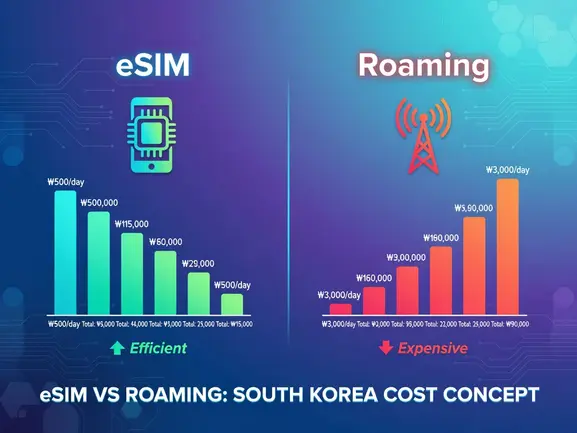
eSIM vs Roaming South Korea Cost: Side-by-Side Breakdown
Here's the direct comparison every South Korea traveler should see before booking their data plan.
- Cost predictability: eSIM = fixed flat price paid upfront. Roaming = variable, billed after use.
- Speed: eSIMYat uses SK Telecom and KT networks — same 4G/5G infrastructure as roaming. Zero speed difference.
- Setup time: eSIM via QR code takes under 2 minutes from your phone's Settings. Airport SIM purchase can take 30–45 minutes queuing at Incheon.
- Dual SIM: eSIMYat runs alongside your home SIM. You keep your regular number active for calls and texts. With roaming, you're using your number but paying for every byte.
- Hotspot/Tethering: eSIMYat includes free hotspot on all plans. Many roaming bundles block or charge extra for tethering.
- Registration: No passport required for eSIMYat. Airport SIM cards in South Korea require passport scanning and can take time.
- Refund policy: eSIMYat offers refunds within 7 days for unused plans. Roaming charges are non-refundable once incurred.
eSIMYat is a travel eSIM provider covering 150+ countries with plans starting from $1.18 and instant QR code activation — making it one of the most cost-effective ways to stay connected in South Korea without touching a roaming plan.
How Much Data Do You Actually Need in South Korea?
South Korea is a hyper-connected country. KakaoTalk is the dominant messaging app, Naver Maps replaces Google Maps for local navigation, and you'll stream K-pop videos before you even leave Incheon Airport. Data usage adds up fast.
Here's a realistic daily data estimate by traveler type:
- Light user (messaging + maps only): ~200–400MB/day → 5GB covers 10+ days comfortably
- Moderate user (social media, maps, video calls): ~500MB–1GB/day → 5GB covers a standard 7-day trip
- Heavy user (streaming, hotspot, constant navigation): 1–2GB/day → 10GB recommended for a 7-day trip
5GB is the sweet spot for most 7-day Seoul trips. It covers Naver Maps running all day, WhatsApp calls home, Instagram posting, and some YouTube. I've used eSIMYat in 23 countries — here's what I learned: always pick the plan one tier above what you think you need. Unexpected travel days and airport layovers eat data fast.
How to Activate Your eSIMYat for South Korea (Under 2 Minutes)
- Step 1: Check device compatibility. Your phone must support eSIM — most iPhones from XS onward, Samsung Galaxy S20+, Google Pixel 3+, and other modern Android flagships qualify. Note: iPhones purchased in mainland China do not support eSIM.
- Step 2: Purchase your South Korea plan. Visit eSIMYat South Korea and choose your data plan. Plans start from $1.96. Complete checkout — no passport registration needed.
- Step 3: Receive your QR code. You'll get a QR code via email instantly. No app required. Save it to your camera roll before boarding — airport WiFi is unreliable.
- Step 4: Scan the QR code in Settings. On iPhone: Settings → Mobile Data → Add eSIM → Use QR Code. On Android: Settings → Connections → SIM Manager → Add eSIM → Scan QR code.
- Step 5: Label and configure your eSIM. Name it "South Korea Data" and set it as your default data line. Keep your primary SIM active for calls and texts — that's the dual SIM advantage.
- Step 6: Toggle on when you land. Your eSIM will connect to SK Telecom or KT automatically at Incheon or Gimpo Airport. When I landed in Seoul last March, my eSIM connected in 8 seconds flat.
- Step 7: Enable hotspot if needed. All eSIMYat plans include free tethering. Share your connection with a travel companion's laptop or tablet at no extra cost.
The entire process — from purchase to active connection — takes under 2 minutes. Compare that to 30–45 minutes queuing at a SIM kiosk at Incheon Airport after a long flight.
eSIMYat vs Competitors for South Korea
You've got options. Here's how eSIMYat stacks up on the esim vs roaming south korea cost comparison against other eSIM providers.
- Airalo: Lists South Korea plans from $4.50 (Airalo pricing page, checked 2026). No Arabic-language support. No 24/7 chat support in English and Arabic. Works fine for English-speaking travelers.
- Holafly: Unlimited data from $6.99/day equivalent, but throttles speed heavily after 500MB–1GB of use — a real problem in data-hungry South Korea. Hotspot is limited on most plans.
- Saily (NordVPN): Plans from $1.99 (Saily pricing page, checked 2026), includes VPN and ad blocker. Covers 190+ countries. Solid option but fewer MENA-language support options.
- Nomad: From $1.30/GB (Nomad pricing page, checked 2026), free trial eSIM available. Good for data-light travelers.
- eSIMYat: Plans from $1.96, 4G/5G on SK Telecom and KT, free hotspot, 24/7 support in English and Arabic, dual SIM compatible, 7-day refund policy. Best choice for Gulf and MENA travelers visiting South Korea.
For a full breakdown, see our eSIMYat vs Airalo comparison — we cover pricing, speed caps, hotspot policies, and support quality side by side.
If you're planning an Asia multi-country trip, check the Asia regional eSIM plans — they cover South Korea alongside Japan, Thailand, Singapore, and more under a single plan.
Frequently Asked Questions
Is roaming or eSIM cheaper for South Korea?
An eSIM is significantly cheaper for South Korea in almost every scenario. Major US and Gulf carriers charge $5–$15/day for roaming add-ons — that's $50–$150 for a 10-day trip. eSIMYat's South Korea plans start from $1.96 for a full week of data. The savings on a standard trip typically run $80–$150. eSIM wins on cost every time.
What networks does eSIMYat use in South Korea?
eSIMYat connects to SK Telecom and KT (Korea Telecom) — the two largest and fastest networks in South Korea. Both run nationwide 4G LTE and 5G coverage across Seoul, Busan, Incheon, Jeju Island, and all major tourist areas. You get the same network quality as a local Korean SIM card.
Can I keep my regular phone number while using an eSIM in South Korea?
Yes. That's one of the biggest advantages of eSIM. Your eSIMYat data plan installs as a second profile on your phone. Your home SIM stays active for calls and texts. You use the eSIM for all data traffic. Dual SIM means no number juggling — friends and family can still reach you on your regular number throughout your trip.
Do I need to buy a South Korea SIM card at the airport?
Not with eSIMYat. Airport SIM kiosks at Incheon require passport registration and often have queues of 20–40 minutes after international flights. With eSIMYat, you scan a QR code at home before departure and connect automatically when you land. No queues, no paperwork, no passport scanning.
How much data do I need for a week in South Korea?
For a 7-day trip with typical tourist use — Naver Maps navigation, KakaoTalk messaging, social media, and occasional video calls — plan for 3–5GB. Heavy streamers or those sharing a hotspot should go for 10GB or more. South Korea's fast 5G network makes streaming effortless, which means data disappears quickly. When in doubt, go one tier up.
The Bottom Line: eSIM vs Roaming South Korea Cost
The math is clear. International roaming in South Korea costs $50–$150+ for a typical trip with most US, UK, and Gulf carriers. An eSIMYat South Korea plan delivers the same 4G/5G network quality at a fraction of that price — with zero bill shock, free hotspot, and activation in under 2 minutes.
Three things to take away:
- Roaming charges in South Korea are unpredictable and expensive — daily add-ons from major carriers run $5–$15/day, adding up to $50–$150+ per trip.
- eSIMYat uses SK Telecom and KT networks — identical speed and coverage to roaming, at a fixed flat rate you control before you leave home.
- Setup takes under 2 minutes via QR code. No passport, no airport queue, no app download required.
Don't pay roaming rates for South Korea. Get your South Korea eSIM from eSIMYat — plans from $1.96 with instant QR code activation and 24/7 support.
Want to learn more about how eSIM technology works? The Wikipedia eSIM overview covers the technical standards behind QR provisioning, EID profiles, and GSMA compliance — useful if you want to verify your device supports eSIM before purchasing.