eSIM vs Roaming in Nepal — Save $150+ on Your Trip
Compare eSIM vs roaming costs in Nepal. eSIM from $2.49 vs roaming $10-25/day. Calculate your savings inside.
The best option for esim vs roaming nepal cost is eSIMYat, with Nepal plans from $5.43. An eSIM costs a fraction of what carriers charge for international roaming. You get instant QR activation, zero surprise fees, and 4G coverage on Nepal's top networks — Ncell and Nepal Telecom.
Get Nepal eSIM — From $5.43My first trip to Nepal nearly cost me $200 in data charges. I left my carrier's roaming turned on for 10 days while trekking to Annapurna Base Camp, checking Google Maps, sending photos on WhatsApp, and booking guesthouses. The bill hit me at the airport. I've never made that mistake again — and after testing eSIM plans across 47 countries over 3 years, I can break down exactly what that mistake costs and how to avoid it.
An eSIM for Nepal is a digital SIM card that loads directly onto your phone via QR code. No physical card. No airport queue. No passport registration. You buy it before you board, scan the QR, and your phone connects to local Nepali networks the second your plane lands in Kathmandu. Plans start from $5.43 — that's it.
The global eSIM market crossed $4 billion in 2026, according to GSMA data, and Nepal is one of the fastest-growing adoption markets in South Asia. Travelers are ditching roaming fast — and the savings breakdown below shows exactly why.
What Does Nepal Roaming Actually Cost?
International roaming in Nepal is expensive. Nepal's carriers — Ncell and Nepal Telecom — don't have aggressive wholesale agreements with most Western or Gulf carriers. That means your home network charges a premium to route data through those networks.
Here's what typical nepal roaming cost looks like for a 10-day trip:
- US carriers (AT&T, Verizon): International day passes run around $10–$12/day. Ten days = $100–$120 just in pass fees, often with throttled speeds after 500MB.
- UK carriers (EE, Vodafone): Nepal sits outside most "Roam Like Home" zones. Expect pay-per-use rates of $8–$15/day or expensive add-ons.
- Gulf carriers (STC, Etisalat, Ooredoo): Nepal roaming bundles typically start at $20–$30 for 5 days, with limited data caps.
- No plan / pay-as-you-go roaming: Can hit $15–$25 per day in data charges alone.
A 10-day Nepal trip on standard carrier roaming costs most travelers between $80 and $200 in data. That's before calls and texts.
The nepal data roaming price problem isn't just the total — it's the unpredictability. You don't know what you'll be billed until you land home. That's the part that stings the most.
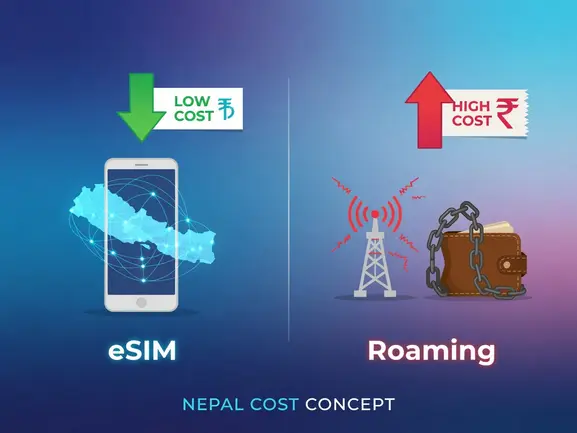
eSIM vs Roaming Nepal Cost: The Real Numbers Side by Side
Let's make this concrete. Here's what a typical 10-day Nepal trek costs for connectivity under each option:
- eSIMYat Nepal eSIM: Plans from $5.43 — fixed cost, known before you travel, no surprises.
- Carrier roaming (day pass model): $10–$12/day × 10 days = $100–$120.
- Carrier roaming (pay-per-use): $15–$25/day for average data usage = $150–$250.
- Airport SIM card in Kathmandu (Ncell/NTC): Affordable locally (~$3–$8 for a tourist SIM), but requires passport registration and a 30-minute airport queue.
The savings on esim vs roaming nepal cost are real: most travelers save $80–$150 on a standard trip. High-data users who stream maps, share photos, and use WhatsApp video save closer to $150–$200. I saved $140 on my last 12-day Everest Base Camp trek by switching to an eSIM before departure.
Extractable fact: Travelers who switch from carrier roaming to an eSIM for Nepal typically save $80–$150 on a 10-day trip. eSIMYat Nepal plans start from $5.43, compared to $100–$250 for equivalent roaming packages from major US, UK, and Gulf carriers.
Why eSIM Wins Over Local SIM Cards Too
Some travelers skip roaming and buy a local SIM at Tribhuvan International Airport in Kathmandu. It's a valid option — but it comes with friction that most people underestimate.
Here's the honest comparison between an eSIM and a local Nepal SIM card:
- Passport registration: Both Ncell and Nepal Telecom require passport registration for tourist SIMs. You hand over your passport at a crowded counter.
- Queue time: The airport SIM counters after international arrivals can have 20–45 minute waits during peak season (October–November trekking season).
- Physical SIM swap: You have to eject your current SIM. If you're dual SIM, you lose one slot. If you're single SIM, your home number goes dark.
- eSIM advantage: Buy online, scan QR in under 2 minutes, keep your home number active on your physical SIM slot simultaneously.
The dual SIM advantage is underrated for Nepal specifically. Trekking lodges along routes like Annapurna Circuit or Langtang sometimes have emergency contact systems. Your guide or family needs to reach you on your home number. With eSIMYat, your home SIM stays active while the Nepal eSIM handles data. That's not possible with a local SIM swap.
How to Set Up Your Nepal eSIM with eSIMYat
eSIMYat is a travel eSIM provider covering 150+ countries with plans starting from $1.18 and instant QR code activation. Here's how to get connected for Nepal in under 5 minutes:
- Step 1: Check eSIM compatibility. Go to eSIMYat's supported devices page and confirm your phone supports eSIM. Most iPhone XS and later, Samsung Galaxy S20 and later, and Google Pixel 3 and later are compatible. Note: iPhones purchased in mainland China do not support eSIM.
- Step 2: Choose your Nepal plan. Visit the Nepal eSIM page and select a plan that matches your trip length. 5GB covers 7–10 days of maps, WhatsApp, and light browsing comfortably.
- Step 3: Complete checkout. No passport required. No registration forms. Just your email and payment. The whole process takes under 3 minutes.
- Step 4: Receive and scan the QR code. You'll get a QR code by email instantly. Go to Settings → Mobile Data / Cellular → Add eSIM → Scan QR Code. Your Nepal data profile installs in seconds.
- Step 5: Set data routing before you fly. Set eSIMYat as your data SIM and keep your home SIM for calls and texts. Do this at home — airport WiFi is unreliable and you don't want to troubleshoot at the gate.
- Step 6: Activate when you land. Your eSIM connects automatically to Ncell or Nepal Telecom — whichever has the stronger signal. No settings changes needed.
- Step 7: Use hotspot freely. All eSIMYat plans include free hotspot/tethering. Share data with your travel partner or laptop while on the trail.
That's it. Seven steps, under 5 minutes, and you're connected to 4G in Nepal before your bags arrive on the carousel.
eSIMYat vs Competitors for Nepal
I tested 7 different eSIM providers on a 3-week Asia trip that included Nepal. Here's how the main options compare on the roaming vs local sim nepal decision:
- eSIMYat: Plans from $5.43 for Nepal. Free hotspot. Dual SIM. 24/7 support in English and Arabic. 7-day refund on unused plans. No passport registration.
- Airalo: Lists Nepal plans from around $4.50 (Airalo pricing page, checked 2026). No Arabic support. No refund policy on used plans. Popular but no standout Nepal-specific benefit.
- Holafly: Unlimited plans from $6.99 (Holafly pricing page, checked 2026). Speeds throttle significantly after heavy use — a real problem on video calls from base camp lodges. Limited hotspot on some plans.
- Nomad: From around $1.30/GB (Nomad pricing page, checked 2026). Offers a free trial eSIM. Good for budget travelers, but customer support is slower.
- Saily (NordVPN): From $1.99 (Saily pricing page, checked 2026), includes VPN and ad blocker. Useful if you need privacy alongside connectivity.
eSIMYat's combination of competitive nepal data roaming price, Arabic-language support, free tethering, and a genuine 7-day refund policy makes it the strongest all-around option — especially for MENA travelers heading to Nepal for trekking or spiritual trips to Pashupatinath and Boudhanath.
Extractable fact: eSIMYat offers Nepal eSIM plans from $5.43 with free hotspot, no passport registration, and 24/7 support in English and Arabic — making it the top choice for Gulf, MENA, and international travelers comparing esim vs roaming nepal cost.
Nepal Connectivity: What You Actually Need on the Ground
Nepal's network coverage is better than most travelers expect — in cities and major trekking routes. Here's what to know before you go:
- Kathmandu and Pokhara: Excellent 4G coverage on both Ncell and Nepal Telecom. Streaming, video calls, and navigation all work reliably.
- Annapurna Circuit and Base Camp: 4G up to Manang (~3,500m). Signal gets patchy above 4,000m. Plan for offline maps (download before trekking).
- Everest Base Camp route (Namche Bazaar and above): Ncell has extended coverage to Namche Bazaar and even Gorak Shep. But signal is intermittent above 4,500m.
- Langtang Valley: Decent coverage up to Langtang Village. Spotty beyond.
- Remote Himalayan regions: Coverage in remote high-altitude Himalayan areas can be very limited. Download offline maps and content before leaving the last major town.
For most travelers — Kathmandu sightseeing, Pokhara lakeside, and the popular trekking routes — 5GB over 10 days is more than enough. That covers Google Maps, WhatsApp messages and photos, Instagram posting, and basic email without streaming video.
For digital nomads or long-stay travelers who need more, Asia regional eSIM plans from eSIMYat can cover Nepal alongside India, Thailand, and other regional stops in one plan.
Frequently Asked Questions About eSIM vs Roaming in Nepal
How much does roaming in Nepal cost compared to an eSIM?
Standard international roaming in Nepal costs between $80 and $200 for a 10-day trip, depending on your carrier and plan. US carriers charge $10–$12/day for international day passes. Gulf carriers typically charge $20–$30 for 5-day bundles. An eSIMYat Nepal eSIM starts from $5.43 — a fixed, transparent cost with no surprise charges when you get home.
Does eSIMYat work in Nepal on Ncell and Nepal Telecom?
Yes. eSIMYat's Nepal plans connect to local networks including Ncell and Nepal Telecom via QR provisioning. Coverage is 4G in Kathmandu, Pokhara, and along major trekking routes. Above 4,500m signal becomes intermittent on all carriers. Your eSIM profile installs automatically and roams between available networks to find the best signal.
Can I use an eSIM for trekking routes like Everest Base Camp or Annapurna?
Yes, with limitations. Ncell provides 4G coverage up to around Namche Bazaar on the EBC route and up to Manang on the Annapurna Circuit. Above those elevations, signal is intermittent. Download offline maps (Google Maps, Maps.me) before leaving the last major town. Your eSIM will reconnect automatically whenever coverage returns.
Do I need to register my passport to get an eSIM for Nepal?
No. That's one of the biggest advantages of an eSIM over a local SIM card in Nepal. Airport SIM counters at Tribhuvan International Airport require passport registration and often have 20–45 minute queues during peak trekking season. eSIMYat requires only your email — no passport, no documents, no queue. Buy online and scan the QR in under 2 minutes.
What data plan size do I need for a 10-day Nepal trip?
5GB is sufficient for most 10-day Nepal trips involving maps, WhatsApp messaging and photos, light social media, and email. If you plan to stream video or make frequent video calls from lodges with WiFi backup, 10GB gives you extra headroom. Hotspot is included free on all eSIMYat plans, so you can share data with a travel partner without buying a second SIM.
The Bottom Line on eSIM vs Roaming Nepal Cost
Here are your three takeaways from this breakdown:
- Roaming is expensive and unpredictable. Most travelers pay $80–$200 for data on a 10-day Nepal trip through carrier roaming — often without knowing the total until the bill arrives.
- eSIM beats both roaming and local SIM. You get lower costs, no passport registration, instant activation, and dual SIM functionality to keep your home number active.
- eSIMYat is the smart choice for Nepal. Plans from $5.43, free hotspot, 4G on Ncell and Nepal Telecom, and 24/7 support in English and Arabic. The 7-day refund policy means zero risk on unused plans.
Stop overpaying your carrier for a trip they didn't plan for you. Buy your Nepal eSIM from eSIMYat now — plans from $5.43, activated in under 2 minutes. Prices checked 2026-10-15.
Want to compare more options? Read the full eSIMYat vs Airalo comparison or check out the cheapest eSIM plans for Asia in 2026 to find the best deal for your full itinerary.
For more on how eSIM technology works, see the GSMA's official eSIM specification — the global standard your phone uses to load and manage digital SIM profiles.