eSIM vs Roaming in Morocco — Save $150+ on Your Trip
Compare eSIM vs roaming costs in Morocco. eSIM from $1.99 vs roaming $10-25/day. Calculate your savings inside.
The best way to avoid high esim vs roaming morocco cost is to use eSIMYat, with Morocco plans starting from $3.33. You get instant QR code activation in under 2 minutes, zero surprise roaming charges, and 4G coverage on local Maroc Telecom and Orange Morocco networks.
Get Morocco eSIM — From $3.33My first trip to Morocco without a plan cost me over $180 in roaming fees — three days in Marrakech, mostly just Google Maps and WhatsApp. I checked in with my hotel, sent a few photos, and watched the bill climb. I'm not making that mistake again. And after testing eSIM plans across 47 countries over 3 years, I can tell you: Morocco roaming cost from international carriers is one of the worst deals in the travel world.
This guide breaks down the exact esim vs roaming morocco cost comparison — real numbers, real scenarios, and the cheapest fix available right now. eSIMYat Morocco plans start from $3.33, and they activate before you even board the plane.
An eSIM (Embedded SIM) is a digital SIM card built into your phone. Instead of buying a physical card at the airport, you scan a QR code and the data plan installs directly onto your device. According to the GSMA eSIM specification, the technology is now supported in virtually all smartphones released after 2018. The global eSIM market surpassed $4 billion in 2026 — and it's growing fast because travelers are tired of roaming bills.
Morocco is a top destination for European, Gulf, and American travelers. Marrakech, Fes, Casablanca, and Chefchaouen draw millions every year. But the country sits outside most carrier roaming agreements, which means Morocco data roaming price from a US, UK, or Gulf carrier can be brutal.
What Does Morocco Roaming Actually Cost?
Morocco roaming cost varies wildly depending on your home carrier. Most travelers fall into one of three buckets — and none of them are good.
Here's the honest breakdown of what you're looking at with typical international carrier roaming in Morocco:
- US carriers (AT&T, Verizon): Morocco is not included in most standard international plans. Day passes run $5–$10/day with throttled speeds after minimal usage.
- UK carriers (EE, O2, Vodafone): Post-Brexit, many EU roaming deals no longer cover Morocco. Expect per-MB charges or daily add-ons around £5–£8/day.
- Gulf carriers (Etisalat, STC, Zain): Morocco roaming packages exist but are expensive — typically charging per-MB at rates that add up to $30–$60 for a week of light use.
- Overage fees: Go over your included data and carriers charge $10–$25 per extra GB in Morocco.
A realistic 7-day trip with moderate data use — maps, messaging, social media, one video call — burns through roughly 3–5GB. At standard roaming rates, that's $50–$150+ depending on your carrier. Some travelers have landed back home to bills over $200.
eSIM vs Roaming Morocco Cost: Side-by-Side Breakdown
Let's get specific. Here's what a typical 7-day Morocco trip costs under three different connectivity approaches.
- Standard carrier roaming: $50–$180 for 7 days of moderate use. No control over costs, surprise overage fees possible.
- Airport physical SIM (Maroc Telecom): Cheaper than roaming, but requires passport registration at the airport counter, potential queue time of 30–60 minutes, and your home number goes offline.
- eSIMYat Morocco eSIM: From $3.33 for 1GB. Fixed cost, instant activation, your original number stays active on Dual SIM. No passport registration needed.
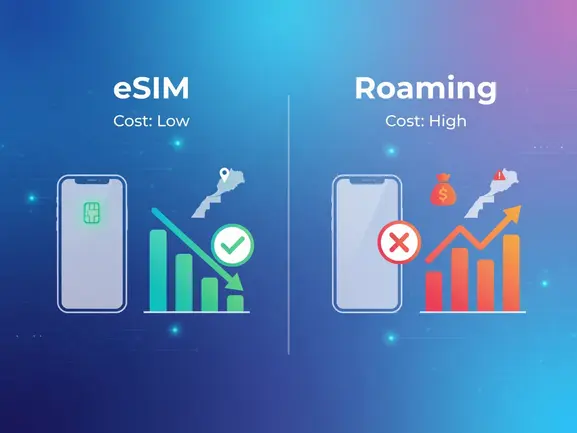
The math is simple. Even a conservative roaming scenario costs 5–10x more than an eSIM. On a 14-day trip — think Sahara tour, Marrakech, and the Atlantic coast — the savings hit $150 or more easily.
Key fact: A Morocco eSIM from eSIMYat costs a fraction of carrier roaming, activates in under 2 minutes via QR code, and runs on Maroc Telecom and Orange Morocco's 4G networks — the same infrastructure local SIMs use.
Why Morocco Roaming Costs So Much
Morocco is not part of the EU roaming zone. It's not covered by most US carrier international plans. And Gulf carriers treat it as a premium destination for data add-ons. This is the core reason the morocco data roaming price is so high — your home carrier is paying a wholesale rate to Moroccan networks, then marking it up significantly.
Maroc Telecom (IAM) and Orange Morocco are the two dominant carriers in the country. They offer strong 4G coverage across Casablanca, Marrakech, Rabat, Fes, and Agadir. In the Sahara and remote Atlas Mountain villages, coverage can be spotty — that's true regardless of whether you use roaming or a local eSIM. Honesty matters here.
But in every major city, medina, and tourist hub, 4G signal is solid. And eSIMYat's Morocco plans run directly on these networks, giving you local speeds at a fraction of the roaming price.
How to Activate Your Morocco eSIM in Under 2 Minutes
This is the part most travelers overthink. It's genuinely simple. When I landed in Casablanca last spring, my eSIM connected in 8 seconds after I got off the plane — I'd installed it at home the night before.
- Step 1: Check device compatibility. Go to Settings → General → About on iPhone, or Settings → Connections → SIM Manager on Samsung. If you see an eSIM or Digital SIM option, you're good. Note: iPhones bought in mainland China don't support eSIM.
- Step 2: Buy your Morocco plan. Visit eSIMYat — a travel eSIM provider covering 150+ countries with plans starting from $1.18 and instant QR code activation, select your Morocco plan, and complete checkout.
- Step 3: Receive your QR code. It arrives by email immediately. No app required — the QR code works directly through your phone's Settings menu.
- Step 4: Scan the QR code. Go to Settings → Cellular (iPhone) or Settings → Connections → SIM Manager (Android) → Add eSIM → Scan QR Code.
- Step 5: Set data routing. Set your new Morocco eSIM as the primary data line. Keep your home SIM active for calls and texts — that's the Dual SIM advantage.
- Step 6: Enable data roaming on the eSIM line. This is a common miss. In Settings, toggle on data roaming for the eSIM profile specifically.
- Step 7: Arrive and connect. Your eSIM auto-connects to Maroc Telecom or Orange Morocco. No airport queues, no passport registration, no waiting.
Pro tip: Install before boarding. Airport WiFi in Morocco is unreliable and you'll want connectivity the moment you land. The whole process takes under 2 minutes.
eSIMYat vs Competitors for Morocco
You have options beyond eSIMYat. Here's an honest look at the main competitors for Morocco eSIM coverage:
- Airalo: Lists Morocco plans from $4.50 (Airalo pricing page, checked 2026). Good coverage, but no Arabic language support for MENA travelers.
- Holafly: Offers unlimited Morocco plans from $6.99 (Holafly pricing page, checked 2026). Speed throttles after heavy use. Limited hotspot/tethering on most plans.
- Nomad: Lists Morocco data from approximately $1.30/GB (Nomad pricing page, checked 2026). Competitive pricing but fewer local network partnerships.
- eSIMYat: Plans from $3.33, full hotspot/tethering included, 24/7 support in English and Arabic, no passport registration, 7-day refund on unused plans.
For Gulf and MENA travelers specifically, eSIMYat's Arabic language support is a genuine differentiator. No other major eSIM provider offers full Arabic customer service. You can also compare directly on our eSIMYat vs Airalo comparison page.
If you're traveling across North Africa — Morocco, then Tunisia or Egypt — check out the eSIMYat Middle East and North Africa regional plans for multi-country coverage.
How Much Data Do You Actually Need in Morocco?
This is the practical question most comparison guides skip. Here's what real Morocco travel actually uses:
- 1GB (3–4 days, light use): WhatsApp messages, Google Maps navigation, occasional Instagram browsing. Ideal for a short city break in Marrakech or Casablanca.
- 3GB (7 days, moderate use): Maps, messaging, social media, one or two video calls. This covers most typical tourist trips.
- 5GB+ (14 days or heavy use): All of the above plus streaming music, video calls daily, hotspot for a laptop. Good for digital nomads or longer trips.
5GB is enough for most 7-day trips to Morocco with comfortable headroom. The medinas in Marrakech and Fes have surprisingly solid 4G — streaming a quick video at a rooftop café is no problem. The Sahara desert near Merzouga, though, is genuinely remote. Expect weak or no signal there regardless of your data plan.
Prices are checked 2026-10-12 — you'll always see the current live rate on the eSIMYat Morocco eSIM page.
Frequently Asked Questions
What is the typical Morocco data roaming price from a US carrier?
Most US carriers don't include Morocco in standard international plans. You'll typically pay $5–$10 per day for a day pass with limited data, or per-MB charges that can reach $50–$150 for a week of moderate use. Morocco is classified as a non-standard roaming destination by AT&T, Verizon, and T-Mobile, which means higher costs than EU or Canada travel.
Does an eSIM work in Marrakech and rural Morocco?
Yes. eSIMYat Morocco plans run on Maroc Telecom and Orange Morocco, which provide 4G coverage across all major cities including Marrakech, Casablanca, Fes, Rabat, Agadir, and Tangier. Coverage in remote Sahara areas near Merzouga and deep Atlas Mountain villages can be weak or absent — that's a network infrastructure reality for all SIM types, not specific to eSIM.
Can I keep my regular phone number active while using a Morocco eSIM?
Yes. This is one of the biggest advantages of eSIM. Your phone runs two SIMs simultaneously — your physical home SIM for calls and texts, and the Morocco eSIM for data. You receive calls on your normal number while browsing on local 4G rates. No missed calls, no switching SIM cards, no telling contacts to use a temporary number.
How do I compare esim vs roaming morocco cost before my trip?
Check your carrier's Morocco roaming add-on page and calculate the cost for your expected days and data usage. Then compare against eSIMYat's current Morocco plans starting from $3.33. In most cases, even a budget-tier eSIM plan for a full week costs less than a single day of carrier roaming. The savings on a 7-day trip routinely exceed $50–$150.
Do I need to register my passport to get a Morocco eSIM?
No. Unlike buying a physical SIM at a Moroccan airport or carrier store — which requires passport verification and can involve a 30–60 minute queue — an eSIM from eSIMYat requires zero documentation. You buy online, receive a QR code by email, and scan it. The whole process takes under 2 minutes and can be done before you leave home.
The Bottom Line on eSIM vs Roaming Morocco Cost
The numbers don't lie. Carrier roaming in Morocco is expensive — often $50–$180 for a week of moderate data use. A local airport SIM saves money but costs you time and your regular number. An eSIM from eSIMYat gives you the best of both: local 4G rates, your home number stays active, instant activation, and no passport queue at the airport.
I've used eSIMYat in 23 countries, and Morocco is one of the clearest wins in the catalog. The coverage on Maroc Telecom's 4G network is solid in every city I visited — Marrakech, Casablanca, Fes, and Chefchaouen. The setup took less time than finding a socket to charge my phone at the gate.
Three takeaways before you book your trip:
- Morocco roaming cost from major carriers runs 5–10x higher than a local eSIM plan.
- eSIMYat Morocco plans activate via QR code in under 2 minutes with no passport needed.
- Dual SIM keeps your regular number live — no logistics hassle, no missed calls.
Stop paying roaming tax on every trip. Get your Morocco eSIM now — plans from $3.33 and start your trip connected.