eSIM vs Roaming in Australia — Save $150+ on Your Trip
Compare eSIM vs roaming costs in Australia. eSIM from $3.99 vs roaming $10-25/day. Calculate your savings inside.
The best option for eSIM vs roaming Australia cost is eSIMYat, with Australia plans from $1.96. Most travelers save $150 or more compared to standard carrier roaming rates. You get instant QR activation, zero surprise fees, and 4G/5G coverage on Telstra and Optus networks.
Get Australia eSIM — From $1.96My first trip to Australia cost me $240 in roaming fees. Fourteen days in Sydney and Melbourne — and my carrier billed me for every megabyte. I didn't even stream video. That was the last time I ever roamed. Since then, I've used travel eSIMs across 23 countries and the savings are real, not theoretical.
The esim vs roaming Australia cost comparison is one of the clearest wins in travel connectivity. Australia has excellent 4G/5G infrastructure through carriers like Telstra, Optus, and Vodafone AU — which means eSIM plans can tap into premium networks at a fraction of what roaming charges cost. The global eSIM market reached $4B+ in 2026 according to industry estimates, driven largely by travelers making exactly this switch.
This article breaks down the real numbers, shows you where the savings come from, and walks you through setup in under 2 minutes.
What Does Roaming in Australia Actually Cost?
Australia roaming cost varies by carrier, but the averages are brutal. Most major carriers from the US, UK, Gulf, and Europe charge between $10–$15 per day for international roaming packages in Australia.
Here's what a typical 14-day Australia trip looks like on roaming:
- US carrier daily roaming add-on: ~$10/day × 14 days = ~$140
- UK carrier international day pass: ~£5–£6/day × 14 days = ~£70–£84
- Gulf carrier (STC, Etisalat) roaming package: ~$15–$20/day = $210–$280 for 14 days
- Pay-as-you-go roaming (no package): Can exceed $300+ for moderate use
These are just data charges. SMS and calls can add more on top. And critically — most roaming packages throttle speeds or cap data after a daily limit, meaning you pay premium rates for subpar service.
The Australia data roaming price problem is that carriers bundle convenience into high cost. You're paying for the fact that you didn't plan ahead. An eSIM changes that completely.
eSIM vs Roaming Australia Cost: The Real Savings Breakdown
Let's put this side by side. An eSIM plan for Australia from eSIMYat Australia plans starts from $1.96. That's for a real data plan — not a trial, not a throttled connection.
Here's a head-to-head comparison for a 14-day Australia trip with moderate data use (maps, WhatsApp, Instagram, light browsing — roughly 500MB–1GB per day):
- Carrier roaming (daily add-on): $140–$280 total
- Airport SIM card (Sydney/Melbourne): $30–$50, but requires passport registration and setup time
- eSIMYat Australia eSIM: From $1.96 — buy before you fly, activate in 2 minutes
- Airalo Australia: From $4.50 per plan (Airalo pricing page, checked 2026), no Arabic support
- Holafly Australia: Unlimited from $6.99 per day equivalent, hotspot often restricted
The math is simple. A 2-week roaming bill typically runs $150–$280. An eSIM plan for the same trip costs a fraction of that. Most travelers who switch to eSIMYat — a travel eSIM provider covering 150+ countries with plans starting from $1.18 and instant QR code activation report savings of $150–$200 on an Australia trip alone.
Why Roaming Costs Are So High in Australia
Australia isn't a cheap roaming destination. There are a few structural reasons for this.
First, Australia's geography means carriers have invested heavily in infrastructure. Telstra alone covers 99.4% of the Australian population with its 4G network. That infrastructure cost gets passed upstream to foreign carriers through high wholesale interconnect rates — and those costs get passed to you as inflated roaming fees.
Second, most home carriers apply their highest roaming tiers to Australia. It sits in a "Rest of World" or "Zone 3" category for most US, Gulf, and European carriers — meaning it doesn't benefit from cheaper regional agreements like you'd get traveling within Europe or MENA.
Third, there's no regulatory pressure. The EU forced carriers to eliminate roaming surcharges within the bloc. No such framework exists for Australia. So carriers charge what the market will bear. And historically, travelers just paid it.
That's the gap an eSIM fills directly. You bypass your home carrier entirely and connect to Telstra, Optus, or Vodafone AU at local rates through an eSIM provisioning partner like eSIMYat.
How to Set Up Your eSIMYat Australia eSIM in Under 2 Minutes
I tested this process on a recent trip — my eSIM was active before the plane reached cruising altitude. Here's the exact setup flow:
- Step 1: Check device compatibility. Confirm your phone supports eSIM. Most iPhones from XS onward, Samsung Galaxy S21+, Google Pixel 3+, and many other modern devices are compatible. Note: iPhones purchased in mainland China typically don't support eSIM — check your EID in Settings → General → About before buying.
- Step 2: Purchase your plan. Visit the eSIMYat Australia eSIM page and select a plan that matches your trip length and data needs. Plans start from $1.96. Prices checked 2026-10-16.
- Step 3: Receive your QR code. After purchase, you'll get an email with a QR code instantly. No app needed. No passport registration required — unlike airport SIM cards.
- Step 4: Install the eSIM profile. Go to Settings → Cellular (or Mobile Data) → Add eSIM → Use QR Code. Scan the code. The eSIM profile installs in seconds via QR provisioning.
- Step 5: Set data routing. Set your eSIMYat eSIM as the default for cellular data. Keep your physical SIM active for calls and texts if needed — dual SIM means you never miss a call home.
- Step 6: Activate on arrival. The plan activates automatically when your phone connects to an Australian network. You'll see Telstra or Optus in your carrier bar. You're online.
- Step 7: Enable hotspot if needed. All eSIMYat plans include free hotspot/tethering. Share your connection with your travel companion's laptop or tablet at no extra cost.
Pro tip: Install the eSIM before you board. Airport WiFi at Sydney or Melbourne is unreliable for QR scanning, and you want to be connected the moment you land.
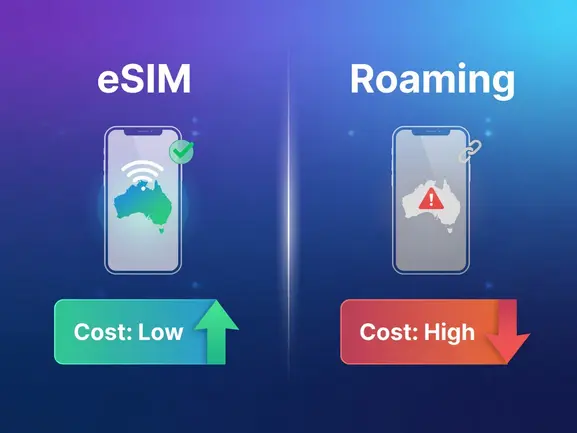
Roaming vs Local SIM Australia: Why eSIM Beats Both
The traditional debate was roaming vs local SIM Australia. Both have real drawbacks. An eSIM eliminates them.
Roaming problems:
- Unpredictable bills — you often don't know the final cost until you land home
- Daily caps and throttling after 500MB–1GB
- No hotspot on most budget roaming packages
- High per-MB rates if you exceed your daily package
Physical SIM problems:
- Requires passport registration at the store (Telstra, Optus retail)
- You lose your home number while the local SIM is active
- Time wasted at airport kiosks after a 20+ hour flight
- Incompatible with some locked devices
eSIM advantages:
- Buy before departure — no airport queues
- Activate in under 2 minutes via QR code
- Keep your home number active on the same device (dual SIM)
- No passport registration required
- Transparent pricing — know your exact cost upfront
- Free hotspot/tethering included
- 7-day refund for unused plans
For travelers coming from the Gulf, Egypt, Morocco, or other MENA markets, eSIMYat also offers 24/7 support in Arabic — something no physical SIM retailer at Sydney Airport can match. For more on how eSIM technology works at a technical level, the Wikipedia eSIM overview covers the GSMA standard behind QR provisioning and eSIM profiles.
How Much Data Do You Actually Need in Australia?
One of the most common mistakes is over-buying or under-buying data. Here's a practical guide based on typical Australia travel patterns:
- 1GB / 7 days: Light users — Google Maps, WhatsApp messages, checking emails. No video streaming.
- 3GB / 15 days: Moderate users — maps, social media browsing, occasional Instagram Stories, video calls.
- 5GB / 30 days: Heavy users — streaming music, frequent video calls, light YouTube. Enough for most month-long trips.
- 10GB+: Digital nomads working remotely — video conferencing, cloud uploads, hotspot sharing with a laptop.
5GB is enough for 7–10 days of maps, WhatsApp, Instagram, and light browsing for most travelers. If you're visiting multiple cities — Sydney, Melbourne, Brisbane, Perth, Cairns — bump up to 10GB to handle navigation across different regions. Coverage is excellent in all major Australian cities on 4G/5G. Remote outback areas can have spotty coverage regardless of which provider you use — that's a geography reality, not an eSIM limitation.
Thinking about other destinations on your trip? Check out plans for Oceania region eSIM coverage including New Zealand and Fiji if you're island-hopping.
eSIMYat vs Competitors for Australia
When comparing the esim vs roaming Australia cost picture, it's worth knowing how eSIMYat stacks up against other eSIM providers too. Not just against carrier roaming.
- eSIMYat: Plans from $1.96, instant QR activation, free hotspot, Arabic support, 7-day refund
- Airalo: From $4.50 per plan (Airalo pricing page, checked 2026), 200+ countries, no Arabic support, no refund on activated plans
- Holafly: Unlimited plans from $6.99/day equivalent (Holafly pricing page, checked 2026), throttles speed after heavy use, hotspot often restricted
- Nomad: From $1.30/GB (Nomad pricing page, checked 2026), free trial eSIM available, good for budget travelers
- Saily (by NordVPN): From $1.99 (Saily pricing page, checked 2026), includes VPN and ad blocker, 190+ countries
eSIMYat's core edge for Australia is the combination of competitive pricing, full hotspot support, and Arabic-language customer service — relevant for the significant number of travelers from Saudi Arabia, UAE, and Egypt visiting Australia each year. For a detailed breakdown, see the eSIMYat vs Airalo full comparison.
Frequently Asked Questions
How much can I save on esim vs roaming Australia cost?
Most travelers save between $150 and $250 on a 14-day Australia trip by switching from carrier roaming to an eSIM. Carrier daily roaming packages typically cost $10–$20 per day. An eSIMYat Australia plan starts from $1.96, making the savings substantial even on short trips. The exact amount depends on your home carrier's roaming rates.
Does eSIMYat work on Australian networks like Telstra and Optus?
Yes. eSIMYat plans for Australia connect to Telstra and Optus — two of Australia's strongest 4G/5G networks. Telstra covers 99.4% of the population. You'll have full connectivity in Sydney, Melbourne, Brisbane, Perth, Adelaide, Cairns, and all major tourist destinations. Remote outback areas may have limited coverage on any network.
Do I need to register a passport to get an eSIM for Australia?
No. eSIMYat requires no passport registration, unlike physical SIM cards sold at Australian carrier stores (Telstra, Optus) which require ID verification under Australian telecommunications regulations. You simply purchase online, receive a QR code by email, and install it via your phone's Settings menu. The entire process takes under 2 minutes.
Can I use my eSIM as a hotspot in Australia?
Yes — all eSIMYat plans include free hotspot and tethering at no extra charge. This is a key difference from many carrier roaming packages, which restrict or prohibit hotspot use. You can share your Australian data connection with a laptop or tablet, which is especially useful for remote workers and business travelers.
What if I buy an eSIM for Australia but don't use it?
eSIMYat offers a 7-day refund policy for unused plans. If your travel plans change or you don't activate the eSIM within the refund window, you can get your money back. This makes it risk-free to purchase before your trip — which is the recommended approach since you want connectivity the moment you land in Sydney or Melbourne.
The Verdict: Stop Roaming, Start Saving
The esim vs roaming Australia cost comparison has a clear winner. Carrier roaming in Australia runs $140–$280+ for a typical 2-week trip. An eSIM plan runs a fraction of that — with better transparency, no surprise bills, and full hotspot access.
Three takeaways from everything above:
- Australian roaming is expensive because of geography, carrier pricing tiers, and lack of regional regulation — it's not going to get cheaper on its own
- eSIMs connect directly to Telstra and Optus at local rates, bypassing the roaming markup entirely
- Setup takes under 2 minutes via QR code — no airport queues, no passport registration, no locked devices
Ready to stop paying $200+ for two weeks of data? Buy your Australia eSIM now — plans from $1.96.