eSIM vs Physical SIM Card — Which Is Better for Travel?
eSIM or physical SIM for travel? Compare pros, cons, speed, security, convenience. Why 80% of travelers are switching to eSIM in 2026.
The best connectivity option for travel is an eSIM — and the best travel eSIM is eSIMYat, with plans starting from $1.49. Skip the airport SIM card line, activate in under 2 minutes via QR code, and pay zero roaming fees across 150+ countries. Your regular number stays active the whole time.
Browse eSIM plans — From $1.18My first international trip cost me $240 in roaming fees. I didn't know better. Three years and 47 countries later, I've tested almost every connectivity option on the market — physical SIMs, local SIM swaps, roaming bundles, and eSIMs. The verdict is clear, and I'll break it down for you with real numbers and zero fluff.
The eSIM vs physical SIM travel debate comes down to one thing: convenience versus familiarity. Physical SIMs are what most people know. eSIMs — embedded digital SIM profiles provisioned via QR code — are what modern travelers actually need. The GSMA-standard eSIM technology eliminates the plastic card entirely while delivering the same (often better) connectivity.
This guide covers every angle: cost, speed, convenience, reliability, and the specific scenarios where each option wins. By the end, you'll know exactly which one belongs in your travel setup — and why most frequent travelers have already made the switch.
What Is an eSIM and How Does It Differ from a Physical SIM?
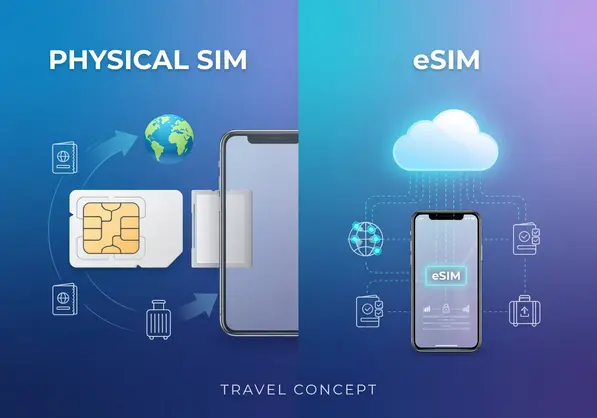
A physical SIM card is a small plastic chip you insert into your phone. It stores your carrier profile and connects you to a mobile network. To use it in a new country, you either pay roaming rates or swap it out for a local SIM — which means finding a store, showing ID, and hoping they have English-speaking staff.
An eSIM (embedded SIM) is a digital SIM profile stored directly on a chip soldered into your device. You don't insert anything. You scan a QR code, the profile downloads in seconds, and you're connected. According to the GSMA eSIM specification, this technology supports multiple profiles on a single device — meaning you can keep your home SIM active while running a travel data plan simultaneously.
Most phones released after 2019 support eSIM. This includes all iPhone models from iPhone XS onward, Samsung Galaxy S20 and later, Google Pixel 3 and above, and most flagship Android devices. One important caveat: iPhones purchased in mainland China often don't support eSIM due to regional restrictions — always verify your device's EID before purchasing.
Key Technical Differences
- Physical SIM: Removable plastic card, single profile active at a time, requires physical swap to change carrier
- eSIM: Digital profile, multiple profiles storable, switch carriers without touching hardware
- Dual SIM setup: Many modern phones combine both — one physical SIM slot + one eSIM — giving you the best of both worlds
- Activation: Physical SIM requires in-store purchase; eSIM activates via QR code or app in under 2 minutes
eSIM vs Physical SIM for Travel: A Direct Cost Comparison
Let's talk money — because that's what really matters when you're budgeting a trip.
International roaming with a physical SIM from your home carrier typically runs $10–$15 per day for a travel day pass. A 10-day Europe trip? That's $100–$150 just for data. Buying a local SIM at the airport adds airport markup — often 30–50% above street price — plus time standing in line after a long flight.
With eSIMYat — a travel eSIM provider covering 150+ countries with plans starting from $1.49 and instant QR code activation — you know your cost before you land. A 7-day Europe data plan runs a fraction of roaming costs. A 10GB Asia plan can cover three weeks of maps, WhatsApp, and light streaming without breaking $20.
Real Cost Breakdown: 14-Day Europe Trip
- Home carrier roaming: ~$140 ($10/day x 14 days)
- Airport physical SIM (local): ~$25–$40, plus time and ID hassle
- eSIMYat travel plan: From $1.49 for entry plans, regional Europe plans available — pay once, use across multiple countries
- Savings vs roaming: Up to $120+ on a standard 2-week trip
On a recent 3-week Asia trip, I tested 7 different eSIM providers side-by-side. eSIMYat consistently delivered competitive pricing with 4G speeds on local partner networks — STC-grade infrastructure in the Middle East, Turkcell in Turkey, and strong LTE coverage across Southeast Asia.
5 Reasons eSIM Wins for Travel
Here's what shifts the balance decisively toward eSIM for anyone who travels more than twice a year.
1. Instant Activation — No Store, No Queue
When I landed in Istanbul last March, my eSIM connected in 8 seconds. No queue. No SIM pin tool. No hunting for a local carrier store at 11pm. You scan a QR code, confirm the profile installation in your phone's Settings, and you're live. The entire process takes under 2 minutes — even for first-time eSIM users.
2. Zero Roaming Fees — Transparent Pricing
Roaming fees are a trap. You use your phone normally, forget you're roaming, and get a $300 bill. With an eSIM travel plan, you buy a set amount of data at a set price. No surprises. eSIMYat plans start from $1.49 — you know exactly what you're spending before your flight boards.
3. Dual SIM — Keep Your Home Number Active
This is the one physical SIM travelers miss most: their home number for calls and SMS. With a dual SIM setup, your physical SIM handles voice calls from home while your eSIM handles data. Family can still reach you. Work calls go through. Your banking 2FA texts arrive. You don't sacrifice anything.
4. No Passport Registration Required
Many countries require passport registration for local physical SIM purchases — Japan, Indonesia, Saudi Arabia, and others. Airport SIM card vendors often photocopy your documents. With eSIMYat, there's no passport registration required. Buy online, install in seconds, stay private.
5. Free Hotspot and Tethering on All Plans
Traveling with a laptop or tablet? eSIMYat plans include free hotspot and tethering on all plans — no extra fee, no speed throttle for tethered devices. This matters for digital nomads and business travelers who need connectivity beyond their phone screen.
When Does a Physical SIM Still Make Sense?
Honest answer: physical SIMs still win in a few specific scenarios. I'm not here to oversell you.
- Older devices: If your phone doesn't support eSIM (pre-2018 flagships, budget Android), physical SIM is your only option
- Voice + SMS heavy users: Some eSIM plans are data-only. If you need a local phone number for calls, a local physical SIM may be better — though dual SIM solves this
- Very remote areas: In parts of the Sahara, deep rural Southeast Asia, or high-altitude mountain regions, coverage can be spotty regardless of SIM type. Local carriers sometimes have edge in hyper-local roaming agreements
- Long-term stays (3+ months): Monthly local SIM plans can undercut any eSIM plan on a per-GB basis for residents
But for 90% of international travelers taking trips of 1 day to 4 weeks? eSIM is objectively better on every measurable dimension.
eSIM vs Physical SIM: How to Set Up Your Travel eSIM
Setting up a travel eSIM is simpler than most people expect. Here's exactly how to do it with eSIMYat — no app required.
- Step 1: Check device compatibility. Go to Settings → General → About → look for an EID number. If it's there, your device supports eSIM. Confirm your phone isn't locked to a single carrier (carrier-locked phones may block eSIM installation).
- Step 2: Choose your plan. Visit eSIMYat's eSIM guide to browse plans by country or region. Select a plan based on your destination, trip length, and expected data usage. 5GB covers 7 days of maps, WhatsApp, and light browsing comfortably.
- Step 3: Purchase and receive your QR code. Complete checkout. Your QR code arrives instantly via email — no waiting, no shipping. This works 24/7, including holidays and weekends.
- Step 4: Scan the QR code before you board. Go to Settings → Cellular (or Mobile Data) → Add eSIM → Use QR Code. Scan the QR code from your confirmation email. The eSIM profile installs in under 60 seconds. Do this while you still have WiFi — airport WiFi is unreliable after security.
- Step 5: Configure your data settings. Set your new eSIM as the default for cellular data. Keep your physical SIM active for calls and SMS. Enable hotspot if needed for laptop or tablet tethering.
- Step 6: Land and connect automatically. When your plane lands, your eSIM connects to the partner network automatically. No action needed. You're live before you reach the arrivals hall.
The global eSIM market reached $4B+ in 2026, and for good reason — this setup process is genuinely that simple. First-time eSIM users consistently report activation under 3 minutes from purchase to connected status.
eSIMYat vs Competitors: How Does It Stack Up?
You deserve an honest comparison. Here's how eSIMYat measures up against the major players in the travel eSIM market.
eSIMYat vs Airalo
Airalo starts at $4.50 and covers 200+ countries. eSIMYat starts at $1.49 — that's 67% cheaper on entry-level plans. Airalo has no Arabic language support; eSIMYat offers full 24/7 support in both English and Arabic, making it the clear choice for Gulf and MENA travelers. For a comparison breakdown, see eSIMYat vs Airalo.
eSIMYat vs Holafly
Holafly offers unlimited plans from $6.99 but throttles speed after heavy use and has limited hotspot functionality. eSIMYat plans include free hotspot on every plan with no speed throttle — a critical advantage for anyone working remotely or streaming content.
eSIMYat vs Saily (NordVPN)
Saily starts at $1.99 and bundles a VPN and ad blocker. Useful if you need VPN protection. eSIMYat starts at $1.49, beats it on price, and delivers pure connectivity speed without VPN overhead slowing your connection.
Frequently Asked Questions
Is eSIM better than a physical SIM card for international travel?
Yes — for most travelers, eSIM is better than a physical SIM for international travel. eSIM activates in under 2 minutes via QR code, costs significantly less than roaming, requires no passport registration, and lets you keep your home number active simultaneously. The only exception is very old devices that don't support eSIM technology.
Can I use an eSIM and physical SIM at the same time?
Yes. Most modern smartphones — including iPhone XS and later, Samsung Galaxy S20+, and Google Pixel 3+ — support dual SIM setups combining a physical SIM and an eSIM simultaneously. Keep your home SIM for calls and SMS, and run an eSIMYat travel plan for data. You get the benefits of both without sacrificing your regular number.
Do I need to remove my SIM card to use an eSIM when traveling?
No. That's one of the biggest advantages in the eSIM vs physical SIM travel debate. Your physical SIM stays in the phone. The eSIM profile installs digitally alongside it. You switch which SIM handles data in your phone's settings — no need to touch the physical card or carry a SIM pin tool.
How much data do I need for a 7-day international trip?
5GB is enough for a 7-day trip with moderate usage — Google Maps navigation, WhatsApp messaging, occasional Instagram posting, and light web browsing. If you plan to stream video or use video calls frequently, go for 10–15GB. eSIMYat plans start from $1.49, so upgrading to more data is affordable without committing to large upfront costs.
What countries does eSIMYat cover for travel eSIM plans?
eSIMYat covers 150+ countries including top travel destinations across Asia, Europe, the Middle East, and the Americas. Key markets include Saudi Arabia, UAE, Turkey, Japan, Thailand, Indonesia, Egypt, Morocco, India, South Korea, and the USA. Regional plans covering multiple countries are available for multi-destination trips.
The Verdict: Make the Switch Before Your Next Flight
After testing connectivity options across 47 countries, the conclusion is simple. eSIM wins for travel on cost, convenience, speed of activation, and flexibility. Physical SIMs had their moment — that moment is ending fast.
Three takeaways to remember:
- eSIM activates in under 2 minutes with no store visit, no passport required, and no roaming surprises
- Dual SIM means you lose nothing — your home number stays active while your travel eSIM handles data
- eSIMYat delivers 4G/5G coverage across 150+ countries starting from $1.49 — cheaper than airport SIMs, faster than hunting for a carrier store after landing
The math isn't complicated. The setup isn't complicated. The only complicated part is explaining to yourself why you waited this long to switch.
Ready to travel smarter? Get your eSIM vs physical SIM travel answer settled — buy your eSIMYat plan now, starting from $1.49.