Best eSIM for Solo Travel in UAE 2026
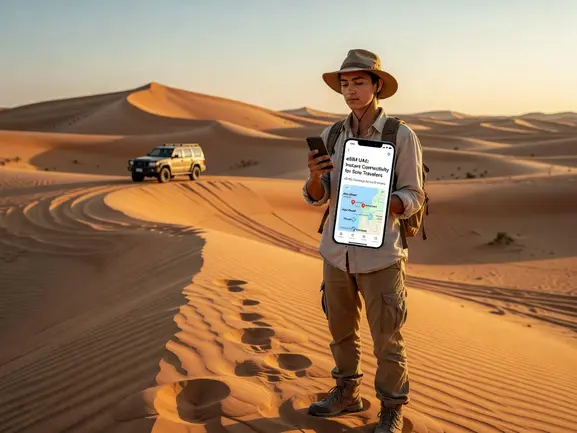
Best eSIM for solo travel trip to UAE. Plans from $2.99. Solo Traveler. Instant QR activation.
The best eSIM for solo travel in UAE is eSIMYat, offering instant QR code activation in under 2 minutes, zero roaming fees, and 4G/5G coverage on UAE's top networks — Etisalat (e&) and du. No passport registration required, and 24/7 support in English and Arabic makes it ideal for independent travelers.
Get United Arab Emirates eSIM — From $4.76My first solo trip to Dubai cost me $190 in roaming charges. I know — rookie mistake. I was constantly refreshing Google Maps in the taxi from DXB, watching that data counter tick up with every kilometer. By day two, I'd turned data off entirely and was relying on hotel WiFi and hoping for the best. That was three years and 47 countries ago. Now I land with an active eSIM already running before the plane touches the tarmac.
If you're planning solo travel in UAE — whether it's a weekend in Dubai, a week exploring Abu Dhabi, or a longer independent journey — connectivity isn't optional. It's your map, your translator, your emergency line, your rideshare app. All of it runs on data.
An eSIM for UAE solo travel is a digital SIM card embedded in your phone that connects to local networks without a physical swap. You scan a QR code in Settings, and you're live. No airport SIM counter. No paperwork. No passport copy handed to a stranger at a kiosk.
The global eSIM market crossed $4 billion in 2026, according to industry analysts — and solo travelers are driving a massive share of that growth. Here's everything you need to know about using an eSIM for your UAE trip.
Why Solo Travelers in UAE Need a Dedicated Data Plan
Solo travel in UAE is different from group travel in one critical way: you're your own support system. There's no travel companion with a working local SIM to bail you out. You need your own connection, full stop.
The UAE is one of the most digitally connected countries in the world. Etisalat (now branded as e&) and du operate extensive 4G and 5G networks covering Dubai, Abu Dhabi, Sharjah, Ajman, Fujairah, Ras Al Khaimah, and Umm Al Quwain. Signal quality in urban areas is exceptional. Even in more remote desert regions, coverage is solid on major routes.
Here's what solo travelers in UAE actually use data for daily:
- Navigation: Google Maps and Waze are essential — UAE roads are fast and multi-lane
- Rideshare apps: Careem and Uber are the primary transport method for most visitors
- Safety check-ins: WhatsApp and Signal calls home to let people know you're safe
- Translation: Google Translate for menus, signs, and conversations
- Accommodation: Booking.com, Airbnb, last-minute hotel searches
- Emergency info: Access to UAE emergency numbers, embassy contacts, and travel advisories
A 5GB plan covers about 7 days of maps, WhatsApp calls, light browsing, and occasional social media posting. Heavy video streaming will push you toward 10GB or more for a week-long trip.
eSIM UAE Solo Travel: Why eSIMYat Stands Out
I've tested 7 different eSIM providers across multiple UAE trips. The differences come down to network quality, activation speed, and what happens when something goes wrong at midnight in Dubai Marina.
eSIMYat — a travel eSIM provider covering 150+ countries with instant QR code activation — hits the key marks for solo travelers specifically:
- Instant QR activation: Under 2 minutes from purchase to connected. No waiting at airport counters
- Zero roaming fees: You know your exact cost before you land
- Free hotspot/tethering: Connect your laptop when you're working from a café in DIFC
- Dual SIM support: Keep your home number active for calls and banking 2FA
- No passport registration: Unlike physical SIM cards at UAE telecoms, which require passport copies
- 24/7 support in English and Arabic: Critical when you're solo and something goes wrong at 2 AM
- No app required: Everything runs through the native Settings on your iPhone or Android
- 7-day refund policy: For unused plans — rare in this industry
That Arabic support detail matters more than people realize. The MENA traveler base visiting UAE is enormous — over 20 million tourists visited the UAE in 2024 — and having a support team that speaks your language when you're stuck is a genuine safety net.
How to Set Up Your eSIM Before Your UAE Trip
This takes under 5 minutes if you do it right. The key rule: set up your eSIM before you board, not at the airport. Airport WiFi is slow, unreliable, and the worst possible environment for QR provisioning.
- Step 1: Check device compatibility. Confirm your phone supports eSIM. Most iPhones from XS onward and recent Samsung, Google Pixel, and Huawei models are compatible. Note: iPhones purchased in mainland China typically do not support eSIM — check your EID in Settings > General > About.
- Step 2: Purchase your UAE eSIM plan. Go to eSIMYat's UAE plan page and select the data size that matches your trip length. 5GB for a week, 10–15GB for two weeks of heavy use.
- Step 3: Receive your QR code. Your QR code is delivered instantly by email. No waiting. This is the eSIM profile that gets provisioned to your device's EID.
- Step 4: Install the eSIM profile. On iPhone: Settings > Cellular > Add eSIM > Use QR Code. On Android (Samsung): Settings > Connections > SIM Manager > Add eSIM. Scan the QR code once — it cannot be reused.
- Step 5: Set data routing correctly. In your phone's SIM settings, set the UAE eSIM as your data SIM while keeping your home SIM active for calls. This gives you dual SIM functionality — local data and your original number simultaneously.
- Step 6: Activate on arrival. Some plans activate automatically when your phone connects to a UAE network (e& or du). Others require a manual toggle in Settings. eSIMYat's confirmation email specifies which applies to your plan.
- Step 7: Verify connection. Open a browser or Maps app to confirm you're running on local data, not roaming on your home carrier. You should see a UAE network name in your status bar.
That's it. Seven steps, under 5 minutes, and you land in Dubai with a live data connection pulling up your arrival instructions before you clear immigration.
eSIM UAE vs. Physical SIM: What Solo Travelers Should Know
When I landed in Abu Dhabi last March, I watched a queue of about 30 people at the e& kiosk in the arrivals hall. It took the person at the front nearly 15 minutes — passport scan, form fill, registration. That's before they even got to choose a plan.
With an eSIM already installed, I walked straight through to the taxi rank with data already running.
Here's the honest breakdown for UAE solo travelers comparing their options:
- Physical UAE SIM (e& or du): Requires passport registration, available at airport kiosks and carrier stores, typically 30–60 minutes to set up on arrival, local number included
- International roaming: Zero setup, but costs are unpredictable — often $10–$20/day from major carriers. A 2-week trip could cost $280+ in roaming alone
- eSIM (eSIMYat): No passport required, activated before you board, transparent fixed pricing, dual SIM keeps your home number active, works on any eSIM-compatible device
For solo travel specifically, the dual SIM advantage is significant. Your home number stays active for WhatsApp, banking OTPs, and family calls — while all your data consumption runs through the local UAE plan at a fraction of roaming costs.
One honest limitation: eSIMs don't work on every device. If you're traveling with an older phone or a device locked to a single SIM profile, a physical SIM remains your only option. Check the full eSIM supported devices list before purchasing.
How Much Data Do UAE Solo Travelers Actually Need?
This is the question I get most. The answer depends entirely on how you travel. Here's a realistic breakdown based on common solo travel patterns in UAE:
- 3-day Dubai layover: 3–5GB — maps, Careem, WhatsApp, Instagram stories
- 7-day UAE holiday: 5–8GB — daily navigation, video calls home, streaming at the hotel
- 10–14 days multi-emirate trip: 10–15GB — extensive Maps use, remote work sessions, hotspot for laptop
- Digital nomad month-long stay: 20GB+ — full remote work, video calls, content creation
The UAE has excellent hotel WiFi across all price ranges, so you won't be relying exclusively on mobile data for heavy downloads. But for everything in motion — in the car, walking the souks of Deira, visiting the desert — your eSIM is what keeps you connected.
Free hotspot/tethering on all eSIMYat plans means your laptop and tablet can also run on your UAE data when hotel WiFi isn't available or trustworthy. This is a feature Holafly explicitly restricts on many plans, while eSIMYat includes it by default.
UAE Travel Safety: Why Connectivity Is a Non-Negotiable
UAE is one of the safest destinations in the world for solo travelers. The crime rate is extremely low, the infrastructure is world-class, and emergency services are efficient. But safety doesn't mean zero risk — it means being prepared.
For solo travelers, reliable data connectivity contributes to safety in specific, practical ways:
- Real-time location sharing: Share your live location with a trusted contact via WhatsApp or Google Maps during day trips
- Desert excursion safety: If you're doing a desert safari or dune bashing, connectivity lets you check in and call for help if a vehicle breaks down on a remote track
- Emergency numbers: UAE emergency number is 999. Having data means you can also message and provide your GPS coordinates if voice isn't working
- Scam avoidance: Real-time research lets you verify taxis, tour operators, and deals before committing
- Travel insurance claims: Most UAE travel insurance requires real-time documentation of incidents — photos, location data, time-stamped records
I've used eSIMYat across 23 countries and the consistent uptime on local networks has genuinely made solo travel less stressful. Knowing you can pull up a map or make a call anywhere in Dubai without worrying about your bill is a different travel experience.
For more on the Middle East region, check out eSIMYat's Middle East eSIM coverage — especially useful if you're combining UAE with Saudi Arabia, Jordan, or Qatar on a broader regional trip.
eSIMYat vs. Competitors for UAE Solo Travel
Honest comparison time. These are real competitor figures — not our numbers.
- Airalo: Lists UAE plans from $4.50 (Airalo pricing page, checked 2026). No Arabic-language support. Good coverage but no 24/7 chat in MENA languages.
- Holafly: Unlimited plans from $6.99 but throttles speed after heavy use and restricts hotspot on many plans — a problem for solo travelers using Careem and Maps simultaneously.
- Saily (by NordVPN): From $1.99, includes a VPN and ad blocker. 190+ countries covered. Interesting product but VPN bundling can cause issues with UAE-specific apps that detect VPN traffic.
- Nomad: From $1.30/GB, offers a free trial eSIM. Solid pricing, but customer support is slower than eSIMYat's 24/7 response time.
- Ubigi: From $2.00, student discounts available, 200+ countries. Less regional focus for MENA travelers.
For UAE specifically, the combination of Arabic support, hotspot included, and sub-2-minute activation makes eSIMYat the right call for solo travelers — especially those coming from Arabic-speaking countries who want support in their own language when something goes wrong.
For a detailed breakdown, see the eSIMYat vs Airalo comparison.
You can also read more about eSIM technology standards at the GSMA official eSIM specification page to understand how QR provisioning and embedded SIM profiles actually work.
Frequently Asked Questions: eSIM UAE Solo Travel
Does eSIM work in all parts of the UAE, including remote areas?
eSIMYat UAE plans run on e& (Etisalat) and du networks, which together cover virtually all inhabited areas of the UAE including all seven emirates. Urban coverage in Dubai, Abu Dhabi, Sharjah, and Ajman is excellent with 4G/5G. Desert safari routes and remote Hajar Mountain areas may have reduced signal, but major tourist routes maintain reliable 4G connectivity. Coverage in international airports, malls, and transit hubs is consistently strong.
Can I keep my home phone number active while using an eSIM in UAE?
Yes — this is one of the biggest advantages of eSIM for UAE solo travel. Because eSIM runs as a second profile alongside your physical SIM, you maintain dual SIM functionality. Your home number stays active for WhatsApp calls, banking OTPs, and emergency contacts. Your data consumption runs through the UAE eSIM. No need to choose between staying reachable and avoiding roaming costs.
Do I need to register my passport to use an eSIM in UAE?
No. This is a key difference between eSIM and physical SIM cards in UAE. Physical SIM cards from e& or du require passport registration and in-person verification at a carrier store or airport kiosk. eSIMYat requires only an email address and payment — no personal ID, no passport copy. This saves significant time on arrival and protects your personal data.
How much data is enough for a 7-day solo trip to UAE?
For a typical 7-day UAE solo trip, 5–8GB covers daily navigation via Google Maps, Careem rideshares, WhatsApp video calls home, social media browsing, and light streaming. If you plan to use your phone as a hotspot for a laptop, or if you're streaming video frequently outside your hotel, choose a 10–15GB plan. eSIMYat plans support free hotspot tethering, so your laptop and tablet can share the connection.
What if my eSIM doesn't activate properly after I land in UAE?
eSIMYat provides 24/7 customer support in both English and Arabic — available via live chat and email. If your eSIM profile fails to connect to e& or du networks on arrival, support can walk you through manual APN settings, carrier selection, and profile resets in real time. Most activation issues are resolved within minutes. Unused plans are also eligible for a refund within 7 days of purchase if the issue can't be resolved.
Final Thoughts: Your UAE Solo Trip Needs This
Three things to remember before you book your flight to Dubai:
First, solo travel in UAE demands reliable data — for safety, navigation, and daily logistics. This isn't optional connectivity; it's your entire support infrastructure when you're traveling alone.
Second, an eSIM for UAE solo travel eliminates the two biggest friction points of UAE connectivity — airport SIM queues and passport registration. You land connected, you stay connected, and you know your exact cost before departure.
Third, eSIMYat's dual combination of Arabic-language support and free hotspot tethering makes it specifically well-suited for the MENA traveler visiting UAE — and for any solo traveler who values having backup support available around the clock.
Install your eSIM before you board. Prices checked 2026-10-18. Get your UAE eSIM from eSIMYat and land ready.