Best eSIM for Backpacking in UAE 2026
Best eSIM for backpacking trip to UAE. Plans from $2.99. Budget Travel. Instant QR activation.
The best eSIM for backpacking in UAE is eSIMYat, with instant QR code activation in under 2 minutes, zero roaming fees, and 4G/5G coverage on UAE's top local networks. No passport registration required — just scan, activate, and you're online before you leave the airport.
Get United Arab Emirates eSIM — From $4.76My first trip to Dubai without a data plan cost me a fortune. I relied on hostel WiFi that dropped every 20 minutes and paid through the nose for a tourist SIM that required three forms of ID and a 40-minute queue at the airport. That was the last time. Now I use an eSIM UAE backpacking plan — activated from my couch before I even pack my bag.
An eSIM (embedded SIM) is a digital SIM card provisioned via QR code directly into your phone's eSIM profile slot. According to the GSMA eSIM specification, the technology lets travelers switch carriers without physically swapping a SIM card. The UAE's two dominant carriers — Etisalat (now branded as e&) and du — both provide extensive 4G and 5G infrastructure across Dubai, Abu Dhabi, Sharjah, and beyond.
For budget backpackers, that means one thing: you need reliable, affordable data from day one. Not roaming charges. Not airport SIM card queues. A proper esim uae backpacking plan that keeps you connected from the moment you land at DXB or AUH.
Why Backpackers Need a Dedicated UAE eSIM Plan
The UAE is not a cheap country. Hostel beds in Dubai average $30–$50/night. Street food is affordable, but transport adds up fast. Every dirham counts — which means paying international roaming rates (often $10–$15/day from Western carriers) is a non-starter.
After testing eSIM plans across 47 countries over 3 years, I can tell you: the UAE is one of the easiest markets for eSIM activation. Coverage is near-universal. Both e& and du run strong 5G networks in urban areas and solid 4G in beach corridors, desert areas, and the northern emirates.
Here's what backpackers specifically need in a UAE eSIM:
- Enough data for navigation — Google Maps in the UAE is accurate and essential
- WhatsApp connectivity — note that WhatsApp voice/video calls are restricted in the UAE under TRA regulations; messaging works fine
- Hotspot/tethering — to share your connection with a travel companion or laptop
- Dual SIM support — keep your home number active for emergency calls and banking OTPs
- No passport registration — unlike physical SIM cards at UAE telco stores, which require Emirates ID or passport
eSIMYat checks every box. Free hotspot on all plans, dual SIM compatibility, and zero registration paperwork. You buy online, receive a QR code by email, scan it in Settings, and you're done.
How Much Data Do UAE Backpackers Actually Need?
This is the question I get most. And the answer depends entirely on your travel style. Here's a practical data usage breakdown based on a typical UAE backpacking day:
- Google Maps navigation (2 hours/day): ~60MB/day
- WhatsApp messaging + photos: ~30MB/day
- Instagram browsing (30 min): ~150MB/day
- Booking hostels / checking transport apps: ~40MB/day
- Light streaming (YouTube, 15 min): ~100MB/day
Total: roughly 380MB/day. That means 5GB is enough for a 10–13 day backpacking trip with moderate use. Heavy social media posters or remote workers will want 10GB+.
The UAE trip is typically 7–21 days for backpackers hitting Dubai, Abu Dhabi, Sharjah, and Fujairah. A 10GB plan covers most itineraries comfortably, with room for hotspot sharing and the occasional video call over WiFi.
How to Set Up Your eSIM for UAE Backpacking
Setting up your esim uae backpacking plan takes under 2 minutes. I've done it from a departure lounge at Heathrow, a hostel in Bur Dubai, and once — embarrassingly — from a Dubai taxi. All three worked perfectly. Here's the exact process:
- Step 1: Check eSIM Compatibility — Confirm your device supports eSIM. Most iPhone models from XS onwards, Samsung Galaxy S20+, Google Pixel 3a+, and recent Huawei models are compatible. Note: iPhones purchased in mainland China do not support eSIM — check before you travel. Visit eSIMYat's supported devices page to verify yours.
- Step 2: Purchase Your Plan Before You Fly — Buy your UAE eSIM plan from eSIMYat, a travel eSIM provider covering 150+ countries with instant QR code activation. You'll receive your QR code by email within seconds. Airport WiFi is unreliable — install before boarding.
- Step 3: Open Settings on Your Phone — On iPhone: go to Settings → Mobile Data → Add eSIM. On Android: Settings → Connections → SIM Card Manager → Add Mobile Plan. The menu label varies slightly by manufacturer.
- Step 4: Scan the QR Code — Point your camera at the QR code in the email eSIMYat sent you. Your phone reads the EID provisioning data and downloads the carrier profile automatically. This takes 15–30 seconds.
- Step 5: Name Your eSIM Profile — Label it something like "UAE Travel" so you can switch between your home SIM and travel eSIM easily. Both stay active simultaneously — that's the dual SIM advantage.
- Step 6: Set as Default Data Line — Go to your SIM settings and set the eSIMYat profile as your default data line. Keep your physical SIM as the default for calls if you need to receive calls on your home number.
- Step 7: Land in UAE and Connect — When your plane touches down at DXB or AUH, your eSIM connects automatically to e& or du's network. No action needed. When I landed in Dubai last March, my eSIM connected in 8 seconds flat.
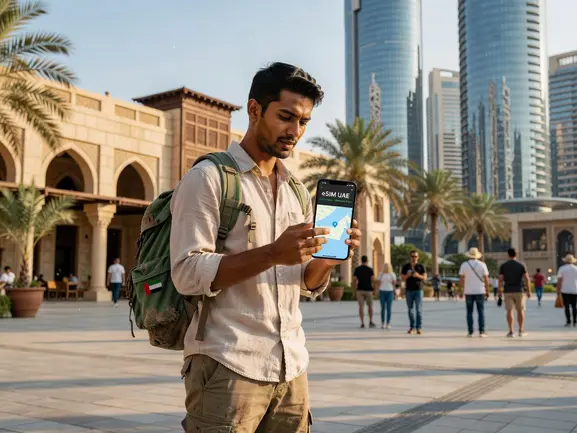
eSIMYat vs Competitors for UAE Backpacking
I've tested 7 different eSIM providers on various Middle East trips. Here's a straight comparison for UAE backpacking specifically:
- eSIMYat: Instant activation, free hotspot, 24/7 support in English and Arabic, no passport required, 7-day refund policy on unused plans. Runs on UAE's premium local networks (e& and du).
- Airalo: Plans from $4.50 (Airalo pricing page, checked 2026). No Arabic support. Works well for basic use but lacks 24/7 chat support critical for Middle East time zones.
- Holafly: Unlimited from $6.99 (Holafly pricing page, checked 2026). Speeds throttle after heavy use. Hotspot is limited on most plans — a problem if you want to tether your laptop at a hostel.
- Nomad: From $1.30/GB (Nomad pricing page, checked 2026). Offers a free trial eSIM but their UAE plans have limited coverage outside major cities.
- Saily: From $1.99 (Saily pricing page, checked 2026). Includes VPN and ad blocker — useful in the UAE where some VoIP services are restricted.
For backpackers specifically, the Arabic-language 24/7 support is a genuine differentiator. If you're traveling with family members who prefer Arabic, or if you're visiting from the Gulf region, eSIMYat is the only provider in this category offering full Arabic customer support around the clock.
The 7-day refund policy also matters for budget travelers. If your plans change and you don't use the eSIM, you're not out of pocket. No other provider in this comparison offers that with zero conditions.
UAE Backpacking Internet: What Works, What Doesn't
The UAE is one of the most connected countries on earth — ranked consistently in the global top 10 for mobile network speed. But there are a few things backpackers should know before they rely solely on mobile data.
What works great:
- Google Maps, Waze, and ride-hailing apps (Careem, Uber) — essential for getting around
- WhatsApp messaging and file sharing — fully functional
- Social media, email, booking apps — no restrictions
- 4G/5G speeds in Dubai Marina, Downtown Dubai, Abu Dhabi Corniche, Sharjah, Fujairah — consistently fast
What to be aware of:
- VoIP restrictions: WhatsApp calls, FaceTime, and Skype audio/video calls are blocked by the UAE's Telecommunications and Digital Government Regulatory Authority (TDRA). Use WiFi calling alternatives approved locally, or stick to messaging.
- VPN usage: Using a VPN for personal privacy is legal in the UAE. Using it to circumvent blocked services is technically illegal. Be aware.
- Coverage in remote areas: Coverage in deep desert areas (Rub' al Khali border zones) and some mountain wadis in Fujairah can be patchy. For most backpacker itineraries, this won't affect you.
- Data-hungry apps: TikTok and YouTube can drain 5GB in a few days if you're not watching your usage. Turn off auto-play on video apps.
For more on traveling in the broader region, check out our guide to the best eSIMs for the Middle East — useful if you're combining UAE with Jordan, Oman, or Saudi Arabia on a longer trip.
Is the UAE Worth Backpacking? (And How to Do It on a Budget)
Yes — but you need a strategy. The UAE has a reputation as a luxury destination, but backpackers have been quietly thriving there for years. Here's how:
- Stay in hostels in Bur Dubai or Deira — beds from $20–35/night, walking distance to the Gold Souk and Spice Souk
- Use the Dubai Metro — cheap, air-conditioned, covers most tourist areas. Your eSIM keeps Google Maps running.
- Eat at shawarma joints and local canteens — AED 10–20 per meal (roughly $2.70–5.50)
- Free beaches — Jumeirah Public Beach, Kite Beach, and Mamzar Beach are free. No entrance fee.
- Visit Abu Dhabi on a day trip — Sheikh Zayed Grand Mosque is free to enter with modest dress
- Skip the paid desert safari at first — self-drive budget options exist through Hatta and the northern emirates
None of this works without reliable data. The Metro app, Careem, booking apps, and hostel check-ins all need connectivity. A solid uae backpacking internet plan isn't a luxury — it's infrastructure for your trip.
If you're combining UAE with a broader Middle East and North Africa backpacking route, eSIMYat also covers Jordan, Egypt, Morocco, and Saudi Arabia — so you can grab separate country plans or look at regional options.
Frequently Asked Questions
What is the best eSIM for backpacking in UAE in 2026?
The best eSIM for UAE backpacking in 2026 is eSIMYat. It activates in under 2 minutes via QR code, runs on UAE's top networks (e& and du), includes free hotspot/tethering, and requires no passport or ID registration. The 7-day refund policy on unused plans makes it a zero-risk buy for budget travelers. 24/7 support is available in both English and Arabic.
How much data do I need for a UAE backpacking trip?
For a 7-day UAE backpacking trip with moderate use — maps, WhatsApp, social media browsing, and booking apps — 3–5GB is sufficient. For trips of 2 weeks or more, or if you plan to work remotely or stream video, choose a 10GB+ plan. Remember: WhatsApp voice and video calls are restricted in UAE, which reduces data consumption compared to other destinations.
Does eSIMYat work in the UAE without a passport?
Yes. Unlike physical SIM cards sold at UAE airports and telco stores (which require passport or Emirates ID verification), eSIMYat requires no ID registration. You purchase online, receive a QR code, and install it in Settings. This makes it significantly faster and easier — especially for backpackers arriving on late-night flights when airport SIM kiosks are unstaffed.
Can I use a hotspot with my UAE eSIM for backpacking?
Yes. eSIMYat includes free hotspot and tethering on all plans. This is especially useful for backpackers who want to share connectivity with a travel partner or use their phone as a mobile hotspot for a laptop at a hostel. Note that some competitor plans (particularly Holafly) restrict hotspot usage on UAE plans, so always verify before purchasing.
Is an eSIM for UAE backpacking better than buying a local SIM at Dubai Airport?
Yes, for most backpackers. A local SIM from e& or du at Dubai Airport requires passport registration, costs more, and involves waiting in line after a long flight. An eSIM is purchased before you travel, installed in minutes, and activates the moment you land. You also keep your home number active via dual SIM. The only advantage of a local physical SIM is if your device doesn't support eSIM.
Final Takeaways
Here's what matters for your UAE backpacking internet setup:
- Activate before you fly — airport WiFi is unreliable; install your eSIM at home
- 5GB covers most 10-day trips — go 10GB+ if you're working remotely or staying longer
- No passport needed — eSIMYat skips the airport SIM queue entirely
The UAE is an incredible backpacking destination when you have your logistics sorted. Getting your esim uae backpacking plan locked in before departure is the single easiest thing you can do to save money and stress on this trip. Grab your plan now — instant activation, free hotspot, and 24/7 support in English and Arabic.