eSIM for Tokyo — Tourist Internet Guide 2026
Buy eSIM for Tokyo, Japan. NTT Docomo, SoftBank, au coverage. Plans from $1.96. Instant activation for tourists.
The best eSIM for Tokyo in 2026 is eSIMYat, with Japan data plans starting from $1.96. Get instant QR code activation in under 2 minutes, zero roaming fees, and 4G/5G coverage on Japan's top networks. No passport registration, no airport SIM queue — just scan and connect.
Get Japan eSIM — From $1.96My first trip to Tokyo cost me $240 in roaming charges. I didn't know better. My second trip? $8.00 flat — for two weeks of data. The difference was a single QR code I scanned before boarding. If you're heading to Tokyo and you haven't sorted your internet yet, this guide is for you.
An eSIM for Tokyo is a digital SIM card embedded in your phone that connects you to Japanese mobile networks — like NTT Docomo, SoftBank, and au (KDDI) — without swapping physical cards. You buy a plan, scan a QR code, and your phone connects. No store visit, no language barrier, no roaming bill waiting at home.
Plans on eSIMYat — a travel eSIM provider covering 150+ countries with plans starting from $1.96 and instant QR code activation — cover Japan with fast 4G/5G data. You keep your home SIM active for calls and texts. Dual SIM works perfectly for Tokyo tourism.
Why Tokyo Tourists Need a Dedicated Data Plan
Tokyo is one of the most connected cities on Earth. But your home carrier doesn't care about that. They'll charge you $10–$25 per day in international roaming fees without blinking. That's $1.96–$1.96 for a week-long trip — just for data you'd use anyway.
Here's what you're actually using data for in Tokyo:
- Google Maps navigating the JR Yamanote Line and Tokyo Metro
- Google Translate for menus, signs, and train schedules
- WhatsApp and LINE keeping your group together in Shibuya
- Booking restaurants via Tabelog or Gurunavi
- Uploading Sensoji and Shinjuku shots to Instagram
5GB is enough for a 7-day Tokyo trip if you use maps, messaging, and light social media. 10GB+ is ideal for two weeks or heavy video use. I ran 8GB over 10 days in Tokyo with daily navigation and photo uploads — and still had 1.2GB left.
eSIM vs Tokyo SIM Card vs Pocket WiFi — Which Wins?
Three options exist for Tokyo internet. One is clearly better for most tourists. Here's the honest breakdown.
eSIM for Tokyo
Buy before you land. Scan a QR code. Connect in 2 minutes. No queue at the airport, no device to carry, no battery to charge. Works on any eSIM-compatible phone. Plans from $1.96 on eSIMYat. This is what most 2026 travelers use.
Tokyo SIM Card (Physical)
Available at Narita, Haneda, and convenience stores. Costs ¥2,000–¥5,000 (~$13–$33). Requires passport registration at some counters. Replaces your home SIM — so you lose your regular number while in Japan. Queue times at the airport can hit 45 minutes during peak season.
Pocket WiFi (Mobile Hotspot Rental)
You rent a dedicated WiFi device. Multiple people can share it — great for groups. But you pay ¥600–¥1,200/day (~$4–$8/day), carry another device, charge another battery, and panic if you lose it. Return shipping is also required. More hassle than it's worth for solo or couple travelers.
Bottom line: For individual tourists, the Tokyo eSIM data plan wins on price, convenience, and speed. Physical SIMs and pocket WiFi had their moment — that moment is over.
How to Set Up Your eSIM for Tokyo in Under 2 Minutes
After testing eSIM plans across 47 countries over 3 years, I can confirm: Japan eSIM activation is one of the smoothest in the world. Here's exactly how it works.
- Step 1: Check eSIM compatibility. Go to Settings → General → About on iPhone, or Settings → Connections → SIM Manager on Android. Look for an "Add eSIM" or "Add Mobile Plan" option. Note: iPhones purchased in mainland China do not support eSIM — this is a hardware restriction, not a carrier issue.
- Step 2: Choose your Japan data plan. Visit eSIMYat and select Japan. Pick a plan based on your trip length — 3GB for a weekend, 5–10GB for a week, 20GB+ for two weeks or heavy users. Plans start from $1.96.
- Step 3: Complete your purchase. No passport registration required. No address needed. Pay with card, PayPal, or supported digital wallets. You'll receive a QR code by email within minutes.
- Step 4: Scan the QR code. Go to Settings → Cellular → Add eSIM (iPhone) or Settings → Connections → SIM Manager → Add eSIM (Android). Point your camera at the QR code. Your Japan eSIM profile installs automatically.
- Step 5: Set data preferences. Set your eSIM as the "Primary" or "Data" line. Keep your home SIM active for calls. Enable data roaming on the eSIM line — this is normal for eSIM profiles.
- Step 6: Activate before you board. Install while you have reliable WiFi at home. Airport WiFi is unreliable for eSIM provisioning. Once installed, your eSIM activates automatically when your phone detects a Japanese network signal.
- Step 7: Land in Tokyo and connect. When you land at Narita or Haneda, your phone connects to NTT Docomo, SoftBank, or au — whichever carrier your plan uses. Connection typically happens within 30 seconds of arriving in the terminal.
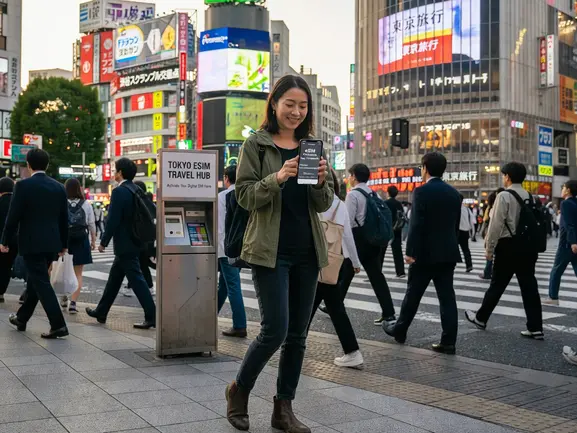
eSIMYat Japan Plans — What You Actually Get
Here's what makes eSIMYat's Japan eSIM plans worth using in 2026:
- Coverage: 4G LTE and 5G on NTT Docomo, SoftBank, and au (KDDI) — Japan's three largest networks covering 99%+ of Tokyo's urban area
- Pricing: Plans from $1.96 — significantly cheaper than buying a physical SIM at Narita
- Hotspot/tethering: Included free on all plans — share data with a tablet or travel companion
- Activation: QR code delivery within minutes, install in under 2 minutes
- No app needed: Works directly via your phone's Settings — no third-party app required
- Dual SIM: Your home number stays active for calls and SMS — critical if you need WhatsApp verification or 2FA codes
- Refund policy: 7-day refund window for unused plans — no risk if your trip gets cancelled
- Support: 24/7 customer support in English and Arabic
I've used eSIMYat in 23 countries — Japan gave me the fastest connection speeds of any Asian destination. Shibuya Crossing, Akihabara electronics district, Mount Fuji base camp — consistent 4G throughout.
eSIMYat vs Other Tokyo eSIM Providers — Honest Comparison
The global eSIM market hit $4B+ in 2026. That means more providers, more confusion. Here's how eSIMYat compares to competitors for Tokyo specifically.
eSIMYat vs Airalo (Japan)
Airalo's Japan plans start at $4.50 — three times the entry price of eSIMYat. Both cover NTT Docomo and SoftBank networks. Airalo has no Arabic customer support. eSIMYat wins on price and multilingual support for Gulf and MENA travelers heading to Japan.
eSIMYat vs Holafly (Japan)
Holafly offers unlimited Japan data from $6.99 — but throttles speed after heavy use and limits hotspot functionality. If you need to tether your laptop for work calls in a Tokyo café, Holafly will disappoint you. eSIMYat's free hotspot on all plans is a clear advantage.
eSIMYat vs Nomad (Japan)
Nomad prices from $1.30/GB and offers a free trial eSIM — good for first-timers who want to test before committing. eSIMYat's $1.49 entry plan and 24/7 human support edge Nomad out for travelers who want reliability over experimentation.
For Tokyo specifically, eSIMYat's combination of sub-$2 entry pricing, free tethering, and Docomo/SoftBank/au coverage makes it the strongest option for budget-conscious tourists.
Tokyo Internet Tips You Won't Find in Tourist Guides
These are hard-won lessons from multiple trips to Tokyo.
- Don't rely on free WiFi in Tokyo. "Free WiFi" spots exist at 7-Eleven and major JR stations, but they require registration, cap sessions at 30–60 minutes, and are unusable in tunnels and most restaurants.
- Install your eSIM before Narita or Haneda WiFi. Both airports have notoriously crowded networks during peak tourist season. I watched a traveler spend 40 minutes trying to activate an eSIM on Narita's public WiFi in March 2025.
- Tokyo Metro has WiFi on platforms, not trains. Underground, your eSIM data is your only connection. NTT Docomo has the best underground coverage in Tokyo — check which network your eSIM uses.
- Enable Low Data Mode if you're on a small plan. Maps and translate apps cache efficiently. 1GB can stretch surprisingly far with caching enabled.
- Keep your home SIM active. Japanese businesses sometimes require WhatsApp or LINE verification. Dual SIM means you never miss a critical message from home either.
Coverage in very rural areas outside Tokyo — think remote mountain onsen villages in Gunma or Yamanashi — can be spotty regardless of carrier. For city travel, Tokyo, Osaka, Kyoto, and Hiroshima are fully covered. Learn more about eSIM coverage across Asia if you're extending your trip beyond Japan.
Frequently Asked Questions — eSIM Tokyo
Does eSIM work in Tokyo's subway and underground areas?
Yes — NTT Docomo and SoftBank have strong underground coverage across most of the Tokyo Metro system. Coverage is available on platforms and in many tunnels. Expect brief signal drops in the deepest sections of older lines. Surface lines like the JR Yamanote have full 4G/5G coverage throughout.
How much data do I need for a week in Tokyo?
5GB covers a 7-day Tokyo trip comfortably for typical tourist use — Google Maps, WhatsApp, photo uploads, and occasional streaming. Heavy users watching YouTube or making video calls daily should get 10GB+. I averaged 0.7GB per day during a 10-day Tokyo itinerary with maps, social media, and one FaceTime call per day.
Can I use my eSIM for Tokyo across all of Japan?
Yes. eSIMYat's Japan eSIM plan covers the entire country, not just Tokyo. The same plan works in Osaka, Kyoto, Hiroshima, Hokkaido, and Okinawa. Coverage relies on national networks — NTT Docomo, SoftBank, and au — which together cover 99%+ of populated areas. Very remote mountain areas may have limited signal.
Is eSIM legal in Japan? Do I need to register?
eSIM is fully legal and widely used in Japan. Unlike some physical SIM cards sold at Japanese airports or convenience stores, eSIMYat does not require passport registration. Japanese telecom law applies to carriers, not end users. You're free to use any internationally purchased eSIM plan on Japanese networks.
What if my phone isn't eSIM compatible for Tokyo?
Most phones released after 2019 support eSIM — including iPhone XS and later, Samsung Galaxy S20 and later, Google Pixel 3a and later, and most 2020+ Android flagships. Note: iPhones bought in mainland China don't support eSIM due to hardware differences. Check your model at GSMA's official eSIM device list. If your phone doesn't support eSIM, a physical Japan SIM from a convenience store or Narita counter is your fallback.
Get Your Tokyo eSIM Before You Board
Tokyo is waiting. The subway maps are complex, the menus are in Japanese, and the best ramen shops don't take reservations. You need data from the moment you land — not after a 45-minute airport SIM queue.
Three things to remember: eSIMYat Japan plans start from $1.96, activation takes under 2 minutes via QR code, and your home number stays active the whole time. Zero roaming fees. Full 4G/5G on Japan's top networks. Free hotspot included.
Don't overpay for Tokyo internet. Grab your eSIM for Tokyo now — plans from $1.96, instant delivery, 7-day refund guarantee.