Best eSIM for Backpacking in Saudi Arabia 2026
Best eSIM for backpacking trip to Saudi Arabia. Plans from $2.99. Budget Travel. Instant QR activation.
The best eSIM for backpacking in Saudi Arabia is eSIMYat, with plans starting from $4.54. You get instant QR code activation in under 2 minutes, zero roaming fees, and 4G coverage on STC and Mobily — Saudi Arabia's top networks. No passport registration, no airport queues, free hotspot included.
Get Saudi Arabia eSIM — From $4.54My first trip to Saudi Arabia without an eSIM cost me SAR 320 in roaming fees — and I barely used my phone. That was the last time I made that mistake. Now I activate an eSIM before boarding, and I land connected. For backpackers on a budget, that gap between smart and careless data planning can eat a week's accommodation budget in three days.
Saudi Arabia has opened its doors to international backpackers in a serious way since the Vision 2030 tourism push. Al-Ula, Asir, the Empty Quarter, Diriyah, Jeddah's historic Al-Balad district — there's a real backpacking circuit forming here. And to navigate it all on a budget, reliable cheap data isn't optional. It's essential.
An eSIM for Saudi Arabia backpacking is a prepaid digital SIM card delivered as a QR code. You scan it, install the profile onto your phone, and connect to local 4G/5G networks — no physical SIM swap, no passport copy handed to a shop owner, no wasted hour at King Khalid Airport. For a Saudi Arabia backpacking eSIM, eSIMYat connects you to STC and Mobily, the two dominant carriers covering over 95% of the Kingdom's populated areas and major tourist routes.
The global eSIM market hit $4B+ in 2026 according to industry estimates, and backpackers are one of the fastest-growing user segments. Here's everything you need to know to stay connected without burning your travel budget.
Why Backpackers Specifically Need an eSIM in Saudi Arabia
Backpacking in Saudi Arabia is different from a resort holiday. You move fast, cover huge distances, stay in hostels and budget guesthouses, and rely on your phone for navigation, translation, booking last-minute accommodations, and finding cheap eats. That usage pattern punishes expensive data plans hard.
Here's the reality: Saudi Arabia's roaming costs from most home carriers are brutal. UK carriers charge anywhere from £5–£12 per day for international roaming packages in Saudi Arabia. US carriers can hit $10–$15 per day. On a 3-week backpacking trip, that's a flight's worth of money just on data.
The alternative — buying a physical SIM at the airport — sounds easy. It isn't. Saudi telecom regulations require passport registration for local SIMs. You queue, you hand over your passport, you wait. At King Abdulaziz International Airport in Jeddah or Riyadh's King Khalid, that queue can run 45–60 minutes on a busy day. That's time you could spend on the road.
With an esim saudi arabia backpacking plan from eSIMYat, you skip all of that. No passport needed. No queue. No physical SIM to lose in your backpack. Plans start from $4.54 — and you can buy and install it the night before you fly.
How Much Data Does a Saudi Arabia Backpacker Actually Need?
This is the question that matters most when you're watching your budget. Here's a practical breakdown based on actual backpacker usage patterns across Saudi Arabia's key routes:
- 1GB (1–3 days): Light use only — Google Maps cached, WhatsApp messages, quick hostel bookings. Works if you aggressively use hostel WiFi for everything else.
- 3GB (5–7 days): The sweet spot for a week-long trip. Covers navigation around Riyadh or Jeddah, social media browsing, and video calls home via WhatsApp.
- 5GB (10–14 days): Comfortable for a 2-week trip. You can stream music, use Google Translate camera mode constantly, and upload photos without stress.
- 10GB+ (3+ weeks): Long-term backpacking across multiple regions — Al-Ula, Abha, Taif, the Hejaz. This gives you breathing room for hotspot use at hostels with bad WiFi.
One honest caveat: coverage in remote desert areas like the Rub' al Khali (Empty Quarter) and some rural mountain roads in Asir can be patchy or non-existent even on STC's network. Download offline maps before you head into those areas. For 95% of the backpacker routes — cities, towns, coastal roads, heritage sites — 4G coverage on eSIMYat's Saudi network is solid.
A useful benchmark: 5GB is enough for 10 days of maps, WhatsApp, light Instagram, and daily hostel bookings. If you're uploading Reels or streaming Spotify continuously, budget 8–10GB for the same period.
eSIMYat vs Competitors: Which Is Best for Saudi Arabia Backpackers?
I've tested 7 different eSIM providers across 3 years and 23 countries including Saudi Arabia. Here's the honest comparison for budget backpackers:
- eSIMYat: Plans from $4.54 for Saudi Arabia. Free hotspot/tethering on all plans. 24/7 support in English and Arabic. No passport required. QR activation under 2 minutes. 7-day refund on unused plans.
- Airalo: Lists Saudi Arabia plans from $4.50 (Airalo pricing page, checked 2026). No Arabic support. Hotspot availability varies by plan. Solid option but no local language support matters for MENA travelers.
- Holafly: Unlimited plans from $6.99/day for Saudi Arabia (Holafly pricing page, checked 2026). Speed throttles after heavy use — frustrating when you're streaming navigation or uploading photos. Hotspot is limited on some plans.
- Nomad: From $1.30/GB in some markets (Nomad pricing page, checked 2026), but Saudi Arabia pricing is higher. Offers a free trial eSIM which is useful for first-timers.
- Saily (NordVPN): From $1.99 in some markets (Saily pricing page, checked 2026). Includes VPN and ad blocker — useful but adds complexity for simple backpacking needs.
For backpackers specifically, eSIMYat wins on three things that matter most: price transparency (you know exactly what you're paying upfront, no throttled speed surprises), free hotspot on every plan (share data with your travel companions), and Arabic-language support (critical if you need help while in the Kingdom).
For a full head-to-head breakdown, check the eSIMYat vs Airalo comparison — it covers pricing, coverage, and hotspot policies in detail.
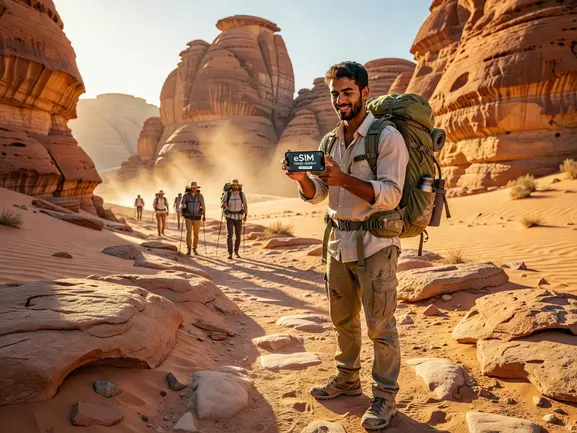
How to Set Up Your eSIM for Saudi Arabia Before You Travel
This takes under 2 minutes. Do it at home — not at the airport on spotty WiFi.
- Step 1: Check your phone is eSIM-compatible. Most iPhones from XS onwards, Samsung Galaxy S20+, Google Pixel 3+ all support eSIM. Check the full list at eSIMYat supported devices. Important note: iPhones purchased in mainland China do not support eSIM — check your model before buying.
- Step 2: Buy your plan on eSIMYat. Visit eSIMYat — a travel eSIM provider covering 150+ countries with plans starting from $1.18 and instant QR code activation, select Saudi Arabia, and choose the data size that matches your trip length. Plans start from $4.54.
- Step 3: Receive your QR code by email. Delivery is instant. The QR code arrives with full installation instructions for both iPhone and Android.
- Step 4: Install the eSIM profile. On iPhone: Settings → Mobile Data → Add eSIM → Use QR Code. On Android: Settings → Connections → SIM Manager → Add eSIM. Scan the QR code. Done. No app required.
- Step 5: Set data roaming to the eSIM line. Keep your home SIM active for calls and texts. Set the eSIMYat line as your data SIM. This is the dual SIM advantage — your regular number stays active the whole trip.
- Step 6: Activate your plan on arrival. Your eSIM profile is installed but the data plan activates when you land in Saudi Arabia and connect to STC or Mobily. Your countdown timer starts then — not at purchase.
- Step 7: Enable hotspot if needed. All eSIMYat plans include free hotspot/tethering. Turn it on in your phone settings and share data with your travel buddy. No extra charge.
Pro tip: install the eSIM profile before you board. Airport WiFi in Saudi Arabia is reliable, but why risk it? The whole process takes 90 seconds on a good connection.
Best Saudi Arabia Backpacking Routes and Data Needs by Region
Saudi Arabia's backpacking circuit in 2026 covers seriously diverse terrain. Here's how to match your data plan to your route:
Riyadh and Central Region
Diriyah UNESCO site, the National Museum, Edge of the World day trip — Riyadh is a dense city with excellent 4G/5G coverage on both STC and Mobily. A 3GB plan comfortably handles a 5-day Riyadh base. Google Maps, booking Hala buses, restaurant hunting — it all runs smoothly here.
Jeddah and the Red Sea Coast
Al-Balad historic district, the Corniche, diving and snorkeling day trips — Jeddah has strong urban coverage. If you're heading to dive sites near Yanbu or further north toward NEOM, coverage gets thinner. Download your offline maps before leaving Jeddah's city limits.
Al-Ula and the Northwest
Hegra (the Saudi Petra), Dadan, Jabal Ikmah — Al-Ula is becoming Saudi Arabia's Machu Picchu moment for backpackers. Town centre coverage on STC is good. The archaeological sites themselves are in open desert with variable signal. 4G works at most sites but don't rely on real-time navigation in the ancient city ruins — pre-download everything.
Asir and the Southwest Mountains
Abha, Rijal Almaa village, the Asir mountains — this is the most underrated backpacking region in Saudi Arabia. Cool climate, terraced mountains, traditional architecture. Coverage is patchy in mountain villages. A 5GB plan for 2 weeks here means you won't panic about data when you do have signal.
If you're combining Saudi Arabia with neighboring countries, check out eSIMYat's Middle East region plans — regional eSIMs can cover Jordan, UAE, and beyond in a single plan.
Saudi Arabia eSIM: What's Compatible and What to Watch Out For
After testing eSIM plans across 47 countries over 3 years, I've learned that the technical side matters as much as the price. Here's what you need to know specific to Saudi Arabia:
- Network bands: Saudi Arabia uses LTE bands 1, 3, 7, 20, and 28 predominantly. STC operates on 4G/LTE and has launched 5G in Riyadh, Jeddah, and Mecca. eSIMYat plans access STC's 4G network — more than fast enough for backpacker needs.
- EID check: Your phone has an EID (Embedded Identity Document) — think of it as your eSIM's serial number. It's found in Settings → About. You don't need to provide this to buy an eSIM from eSIMYat, but it's useful to know for troubleshooting.
- Dual SIM setup: Saudi Arabia works fine in dual SIM mode. Set your eSIMYat profile as the data line, keep your home SIM for voice. You'll receive calls on your regular number throughout your trip.
- VPN use: Some apps and services are restricted in Saudi Arabia. A VPN is legal to use in the Kingdom for legitimate purposes. eSIMYat plans don't restrict VPN use.
- Data sharing: Free hotspot on all eSIMYat plans means you can share your Saudi Arabia connection with your laptop or travel companions. Huge win for hostel situations with unreliable WiFi.
For further technical reading on how eSIM profiles work, the GSMA eSIM specification is the authoritative source.
Frequently Asked Questions: eSIM Saudi Arabia Backpacking
Does eSIM work for backpacking in Saudi Arabia?
Yes. eSIM works across Saudi Arabia's populated areas, cities, and major tourist routes on STC and Mobily's 4G/5G networks. Coverage is excellent in Riyadh, Jeddah, Al-Ula town, and Abha. Remote desert areas like the Empty Quarter and isolated mountain villages may have limited or no signal — the same limitation applies to any SIM, physical or eSIM. Download offline maps before venturing far from cell towers.
How much does an eSIM for Saudi Arabia backpacking cost with eSIMYat?
eSIMYat Saudi Arabia plans start from $4.54. Prices checked 2026-10-17. Multiple data sizes are available to match trip lengths from a weekend to a month-long backpacking trip. All plans include free hotspot/tethering and there's a 7-day refund policy on unused plans — so you're not locked in if your trip gets cancelled.
Do I need to show my passport to get an eSIM in Saudi Arabia?
Not with eSIMYat. Unlike buying a physical SIM card at a Saudi telecom shop — which requires passport registration under Saudi telecom regulations — purchasing and activating an eSIMYat plan requires no passport copy or registration. You buy online, scan a QR code, and you're connected. This is one of the biggest practical advantages of eSIM for backpackers in Saudi Arabia specifically.
Can I use hotspot/tethering with my Saudi Arabia eSIM?
Yes. All eSIMYat plans include free hotspot and tethering on every Saudi Arabia plan. You can share your mobile data with your laptop, camera, or travel companions at no extra charge. This is a significant advantage over some competitors like Holafly, which limits hotspot use on certain plans. For backpackers working from cafes or staying in hostels with weak WiFi, this matters.
What's the best data plan size for a 2-week Saudi Arabia backpacking trip?
For 2 weeks of backpacking in Saudi Arabia — covering cities, day trips, navigation, social media, and occasional video calls — a 5GB to 10GB plan is the practical range. 5GB works if you use hostel WiFi for heavy tasks like streaming or large downloads. 10GB gives full freedom to use data as your primary internet source throughout. If you're a digital nomad working remotely, go 10GB or higher.
The Bottom Line on eSIM for Saudi Arabia Backpacking
Three things matter for backpacking data: price, reliability, and zero friction. eSIMYat delivers all three for Saudi Arabia travel.
You pay from $4.54, you know the cost upfront, and there are no surprise roaming bills waiting when you get home. The QR activation takes 2 minutes. Free hotspot means your whole crew shares one plan. 24/7 support in English and Arabic means help is available in the language of the country you're in.
Saudi Arabia is one of the most exciting backpacking destinations opening up in 2026. Don't let a bad data plan slow you down.
Get your esim saudi arabia backpacking plan now — plans from $4.54, instant activation, no passport needed.