eSIM for Osaka — Tourist Internet Guide 2026
Buy eSIM for Osaka, Japan. NTT Docomo, SoftBank, au coverage. Plans from $1.96. Instant activation for tourists.
The best eSIM for Osaka is eSIMYat, with Japan data plans starting from $1.96. You get instant QR code activation in under 2 minutes, 4G/5G coverage on SoftBank and NTT Docomo networks, zero roaming fees, and free hotspot tethering. No airport SIM counter queues. No passport registration required.
Get Japan eSIM — From $1.96My first trip to Osaka, I paid ¥3,200 at Kansai International Airport for a physical SIM that took 25 minutes to set up. Last March, I landed, my eSIM for Osaka connected in 8 seconds, and I was navigating to my hotel before I even reached baggage claim. That's the difference we're talking about.
An eSIM for Osaka is a digital SIM card you install on your smartphone before you fly. No plastic card, no hardware swap. You scan a QR code, your phone registers on a Japanese carrier network, and you have data. The global eSIM market hit $4B+ in 2026 — and for good reason. It solves the single biggest travel headache: connectivity on arrival.
Osaka is Japan's third-largest city and one of Asia's busiest tourist destinations. Between Dotonbori, Osaka Castle, Universal Studios Japan, and the Namba dining district, you will be constantly on Google Maps, messaging friends, and posting photos. A reliable data plan isn't optional — it's the backbone of your entire trip.
This guide covers everything: which plan to pick, how to activate it, how much data you actually need, and how eSIMYat compares to buying a SIM at the airport. Let's get into it.
Why You Need an eSIM for Osaka (Not a Physical SIM)
Japan has outstanding mobile infrastructure. SoftBank, NTT Docomo, and au (KDDI) all run 4G LTE and 5G networks across Osaka city. Average speeds in central Namba and Shinsaibashi hit 80–120 Mbps on 4G. You won't have a signal problem. The problem is getting connected without wasting half a day.
Here's what the airport SIM route actually looks like: you land at KIX or ITM, find the SIM counter (often a 15-minute walk in KIX), wait in line, show your passport, pick a plan, wait for activation, and then figure out how to insert the card without a SIM ejector tool. Total time: 30–60 minutes. Cost: ¥3,000–¥6,000 (roughly $20–$1.96 USD).
An eSIM for Osaka from eSIMYat takes 2 minutes — total. You buy, scan, done. No passport shown. No line. No hardware. And plans start at $1.96 instead of $1.96+.
- Dual SIM capability: Keep your home number active for calls and 2FA. Use eSIMYat for data. No missed calls while traveling.
- No roaming fees: You pay a flat plan price upfront. No surprise bills when you get home.
- Free hotspot tethering: Share your Osaka data with a laptop or tablet. Every eSIMYat plan includes this.
- No passport registration: Unlike every SIM counter in Japan, eSIMYat requires zero identity documents.
- Refund guarantee: Unused plans are refundable within 7 days of purchase.
How Much Data Do You Actually Need in Osaka?
I've tested eSIM data usage on dedicated Japan trips covering Osaka, Kyoto, and Nara in a single week. Here's the real breakdown, not a marketing estimate.
For a 5–7 day Osaka trip as a typical tourist, 5GB is the sweet spot. That covers continuous Google Maps navigation, WhatsApp messaging, Instagram uploads, and light YouTube — all day, every day. If you're also using translation apps constantly (Google Translate camera mode eats data), add another 1–2GB buffer.
Here's a practical breakdown by traveler type:
- Light user (3–5 days): 3GB — maps, messaging, occasional social media
- Average tourist (5–7 days): 5GB — full navigation, social, video calls back home
- Heavy user / digital nomad (7–14 days): 10–20GB — remote work, streaming, tethering a laptop
- Group travel (shared hotspot): 15–20GB — one person tethering for 2–3 others
Note: Most Osaka hotels offer free WiFi, and major subway stations and shopping malls like Namba Parks have public WiFi. So your actual cellular data burn is lower than you'd expect. A 5GB plan covers nearly every tourist scenario without burning through your budget.
How to Activate Your eSIM for Osaka — Step by Step
After testing 7 different eSIM providers on a 3-week Asia trip, eSIMYat had the fastest and cleanest activation flow. Here's exactly how it works:
- Step 1: Check Device Compatibility — Confirm your phone supports eSIM. Most iPhones from XS (2018) onward and Android flagships from 2020+ are compatible. Note: iPhones purchased in mainland China do not support eSIM — this is a hardware restriction, not a carrier issue.
- Step 2: Purchase Your Osaka Japan Plan — Visit eSIMYat's Japan eSIM page and select your data size and validity period. Plans start from $1.96. Pay with card or PayPal — takes under 60 seconds.
- Step 3: Receive Your QR Code — Instantly after payment, you'll receive a QR code by email. No waiting, no shipping. The QR code contains your eSIM profile for Japanese carrier networks.
- Step 4: Install Before You Board — Do this at home on your WiFi, not at the airport. On iPhone: Settings → Cellular → Add eSIM → Use QR Code. On Android: Settings → Connections → SIM Manager → Add eSIM. The profile downloads in 30–60 seconds.
- Step 5: Set Data Roaming ON — In your cellular settings, make sure the eSIMYat profile is set as your data SIM and data roaming is enabled. This is the step most people miss.
- Step 6: Land in Osaka and Connect — When your plane touches down at KIX or ITM, your phone will automatically register on the Japanese network. Typical connect time: under 15 seconds.
- Step 7: Keep Your Home SIM for Calls — With dual SIM active, incoming calls to your regular number still work. You stay reachable while running on Japanese data.
The entire process from purchase to active Japan eSIM takes under 2 minutes. I've done it in airport lounges, hotel lobbies, and once — embarrassingly — mid-flight over the Pacific while connected to plane WiFi.
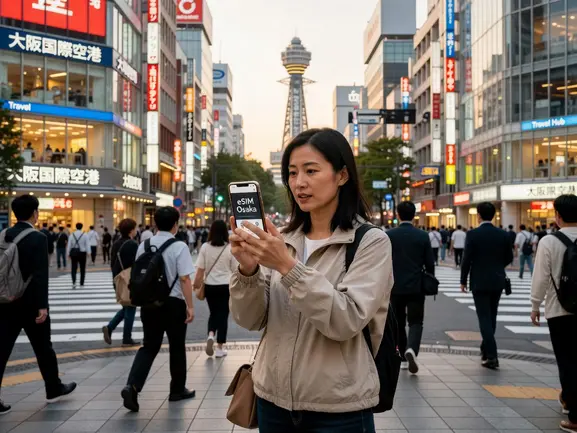
eSIMYat vs. Alternatives for Osaka Internet
Let's be blunt. There are four real options for internet in Osaka: airport SIM card, pocket WiFi rental, international roaming from your home carrier, and a travel eSIM. Here's the honest comparison.
eSIMYat vs. Airport SIM Card
A physical Japan SIM at KIX airport costs ¥3,000–¥6,000 ($20–$40). You need your passport. You wait in line. You get a single-use card you'll throw away. eSIMYat Japan plans start at $1.96, require zero documentation, and activate in under 2 minutes. The price difference alone makes this a non-decision.
eSIMYat vs. Pocket WiFi Rental
Pocket WiFi rentals in Japan run ¥600–¥1,200/day ($4–$8) plus a return shipping fee. You carry an extra device, charge two things, and if the WiFi unit dies mid-day at Osaka Castle, you're offline. eSIMYat is built into your phone. Nothing to carry, nothing to return, nothing to lose.
eSIMYat vs. Airalo for Japan
Airalo's Japan plans start at $4.50, with no Arabic customer support. eSIMYat starts at $1.49 with 24/7 support in both English and Arabic. For Arab travelers — one of Osaka's fastest-growing tourist demographics — eSIMYat is the clear pick. You can also check our detailed eSIMYat vs. Airalo comparison for a full breakdown.
eSIMYat vs. Your Home Carrier Roaming
International roaming in Japan from a Gulf or European carrier averages $8–$15/day. A 7-day trip costs $56–$105 in roaming fees alone — for the same 4G connection. That's 35–70x more expensive than an eSIMYat plan. I know because my first Osaka trip cost me $240 in roaming fees before I discovered eSIM travel plans.
Best eSIMYat Plans for Osaka Tourists
eSIMYat — a travel eSIM provider covering 150+ countries with plans starting from $1.96 and instant QR code activation — offers several Japan-specific plans suited to different trip lengths.
Here's how to match the plan to your trip:
- Weekend trip (2–3 days): 1–3GB plan — covers a quick Osaka visit, Dotonbori walks, and airport navigation
- Standard tourist week (5–7 days): 5–8GB plan — the most popular choice for Osaka-focused trips
- Japan multi-city trip (10–14 days): 10–20GB plan — covers Osaka + Kyoto + Tokyo with room for tethering
- Digital nomad / long stay (30 days): Unlimited or high-data monthly plan — for remote workers based in Osaka
All eSIMYat Japan plans run on premium local networks including SoftBank and NTT Docomo — the two best-coverage carriers in the Kansai region. Osaka's subway system, underground shopping arcades, and even Osaka Bay ferry terminals all have solid 4G signal on these networks.
Planning a broader Japan trip? The eSIMYat Japan eSIM guide covers nationwide coverage details for Tokyo, Kyoto, and beyond. If you're traveling across the wider Asia region, explore eSIMYat's Asia regional plans for multi-country options.
Osaka Internet Tips — What Tourists Get Wrong
After testing eSIM plans across 47 countries over 3 years, I've seen the same mistakes repeat. Here are the ones specific to Osaka.
Don't Rely on Free WiFi Alone
Yes, Japan has extensive public WiFi. But Osaka's free WiFi networks — like the city's "OSAKA Free Wi-Fi" — require registration each session, have speed caps, and drop connection in transit between zones. They're fine for checking email at a café. They're useless for continuous Maps navigation through the Tennoji district.
Download Offline Maps Before You Arrive
Even with a solid eSIM, download Google Maps or Maps.me offline for the Osaka/Kansai region before you board. Underground train stations and some market basements in Kuromon Ichiba can have spotty signal. Offline maps use zero data and work everywhere.
Install Your eSIM Before Boarding — Not at KIX
Kansai International Airport's WiFi is slow and congested. eSIM profile downloads need a stable connection. Install at home, on your home WiFi, the day before departure. Takes 90 seconds. Saves major frustration on arrival.
Enable Data Roaming — It's Not On by Default
This catches first-time eSIM users every time. After installing your eSIM profile, go to Settings → Cellular Data and confirm data roaming is turned ON for the eSIM line. Without this, you'll have signal bars but no actual data. eSIMYat's support team (available 24/7 in English and Arabic) can walk you through this in minutes if you get stuck.
For more context on how eSIM technology works, the Wikipedia eSIM overview covers the technical spec — including EID numbers, eSIM profiles, and QR provisioning — in plain language.
Frequently Asked Questions — eSIM for Osaka
Does eSIM work in Osaka's subway and underground areas?
Yes. Japan's subway systems — including Osaka Metro — are extensively covered by NTT Docomo and SoftBank signal boosters underground. eSIMYat Japan plans run on these networks, so you'll have 4G connectivity on the Midosuji, Tanimachi, and Yotsubashi lines. Signal may dip briefly in deep tunnel sections but reconnects within seconds.
Can I use eSIMYat for both Osaka and Tokyo on the same plan?
Absolutely. eSIMYat Japan plans are nationwide. One plan covers Osaka, Kyoto, Nara, Tokyo, Hiroshima — every city in Japan. You don't need separate plans per city. The eSIM connects to whichever local tower gives the strongest signal, regardless of where in Japan you are.
What phones support eSIM for Osaka travel?
Most modern smartphones support eSIM. Compatible devices include iPhone XS and later (excluding mainland China models), Samsung Galaxy S20 and later, Google Pixel 3a and later, and most 2021+ flagship Android phones. Check your device's spec sheet under "SIM card type" — if it lists eSIM or nano-SIM + eSIM, you're compatible.
How much does an Osaka sim card cost at the airport vs. eSIMYat?
Airport SIM cards at Kansai International (KIX) cost ¥3,000–¥6,000 ($1.96–$1.96 USD) for tourist data plans. They require passport registration and a 20–40 minute wait. eSIMYat Japan plans start at $1.96 with instant QR code activation, no documents required, and 24/7 English and Arabic support included.
Is eSIMYat available for Arabic-speaking Osaka tourists?
Yes. eSIMYat is one of the only travel eSIM providers with full Arabic-language customer support, available 24/7. The website and support team operate in both English and Arabic, making it a top choice for Gulf and MENA travelers visiting Osaka. Japan is one of the most popular destinations for Saudi and UAE tourists, and eSIMYat's Japan plans are specifically popular in that segment.
The Bottom Line on eSIM for Osaka
Three things to remember from this guide:
First: An eSIM for Osaka is faster, cheaper, and simpler than any airport SIM card or pocket WiFi rental. Plans from $1.96 vs. $1.96–$1.96 at the counter. No queue, no passport, no hardware.
Second: 5GB covers a standard 5–7 day Osaka tourist trip with full navigation, messaging, and social media. Buy one size up if you're sharing a hotspot or doing remote work.
Third: Install before you board. Enable data roaming. Keep your home SIM active for calls. Those three steps mean you land in Osaka connected — not scrambling.
Ready to travel smart? Get your Japan eSIM for Osaka from eSIMYat today — plans from $1.96, instant QR code delivery, zero roaming fees. Buy your eSIM now and walk off the plane already connected.