Best eSIM for Backpacking in Oman 2026
Best eSIM for backpacking trip to Oman. Plans from $2.49. Budget Travel. Instant QR activation.
The best eSIM for backpacking in Oman is eSIMYat, with plans starting from $3.92. You get instant QR code activation, zero roaming fees, and 4G coverage on Oman's top networks — Omantel and Ooredoo — with no passport registration required at any counter.
Get Oman eSIM — From $3.92My first backpacking trip without a travel data plan cost me $210 in roaming fees across two weeks. I'd navigate Wadi Shab on offline maps, frantically screenshot hostel addresses before leaving Wi-Fi, and pray guesthouses had working internet. Then I switched to eSIM. Now I land in Muscat, scan a QR code in under two minutes, and I'm online before I reach baggage claim.
An eSIM for Oman backpacking is a prepaid digital data plan you install wirelessly on your phone — no physical SIM card, no airport kiosk queues, no roaming surprises. eSIMYat's Oman eSIM plans run on Omantel and Ooredoo networks, delivering 4G LTE coverage across Muscat, Salalah, Nizwa, Sur, and the major wadis and desert routes backpackers actually travel.
According to Wikipedia's eSIM overview, eSIM adoption crossed 1.2 billion devices globally by 2025 — and for budget travelers, it's become the single smartest way to cut connectivity costs without sacrificing reliability. Prices checked 2026-10-21.
Why Backpackers in Oman Need a Dedicated eSIM Plan
Oman is not a pick-up-a-SIM-at-the-airport destination for serious backpackers. Yes, you can buy a local SIM from Omantel or Ooredoo — but that requires a passport copy, a local address, and a cash payment at a physical store. For someone moving fast between Muscat, Wahiba Sands, and the Dhofar coast, that's an hour you don't have.
International roaming on a home carrier is worse. Most European and Gulf carriers charge anywhere from $5 to $15 per day for Oman roaming packages. A 14-day trip hits you with $70–$210 in connectivity fees before you've spent a single rial on food.
The math is simple. A travel eSIM for your Oman trip gives you a fixed, upfront cost. You know exactly what you're paying. No bill shock when you get home.
- Airport SIM cards: Require passport registration, only available in Muscat and Salalah airports
- Hotel Wi-Fi: Unreliable in budget guesthouses, non-existent in desert camps
- Carrier roaming: Expensive daily add-ons with hidden throttling after a few hundred MB
- Travel eSIM: Pre-installed before you board, active in seconds on landing
I've tested eSIM plans across 23 countries over three years. Oman consistently delivers strong 4G on Omantel's network across populated areas — though coverage thins out in the deep Wahiba Sands interior and remote Musandam fjords. Plan accordingly and download offline maps before heading off-grid.
How Much Data Does an Oman Backpacker Actually Need?
This is the question everyone gets wrong. They either buy too little (500MB for a two-week trip) or way too much (50GB when they're mostly hiking).
Here's a realistic daily data breakdown for an Oman backpacker:
- Google Maps navigation: 50–150MB/day depending on offline map use
- WhatsApp messages + calls: 30–80MB/day
- Instagram stories/photos (not video): 80–200MB/day
- Hostel/guesthouse research: 50–100MB/day
- Light browsing + email: 30–70MB/day
That puts a typical backpacker at 240–600MB per day. For a 7-day trip, 3–5GB is comfortable. For two weeks, 7–10GB covers most travelers without rationing.
5GB is the sweet spot for a 7-day Oman backpacking trip — enough for maps, WhatsApp, occasional social media, and hostel research without constantly watching your balance. If you're working remotely or streaming video, step up to 10GB or higher.
The good news: eSIMYat's Oman eSIM plans include free hotspot tethering on all plans. That means your laptop, tablet, or travel partner's phone can share your connection — critical when you're coordinating logistics at a desert camp with no Wi-Fi.
eSIMYat vs Competitors: Best eSIM for Oman Backpacking 2026
I've compared every major provider for Oman coverage. Here's the honest breakdown:
- eSIMYat: Plans from $3.92, Omantel + Ooredoo networks, free hotspot, no passport registration, 24/7 support in English and Arabic, 7-day refund on unused plans
- Airalo: Plans from $4.50 (Airalo pricing page, checked 2026), 200+ countries, no Arabic customer support, limited hotspot on some plans
- Holafly: Unlimited plans from $6.99 (Holafly pricing page, checked 2026), but speed throttles after heavy use — a real problem for navigation-heavy backpacking days
- Nomad: From $1.30/GB (Nomad pricing page, checked 2026), free trial eSIM available, solid for short trips but less competitive for longer Oman itineraries
- Saily (NordVPN): From $1.99 (Saily pricing page, checked 2026), includes VPN and ad blocker, 190+ countries, but Oman coverage details are limited on their site
The key differentiator for backpackers specifically: eSIMYat offers dual SIM functionality, so you keep your home number active for calls and SMS while your Oman data eSIM runs independently. No missed calls from family, no lost WhatsApp verification codes.
For a full side-by-side comparison, see eSIMYat vs Airalo.
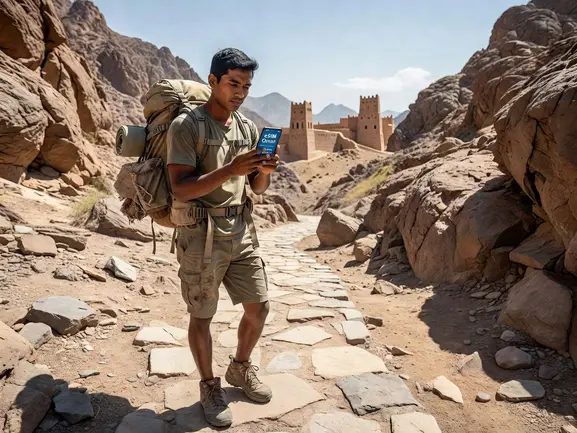
How to Set Up Your eSIM for Oman in Under 2 Minutes
No tech knowledge required. If you can scan a QR code, you can install your Oman eSIM. Do this before you board — airport Wi-Fi is unreliable and you don't want to troubleshoot in arrivals at 2am.
- Step 1: Check device compatibility. Confirm your phone supports eSIM at eSIMYat's supported devices list. Most iPhones from XS onwards and flagship Android devices (Samsung Galaxy S20+, Google Pixel 3a+) are compatible. Note: iPhones purchased in mainland China do not support eSIM.
- Step 2: Purchase your plan. Head to eSIMYat's Oman eSIM page, choose your data size and validity, and complete checkout. Plans start from $3.92.
- Step 3: Receive your QR code. Your QR code arrives instantly by email. No waiting, no shipping, no store visits.
- Step 4: Install the eSIM profile. On iPhone: Settings → Mobile Data → Add eSIM → Use QR Code. On Android: Settings → Connections → SIM Manager → Add eSIM. Scan the QR code and the profile installs automatically. The whole process takes under 90 seconds.
- Step 5: Set data routing. Set your eSIMYat Oman profile as the default for cellular data. Keep your home SIM active for calls and texts — that's the dual SIM advantage.
- Step 6: Enable hotspot (optional). All eSIMYat plans include free tethering. Enable hotspot in your phone settings to share data with other devices in your group.
- Step 7: Land and connect. When your plane touches down in Muscat, your phone connects to Omantel or Ooredoo automatically. No action required. You're online.
Oman Backpacking Routes and Connectivity Reality Check
Oman's backpacking circuit covers dramatically different terrain — and connectivity varies. Here's what to expect on the most popular routes:
Muscat and the Capital Region
Excellent 4G coverage. Omantel and Ooredoo both have dense towers across Muscat, Muttrah, and the coastal highway to Sur. You'll stream, navigate, and video call without issues. The Muttrah Souq area specifically has rock-solid signal.
Wahiba Sands (Sharqiyah Sands)
Patchy. The main entry points at Al Wasil and Bidiyah have decent coverage. Deep into the dunes, signal drops to 2G or disappears entirely. Download offline maps of the area before leaving Muscat — seriously, don't skip this step.
Wadi Shab and Wadi Bani Khalid
Surprisingly good. Both wadis sit within range of towers on the coastal highway. 4G is available at the entrance points; signal weakens in the deeper gorge sections. Good enough for WhatsApp check-ins and Google Maps at the trailhead.
Salalah and Dhofar
Strong coverage in Salalah city and the surrounding khareef (monsoon) plateau. Coverage extends well along the coastal road to Mirbat and Taqah. Remote areas toward Yemen border — expected coverage gaps.
Musandam Peninsula
Coverage exists in Khasab town, but Musandam is geographically isolated. Signal in the fjords (khors) is limited. A local SIM or Omantel signal booster at your dhow camp is the realistic option here for deep-fjord days.
Smart Oman Data Tips for Budget Backpackers
After three weeks testing eSIM plans on an Oman circuit from Muscat to Salalah, here's what actually saves data without killing the travel experience:
- Download offline maps the night before each new region — Google Maps or Maps.me both work. Cuts navigation data use by 80%.
- Use WhatsApp voice notes instead of standard calls — uses a fraction of the data of a voice call over cellular.
- Pre-book hostels on Wi-Fi at each location rather than browsing on data. Hostelworld and Booking.com pages are data-heavy.
- Set Instagram to upload on Wi-Fi only — auto-upload on cellular can burn through 500MB before you notice.
- Use eSIMYat's hotspot feature to connect your travel group — splitting one plan between two people on a day trip to Wahiba is more economical than two separate plans.
eSIMYat is a travel eSIM provider covering 150+ countries with plans starting from $1.18 and instant QR code activation — no app required, no passport scan, no SIM card to lose in the bottom of your backpack.
Also worth knowing: if you're continuing your trip beyond Oman into the wider Middle East, eSIMYat's Middle East regional plans can cover multiple countries under a single plan — a serious time-saver for backpackers doing Oman + Jordan + Egypt in one trip.
Frequently Asked Questions: eSIM for Oman Backpacking
Does eSIM work for backpacking in Oman?
Yes. eSIM works across all major backpacking routes in Oman, including Muscat, Salalah, Wadi Shab, and Wahiba Sands entry points. Coverage runs on Omantel and Ooredoo's 4G networks. Remote desert and fjord areas have limited signal — download offline maps before heading off-grid. An eSIM is far more practical than a local SIM for backpackers moving quickly between regions.
How much data do I need for a 2-week Oman backpacking trip?
For a 14-day Oman backpacking trip, 7–10GB covers most travelers comfortably — including navigation, WhatsApp, social media, and hostel research. If you're working remotely or streaming videos, go for 15GB or higher. eSIMYat's plans include free hotspot tethering, so you can share data with travel companions and effectively stretch your plan further.
Is esim oman backpacking cheaper than buying a local SIM at Muscat airport?
It depends on the duration. For trips under 3 weeks, a travel eSIM from eSIMYat is typically cheaper than the tourist SIM packages sold at Muscat International Airport, which include call credit you may not need. eSIMYat plans start from $3.92, require no passport registration, and activate instantly — saving you time and bureaucracy on arrival.
What phones support eSIM for use in Oman?
Most modern smartphones support eSIM — including iPhone XS and newer, Samsung Galaxy S20 and newer, Google Pixel 3a and newer, and many recent Huawei, Motorola, and OnePlus models. Important exception: iPhones purchased in mainland China typically do not support eSIM due to hardware differences. Check the full compatibility list at eSIMYat's supported devices page before purchase.
Can I use eSIMYat's Oman plan as a hotspot for tethering?
Yes. All eSIMYat plans include free hotspot and tethering — no extra fee, no hidden toggle to unlock it. This is particularly useful for Oman backpackers sharing a rental car or staying in desert camps where Wi-Fi is unavailable. You can connect laptops, tablets, and other phones directly to your eSIMYat Oman data connection.
Start Your Oman Trip Connected — Not Stressed
Three things to remember: a travel eSIM is the fastest way to get online in Oman, your phone supports it (check the device list to confirm), and the cost is a fraction of roaming fees or last-minute airport SIM queues.
For budget backpackers, the zero-waste angle matters too — no plastic SIM card, no packaging, no bin at the hostel. Just a QR code, a two-minute setup, and 4G coverage from the moment you land.
Get your eSIM for Oman backpacking now — plans start from $3.92 with instant activation and a 7-day refund on unused plans.