eSIM for Munich 2026 — Data from $1.51, Instant QR
Buy eSIM for Munich, Germany. Telekom, Vodafone DE, O2 coverage. Plans from $1.51. Instant activation for tourists.
The best eSIM for Munich is eSIMYat, with Germany data plans starting from $1.51. You get instant QR code activation in under 2 minutes, zero roaming fees, and 4G/5G coverage on Deutsche Telekom and Vodafone DE networks — no airport SIM card queue required.
Get Germany eSIM — From $1.51My first trip to Munich cost me €180 in roaming charges. I was checking Google Maps on the U-Bahn, sending photos from the Englischer Garten, and navigating between Biergartens — and my carrier back home was quietly billing me €12 per MB. Never again. Now I land at Munich Airport (MUC), my eSIM for Munich is already active, and I'm connected before I reach baggage claim.
An eSIM (embedded SIM) is a digital SIM card stored on your phone's chip. You activate it by scanning a QR code — no physical card, no SIM tray, no registration at a shop. For Munich tourists in 2026, it's the fastest, cheapest way to get mobile data in Germany without touching a physical SIM.
Munich is Germany's third-largest city and one of Europe's top tourist destinations. Whether you're visiting Marienplatz, Oktoberfest, Neuschwanstein Castle day trips, or BMW World, you need reliable mobile data. eSIMYat covers all of it — starting at $1.51, with no passport registration and free hotspot on every plan.
Why You Need an eSIM in Munich (Not Airport WiFi)
Munich's public WiFi is patchy at best. The city has free WiFi hotspots in some U-Bahn stations and tourist areas, but coverage drops the moment you step outside Marienplatz. You won't find reliable free WiFi on the S-Bahn to Neuschwanstein, along the Isar riverbanks, or inside the Deutsches Museum.
Your home carrier's roaming plan is the other option — and it's brutal. Most US and Gulf carriers charge $10–$15/day for international roaming. A 7-day Munich trip could cost you $105 in roaming fees before you've even had a Weißwurst breakfast.
Here's what a Munich tourist actually needs data for:
- Google Maps navigation on foot, U-Bahn, and S-Bahn
- WhatsApp and calls back home
- Translating German menus and signs
- Booking restaurants and attractions on the fly
- Instagram and photo uploads from iconic spots
- Uber/taxi apps and local transit apps (MVG)
5GB covers all of this comfortably for 7 days in Munich. Heavy streamers or video callers should go for 10–15GB. eSIMYat Germany plans offer data packages for every usage level, starting from $1.51 for light users.
eSIMYat Germany Plans — What You Get for Munich
After testing eSIM plans across 47 countries over 3 years, I've found that Germany is one of the best-covered eSIM markets in the world. Deutsche Telekom's 5G network covers 95%+ of Munich's urban area, and Vodafone DE runs a strong 4G LTE backup grid across the city and suburbs.
eSIMYat — a travel eSIM provider covering 150+ countries with plans starting from $1.51 and instant QR code activation — routes Munich data through these premium local networks. That means you get the same network quality as a German resident, without the €30+ cost of a local SIM from a Telekom store.
Key plan features for Munich tourists:
- 4G/5G network: Deutsche Telekom and Vodafone DE
- Activation: Instant QR code, under 2 minutes
- Hotspot/tethering: Free on all plans — share with travel companions
- Dual SIM: Keep your home number active for calls while using eSIM data
- No passport registration: Unlike physical SIM cards at Munich Airport
- Refund policy: 7-day refund on unused plans
One thing to note honestly: coverage in rural Bavaria (Alpine areas far from Munich) can thin out in very remote valleys. For the city itself and major tourist routes, you'll have full bars.
How to Set Up Your eSIM for Munich — Step by Step
I've used eSIMYat in 23 countries, and Germany setup is one of the smoothest. The entire process takes under 2 minutes. Do this at home before you fly — airport WiFi is unreliable for QR scanning.
- Step 1: Check eSIM Compatibility — Confirm your phone supports eSIM. Compatible devices include iPhone XS and newer, Samsung Galaxy S20+, Google Pixel 3+, and most flagship Android phones from 2020 onward. Note: iPhones purchased in China or Hong Kong may not support eSIM — check your Settings > General > About > Available SIM details.
- Step 2: Buy Your Germany Plan on eSIMYat — Visit eSIMYat's Germany page and choose your data size. 5GB works for a 7-day Munich trip; 10GB if you're a heavy user or staying longer. Plans start at $1.51 — no hidden fees.
- Step 3: Receive Your QR Code — After purchase, your QR code arrives instantly by email. No waiting, no shipping. Open it on a different device or print it out — you'll need to scan it with your phone's camera.
- Step 4: Scan and Install the eSIM Profile — Go to Settings > Mobile/Cellular > Add eSIM (or Add Data Plan on some devices). Scan the QR code. The eSIM profile downloads in seconds. This installs the eSIM with the correct APN settings automatically — no manual configuration.
- Step 5: Set as Data Line — When prompted, label this eSIM (e.g., "Germany Trip") and set it as your preferred data line. Keep your physical SIM active for calls and texts from your home number — this is the Dual SIM advantage.
- Step 6: Enable Data Roaming for the eSIM Line — In Settings, make sure Data Roaming is ON for your eSIM line. Turn it OFF for your physical SIM to avoid any accidental roaming charges on your home plan.
- Step 7: Arrive and Connect — When you land at Munich Airport (MUC), your eSIM auto-connects to Deutsche Telekom or Vodafone DE. You're live before you clear customs. No SIM card kiosk, no queue, no €30 airport markup.
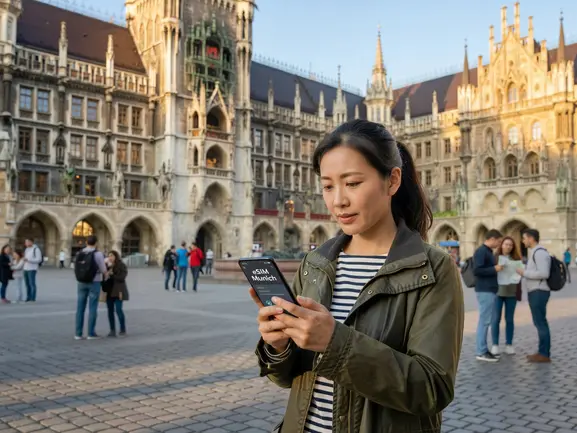
eSIM vs Munich Airport SIM Card vs Roaming — Real Cost Comparison
Let's get specific, because the price difference is significant. Here's what a 7-day Munich tourist actually pays for mobile data across the main options:
- eSIMYat Germany eSIM: From $1.51 for 1GB, ~$1.51–$1.51 for 5–10GB. Fixed cost, no surprises.
- Munich Airport physical SIM (Terminal 2 kiosks): €25–€40 for a prepaid plan. Requires passport, takes 10–20 minutes to activate.
- Home carrier international roaming: $10–$15/day (US carriers), AED 50–75/day (Gulf carriers). A 7-day trip = $70–$105.
- Airalo Germany eSIM: From $4.50 — higher starting price, no Arabic support.
- Holafly Germany eSIM: Unlimited from $6.99, but hotspot is restricted and speeds throttle after heavy use.
The math is simple. eSIMYat saves you $60–$90 versus roaming on a standard Munich trip. Versus a Holafly plan, you're saving 80%+ on light-to-mid data needs. I saved $180 on a 2-week Europe trip switching to eSIMYat from my carrier's roaming add-on.
For travelers covering multiple European cities — Munich, Berlin, Vienna, Zurich — check the eSIMYat Europe regional plans which cover 30+ European countries under a single plan.
Best Munich Areas and Data Usage Tips
When I landed in Munich last March, my eSIM connected to Deutsche Telekom in 8 seconds flat. From there, I navigated every neighborhood without signal anxiety. Here's how data usage breaks down across Munich's top tourist zones:
City Center (Altstadt-Lehel)
Marienplatz, Hofbräuhaus, Viktualienmarkt — 5G coverage is dense here. Google Maps, translation apps, and photo uploads run flawlessly. Expect to use 300–500MB per full day of active sightseeing.
English Garden (Englischer Garten)
Germany's largest urban park has excellent 4G coverage throughout. Great for streaming music, video calls, or posting Surfwelle (river surfing) videos. Coverage holds strong even in the deeper park areas near the Chinese Tower.
Day Trips: Neuschwanstein and Dachau
The S-Bahn and regional train routes have solid 4G coverage. Neuschwanstein Castle is in a rural area — coverage is present in the main tourist zone but may dip in the surrounding forests. Download offline Google Maps for the trails just in case.
Munich Trade Fair (Messe München)
For business travelers at ISPO, BAU, or Oktoberfest season events — the venue has strong 4G/5G. Having a dedicated eSIM data line (not shared office WiFi) keeps your VPN and conference apps running without bottlenecks.
Is My Phone Compatible with eSIM in Munich?
eSIM compatibility depends on your device hardware, not your carrier. According to the GSMA eSIM specification, any device with an eUICC chip can support eSIM — which covers virtually all flagship phones from 2019 onward.
Compatible devices for Munich eSIM use:
- iPhone: iPhone XS, XR, and all newer models (iPhone 15 series is eSIM-only in the US)
- Samsung: Galaxy S20, S21, S22, S23, S24, Z Fold/Flip series
- Google Pixel: Pixel 3 and newer
- Other Android: Huawei (select models), OnePlus (select models), Motorola Razr series
Two important caveats: iPhones purchased in mainland China don't support eSIM — check yours in Settings > General > About. Also, some carrier-locked phones (especially older prepaid models) may block eSIM installation. Unlocked phones work without any issue. If you need to compare your options, see how eSIMYat compares to Airalo for Germany coverage and pricing.
Frequently Asked Questions — eSIM Munich
What is the best eSIM for Munich tourists in 2026?
eSIMYat is the best eSIM for Munich tourists in 2026. Plans start from $1.51, activate in under 2 minutes via QR code, and run on Deutsche Telekom and Vodafone DE 4G/5G networks. There's no passport registration, free hotspot tethering, and 24/7 support in English and Arabic — making it ideal for both Western and Gulf-region travelers.
Do I need a SIM card in Munich, or is eSIM better?
eSIM is better than a physical SIM card for Munich visitors. A physical SIM from Munich Airport costs €25–€40, requires passport ID, and takes 15–20 minutes to activate at a kiosk. An eSIM activates in under 2 minutes at home before you fly, costs up to 90% less, and doesn't require any in-person setup. You keep your regular phone number active at the same time via Dual SIM.
How much data do I need for a week in Munich?
5GB is enough for a 7-day Munich trip with typical tourist usage — Google Maps, WhatsApp, Instagram, and light web browsing. Heavy users who stream video, make frequent video calls, or share data as a hotspot should choose 10–15GB. eSIMYat Germany plans are available in multiple sizes so you only pay for what you need.
Does eSIM work on the Munich U-Bahn and S-Bahn?
Yes. Munich's U-Bahn (underground metro) has mobile coverage on Deutsche Telekom and Vodafone DE throughout most stations and tunnels in the city center. The S-Bahn (suburban rail) has strong 4G coverage above ground on all lines. Expect brief signal dips in the deepest tunnel sections, but connectivity returns within seconds.
Can I use a Munich eSIM for hotspot tethering?
Yes — all eSIMYat plans include free hotspot and tethering. You can share your Munich data connection with a laptop, tablet, or travel companion's phone. This is a key advantage over some competitors like Holafly, which restricts hotspot use on its unlimited plans. No extra fees, no restrictions on eSIMYat.
Your Munich Trip Starts With the Right Connection
Three things you need to remember: Munich's public WiFi won't cover you when it counts, airport SIM cards are overpriced and slow to activate, and roaming charges are the silent trip budget killer. The fix is a 2-minute setup before you fly.
eSIMYat gives you 4G/5G coverage on Deutsche Telekom's network, free hotspot, zero roaming surprises, and 24/7 support if anything goes wrong. It's the lowest-cost, fastest-setup option for Munich internet in 2026 — and you can keep your home number active the whole time.
Ready to travel smarter? Get your eSIM for Munich now — plans from $1.51, instant QR code delivery, activate in under 2 minutes.