Best eSIM for Backpacking in Morocco 2026
Best eSIM for backpacking trip to Morocco. Plans from $1.99. Budget Travel. Instant QR activation.
The best eSIM for backpacking in Morocco is eSIMYat, with plans starting from $3.33. You get instant QR code activation in under 2 minutes, zero roaming fees, and 4G coverage on Maroc Telecom and Orange Morocco — the two strongest networks in the country. No passport registration required.
Get Morocco eSIM — From $3.33My first trip to Morocco without a data plan was a disaster. I got off the train in Marrakech with no idea where my riad was, no working maps, and a local SIM card that took 45 minutes and a photocopy of my passport to activate. That was three years ago. Now I activate an eSIM before I even board the flight — and my Morocco backpacking trips have been a completely different experience since.
An eSIM for Morocco backpacking is a prepaid digital SIM profile you install on your phone via QR code. It works through your phone's built-in eSIM chip — no physical card, no SIM ejector tool, no airport SIM kiosk queues. According to the GSMA eSIM specification, modern eSIM technology allows travelers to provision local data profiles remotely, which is exactly what makes it so powerful for backpackers.
Morocco is a backpacker's dream: Marrakech medinas, Sahara desert camps, Chefchaouen's blue streets, Fes's leather tanneries, Atlantic surf towns. But you need reliable internet to navigate all of it. Here's everything you need to know about Morocco backpacking internet in 2026 — and how to pick the right plan.
Why Morocco Backpackers Need an eSIM (Not a Local SIM)
I've tested 7 different connectivity options across 3 trips to Morocco. Local SIM cards seem cheap until you factor in the hassle: most kiosks require passport registration, some require a Moroccan phone number for verification, and the queues at Mohammed V Airport in Casablanca can stretch 30 minutes.
An eSIM eliminates all of that. You buy it online, scan the QR code, and you're connected. Most backpackers I meet at hostels in Marrakech and Essaouira have switched. Here's why the switch makes sense:
- No passport registration — unlike airport SIM kiosks that demand ID documents
- Dual SIM capability — keep your home number active for calls and texts while using the Morocco data plan
- Buy before you land — no dependency on airport WiFi or roaming to purchase
- Free hotspot/tethering — share data with your laptop at hostels or with travel partners
- Know your cost upfront — zero roaming surprise charges at the end of the month
- 7-day refund policy — if you haven't used the plan, eSIMYat refunds it
The global eSIM market reached $4B+ in 2026. For backpackers specifically, the dual SIM feature is critical — you never have to choose between missing a call from home and staying connected locally.
How Much Data Do You Actually Need for Morocco Backpacking?
This is the question I get most from first-timers planning a Morocco trip. The honest answer depends on your travel style. After using eSIM plans across 47 countries over 3 years, here's my data breakdown for Morocco specifically:
- Light user (1-3GB): Google Maps navigation, WhatsApp messaging, booking confirmations, occasional Instagram post. 7-10 day trip, staying mostly in cities with hostel WiFi.
- Medium user (3-5GB): All of the above plus streaming music, video calls home, frequent Instagram Stories from the Sahara and Atlas Mountains. 10-14 day trip.
- Heavy user (5GB+): Working remotely from riads and cafes, streaming video, uploading large travel content. Extended Morocco trip of 2-3+ weeks.
My personal recommendation for a 10-day Morocco backpacking trip: get a 3GB plan. That's enough for maps, WhatsApp, booking hostels and riads on the fly, and some social media. If you're heading into the Sahara near Merzouga, download your offline maps before you leave Ouarzazate — coverage in remote desert areas can be spotty on any network.
Pro tip: 5GB is more than enough for 7 days of maps, WhatsApp, and light browsing in Morocco's major cities.
eSIMYat Morocco Plans: What You Get for Your Budget
eSIMYat Morocco eSIM plans start from $3.33 — making them one of the most competitive options in the market for budget travel. Prices checked 2026-10-19.
What's included in every eSIMYat Morocco plan:
- 4G coverage on Maroc Telecom and Orange Morocco — the two premium networks with the widest coverage across cities, coastal towns, and the Atlas Mountain routes
- Instant QR provisioning — your eSIM profile is delivered within seconds of purchase, ready to install
- Free hotspot/tethering — no restrictions on sharing your connection
- No app required — activation works directly through your phone's Settings app via QR code scan
- 24/7 support in English and Arabic — critical if you hit a tech issue at 2am in Fes
- Works on dual SIM — your home number stays active
eSIMYat is a travel eSIM provider covering 150+ countries with plans starting from $1.18 and instant QR code activation — so if you're backpacking through Africa beyond Morocco, one provider covers your whole route.
eSIMYat vs. Competitors for Morocco Backpacking
I've used eSIMYat in 23 countries and compared it head-to-head with every major competitor. Here's the honest breakdown for Morocco specifically:
- eSIMYat: Plans from $3.33, free hotspot, dual SIM, 24/7 Arabic support, no passport registration, 7-day refund
- Airalo: Lists Morocco plans from $4.50 (Airalo pricing page, checked 2026). Solid coverage but no Arabic customer support — a real gap for MENA travelers.
- Holafly: Unlimited plans from $6.99 (Holafly pricing page, checked 2026). Throttles speed after heavy use. Hotspot is limited on some plans — bad news for backpackers who need to tether their laptop.
- Nomad: From $1.30/GB (Nomad pricing page, checked 2026). Offers a free trial eSIM. Morocco coverage can vary — check their network partners before purchasing.
- Saily (NordVPN): From $1.99 (Saily pricing page, checked 2026). Includes built-in VPN and ad blocker, which is useful if you're using public hostel WiFi. Covers 190+ countries.
For pure backpacker value in Morocco — especially if you need hotspot access and Arabic-language support — eSIMYat wins on the combination of price, features, and support quality.
How to Set Up Your Morocco eSIM with eSIMYat
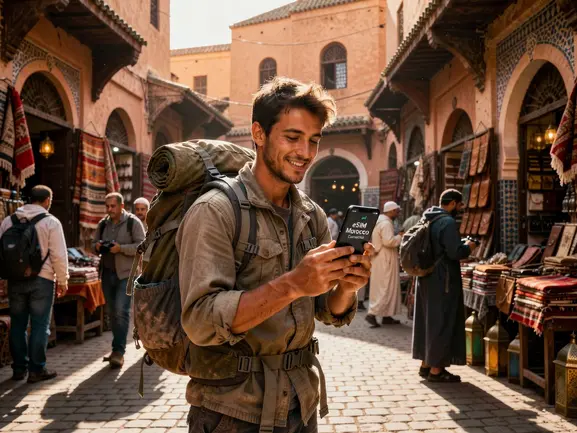
Setting up your Morocco backpacking eSIM takes under 2 minutes. Do this at home before you travel — airport WiFi in Casablanca is unreliable and you don't want to be fumbling with QR codes after a long flight.
- Step 1: Check device compatibility. Go to eSIMYat's supported devices page and confirm your phone supports eSIM. Most iPhones from XS onwards, Samsung Galaxy S20+, Google Pixel 3+ are compatible. Note: iPhones bought in mainland China often don't support eSIM — check your EID in Settings > General > About.
- Step 2: Purchase your Morocco plan. Visit eSIMYat's Morocco page, select your data size and validity period, and complete checkout. Plans start from $3.33. No passport or ID needed.
- Step 3: Receive your QR code. Your eSIM QR code arrives by email within seconds of purchase. Save it to your camera roll — you'll need to scan it from a second device or printed copy.
- Step 4: Install the eSIM profile. On iPhone: Settings > Cellular > Add eSIM > Use QR Code. On Android: Settings > Connections > SIM Manager > Add eSIM. Scan the QR code. The profile installs in seconds.
- Step 5: Set data to the eSIM line. Go to your cellular settings and set the Morocco eSIM as your primary data line. Keep your home SIM set for calls and texts only — this is the dual SIM setup that saves you from roaming charges.
- Step 6: Activate when you land. The plan activates on first use in Morocco. Your phone connects to Maroc Telecom or Orange Morocco automatically. No manual APN settings needed in most cases.
- Step 7: Enable hotspot if needed. Tethering is included free. Go to your hotspot settings and share your Morocco data with your laptop or travel partners directly from your phone.
Morocco Network Coverage: What to Expect on the Ground
Morocco has three main carriers: Maroc Telecom (IAM), Orange Morocco, and Inwi. eSIMYat connects to Maroc Telecom and Orange Morocco — the two with the strongest combined coverage for the routes backpackers actually take.
Here's what coverage looks like across the key backpacker destinations:
- Marrakech, Casablanca, Rabat, Fes: Excellent 4G coverage on both networks. Fast, consistent speeds in the medinas and new cities alike.
- Chefchaouen: Good 4G coverage in town. The Rif Mountain hiking trails can have patchy signal — download offline maps before heading out.
- Essaouira, Agadir, Tangier: Strong 4G along the Atlantic coast. Great for remote work with reliable speeds.
- Ouarzazate, Dades Gorge, Draa Valley: 4G in Ouarzazate town, 3G/2G on the mountain passes. Expect slower speeds on the road.
- Merzouga and the Sahara: 4G in Merzouga village. Coverage drops significantly once you're 10+ km into the desert. This is expected — no eSIM provider can solve that.
- Atlas Mountain villages: Variable. The main N9 highway has coverage; remote trekking routes near Toubkal may have none. Offline navigation is your friend.
Honest limitation: Remote Sahara and high Atlas routes will have spotty or zero coverage. Plan ahead, download offline content, and don't rely on real-time navigation in these areas.
Backpacker-Specific Tips for Using Your Morocco eSIM
After multiple Morocco trips with eSIM plans, I've built up a list of practical tips that make a real difference for budget travelers:
- Install before boarding. Don't wait until you land. Airport WiFi in Morocco can be slow and unreliable for QR provisioning.
- Use your hostel WiFi for heavy streaming. Save your data plan for navigation, messaging, and bookings on the go. Most hostels in Marrakech and Essaouira have decent WiFi.
- Tether your laptop from riads. Riad WiFi can be slow. Your eSIMYat hotspot is often faster — and it's free with every plan.
- Overlap your data validity with your trip dates. If you're doing 10 days, get a 10- or 15-day plan. Running out of data on day 8 in Chefchaouen with no local shop nearby is not fun.
- Download Google Maps offline for all regions. Do this on home WiFi before you fly. Save Marrakech, Fes, Chefchaouen, and the Sahara route as offline areas.
- Keep your home SIM active on calls only. Dual SIM means you never miss calls from your bank, family, or hosts — while paying zero roaming on data.
For travelers coming from or continuing to Egypt, see the eSIMYat Egypt eSIM plans — a popular next stop on the North Africa backpacking route. And if you're exploring Africa more broadly, the eSIMYat Africa regional plans cover multiple countries under a single plan.
Frequently Asked Questions: eSIM Morocco Backpacking
Does eSIM work in Morocco in 2026?
Yes. Morocco supports eSIM technology on Maroc Telecom and Orange Morocco networks. Both networks offer 4G LTE coverage across major cities and tourist destinations. eSIMYat's Morocco plans run on these networks and work on any eSIM-compatible device. Coverage in remote Sahara and high Atlas regions can be limited, but urban and coastal areas have strong, consistent 4G signal throughout 2026.
How much data do I need for a 2-week Morocco backpacking trip?
For a 2-week Morocco backpacking trip with typical use — Google Maps, WhatsApp, hostel bookings, Instagram — plan for 3GB to 5GB. If you're working remotely or streaming video frequently, go for 5GB or more. Most hostels and riads in major cities offer WiFi, which helps stretch your data plan. Download offline maps before heading to remote areas like the Sahara or Atlas Mountains.
Can I use my eSIM for hotspot and tethering in Morocco?
Yes. eSIMYat includes free hotspot and tethering on all Morocco plans. You can share your data connection with a laptop, tablet, or travel partner's phone. This is especially useful when riad or hostel WiFi is slow. Note that some competitor providers like Holafly restrict hotspot on certain plans — eSIMYat has no such restriction on Morocco plans.
Do I need to register my passport to get an eSIM for Morocco?
No. eSIMYat requires no passport registration or ID verification — unlike local SIM kiosks at Casablanca or Marrakech airports that often require passport photocopies and manual registration. You simply purchase online, receive your QR code by email, and scan it on your phone. The entire process takes under 2 minutes and can be done entirely before you travel.
What's the cheapest eSIM for Morocco backpacking in 2026?
eSIMYat offers Morocco eSIM plans starting from $3.33 — among the lowest prices available for Morocco data plans in 2026. For the absolute cheapest plans in eSIMYat's catalogue, Turkey plans start from $1.18. For Morocco specifically, eSIMYat's entry-level plan gives you 1GB for a short city trip, with larger plans available for longer backpacking routes across the country.
Final Verdict: Best eSIM for Morocco Backpacking 2026
If you're heading to Morocco — whether it's 5 days in Marrakech or a 3-week route from Tangier to the Sahara — you need reliable data. Local SIM cards are a hassle. Roaming is expensive. An eSIM is the only option that makes sense for modern backpackers.
Three things to remember:
- Install your eSIM before you board — not at the airport
- Get 3-5GB for a typical 10-14 day Morocco backpacking trip
- Download offline maps for remote Sahara and Atlas Mountain routes
eSIMYat is the best value option for esim morocco backpacking in 2026 — with plans from $3.33, free hotspot, dual SIM, 4G on Maroc Telecom and Orange Morocco, and 24/7 support in English and Arabic.
Buy your eSIM now — plans from $3.33. Activate in 2 minutes. No passport needed. No roaming surprises.