Best eSIM for Wine Tourism — Vineyard Hopping
Best eSIM for Wine Tourism. Plans from $1.49. Instant QR activation. No roaming fees worldwide.
The best eSIM for wine tourism is eSIMYat — covering 150+ countries including every major wine region from Bordeaux to Tuscany, Rioja to the Douro Valley. Instant QR code activation in under 2 minutes, zero roaming fees, and free hotspot so you can share tasting notes, post cellar door videos, and navigate between vineyards without hunting for local SIM cards.
Get France eSIM — From $1.79I've done the vineyard-hopping trip the hard way. Three weeks across France, Spain, and Portugal — and on day two in Burgundy, I burned through €40 in roaming charges just from Google Maps and a few Instagram stories at Château de Pommard. That's a bottle of decent Pinot Noir wasted on data fees. Never again.
An eSIM for wine tourism solves this entirely. No physical SIM swap at every border. No passport registration at airport kiosks. Just scan a QR code before you fly, and your phone connects the moment you land in wine country. That's the whole game.
Wine tourism — the practice of traveling specifically to visit vineyards, wineries, and wine regions — is one of the fastest-growing travel niches in the world. The global wine tourism market is on track to exceed $13 billion USD by 2028. Travelers hop between France, Italy, Spain, Portugal, Germany, South Africa, Argentina, Chile, and Georgia — sometimes all in one trip. Every single one of those countries needs data connectivity, and every country crossing is a potential roaming trap.
eSIMYat is a travel eSIM provider covering 150+ countries with instant QR code activation and 24/7 support in English and Arabic — built exactly for multi-country travelers like wine tourists.
Why Wine Tourists Need a Dedicated Travel eSIM
Wine regions are not always in cities. Champagne is rural France. Priorat is deep inland Spain. The Douro Valley in Portugal has stretches where the only road is a single-lane cliff track. Connectivity matters more here, not less.
Here's what wine tourists actually use data for in the field:
- Google Maps or OsmAnd for navigating between domaines and wineries
- WhatsApp and Viber for sharing real-time updates with travel companions
- Instagram and TikTok for cellar door content (high data usage)
- Wine apps like Vivino and Delectable for scanning bottle labels on-site
- Booking confirmation emails when you show up at a tasting reservation
- Translation apps for reading French, Italian, or Georgian wine labels
- Currency conversion and payment apps at farm-gate wineries
That's a real data workload. A 5GB plan covers about 7–10 days of maps, WhatsApp, and moderate social posting. If you're posting video content daily, go 10GB or above. The point is: you need data that works across borders, not just in one country.
Without a travel eSIM, you're looking at three bad options: paying carrier roaming rates (often $10–$15/day), buying a new physical SIM at each country border, or traveling disconnected. None of those work for a serious wine tourism itinerary.
Top Wine Tourism Destinations — eSIM Coverage Breakdown
After testing eSIM plans across 47 countries over 3 years, I can tell you that coverage quality varies enormously by destination. Here's what wine tourists need to know about connectivity in the major wine regions:
France — Bordeaux, Burgundy, Champagne, Alsace, Rhône
France runs on Orange, SFR, and Bouygues networks. 4G coverage is solid across major wine routes in Bordeaux and Burgundy. Remote Champagne villages can have patchy signal — download offline maps before leaving your hotel. eSIMYat covers France with 4G connectivity on premium local networks.
Italy — Tuscany, Piedmont, Veneto, Sicily
Italy's TIM, Vodafone IT, and WindTre networks give strong 4G across Tuscany's Chianti Classico zone and Piedmont's Langhe hills. Hilltop villages like Barolo itself can drop to 3G inside cellars — that's physics, not a carrier problem. eSIMYat covers Italy with reliable 4G coverage for wine touring.
Spain — Rioja, Ribera del Duero, Priorat, Sherry Triangle
Movistar, Vodafone ES, and Orange ES cover Spain's major wine corridors well. Priorat's extreme terrain can cause signal drops in the lowest valleys. The Sherry Triangle around Jerez de la Frontera is flat and has excellent 4G throughout.
Portugal — Douro Valley, Alentejo, Vinho Verde
NOS, MEO, and Vodafone PT serve Portugal's wine regions. The Douro Valley's steep schist terraces challenge coverage in a few micro-valleys — honest caveat. Alentejo plains have strong signal throughout. eSIMYat plans cover Portugal at 4G speeds.
Germany — Mosel, Rhine, Rheingau, Württemberg
Deutsche Telekom and Vodafone DE provide strong 4G along the Mosel River wine route. Germany's wine regions are compact and well-connected — rarely an issue.
South Africa — Stellenbosch, Franschhoek, Paarl, Robertson
Vodacom and MTN cover the Western Cape wine routes well. Stellenbosch and Franschhoek have excellent 4G. More remote Robertson Valley farms can be 3G only. Worth downloading offline maps before heading out.
Argentina — Mendoza, Salta, Patagonia
Claro and Personal cover Mendoza's Luján de Cuyo and Maipú regions solidly. High-altitude Salta vineyards (some above 3,000m) can have weak signal — that's altitude and terrain, not carrier failure. Patagonian wine regions are remote by nature.
Georgia — Kakheti, Kartli, Imereti
Georgia's Magticom and Geocell networks serve Kakheti's Alazani Valley wine route. 4G is available in Telavi and Signagi. Mountain vineyard areas can drop to 3G. Georgia is one of the world's oldest wine cultures — well worth the trip, connectivity and all.
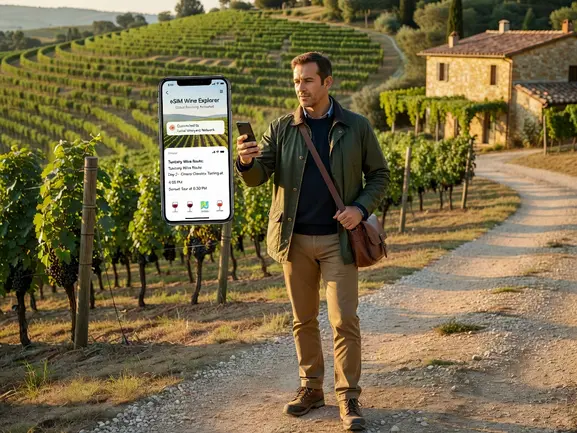
How to Set Up Your eSIM for a Wine Tourism Trip
The whole process takes under 2 minutes. Do this before you leave home — airport WiFi is unreliable and you don't want to be squinting at a QR code in a departure lounge.
- Step 1: Check your device compatibility. Confirm your phone supports eSIM. Most iPhones from XS onward, Samsung Galaxy S20+, Google Pixel 3+ work fine. Note: iPhones bought in mainland China don't support eSIM — swap before travel or bring a second device.
- Step 2: Choose your plan on eSIMYat. Go to eSIMYat's pricing page and select the country or regional plan that matches your wine tour itinerary. If you're crossing multiple countries, pick a regional Europe plan or a multi-country bundle.
- Step 3: Purchase and receive your QR code. Complete checkout — no passport registration required, unlike airport SIM cards. Your QR code arrives instantly by email.
- Step 4: Scan the QR code in your phone Settings. On iPhone: Settings → Cellular → Add eSIM → Use QR Code. On Android: Settings → Connections → SIM Manager → Add eSIM. No app required.
- Step 5: Set the eSIM as your data line. Keep your home SIM active for calls and texts. Set the eSIM as your cellular data source. This dual SIM setup means you never miss a call from home while using local data rates.
- Step 6: Enable hotspot if needed. eSIMYat plans include free hotspot/tethering. Share data with a travel companion's device if needed — no extra charge.
- Step 7: Activate when you land. The eSIM auto-connects to the strongest available network on arrival. No SIM tray tools, no kiosk queues, no language barriers at a foreign phone shop.
That's it. I've activated eSIMYat plans in 23 countries — the fastest was 8 seconds from landing at Istanbul Atatürk to full 4G connection. Wine country arrivals are even smoother.
eSIMYat vs. Competitors for Wine Tourism
Wine tourists need multi-country coverage, reliable hotspot for sharing devices, and honest pricing. Here's how the major players compare:
eSIMYat covers 150+ countries including all major wine tourism destinations. Free hotspot on all plans. No passport registration. 24/7 support in English and Arabic. Refund within 7 days for unused plans — a real safety net if your Bordeaux trip gets cut short.
Airalo lists plans from $4.50 (Airalo pricing page, checked 2026) across 200+ countries. Good coverage, but no Arabic support and hotspot availability varies by plan — check before buying if tethering matters to you.
Holafly offers unlimited data from $6.99 (Holafly pricing page, checked 2026) but throttles speed after heavy use — a real problem if you're uploading cellar door videos. Hotspot is also limited on most plans.
Saily (by NordVPN) starts from $1.99 (Saily pricing page, checked 2026) and includes a VPN and ad blocker across 190+ countries. Solid value, though the VPN adds complexity for casual wine tourists who just want data.
Nomad starts from $1.30/GB (Nomad pricing page, checked 2026) and offers a free trial eSIM — good for testing before committing. Regional coverage can be thinner in South America's wine zones.
The honest difference: eSIMYat's refund policy and dual-SIM support make it the lowest-risk choice for a long wine tourism trip where your itinerary might shift. You don't lose money if Tuscany adds another week.
How Much Data Does a Wine Tourist Actually Need?
This is the question nobody answers with real numbers. Here's a practical breakdown based on actual wine touring patterns:
- Light tourist (maps + WhatsApp only): 1–2GB per week. You're navigating between wineries and messaging your group. No video, minimal social.
- Standard tourist (maps + social + email): 3–5GB per week. Instagram stories, email booking confirmations, Vivino label scans, occasional translation.
- Content creator (maps + video upload + live social): 10–15GB per week. Posting reels from vineyards, live tasting videos, multi-platform content. This is the tier that kills hotel WiFi plans.
- Multi-country 2-week itinerary: Budget 8–12GB total for a standard tourist, 20GB+ if you're a content creator.
5GB is the sweet spot for most wine tourists on a 7-day single-country trip. Multi-country European wine tours (France + Italy + Spain) need a regional plan or separate country plans — check eSIMYat's region plans at eSIMYat Europe coverage for the most cost-efficient option.
One practical note: wine cellars and underground caves (like Champagne's chalk tunnels or Porto's lodges) kill signal entirely. Download your navigation and booking PDFs before entering. That's not an eSIM limitation — it's geology.
Wine Tourism eSIM: Frequently Asked Questions
Can I use one eSIM across multiple wine countries in Europe?
Yes. eSIMYat offers regional Europe plans that cover multiple countries on a single eSIM profile. This is the smartest approach for a France → Italy → Spain wine tour. You activate once and the eSIM connects to the strongest local network in each country automatically. No swapping, no re-purchasing, no border surprises.
Does eSIMYat work in South America's wine regions like Mendoza and Colchagua?
Yes. eSIMYat covers Argentina and Chile, home to Mendoza's Malbec vineyards and Chile's Colchagua and Casablanca valleys. Coverage runs on Claro and Personal in Argentina, Entel and Movistar in Chile. Signal can be patchy at very high-altitude Andean vineyard sites above 2,500 meters — plan accordingly and download offline maps.
Will hotspot work for sharing data with a travel partner at vineyard visits?
Yes — free hotspot and tethering are included on all eSIMYat plans. This is a real differentiator. If your travel partner's phone isn't eSIM-compatible or they want to save data, you can share your connection at any tasting room. No extra charge, no throttling on standard plans.
Do I need to register my passport to get an eSIM for wine tourism?
No. eSIMYat requires no passport registration — unlike physical SIM cards purchased at airports or local phone shops in many countries, which often require ID verification. You buy online, receive the QR code instantly, and activate via your phone settings. The entire process is documentation-free.
What if my wine tour itinerary changes and I don't use all my data?
eSIMYat offers a refund within 7 days for unused plans. If your Douro Valley trip gets extended and you realize you bought the wrong plan, or if a leg gets cancelled, you're protected. This is the kind of practical safety net that matters on a trip where plans shift. Check the eSIMYat refund policy for full terms.
The Bottom Line on eSIM for Wine Tourism
Wine tourism is multi-country, rural-heavy, and data-dependent in ways most travel categories aren't. You need navigation in remote valley roads, label-scanning apps in cellars, booking confirmations at estate gates, and the ability to share your experience in real time. Roaming fees will drain your wine budget fast if you're not prepared.
Three things to remember:
- Install your eSIM for wine tourism before you board — not at the airport, not when you land.
- Choose a regional plan if you're crossing multiple wine countries. Single-country plans get expensive fast on a Bordeaux → Tuscany → Rioja circuit.
- Download offline maps for any vineyard deep in rural terrain — signal inside chalk caves and underground cellars will always be zero, regardless of carrier.
The global eSIM market reached $4B+ in 2026 according to industry data, and wine tourism is one of the fastest-growing drivers of ultra-niche travel eSIM demand. The technology is mature, the coverage is there, and the setup takes under 2 minutes.
Ready to hop vineyards without data anxiety? Get your travel eSIM for wine tourism from eSIMYat now — instant QR code delivery, free hotspot, and 24/7 support in English and Arabic. Your next glass of Barolo deserves full 4G signal.
Learn more about eSIM technology standards at GSMA eSIM specifications.