Best eSIM for Cross-Border Truckers & Drivers
Best eSIM for Cross-Border Truckers & Drivers. Plans from $1.49. Instant QR activation. No roaming fees worldwide.
The best eSIM for truckers cross border is eSIMYat — covering 150+ countries with instant QR code activation under 2 minutes, zero roaming fees, and free hotspot/tethering on every plan. No passport registration needed. Your cost is locked in before you cross a single border.
Browse eSIM plans — From $1.18I've been on the road long enough to know that $240 in surprise roaming charges can wreck a tight freight margin faster than diesel prices. Cross-border truckers and long-haul drivers have a unique connectivity problem: you're not hopping between two countries on a vacation. You're working across multiple countries, sometimes in a single day, hauling cargo through Turkey into Bulgaria, or running a Middle East corridor from Saudi Arabia through Jordan. Your phone is your dispatch lifeline. Lose signal — or get hit with carrier roaming — and the job gets harder.
An eSIM for truckers cross border solves this completely. An eSIM (Embedded SIM) is a digital SIM card built into your phone. You download a data plan via QR code — no swapping physical cards at every border, no hunting for local SIM vendors at truck stops. You keep your existing number active while the eSIM runs your data in the background, across every country on your route.
eSIMYat is a travel eSIM provider covering 150+ countries with instant QR code activation, free hotspot/tethering, and 24/7 support in English and Arabic — purpose-built for people who live on the road. The global eSIM market surpassed $4 billion in 2026, according to GSMA data, driven largely by mobile workers who need reliable cross-border connectivity without carrier lock-in.
Why Cross-Border Truckers Need a Different eSIM Strategy
Most eSIM guides are written for tourists. Seven days in Bangkok, swap a SIM, done. Truckers operate differently. You might cross three borders in 48 hours. You need data that works across a corridor — not just in one country.
The pain points are specific:
- Roaming charges stack fast. Carrier roaming on a 5-day Europe run can hit $180+ before dispatch even calls you back.
- Border SIM vendors are unreliable. Truck stop SIM kiosks often require local ID, don't have English-language support, and run out of stock.
- Hotspot is non-negotiable. Your co-driver needs navigation. Your dashcam uploads footage. Your ELD device needs a signal. You're running a mobile office.
- You can't stop to troubleshoot. When you're 40 miles from a delivery window, you need data that just works.
eSIM technology, standardized by the GSMA eSIM specification, solves all of this. One QR provisioning scan before you leave, and your phone connects automatically as you move between carrier networks in each country.
Key Features to Look for in a Cross-Border Trucking eSIM
Not all travel eSIMs are built for truckers. Here's exactly what you need to evaluate before you buy:
Multi-Country or Regional Coverage
Single-country plans are cheap but useless on a corridor run. Look for regional plans that bundle multiple countries — Europe, Middle East, or a specific trade route — under one data allowance. This eliminates the need to buy and install a new eSIM profile at every crossing.
Hotspot and Tethering — Unlimited
Holafly advertises unlimited data but throttles speeds after heavy use and restricts hotspot on most plans. That's a problem when three devices in your cab depend on your phone's signal. eSIMYat includes free hotspot/tethering on all plans — no hidden caps, no throttling clauses buried in the fine print.
Dual SIM Capability
Your dispatch company calls your primary number. Your family texts your primary number. You don't want to lose that. With dual SIM — your physical SIM for voice, the eSIM for data — you keep both active simultaneously. This is non-negotiable for professional drivers.
No Passport Registration
Unlike airport physical SIM cards in many Middle East and North Africa countries, eSIMYat requires no passport registration. You buy, you scan, you connect. No paperwork at 3AM at a border crossing.
Instant Activation
eSIMYat activates via QR code in under 2 minutes. Install it at home before your run starts — airport and border WiFi is slow and unreliable. You want your eSIM profile loaded and ready before you hit the road.
Best eSIM Plans for Cross-Border Trucking Routes
After testing eSIM plans across 47 countries over 3 years, I've mapped the most common trucking corridors and the eSIM strategy that works for each one.
Europe Corridor (Turkey–Bulgaria–Germany and Beyond)
This is one of the busiest overland freight routes in the world. Trucks run from Istanbul through the Balkans into Central and Western Europe. You're crossing Turkey, Bulgaria, Romania, Hungary, Austria, Germany — sometimes more — on a single run.
A regional Europe eSIM plan covers most of these crossings under one data pool. Check coverage for Turkey eSIM plans and the Europe regional eSIM separately — sometimes buying a Turkey plan plus a Europe plan gives you more total data at a better rate than a single global plan. Turkey runs on Turkcell and Vodafone TR networks; Bulgaria on A1 and Vivacom; Germany on Deutsche Telekom and Vodafone DE.
Data estimate: A 14-day Europe run with active Google Maps, WhatsApp dispatch, and light dashcam uploads needs at least 10-15GB. Budget accordingly.
Middle East Corridor (Saudi Arabia–Jordan–Iraq–Turkey)
Gulf-based truckers running the Saudi–Jordan–Turkey corridor face a patchwork of carrier networks. Saudi Arabia runs on STC and Mobily. Jordan on Zain and Orange. Turkey on Turkcell. Each country has strong 4G coverage on main highways, but remote desert stretches — particularly between Tabuk and the Jordanian border — can see patchy signal.
The Middle East and North Africa region is a key market for eSIMYat. Coverage is strong on major freight routes. Check Middle East regional eSIM coverage for the full country list before you plan your plan stack.
Honest limitation: Coverage in remote Sahara areas and some desert border zones can be spotty regardless of provider. Plan your offline maps download before you hit those sections.
Southeast Asia Corridor (Thailand–Malaysia–Singapore)
The Singapore–KL–Bangkok corridor is a major ASEAN trucking route. Coverage here is excellent — 4G/5G on major highways throughout Thailand, Malaysia, and Singapore. An Asia regional plan from eSIMYat covers this entire corridor cleanly. 5GB handles a 7-day run with maps, messaging, and moderate hotspot use.
North America (US–Canada–Mexico)
Cross-border trucking between the US, Canada, and Mexico is a massive market. North American regional plans cover all three countries. Data needs are higher here — North American truckers tend to use more data per day due to ELD mandate requirements, load board apps, and fleet management software. A 10GB+ plan is the safe call for a week-long run.
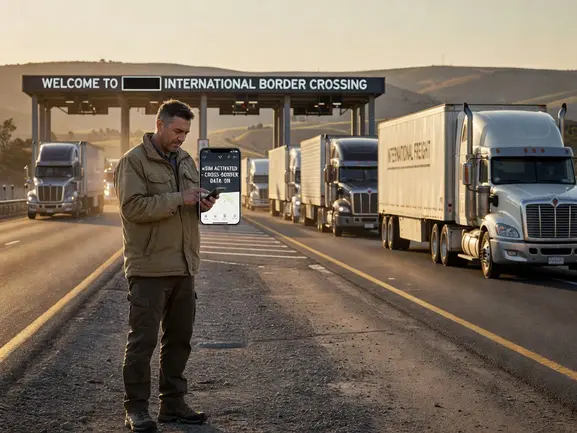
eSIMYat vs. Competitors for Cross-Border Truckers
There are several travel eSIM providers on the market. Here's a direct comparison for the trucking use case specifically — not the tourist use case:
- eSIMYat: 150+ countries, free hotspot on all plans, 24/7 support in English and Arabic, no passport registration, dual SIM, instant QR activation. Strong choice for MENA and Europe corridors.
- Airalo: Lists plans from $4.50 (Airalo pricing page, checked 2026). 200+ countries. No Arabic support — a real gap for Gulf truckers. No dedicated hotspot policy disclosed upfront.
- Holafly: Unlimited plans from $6.99 (Holafly pricing page, checked 2026). Throttles speed after heavy use. Hotspot restricted on most plans. Not suitable for a cab running 3 tethered devices.
- Saily (NordVPN): Plans from $1.99 (Saily pricing page, checked 2026). Includes VPN and ad blocker. 190+ countries. Good value but VPN bundling adds complexity truckers don't need.
- Nomad: From $1.30/GB (Nomad pricing page, checked 2026). Offers a free trial eSIM. Per-GB pricing works well for light users but costs scale on high-data trucking runs.
For cross-border truckers specifically, the hotspot requirement and Arabic language support tip the balance toward eSIMYat. You can also read a full breakdown on the eSIMYat vs Airalo comparison page if you want to go deeper on the numbers.
How to Set Up Your eSIM Before a Cross-Border Run
Setting up an eSIM for truckers cross border takes under 2 minutes when you follow these steps. Do this at home — not at the border.
- Step 1: Check your device compatibility. Your phone must be eSIM-capable and unlocked. Most iPhones from XR onward and many Android flagships support eSIM. Note: iPhones bought in China don't support eSIM — check your EID in Settings > General > About before purchasing. Visit eSIMYat's supported devices page for the full compatibility list.
- Step 2: Choose your plan based on your route. Match your plan to your corridor — single-country, regional, or global. For multi-country runs, a regional plan almost always gives better value than stacking single-country plans.
- Step 3: Purchase and receive your QR code. Complete your order on eSIMYat. Your QR code arrives by email instantly. No waiting, no shipping, no physical card.
- Step 4: Install the eSIM profile via QR code. Go to Settings > Cellular (iPhone) or Settings > Connections > SIM Manager (Android). Tap "Add eSIM" or "Add Mobile Plan." Scan the QR code. The eSIM profile downloads in seconds.
- Step 5: Set data routing correctly. Assign your physical SIM to calls and SMS. Assign the eSIM to cellular data. Enable data roaming on the eSIM line — this is what allows it to switch between local networks as you cross borders.
- Step 6: Enable hotspot before departure. Test your hotspot connection at home. Connect your co-driver's device, your ELD, and any other cab equipment to confirm tethering works.
- Step 7: Download offline maps as backup. Open Google Maps or maps.me and download offline maps for every country on your route. In remote border zones, having offline maps means a dead signal doesn't mean a wrong turn.
Data Usage Guide for Long-Haul Truckers
Knowing how much data you actually need prevents both overpaying and running dry mid-route. Here's a realistic breakdown based on a typical trucking week:
- Google Maps (active navigation, 10 hours/day): ~150-300MB per day
- WhatsApp dispatch (messages + voice calls): ~50-100MB per day
- Load board apps (DAT, Truckstop): ~30-50MB per day
- ELD/fleet management software: ~20-50MB per day
- Co-driver tethering (basic browsing + maps): ~200-400MB per day
- Total estimated per day: 450MB–900MB
- 7-day run total: 3GB–6GB minimum
Add buffer for dashcam uploads, video calls home, and unexpected detours. A 10GB plan is the comfortable choice for a 7-10 day international run. A 5GB plan works for shorter domestic-adjacent cross-border trips where hotspot use is minimal.
Frequently Asked Questions
Can I use an eSIM for truckers cross border across multiple countries on one plan?
Yes. eSIMYat offers regional and global plans that cover multiple countries under a single data allowance. When your truck crosses a border, the eSIM automatically connects to the best available local network in that country — no manual switching, no new SIM purchase required. Regional plans covering Europe or the Middle East are the most cost-effective option for corridor runs.
Will my hotspot work for ELD devices and co-driver navigation on an eSIM?
Yes — eSIMYat includes free hotspot and tethering on all plans. You can connect your co-driver's phone, an ELD device, and a tablet simultaneously. Holafly restricts hotspot on most plans, which makes it a poor fit for truckers running multiple devices. Always verify the hotspot policy before purchasing any eSIM plan for professional use.
Do I need to register a passport or local ID to activate an eSIM for cross-border driving?
No. Unlike physical SIM cards at many MENA and Asian borders — which require ID registration and can take 20-30 minutes — eSIMYat requires no passport registration. You scan the QR code in Settings and you're connected in under 2 minutes. This is a major practical advantage when you're working against a delivery window.
What happens if my eSIM data runs out mid-route?
eSIMYat offers a 7-day refund for unused plans and allows you to purchase additional data. If your plan is running low, buy a top-up or a new plan from your phone while you still have a connection — don't wait until you're out. Offline maps downloaded in advance cover navigation gaps while you sort out a new plan.
Is an eSIM compatible with all truckers' smartphones?
Most modern unlocked smartphones support eSIM, including iPhones from XR onward and flagship Android devices from Samsung, Google Pixel, and others. Key exceptions: iPhones purchased in mainland China don't support eSIM due to hardware restrictions. Carrier-locked phones may not support eSIM profiles from third parties. Check your EID (Settings > General > About on iPhone) to confirm eSIM support before buying. The full list is at eSIMYat's supported devices page.
Get Connected Before You Roll
Cross-border trucking is hard enough without connectivity killing your schedule. Roaming fees, border SIM kiosks, and dead zones cost you time and money. An eSIM for truckers cross border fixes the data problem permanently.
Three things to remember:
- Install before you leave. Border WiFi is trash. Set up your eSIM at home with a stable connection.
- Match the plan to your route. Regional plans beat stacked single-country plans on multi-border runs, almost every time.
- Hotspot matters. Don't buy a plan that restricts tethering — your cab runs on multiple connected devices.
eSIMYat covers 150+ countries, activates in under 2 minutes, and includes free hotspot on every plan. Browse eSIMYat plans and get your eSIM for truckers cross border now — zero roaming fees, no passport required, 24/7 support in English and Arabic.