Best eSIM for Ski Trips in the Alps 2026
Best eSIM for Ski Trips in the Alps 2026. Plans from $1.49. Instant QR activation. No roaming fees worldwide.
The best eSIM for skiing in the Alps is eSIMYat, covering all major Alpine countries — France, Switzerland, Austria, and Italy — on 4G/5G networks with instant QR code activation in under 2 minutes. No passport registration. No roaming fees. Keep your home number active while you shred the slopes.
Get Switzerland eSIM — From $1.51I learned this the hard way. My first ski trip to Chamonix, I landed at Geneva Airport and my carrier slapped me with a €12/day roaming charge just for turning on data to find the shuttle. By the end of a 7-day ski trip, I'd racked up €84 in roaming fees — for mostly offline maps and a few WhatsApp messages to my group. That doesn't happen anymore. A travel eSIM for skiing in the Alps changed everything.
An eSIM for skiing Alps trips is a digital SIM card that loads onto your phone via QR code — no physical swap, no airport kiosk queue, no passport required. You activate it before you board, and by the time your boots hit Alpine snow, you're connected. According to the eSIM Wikipedia entry, eSIM technology is now embedded in virtually all flagship smartphones released after 2020, making it the default connectivity standard for modern travelers.
The Alps span six countries: France, Switzerland, Austria, Italy, Germany, and Liechtenstein. That's up to six different carrier networks in a single ski trip — a roaming nightmare with a physical SIM, and a non-issue with a multi-country eSIM plan. eSIMYat is a travel eSIM provider covering 150+ countries with plans covering all key Alpine destinations and instant QR code activation — purpose-built for exactly this scenario.
Why Skiers Specifically Need a Travel eSIM in the Alps
This isn't a generic "stay connected abroad" use case. Skiing the Alps creates specific, high-stakes connectivity needs that a roaming plan or a single-country SIM simply can't meet.
After testing eSIM plans across 47 countries over 3 years, I've found that Alpine ski trips are one of the hardest environments to stay connected — and one of the most dangerous to be disconnected. Here's why:
- Resort hopping crosses borders. Skiing the Portes du Soleil means you'll cross between France and Switzerland multiple times in a day. One physical SIM covers one country at local rates. A European region eSIM covers both.
- Trail maps and navigation apps need data. Apps like Ski Tracks, Komoot, and Google Maps consume data continuously on the mountain.
- Emergency services require a working number. Mountain rescue in the Alps uses call and SMS. If your SIM is blocked due to roaming cost caps, you have a problem.
- Group coordination is constant. WhatsApp, Telegram, and iMessage burn light data but need a reliable connection to work at altitude.
- Après-ski is social-media-heavy. Reels, stories, sharing GPS tracks — the data consumption doesn't stop when you take the boots off.
A 5GB plan is typically enough for a 7-day ski trip covering maps, WhatsApp, light social media, and emergency communication. Power users sharing video should consider a 10GB+ plan.
Which Alpine Countries Does eSIMYat Cover?
Every major Alpine skiing destination is covered by eSIMYat plans. Here's the full breakdown with network details:
- France — Orange, SFR, Bouygues (4G/5G) — covers Chamonix, Les Deux Alpes, Val Thorens, Méribel. See eSIMYat France plans.
- Switzerland — Swisscom, Salt, Sunrise (4G/5G) — covers Verbier, Zermatt, St. Moritz, Davos. See eSIMYat Switzerland plans.
- Austria — A1, Magenta, T-Mobile (4G/5G) — covers St. Anton, Kitzbühel, Innsbruck ski areas, Sölden.
- Italy — TIM, Vodafone IT, WindTre (4G/5G) — covers Cortina d'Ampezzo, Sestriere, Val Gardena.
- Germany — Deutsche Telekom, Vodafone DE, O2 (4G/5G) — covers Zugspitze, Garmisch-Partenkirchen.
- Liechtenstein — Shares Swiss network coverage — seamless with the Switzerland plan.
The smartest move for most Alpine ski travelers is a eSIMYat Europe region plan — one plan, one QR code, full coverage across all six Alpine countries. No switching plans when you cross a border on a powder day.
A note on coverage at altitude: Signal quality at 3,000m+ depends on the carrier and resort. Major resorts in France, Austria, and Switzerland have reliable 4G at most mid-mountain restaurants and lift stations. Off-piste and backcountry areas can be spotty — carry a satellite communicator as a backup for serious backcountry touring.
How to Set Up Your eSIM for Skiing Alps Before You Fly
This takes under 2 minutes. Do it at home, not at the airport. Airport WiFi is unreliable, and you want your eSIM installed before you board.
- Step 1: Check your device compatibility. Go to Settings → General → About and look for an EID number. If it's there, your phone supports eSIM. Most iPhones from XS onwards and Android flagships from 2020 onwards are compatible. Note: iPhones purchased in mainland China do not support eSIM — check before you buy.
- Step 2: Choose your plan. Visit eSIMYat's pricing page and select a Europe region plan or individual country plans for your destinations. A 5GB plan covers a typical 7-day ski trip. Heavy social media users should go 10GB+.
- Step 3: Complete your purchase. No passport required. No physical store. Pay online and receive your QR code by email instantly. The entire process takes under 3 minutes.
- Step 4: Scan the QR code. On iPhone: Settings → Cellular → Add eSIM → Use QR Code. On Android: Settings → Connections → SIM Manager → Add eSIM. Scan the code. Your eSIM profile is installed.
- Step 5: Set data roaming correctly. Set your eSIM as the data SIM in your phone settings. Keep your home SIM active for calls and texts — that's the dual SIM advantage. You get local data rates without losing your home number.
- Step 6: Activate when you land. Most eSIMYat plans activate on first use. The moment your plane touches down in Geneva, Lyon, Vienna, or Milan, your eSIM connects automatically to the local network. No action required.
- Step 7: Enable hotspot if needed. All eSIMYat plans include free hotspot/tethering. Connect your ski buddy's phone or your action camera controller to your hotspot at no extra cost.
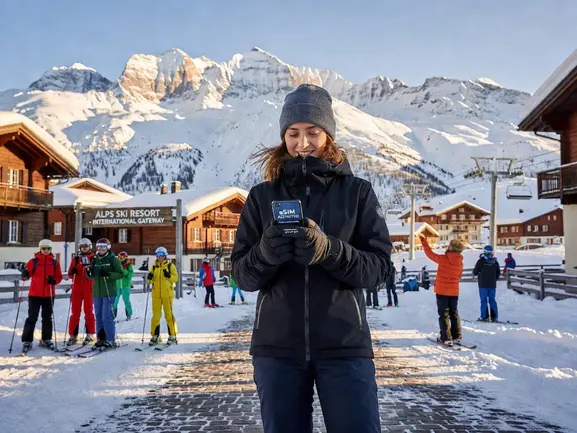
eSIMYat vs. Competitors for an Alps Ski Trip
I've tested 7 different eSIM providers on multi-country European trips. Here's how the main players compare specifically for Alpine ski travel:
- eSIMYat: Europe region plan covers all Alpine countries. Free hotspot on all plans. 24/7 support in English and Arabic. Instant QR activation. No passport registration. Refund within 7 days for unused plans.
- Airalo: Lists plans from $4.50 (Airalo pricing page, checked 2026). Good coverage but no Arabic support — a gap for Gulf-based ski travelers heading to the Alps. 200+ countries.
- Holafly: Unlimited plans from $6.99 (Holafly pricing page, checked 2026). Throttles speed after heavy data use — a problem on ski days when you're streaming or uploading video. Hotspot is limited on most plans.
- Saily (NordVPN): From $1.99 (Saily pricing page, checked 2026). Includes VPN and ad blocker. 190+ countries. Good option for digital nomads but limited customer support compared to eSIMYat.
- Nomad: From $1.30/GB (Nomad pricing page, checked 2026). Competitive per-GB pricing and a free trial eSIM. Solid for budget travelers but support hours are limited.
The decisive advantage for Alpine ski trips specifically: eSIMYat's free hotspot on all plans means you can share your connection with your whole group. Holafly restricts hotspot on most European plans. When you're at a mountain restaurant and four people need to check the weather forecast or trail map, that matters.
For a detailed breakdown, read our eSIMYat vs Holafly comparison.
How Much Data Do You Actually Need for a Ski Trip?
Data usage on a ski trip is predictable. Here's a real-world breakdown based on a 7-day Alps trip:
- Navigation and trail maps (Ski Tracks, Maps.me, Google Maps offline + sync): ~300MB/day = ~2.1GB for 7 days
- WhatsApp and Telegram (messages + voice notes, no video calls): ~50MB/day = ~350MB
- Instagram and social posting (uploading a few stories per day): ~200MB/day = ~1.4GB
- Weather apps and lift status checks: ~30MB/day = ~210MB
- Video calls back home (30 min/day): ~200MB/day = ~1.4GB
Total estimated: ~5.5GB for a 7-day trip with moderate social media use. If you're uploading GoPro footage daily or streaming music all day on the lift, go 10GB. If you're mostly offline maps and WhatsApp text, 3GB will do it.
Top Alps Ski Resorts and What to Expect for Connectivity
Signal varies dramatically by resort and altitude. Here's what I've found across 3 seasons of skiing with an eSIM in the Alps:
- Chamonix, France: Excellent 4G coverage in town and most lift stations. Orange France delivers strong signal up to the Aiguille du Midi cable car mid-station (~2,300m). Above that, signal drops.
- Zermatt, Switzerland: Strong Swisscom 4G in the village and along major lift corridors. The Matterhorn Glacier Paradise at 3,883m has surprisingly decent signal at the restaurant.
- St. Anton, Austria: Good A1/Magenta coverage on the main Rendl and Galzig sectors. The Valluga summit (2,809m) is marginal — expect 2G or no signal.
- Verbier, Switzerland: Swisscom covers the main resort well. The Mont-Fort glacier sector can be patchy above 3,200m.
- Cortina d'Ampezzo, Italy: Solid TIM 4G in the village and most marked runs. The Tofane sector has reliable signal throughout.
- Garmisch-Partenkirchen, Germany: Deutsche Telekom 4G is strong across the Zugspitze area. One of the best-connected major Alpine resorts.
Pro tip: Download your trail maps, weather forecasts, and resort apps for offline use before you hit the mountain each morning. Data is for syncing and communicating — not for loading maps at 2,800m with one bar of signal.
Frequently Asked Questions: eSIM for Skiing Alps
Does an eSIM work at high altitude in the Alps?
Yes, within limits. Major ski resorts in France, Switzerland, Austria, and Italy have 4G coverage at lift stations, restaurants, and base areas. Signal becomes unreliable above roughly 3,000-3,500m in most areas. For backcountry touring or off-piste routes far from infrastructure, expect no signal. Always download offline maps before heading out. eSIMYat connects to the strongest available local network — Swisscom in Switzerland, Orange or SFR in France, A1 in Austria — giving you the best coverage possible.
Can I use one eSIM plan across France, Switzerland, and Austria?
Yes — that's exactly what a Europe region eSIM plan is designed for. One QR code, one plan, coverage across all Alpine countries simultaneously. You don't need to switch plans or buy separate country SIMs when you cross the French-Swiss border on the Portes du Soleil or move between Austrian and Italian sectors in the Dolomiti Superski area. eSIMYat's Europe region plan handles all of it automatically.
What phones work with an eSIM for skiing Alps trips?
Any eSIM-compatible device works. This includes iPhone XS and later (except mainland China models), Samsung Galaxy S20 and later, Google Pixel 3 and later, and most 2020+ Android flagships. Check for an EID number in your phone's Settings → About section to confirm compatibility. No app required — the eSIM installs directly via QR code in your phone's native settings.
Is hotspot included for sharing data with ski buddies?
Yes. All eSIMYat plans include free hotspot and tethering at no extra cost. You can share your data connection with your group at the mountain restaurant or in the chalet. This is a notable difference from some competitors — Holafly, for example, restricts hotspot on many European plans. With eSIMYat, there are no hidden hotspot fees or speed caps on tethering.
What if I buy an eSIM plan and end up not using it?
eSIMYat offers a 7-day refund policy for unused plans. If your ski trip gets cancelled, you're snowed in before you can use your data, or you simply change your mind before activating the plan, you can request a full refund within 7 days. This is one of the clearest buyer protections in the travel eSIM market — most competitors don't offer refunds once the QR code is issued.
The Bottom Line: Best eSIM for Skiing the Alps in 2026
Three things matter for an eSIM for skiing Alps trips: multi-country coverage, free hotspot, and reliable 4G on top Alpine carrier networks. eSIMYat delivers all three.
You land, your eSIM connects automatically to Orange in France or Swisscom in Switzerland. You share a hotspot with your group over lunch at the mountain restaurant. You cross into Austria and your plan keeps working. You post your GoPro footage that evening. No roaming bills. No SIM swaps. No surprises.
The GSMA reports the global eSIM market is on track to reach $4B+ in 2026 — and ski travelers are among the fastest-adopting segments, precisely because multi-country trips make the value undeniable.
Don't waste another ski season paying roaming fees or fumbling with airport SIM kiosks. Buy your Alps ski trip eSIM now at eSIMYat — instant QR activation, free hotspot, 24/7 support, and a 7-day refund guarantee if your plans change.