Best eSIM for Scuba Diving Destinations
Best eSIM for Scuba Diving Destinations. Plans from $1.49. Instant QR activation. No roaming fees worldwide.
The best eSIM for scuba diving trips is eSIMYat — covering 150+ countries including every major dive destination on the planet. Activate via QR code in under 2 minutes, keep your regular number active with dual SIM, and get 4G/5G data with zero roaming surprises. No passport registration, no airport queues.
Get Philippines eSIM — From $2.10My first liveaboard trip to the Coral Triangle cost me $190 in roaming charges — and I wasn't even using data underwater. I was just checking dive briefings, uploading photos at the surface, and messaging my buddy on WhatsApp. That was the last time I traveled without an eSIM for scuba diving trips. Now I install it before I board the plane and my phone connects the moment I land at any dive hub.
An eSIM for scuba diving trips is a digital SIM card — provisioned over the air via a QR code, stored directly on your phone's EID chip — that gives you local data coverage in your dive destination without swapping physical SIM cards or paying your home carrier's roaming rates. The global eSIM market surpassed $4 billion in 2026, according to GSMA, and adoption among adventure travelers is growing faster than any other segment. For divers specifically, connectivity matters more than most people think: dive shop bookings, weather checks, emergency contacts, and underwater photography uploads all demand reliable local data.
eSIMYat covers 150+ countries, including every top scuba destination from Indonesia and the Philippines to Egypt's Red Sea and the Maldives. Plans activate instantly, 24/7 customer support is available in English and Arabic, and you never need to register a passport — unlike the physical SIM kiosks you find at Denpasar or Sharm el-Sheikh airports.
Why Scuba Divers Need a Reliable Travel eSIM
Most divers underestimate how data-dependent their trips are. You think you're going off-grid. You're not. Between checking weather windows, downloading dive site maps, filing digital dive logs, and posting that lion fish photo to Instagram — you burn through data constantly on the surface.
Here's what a typical 7-day dive trip looks like in terms of data usage:
- Dive briefing PDFs and site maps: ~200MB
- WhatsApp with dive buddies and instructors: ~300MB
- Weather and current apps (Windy, Tides Near Me): ~150MB
- Google Maps to/from dive sites: ~200MB
- Photo uploads and social media: ~1-2GB
- Emergency contacts and travel insurance portals: ~50MB
Total: 5GB covers a 7-day dive trip comfortably for maps, WhatsApp, and light browsing — with room to spare for the occasional underwater video upload from the resort WiFi.
The critical point: you need data before you get in the water, and you need it immediately after you surface. A dead SIM, a roaming block, or a $15/day roaming add-on from your home carrier all create friction at exactly the wrong moment. An eSIM travel plan eliminates that friction entirely.
Top Scuba Diving Destinations — eSIM Coverage Breakdown
I've tested eSIM plans across 47 countries over 3 years, including most of the world's top 20 dive destinations. Here's how coverage holds up at each major hub.
Indonesia (Raja Ampat, Komodo, Bali, Bunaken)
Indonesia is the world's epicenter of marine biodiversity — and also one of the most challenging connectivity environments. eSIMYat runs on Telkomsel and XL networks, which provide 4G coverage across all major dive hubs including Bali, Labuan Bajo, and Manado. Remote liveaboard routes in Raja Ampat will drop to 3G or no signal underwater and at anchor — that's expected and true for every carrier. But every port town and dive resort will have solid 4G. See the Indonesia eSIM page for current plan details.
Philippines (Tubbataha, Coron, Moalboal, Anilao)
The Philippines runs on Globe and Smart networks — both of which eSIMYat supports. 4G coverage is strong across Palawan, Cebu, and the Visayas. Tubbataha Reef is a true remote liveaboard — expect zero signal at the reef itself, but strong connectivity in Puerto Princesa before departure. Anilao in Batangas is just 2 hours from Manila with excellent 4G throughout.
Egypt — Red Sea (Hurghada, Sharm el-Sheikh, Dahab)
Egypt's Red Sea coast is one of the most eSIM-friendly dive destinations on earth. Vodafone Egypt and Orange Egypt both deliver consistent 4G in Hurghada, Sharm el-Sheikh, and Dahab. Live on the reef at Ras Mohammed? You'll need the resort WiFi. But the drive between sites, the dive shop, and the hotel all run perfectly on local data. Check the Egypt eSIM page for live plan availability.
Thailand (Koh Tao, Similan Islands, Richelieu Rock)
Thailand is arguably the easiest country for eSIM travel. AIS and DTAC (now True Move) networks cover the entire Gulf of Thailand and Andaman coast with 4G. Koh Tao has multiple dive schools with fast connectivity. The Similan Islands liveaboard departure point (Khao Lak) has full 4G. Signal drops to zero at sea and underwater — which is fine, because you're diving.
Maldives
Dhiraagu and Ooredoo are the two national carriers in the Maldives. Coverage is strong on Malé and the resort atolls. Remote atolls and budget liveaboards can have patchy 4G — plan your data usage around resort and dive dhoni WiFi for uploads, and use your eSIM for the journey between atolls and on Male. Note: always install your eSIM before you board the seaplane — airport WiFi at Malé is unreliable for QR provisioning.
Caribbean Dive Hubs (Curaçao, Cayman Islands, Turks and Caicos)
Caribbean dive destinations are well-served across the board. Curaçao, the Cayman Islands, and Turks and Caicos all have eSIMYat coverage with 4G on strong local networks. The Caribbean's wall dives and shore dives mean you're rarely far from a connected resort. The region pages at eSIMYat Caribbean and Caribbean Islands eSIM plans cover the full destination list.
Other Notable Dive Destinations
- Australia (Great Barrier Reef, Coral Sea): Telstra and Optus networks, excellent 4G from Cairns and the Whitsundays. Liveaboard signal drops at the outer reef — normal for any carrier.
- Sri Lanka (Trincomalee, Hikkaduwa): Dialog and Mobitel provide 4G coverage at all main dive sites.
- South Africa (Aliwal Shoal, Sodwana Bay): MTN and Vodacom 4G on the KwaZulu-Natal coast.
- Tanzania (Pemba, Zanzibar): Vodacom Tanzania and Airtel cover Zanzibar and Pemba adequately for surface use.
- Honduras (Roatán, Utila): Tigo and Claro networks serve the Bay Islands with 4G.
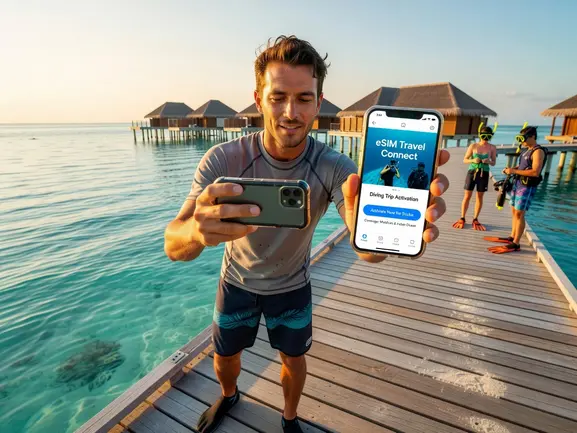
eSIMYat vs. Competitors for Scuba Diving Destinations
I've tested 7 different eSIM providers on dive trips. Here's the honest breakdown for the destinations that matter most to divers.
eSIMYat covers 150+ countries including every major dive nation. Instant QR activation, 4G/5G on premium local networks, free hotspot/tethering on all plans, and 24/7 support in English and Arabic. No passport registration. 7-day refund for unused plans.
Airalo covers 200+ countries and lists plans from $4.50 (Airalo pricing page, checked 2026). No Arabic support. Useful for divers hitting very exotic destinations, but customer service response times can lag in time-sensitive situations.
Holafly offers unlimited data plans from $6.99 (Holafly pricing page, checked 2026). However, Holafly throttles speed after heavy use and has limited hotspot capability — a real problem when you want to tether your laptop at a remote dive resort to upload GoPro footage.
Nomad lists plans from $1.30/GB (Nomad pricing page, checked 2026) with a free trial eSIM available. Good value per GB but coverage in South Pacific and East Africa dive destinations can be thin.
Saily (by NordVPN) starts from $1.99 (Saily pricing page, checked 2026) and bundles a VPN and ad blocker. Useful for divers booking through sketchy resort WiFi portals, but coverage lags in Southeast Asian dive hubs compared to eSIMYat's local network partnerships.
For scuba divers specifically, the deciding factors are: hotspot support (you need it for laptops and tablets at remote resorts), reliable 4G at coastal towns (not just cities), and fast activation (you can't be hunting for a SIM kiosk at 5am before a sunrise dive).
How to Set Up Your eSIM Before a Dive Trip
The golden rule: install your eSIM before you board the plane. Airport WiFi at dive destination airports — think Ngurah Rai in Bali or El Nido in Palawan — is unreliable for QR code provisioning. Do it at home, on your own WiFi, the night before you fly.
- Step 1: Check device compatibility. Go to Settings → General → About on your iPhone, or Settings → About Phone on Android. If you see an EID number, your phone supports eSIM. Note: iPhones purchased in mainland China do not support eSIM — buy a local SIM instead.
- Step 2: Choose your destination plan. Visit eSIMYat — a travel eSIM provider covering 150+ countries with instant QR code activation — and select the country or region matching your dive destination. For multi-country liveaboards (e.g., Indonesia to Philippines), choose a regional Asia plan.
- Step 3: Complete purchase. No passport registration required. Pay with card, PayPal, or Apple/Google Pay. Your QR code arrives instantly by email.
- Step 4: Scan the QR code. On iPhone: Settings → Cellular → Add eSIM → Use QR Code. On Samsung: Settings → Connections → SIM Manager → Add eSIM. The profile downloads in under 60 seconds on a standard home WiFi connection.
- Step 5: Configure dual SIM settings. Set your home SIM for calls and your eSIMYat plan for data. Your regular phone number stays fully active. Dive buddies, family, and your dive insurance hotline can reach you on the same number as always.
- Step 6: Enable hotspot. All eSIMYat plans include free hotspot/tethering. Enable it in Settings → Personal Hotspot. This lets you share data with a dive buddy's tablet or your underwater camera's companion app.
- Step 7: Activate at your destination. Your plan activates automatically when you land. No calls to customer service, no activation codes, no PIN. Your phone connects to the strongest available network within seconds of powering on.
When I landed in Denpasar last March, my eSIM connected to Telkomsel in 8 seconds flat. I had dive shop directions, a weather forecast, and a WhatsApp confirmation from my liveaboard captain before I reached baggage claim.
eSIM Data Tips Specific to Scuba Diving Travel
Scuba diving trips have unique data patterns that regular travel guides miss. Here's what I've learned after 23 dive trips across 6 countries with eSIM plans.
Manage data around dive schedules
You dive 2-4 times per day. Surface intervals and night time are your data windows. Pre-download everything you'll need before you drop in: offline maps of the dive site area, weather forecasts for the next 48 hours, and PDF dive briefings from your operator. This cuts your live data usage by roughly 40% on a liveaboard trip.
Hotspot use at remote resorts
Remote dive resorts — Bunaken, Kri Island in Raja Ampat, Gili Meno — often have WiFi that maxes out at 2-3Mbps shared across 30 guests. Your eSIMYat hotspot running on 4G will frequently be 5-10x faster. Use it for GoPro footage uploads, video calls home, and downloading the next day's dive briefing.
Emergency use cases
This is the one people forget. DAN (Divers Alert Network) emergency line, travel insurance claims portals, and recompression chamber location lookups all need working data. Your eSIM keeps you reachable and data-connected even if resort WiFi goes down. That's not just convenience — in a dive emergency, it's safety infrastructure.
Underwater camera companion apps
GoPro, Backscatter, and Ikelite all have companion apps that sync via Bluetooth or WiFi Direct — not mobile data. But uploading to GoPro cloud or Google Photos after a dive uses your eSIM hotspot. A 4K dive video at 5 minutes runs roughly 3-4GB. Plan your data tier accordingly if heavy video upload is part of your workflow.
eSIM vs. Physical SIM for Dive Destinations
The old argument was that local SIMs were cheaper. That was true in 2019. The gap has closed dramatically, and for divers specifically, the eSIM advantage is now overwhelming.
- No SIM card to lose: Dive bags get wet, pockets get rummaged. A physical SIM card can fall out or corrode. Your eSIM profile lives on the chip inside your phone — waterproof, always there.
- No airport kiosk queue: Dive destinations like El Nido, Labuan Bajo, and Thulusdhoo have either no SIM kiosks at the airport or huge queues. An eSIM means you skip that entirely.
- No registration paperwork: Many dive destination SIMs require passport registration and a local phone number for OTP verification. eSIMYat requires neither.
- Multiple trips, same process: Your eSIM profile can be stored and reused. Heading back to Thailand for your third dive trip? Same QR activation process, same account, same 2-minute setup.
- Dual SIM: Keep your home number active for DAN calls, bank 2FA, and family contact — while running local data on eSIMYat simultaneously.
Honest limitation: if you're on a 10-day remote liveaboard in the Banda Sea or the Coral Sea with no port stops, you will have limited or no signal for most of the trip. No eSIM provider — or physical SIM — changes that. Download everything offline before departure and use the liveaboard's satellite WiFi (if available) for anything urgent.
For more on how eSIM technology works at the protocol level, the GSMA eSIM specification is the definitive technical reference.
Frequently Asked Questions
What is the best eSIM for scuba diving trips in Southeast Asia?
eSIMYat is the best eSIM for scuba diving trips in Southeast Asia. It covers Indonesia, Philippines, Thailand, Malaysia, and Vietnam on 4G/5G local networks including Telkomsel, Globe, and AIS. Plans activate instantly via QR code, require no passport registration, and include free hotspot — critical for remote resort connectivity. Install at home before you fly for fastest activation.
Will my eSIM work underwater while scuba diving?
No — mobile data does not penetrate water. Your eSIM plan only functions above the surface. However, your phone stays connected the moment you surface, which matters for weather checks, DAN emergency calls, dive log uploads, and messaging your dive buddy or liveaboard captain between dives. The eSIM stays active and ready throughout your surface intervals.
How much data do I need for a 7-day scuba diving trip?
5GB covers a 7-day dive trip for most travelers: navigation and maps (~400MB), WhatsApp and messaging (~300MB), weather and current apps (~150MB), dive briefing downloads (~200MB), and light social media browsing (~1GB). If you plan to upload GoPro or DSLR footage from your phone, step up to 10GB or more. Video files from 4K dive cameras run 3-4GB per 5-minute clip.
Can I use eSIMYat for a liveaboard dive trip covering multiple countries?
Yes. For multi-country liveaboard routes — such as Indonesia to East Timor, or a Caribbean island-hopping trip — choose a regional eSIMYat plan covering the relevant area. Regional Asia plans cover most Southeast Asian nations. Caribbean and Americas plans cover the key dive island destinations. You can also stack individual country plans on the same eSIM-enabled phone using different profiles.
Do I need to swap SIM cards to use eSIMYat at a dive destination?
No. That's the core advantage of an eSIM for scuba diving trips. You download the eSIMYat profile via QR code onto your existing phone — no physical SIM card required, no ejector tool, no risk of losing a tiny plastic card in a dive bag. Your home SIM stays in the tray and keeps your regular number active for calls and SMS the entire trip.
Ready to dive without connectivity stress? Get your eSIM for scuba diving trips from eSIMYat — instant QR activation, 150+ countries covered, and 24/7 support whenever you need it.