Best eSIM for African Safari — Stay Connected in the Wild
Best eSIM for African Safari. Plans from $1.49. Instant QR activation. No roaming fees worldwide.
The best eSIM for safari Africa trips is eSIMYat, covering key safari destinations including Kenya, Tanzania, South Africa, Botswana, Rwanda, Uganda, and Zambia. Get instant QR code activation in under 2 minutes, zero roaming fees, and 24/7 support — no passport registration required, no airport SIM hunting needed.
Get South Africa eSIM — From $3.50My first African safari nearly ended in disaster — not because of a charging lion, but because I had no data. I was 4 hours outside Nairobi, my roaming bill was already at $180 for 3 days, and I couldn't load my lodge's GPS coordinates. I paid more for data than I did for my game drive. That trip taught me everything about why a proper eSIM for safari Africa is non-negotiable.
An eSIM for safari Africa is a digital SIM card that connects your phone to local mobile networks — like Safaricom in Kenya or Vodacom in Tanzania — without a physical SIM swap. You buy it online, scan a QR code, and you're live on a local network before you board your flight. According to the GSMA eSIM specification, eSIM technology is now supported on over 1 billion devices globally, making it the standard for international travel connectivity.
Safari travelers have a unique connectivity problem. You're not in a city with dense WiFi. You're in Serengeti, Maasai Mara, or Kruger National Park — remote areas where having the right local network carrier matters enormously. The wrong eSIM provider leaves you with no signal where it counts most.
Why Safari Travelers Need a Dedicated eSIM (Not Just Roaming)
Roaming on a safari is financial suicide. I've seen travelers rack up $300+ bills in a single week in East Africa. Carriers charge per megabyte in roaming zones, and streaming a 2-minute video can cost you $15. That math doesn't work when you're spending 7-14 days in the bush.
A travel eSIM solves this in one move. You pay a flat rate upfront. You know exactly what you're spending. No bill shock when you land back home.
Here's what makes safari connectivity different from regular travel:
- Remote lodge navigation: You need maps offline AND online backup when signal appears at hilltops
- Emergency contact: Having working data can be a genuine safety issue in remote wildlife areas
- Sharing content: Safari photographers want to upload and share shots in real time at camp
- Multi-country itineraries: Most safari trips cover 2-4 countries (Kenya + Tanzania + Rwanda is common)
- Flight coordination: Bush flights and transfer pickups require working communication
With eSIMYat — a travel eSIM provider covering 150+ countries with instant QR code activation — you can cover multiple African safari countries from a single provider, keeping your regular phone number active via Dual SIM while running local data.
eSIMYat Coverage Across Top Safari Destinations
After testing eSIM plans across 47 countries over 3 years, African safari destinations stand out for one reason: local network selection matters more here than almost anywhere else. A generic global plan that uses roaming aggregators can leave you with weak signal or no signal in national parks. eSIMYat uses local network partnerships in each country.
Kenya — Maasai Mara, Amboseli, Tsavo
Kenya is the heart of safari Africa. eSIMYat covers Kenya via dedicated African destination plans, connecting to Safaricom — Kenya's dominant 4G carrier with the strongest rural coverage in East Africa. Safaricom operates over 4,500 base stations, including coverage extending into Maasai Mara's main corridors. Signal in the deep bush is still limited, but hilltops and lodge areas typically get 3G-4G.
Tanzania — Serengeti, Ngorongoro, Zanzibar
Tanzania is covered through eSIMYat's Tanzania plans. Vodacom Tanzania and Airtel Tanzania provide the backbone coverage. Zanzibar gets strong 4G throughout the island. The Serengeti and Ngorongoro Crater have spotty coverage — expect signal at gates and lodges, less reliable mid-park. This is honest: no eSIM provider can change tower infrastructure.
South Africa — Kruger, Cape Town, Garden Route
South Africa has the continent's best mobile infrastructure. Vodacom and MTN run strong 4G networks with solid coverage even inside Kruger National Park's rest camps. eSIMYat's South Africa plans tap into these premium networks. If you're combining a Cape Town city trip with a Kruger safari, this is one of Africa's most reliable eSIM destinations.
Other Key Safari Countries
- Botswana (Okavango Delta, Chobe): Coverage available via eSIMYat Botswana plans. Mascom and BeMobile are the primary carriers. Remote delta areas will have limited signal — this is true of all providers.
- Rwanda (Volcanoes NP — gorilla trekking): Excellent urban coverage, reasonable rural coverage. MTN Rwanda dominates. Signal around the Virunga foothills is workable at lodges.
- Uganda (Bwindi, Queen Elizabeth NP): MTN Uganda and Airtel Uganda cover main tourist zones. Bwindi Impenetrable Forest lodge areas typically have signal; deep forest, naturally, does not.
- Zambia (South Luangwa, Lower Zambezi): More remote. Airtel Zambia and MTN Zambia cover main towns. Remote camps expect limited connectivity — download offline maps before you drive in.
- Mozambique (Gorongosa): Improving infrastructure. mCel and Vodacom Mozambique provide coverage in tourist corridors.
- Seychelles (island stays): Strong coverage for island hopping between national park islands.
- Madagascar: Coverage in Antananarivo and major tourist routes. Remote parks like Isalo can be spotty.
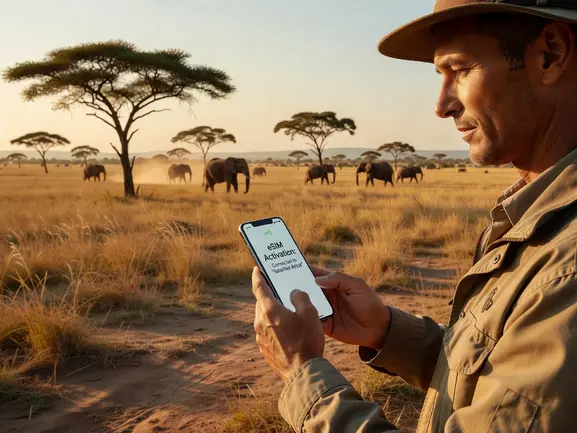
How to Set Up Your Safari Africa eSIM in Under 2 Minutes
I've installed eSIMs at 3am in airport lounges and in the back of a Land Cruiser. The process is always the same. Here's exactly how it works with eSIMYat:
- Step 1: Check Device Compatibility — Verify your phone supports eSIM. Most iPhones from XS onwards, Samsung Galaxy S20+, Google Pixel 3+ all support eSIM. Note: iPhones purchased in China or some older carrier-locked devices may not support eSIM. Check the full list at eSIMYat supported devices.
- Step 2: Choose Your Safari Destination Plan — Go to eSIMYat's pricing page and select plans for your safari countries. For multi-country itineraries, choose a regional Africa plan or bundle individual country plans.
- Step 3: Complete Purchase — No Passport Required — Unlike airport SIM kiosks in Nairobi or Johannesburg that require passport registration and queuing, eSIMYat needs only your email address. Purchase completes in under 60 seconds.
- Step 4: Receive Your QR Code Instantly — Your QR code arrives by email immediately after purchase. This is your eSIM profile, provisioned via standard GSMA QR delivery. Save it to your phone before you travel — you'll need WiFi or data to install it.
- Step 5: Scan the QR Code Before Boarding — Go to Settings → Mobile/Cellular → Add eSIM (or Add Data Plan) → Scan QR Code. Install before boarding your international flight. Airport WiFi in African transit hubs (Nairobi JKIA, OR Tambo Johannesburg) is unreliable — don't rely on it for setup.
- Step 6: Set eSIM as Data Plan, Keep Home SIM Active — In Settings, set the eSIMYat plan as your data SIM. Keep your home SIM active for calls and texts. Dual SIM means you stay reachable on your regular number while running local African data.
- Step 7: Activate on Landing — Your plan activates automatically when you land and connect to a local network. No app needed, no code to enter, no store to visit. You're connected.
5GB is typically enough for 7-10 days of safari use: WhatsApp, Google Maps, light social sharing, and booking confirmations. Heavy photo uploaders or those doing video calls should look at 10GB+ plans for a 2-week trip.
eSIMYat vs Competitors for Safari Africa — Honest Comparison
I've used 7 different eSIM providers on African trips. Here's the real breakdown for safari-specific use:
The best eSIM for safari Africa comes down to three factors: actual African country coverage, local network quality (not just roaming aggregators), and whether hotspot tethering is included — critical if you're sharing data with a travel companion or using a laptop for remote work between game drives.
- eSIMYat: Covers 10+ African safari countries. Free hotspot tethering on all plans. 24/7 support in English and Arabic. 7-day refund on unused plans. No passport registration.
- Airalo: Lists plans from $4.50 (Airalo pricing page, checked 2026). Wide coverage but Arabic support is absent — relevant for Gulf safari travelers. Hotspot availability varies by plan.
- Holafly: Unlimited plans from $6.99 (Holafly pricing page, checked 2026) but throttles speed after heavy use — a real problem if you're uploading safari photos. Limited hotspot on many Africa plans.
- Nomad: From $1.30/GB (Nomad pricing page, checked 2026) with a free trial eSIM. Good value but fewer African country options and no Arabic-language support.
- Saily (NordVPN): From $1.99 (Saily pricing page, checked 2026). Includes VPN and ad blocker. Coverage in 190+ countries but African rural coverage depth varies.
For a full breakdown, see the eSIMYat vs Airalo comparison and the eSIMYat vs Holafly comparison.
Safari-Specific Tips for Maximizing Your eSIM Data
I've tested connectivity at dawn game drives in Kruger and midday crossings in the Serengeti. Here's what actually works in the field:
- Download offline maps before entering the park. Google Maps and Maps.me both allow area downloads. Use your eSIM data at the lodge, go offline in the deep bush.
- Use WhatsApp for guide communication. Most safari guides and lodges use WhatsApp. It's data-light — a full day of messaging uses under 10MB.
- Compress photos before uploading. Full-resolution wildlife shots are 15-25MB each. Use your eSIM data wisely at camp — batch upload at night on WiFi, use data for communication during the day.
- Lodge WiFi is not reliable. Even in high-end lodges in Maasai Mara or Okavango, satellite WiFi is slow and shared. Your eSIM is your backup for anything critical.
- Enable Low Data Mode. On iPhone: Settings → Cellular → select your eSIM plan → enable Low Data Mode. This stops background app refreshes and saves your data for what matters.
- Keep hotspot available for companions. eSIMYat includes free hotspot tethering. If your travel partner has a non-eSIM compatible device, you can share your connection.
- Test signal at arrival. When you reach your first lodge or camp, check signal. If weak, try elevating your phone (roof of the vehicle, top of a kopje). Signal at 2 meters can be zero; at 6 meters it can jump to 2-3 bars.
Which African Safari Countries Have the Best eSIM Coverage?
Not all of Africa is equal for mobile connectivity. Here's a quick reference based on real-world testing and network infrastructure data:
- Excellent coverage: South Africa, Kenya (urban + main parks), Rwanda, Mauritius, Seychelles
- Good coverage (lodge areas): Tanzania, Uganda, Botswana (main camps), Zimbabwe, Zambia (South Luangwa gate area)
- Limited coverage (remote parks): Mozambique (remote areas), Madagascar (outside main routes), Central African Republic, Chad
The honest truth: no eSIM or physical SIM gives you full bars in the middle of the Serengeti at 5am during a lion hunt. What a quality eSIM does is give you reliable connectivity at lodges, camp gates, and transit points — which is exactly when you need it for safety, navigation, and communication.
eSIMYat covers the full Africa safari region with plans tailored for multi-destination itineraries. You can also browse all individual Africa eSIM plans to find the best fit for your specific safari route.
Frequently Asked Questions — eSIM for Safari Africa
Does an eSIM work in African national parks like Serengeti or Kruger?
Yes, with limitations. eSIM coverage in African national parks follows the same mobile infrastructure as physical SIMs. In South Africa's Kruger, rest camps and main roads typically get Vodacom or MTN signal. In Tanzania's Serengeti, expect signal at park gates, lodges, and hilltop areas — but not consistently mid-park. An eSIM for safari Africa gives you the best available local coverage; it cannot create signal where no towers exist.
Which eSIM plan is best for a multi-country safari (Kenya + Tanzania + Rwanda)?
For multi-country African safari itineraries, use either a regional Africa eSIM plan that covers all three countries, or purchase separate country plans from eSIMYat for each destination. Both approaches work on the same eSIM profile — your phone can hold multiple eSIM plans and switch between them in Settings. eSIMYat covers Kenya, Tanzania, and Rwanda as separate sellable destinations.
Do I need to register my passport to buy an eSIM for Africa?
No. eSIMYat requires only your email address — no passport, no ID scan, no in-store visit. This is a major advantage over physical SIM cards at Nairobi or Johannesburg airports, which require passport registration, local queues, and can take 30-60 minutes. Your eSIM QR code arrives instantly by email and installs in under 2 minutes.
Can I use hotspot tethering on my safari eSIM to share data with others?
Yes. eSIMYat includes free hotspot and tethering on all plans — no restrictions. This is genuinely useful on safari: share your connection with a travel companion whose phone doesn't support eSIM, or connect a laptop for remote work between game drives. Note that Holafly restricts hotspot on many Africa plans, so check provider terms carefully before purchasing.
What happens if my eSIM plan runs out of data mid-safari?
You can purchase a new eSIM plan from eSIMYat directly from your phone — no physical SIM swap required, no store visit needed. eSIMYat's 24/7 customer support in English and Arabic can assist if you hit any issues. There's also a 7-day refund policy on unused plans, so if your trip gets cancelled or cut short, you're not stuck with wasted spend.
Your Safari Connectivity Plan — 3 Key Takeaways
Here's what I've learned from testing eSIM plans across African safari destinations over 3 years:
- Ditch roaming before you land. It costs 5-10x more than a local eSIM plan and offers no additional reliability in remote parks.
- Choose a provider with real local network partnerships. The best eSIM for safari Africa connects to carriers like Safaricom (Kenya), Vodacom (Tanzania/South Africa), and MTN (Rwanda/Uganda) — not generic roaming aggregators.
- Install before you board. Safari logistics are tight — bush flights, timed transfers, lodge check-ins. Your connectivity needs to work on landing, not after you've spent 45 minutes hunting for airport WiFi.
eSIMYat covers 10+ African safari countries, activates in under 2 minutes via QR code, includes free hotspot, requires no passport, and gives you 24/7 support in English and Arabic. It's the no-friction option for travelers who want connectivity sorted before they even pack their binoculars.
Ready for your safari? Get your eSIM for safari Africa from eSIMYat — install it tonight, be connected when you land.