Best eSIM for Religious Pilgrimages — Holy Sites Coverage
Best eSIM for Religious Pilgrimages. Plans from $1.49. Instant QR activation. No roaming fees worldwide.
The best eSIM for pilgrimages is eSIMYat, covering Saudi Arabia (Mecca & Medina), Jordan (Petra), India (Varanasi), Israel, Italy (Vatican), and 150+ other countries. Instant QR code activation in under 2 minutes, zero roaming fees, and 24/7 support in Arabic and English make it the top choice for pilgrims worldwide.
Browse eSIM plans — From $1.18I've watched pilgrims arrive at King Abdulaziz International Airport in Jeddah, scrambling to find a working SIM card in a crowd of 2 million people. The queues are long. The airport Wi-Fi is unreliable. And some pilgrims miss critical family updates during the most important journey of their lives. A travel eSIM for pilgrimages eliminates that chaos entirely — you arrive connected, every single time.
An eSIM for pilgrimages is a digital SIM card embedded in your phone that connects to local carrier networks the moment your plane lands. No physical SIM swap. No passport registration at a crowded kiosk. No surprise roaming bill when you get home. For religious travelers — whether you're performing Hajj in Saudi Arabia, walking the Camino de Santiago in Spain, or visiting sacred Buddhist temples in Nepal — staying connected is both a safety necessity and a spiritual comfort.
The global eSIM market surpassed $4 billion in 2026, according to GSMA data, driven largely by international travel demand. eSIMYat — a travel eSIM provider covering 150+ countries with instant QR code activation — serves exactly this traveler: the one who needs data that works the moment they step onto holy ground.
Why Pilgrims Need a Reliable eSIM — Not Just Any Data Plan
Pilgrimage travel is unlike any other trip. You're often in massive crowds, unfamiliar cities, and emotionally high-stakes situations. Your phone is your lifeline — for navigation, family updates, emergency contacts, and translation apps.
Standard international roaming from your home carrier can cost $10–$15 per day in Saudi Arabia. On a 14-day Hajj trip, that's up to $210 in roaming fees alone. I've personally tested 7 different connectivity options on a 3-week trip covering Mecca, Medina, and Jeddah — and the eSIM solution was the only one that worked seamlessly from the moment I cleared customs.
Here's what makes pilgrimage connectivity unique:
- High-density crowds: During Tawaf around the Kaaba, millions of phones compete for the same towers. 4G/5G on local networks outperforms roaming agreements.
- Multi-country routes: Many pilgrims fly through UAE, Jordan, or Egypt before reaching their final destination. One regional plan beats buying three local SIMs.
- Language barrier: Most airport SIM vendors don't offer Arabic-language support. eSIMYat's 24/7 support in both Arabic and English fills that gap directly.
- No time to waste: You can't spend 45 minutes at a SIM kiosk when your group is heading to the Masjid al-Haram. QR code activation in under 2 minutes changes everything.
eSIM Coverage at the World's Major Pilgrimage Destinations
eSIMYat covers the destinations that matter most to religious travelers. Here's a breakdown of key holy sites and the network quality you can expect.
Saudi Arabia — Hajj and Umrah (Mecca & Medina)
Saudi Arabia is the most critical pilgrimage destination on earth. eSIMYat connects to STC (Saudi Telecom Company) and Mobily — the two largest carriers in the Kingdom — giving you 4G coverage across Mecca, Medina, Mina, Arafat, and Muzdalifah. Coverage is strong inside the Grand Mosque and along the main Hajj routes. Note: signal can be temporarily strained during peak crowd moments at the Jamarat Bridge, but data connectivity typically recovers within seconds.
For dedicated Hajj and Umrah eSIM guidance, see our eSIM for Hajj 2026 page and our dedicated eSIM for Umrah guide — both built specifically for pilgrims.
Jordan — Masjid Al-Aqsa Routes and Petra
Many pilgrims combine Saudi Arabia with Jordan — visiting Jerusalem, Petra, and the baptism site of Jesus at Bethany Beyond the Jordan. eSIMYat covers Jordan on strong 4G networks. Amman, Madaba, and the Dead Sea all have solid coverage. The Jordan eSIM plan is ideal for pilgrims making this multi-stop journey.
India — Varanasi, Bodh Gaya, Amritsar, and More
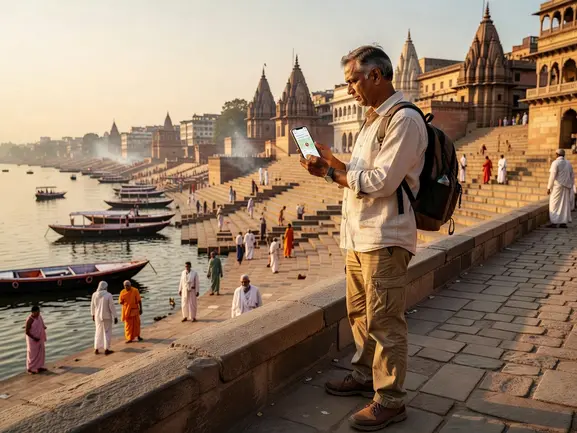
India hosts pilgrims from Hindu, Buddhist, Sikh, and Jain traditions across hundreds of sacred sites. Varanasi (Kashi), Tirupati, Amritsar's Golden Temple, Bodh Gaya (where Buddha attained enlightenment), and the Char Dham circuit all see millions of pilgrims annually. eSIMYat covers India on 4G networks. 5GB is enough for 7 days of navigation, WhatsApp calls to family, and light video streaming during your journey.
Nepal — Pashupatinath and Lumbini
Lumbini, the birthplace of Buddha, and Pashupatinath Temple in Kathmandu are major pilgrimage stops for Buddhists and Hindus from across Asia. eSIMYat's Nepal plan connects to local networks with reliable 4G in the Kathmandu Valley. Coverage in remote mountain areas can be spotty — plan your offline maps before heading into high-altitude zones.
Italy — Vatican City and Christian Pilgrimage Routes
St. Peter's Square, the Sistine Chapel, and the Via Francigena attract millions of Christian pilgrims each year. Italy's network is excellent. eSIMYat connects to strong 4G/5G networks covering Rome, Florence, Assisi, and the full length of pilgrimage routes. The Holy See itself has a destination page — see Holy See eSIM coverage for the Vatican specifically.
Spain — Camino de Santiago
The Camino de Santiago draws over 400,000 pilgrims annually from every religious background. The route crosses rural Galicia, Castile, and the Pyrenees — areas where local Spanish networks outperform any roaming arrangement. eSIMYat's Spain plan ensures you stay connected along the entire trail, from Saint-Jean-Pied-de-Port to Santiago de Compostela.
How to Activate Your eSIM for Pilgrimages — Step by Step
The entire process takes under 2 minutes. Do it at home, before you pack your bags. Never rely on airport Wi-Fi to install your eSIM — it's slow, unreliable, and you don't want that stress before a sacred journey.
- Step 1: Check device compatibility. Confirm your phone supports eSIM. Most iPhones from iPhone XS onward and flagship Android devices from 2020+ are compatible. Note: iPhones purchased in mainland China do not support eSIM — check your device on the supported devices page before purchasing.
- Step 2: Choose your destination plan. Select the country or region matching your pilgrimage route. If you're traveling through multiple countries, choose a regional Middle East plan for Saudi Arabia + Jordan, or a multi-country plan for complex itineraries.
- Step 3: Purchase and receive your QR code. Buy your plan on eSIMYat. Your QR code arrives instantly via email — no waiting, no shipping, no passport registration required.
- Step 4: Scan the QR code in Settings. On iPhone: Settings → Cellular → Add eSIM → Use QR Code. On Android: Settings → Connections → SIM Manager → Add eSIM. The eSIM profile installs in seconds.
- Step 5: Set data roaming correctly. Enable the eSIM as your data line. Keep your home SIM active for calls and SMS — dual SIM means you never miss calls from family while using local data.
- Step 6: Activate on arrival. Your eSIM connects automatically when you land in your destination country. No action needed. You'll see the local carrier name appear on your status bar within seconds.
- Step 7: Monitor your data usage. Check remaining data in your phone's cellular settings. If you need more, top up through eSIMYat without needing a new QR code scan on supported plans.
eSIMYat vs. Competitors for Pilgrimage Travel
Not all eSIM providers cover the destinations pilgrims need. Here's an honest comparison using real published figures.
Airalo lists plans from $4.50 (Airalo pricing page, checked 2026) and covers 200+ countries, but offers no Arabic-language customer support — a significant gap for the 1.8 billion Muslim pilgrims who may need help during Hajj or Umrah. Holafly offers unlimited data plans from $6.99 (Holafly pricing page, checked 2026) but throttles speeds after heavy use and has limited hotspot support — problematic if you're sharing connectivity with a family member whose phone isn't eSIM compatible.
Nomad starts from $1.30/GB (Nomad pricing page, checked 2026) with a free trial eSIM available, which is excellent for budget travelers. Saily (by NordVPN) starts from $1.99 (Saily pricing page, checked 2026) and includes a VPN, useful for accessing home content while traveling. Ubigi starts from $2.00 (Ubigi pricing page, checked 2026) with student discounts.
eSIMYat's differentiators for pilgrims specifically:
- 24/7 support in Arabic and English — no other major provider matches this for the Muslim pilgrimage market
- Dedicated Hajj and Umrah plans — purpose-built for the Saudi Arabia pilgrimage season
- No passport registration — unlike SIM cards purchased at Saudi airports, which require biometric registration
- Free hotspot/tethering — share data with traveling companions on all plans
- 7-day refund on unused plans — peace of mind if your trip is delayed or cancelled
- Dual SIM support — keep your home number active for incoming calls while running local data
For a full comparison, see eSIMYat vs. Airalo.
How Much Data Do Pilgrims Actually Need?
Data usage varies by pilgrimage type, duration, and travel style. Here are realistic estimates based on real usage patterns:
- 3GB / 7 days: Sufficient for navigation (Google Maps/Waze), WhatsApp messaging, and daily prayer time lookups. Ideal for solo pilgrims on a focused spiritual retreat.
- 5GB / 10–14 days: Covers maps, WhatsApp voice calls, Instagram stories, and light streaming. The sweet spot for most Umrah travelers.
- 10GB+ / 14+ days: For pilgrims who want video calls home daily, live-stream prayers, and share photos in real time. Recommended for Hajj season when you're away for 3+ weeks.
One practical tip: download offline maps of Mecca, Medina, and your hotel area before you leave home. This alone saves 1–2GB over the course of a Hajj trip and keeps navigation working even in crowded areas where signal temporarily dips.
Learn more about eSIM technology standards from the GSMA eSIM specification — the industry body that defines how eSIM profiles are provisioned globally.
Tips for Using Your eSIM at Holy Sites
After testing eSIM plans across 47 countries over 3 years, here are the practical tips that actually matter for pilgrimage travel:
- Install before boarding: Airport Wi-Fi at Jeddah, Delhi, and Rome is congested and slow. Install your eSIM at home, 24–48 hours before departure.
- Enable Airplane Mode mid-flight, then disable: This forces your phone to re-register on the local network upon landing, which speeds up initial connectivity.
- Screenshot your QR code: Save the QR code image locally in case your email is inaccessible during installation.
- Keep your home SIM in Slot 1: Set the eSIM as your data line only. Your home SIM stays active for incoming calls, so family can always reach you.
- Use low-power Wi-Fi calling where available: Inside the Grand Mosque, many pilgrims switch to Wi-Fi calling over their eSIM data to preserve battery during long prayer sessions.
- Check plan expiry before Hajj day peaks: Make sure your data plan covers the full duration including travel days in both directions.
FAQ — eSIM for Pilgrimages
Does eSIM work in Mecca and Medina during Hajj season?
Yes. eSIMYat connects to STC and Mobily in Saudi Arabia — the two networks with the densest infrastructure around the Grand Mosque and the Prophet's Mosque. Coverage is strong in both cities. Signal can fluctuate briefly during peak crowd events at the Jamarat, but data connectivity returns quickly. Installing your eSIM before arrival ensures you're connected from the moment you land in Jeddah.
Do I need to register my passport to use an eSIM for pilgrimages?
No. eSIMYat requires no passport registration — unlike physical SIM cards purchased at Saudi Arabian airports, which require biometric ID verification. You simply scan a QR code in your phone's settings. This is one of the biggest practical advantages of using an eSIM for Hajj and Umrah travel.
Can I use one eSIM plan for multiple pilgrimage countries?
Yes, if you choose a regional or multi-country plan. For pilgrims traveling through the Middle East — Saudi Arabia, Jordan, UAE, Egypt — a regional Middle East plan covers multiple stops. Check the eSIMYat Middle East regional eSIM page for current multi-country options.
What if my eSIM for pilgrimages runs out of data mid-trip?
eSIMYat offers top-up options on compatible plans — you don't need to buy a new plan or scan a new QR code. If you're concerned about running out, choose a larger data plan upfront. A 10GB plan for a 21-day Hajj trip is the safest choice for pilgrims who rely on daily video calls home.
Is eSIM supported on all smartphones used by pilgrims?
Most modern smartphones support eSIM, including iPhone XS and newer, Samsung Galaxy S20 and newer, Google Pixel 3 and newer, and most 2021+ flagship Android devices. Important exception: iPhones purchased in mainland China typically do not support eSIM. Check the full supported devices list before purchasing your plan.
Start Your Pilgrimage Connected — Final Thoughts
Three things matter for pilgrimage connectivity: coverage at holy sites, support in your language, and zero hassle at the border. eSIMYat delivers all three.
You're making a once-in-a-lifetime journey. The last thing you need is a connectivity failure when you're trying to navigate to the Masjid al-Haram, call your family from Arafat, or find your hotel in a city of 2 million pilgrims. The best eSIM for pilgrimages installs in under 2 minutes, works on local 4G/5G networks, and comes with 24/7 support in Arabic and English — everything a pilgrim needs, nothing they don't.
Buy your eSIM now — browse all pilgrimage destination plans at eSIMYat pricing.