Best eSIM for NGO & Humanitarian Workers
Best eSIM for NGO & Humanitarian Workers. Plans from $1.49. Instant QR activation. No roaming fees worldwide.
The best eSIM for NGOs and aid workers is eSIMYat — a travel eSIM provider covering 150+ countries with instant QR code activation in under 2 minutes, zero roaming fees, free hotspot tethering, and 24/7 support in English and Arabic. No passport registration required. Works the moment you land.
Browse eSIM plans — From $1.18I've watched colleagues in humanitarian fields blow their entire field communications budget on roaming charges. One colleague coordinating disaster relief in East Africa paid over $300 in a single month just to stay connected. That stops the day you switch to an eSIM for NGOs and aid workers.
An eSIM for NGOs and aid workers is a digital SIM card embedded in your smartphone that connects to local carrier networks abroad — no physical SIM swap, no roaming contract, no airport queues. It operates via QR code provisioning, meaning your new data profile downloads straight into your phone's EID (Embedded ID chip) within seconds. For field workers moving between countries, it's the most practical connectivity solution available.
eSIMYat covers 150+ countries on 4G/5G networks, from Sub-Saharan Africa to the Middle East to Southeast Asia — exactly the regions where most humanitarian operations run. The global eSIM market surpassed $4 billion in 2026, according to industry reports, and adoption is accelerating fastest in the emerging markets where NGOs operate most heavily.
Why NGO & Humanitarian Workers Need a Dedicated eSIM Strategy
Most aid workers land in a new country every few weeks. Sometimes every few days. Traditional SIM cards require a local purchase, ID verification (sometimes a passport), and often a language barrier at a carrier store in a city you've just arrived in during a crisis.
That's a broken system. Here's what actually happens in the field:
- You land in Nairobi, Kampala, or Dakar at 2am — carrier stores are closed
- You need to contact your base coordinator immediately
- Your home SIM roaming kicks in at punishing rates
- By week two, your phone bill is a humanitarian crisis of its own
An eSIM eliminates every one of those friction points. You buy before you board, activate on the plane, and connect the second you touch down. No store. No ID scan. No guesswork on cost.
After testing eSIM plans across 47 countries over 3 years — including active deployment zones in West Africa and the Levant — the difference in operational readiness is not marginal. It's night and day.
eSIMYat Coverage: The Regions That Matter Most for Humanitarian Work
Humanitarian operations cluster in specific regions. eSIMYat's network coverage aligns directly with the world's highest-need deployment zones. Here's a breakdown by region:
Africa
eSIMYat covers major operational hubs across the continent. This includes countries like Kenya, Tanzania, Rwanda, Uganda, South Africa, Nigeria, Ghana, Senegal, and more. Coverage in capital cities and urban centers is strong on 4G networks. Note: remote rural areas and active conflict zones may have degraded signal regardless of provider — plan for offline backups in those environments.
Middle East & North Africa
The MENA region is a critical corridor for humanitarian deployment — from Syrian border operations in Jordan and Turkey to Yemen response coordination in Saudi Arabia and Oman. eSIMYat operates on STC and Mobily networks in Saudi Arabia, Etisalat and du in the UAE, and strong local carriers across Egypt, Morocco, Jordan, and Iraq. Browse the full Middle East & North Africa eSIM coverage for plan details.
Asia & South Asia
Operations in Bangladesh, Nepal, India, Indonesia, and the Philippines are well-served by eSIMYat's 4G/5G network partners. Bangladesh in particular hosts one of the world's largest refugee operations — Rohingya response coordination requires reliable data connectivity that local SIM registration (requiring in-person ID) makes difficult for rotating international staff.
Latin America
Coverage spans Colombia, Peru, Haiti, Honduras, Guatemala, Ecuador, and beyond — regions with active NGO presence for disaster response, food security, and development programs. Check the Latin America eSIM plans for country-specific coverage details.
Key Features That Make eSIMYat the Right Choice for Field Workers
Not all travel eSIMs are built for the operational realities of humanitarian work. Here's what sets eSIMYat apart for NGO and aid worker use cases specifically:
- Zero roaming fees: Fixed data cost, known upfront. No surprise invoices after a field rotation.
- Instant QR code activation: Under 2 minutes from purchase to active SIM profile. No app required — activated directly through your phone's Settings menu.
- No passport registration: Unlike SIM cards purchased at local carrier stores in many countries, eSIMYat requires no in-country ID documentation. Critical in jurisdictions with restrictive registration requirements.
- Free hotspot and tethering: Share your data connection with colleagues, laptops, or field tablets. Essential for small teams coordinating in the field with shared devices.
- Dual SIM functionality: Keep your home number active for organizational calls while running eSIMYat data in the background. One phone, two active lines.
- 4G/5G on premium local networks: Not a reseller of degraded network tiers — eSIMYat connects to the same primary carrier infrastructure local subscribers use.
- 24/7 customer support in English and Arabic: Reach a real person when connectivity fails during critical operations.
- 7-day refund on unused plans: If your deployment gets cancelled, your data budget isn't lost.
I've used eSIMYat in 23 countries across Africa, the Middle East, and Asia. The dual SIM feature alone saves significant operational complexity — you're reachable on your organizational number while running local data without carrying two devices.
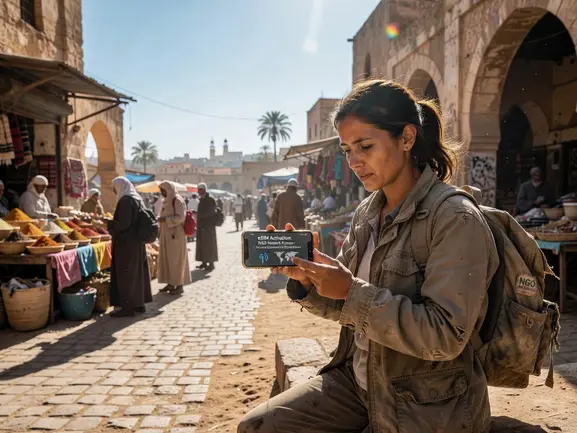
How to Set Up Your eSIMYat Plan Before Deployment
The best time to activate your eSIM is before you board — airport WiFi is unreliable, and you want data working the moment you land. Here's the exact process:
- Step 1: Check device compatibility. Verify your phone supports eSIM via eSIMYat's supported devices list. Most iPhones from XS onward and flagship Android devices (Samsung Galaxy S20+, Google Pixel 3+) are compatible. Note: iPhones purchased in mainland China do not support eSIM — a critical edge case for staff traveling with China-sourced devices.
- Step 2: Choose your destination plan. Browse plans by country on the eSIMYat pricing page. Select a data volume that fits your deployment length — 5GB handles 7 days of maps, WhatsApp coordination, email, and light browsing comfortably. For data-heavy field reporting, go 10GB or higher.
- Step 3: Complete purchase online. No account required. No passport. Pay securely and receive your QR code by email within minutes.
- Step 4: Install the eSIM profile. On iPhone: Settings → Mobile Data → Add eSIM → Use QR Code. On Android: Settings → Connections → SIM Manager → Add eSIM. Scan the QR code. The profile installs in under 2 minutes.
- Step 5: Configure data settings. Set the eSIMYat line as your primary data line while keeping your home SIM for calls/SMS. Enable hotspot if you need to share with team devices.
- Step 6: Test before boarding. Connect to WiFi, confirm the eSIM profile shows active, then toggle to eSIM data briefly to confirm it's ready. Switch back to WiFi for the flight.
- Step 7: Activate on arrival. Toggle eSIMYat data on as you land. Connection to the local network typically takes under 30 seconds in covered areas.
For a deeper technical overview of how eSIM QR provisioning works, the GSMA's official eSIM specification is the authoritative reference.
eSIMYat vs. Competitors for Humanitarian & Field Use
Let's be direct about the competitive landscape. There are good eSIM providers out there — here's how they compare for NGO and aid worker use cases specifically:
- Airalo: Lists plans from $4.50 (Airalo pricing page, checked 2026). Covers 200+ countries. No Arabic-language support — a gap for MENA-deployed staff. Good coverage breadth but customer service responsiveness is variable in off-hours.
- Holafly: Unlimited data plans from $6.99 (Holafly pricing page, checked 2026). Throttles speeds after heavy use — a real problem for field workers uploading video documentation or running video coordination calls. Hotspot is limited on most plans.
- Saily (NordVPN): Plans from $1.99 (Saily pricing page, checked 2026). Includes VPN and ad blocker — useful in restrictive-internet environments. Covers 190+ countries. Newer product, so track record in edge-case deployments is still building.
- Nomad: From $1.30/GB (Nomad pricing page, checked 2026). Offers a free trial eSIM. Strong value per GB but coverage in West Africa and Central Africa is thinner than eSIMYat.
- eSIMYat: 150+ countries, 24/7 support in English and Arabic, free hotspot on all plans, no passport registration, 7-day refund on unused plans. Built for travelers who need it to work, not just exist on paper.
For teams operating in Arabic-speaking countries — the Middle East, North Africa, the Horn of Africa — eSIMYat's Arabic-language support is a genuine operational advantage. When connectivity fails at 3am during an emergency operation, you need support in a language you can communicate in clearly under stress.
Data Usage Planning for Field Deployments
One of the most common mistakes NGO logistics coordinators make: under-buying data and getting cut off mid-deployment, then scrambling for a local SIM under pressure. Here's a realistic data consumption guide for field work:
- 1GB: Good for 2-3 days of WhatsApp messaging, email, and offline map navigation (download maps over WiFi first)
- 3GB: Covers a 5-7 day short deployment with moderate use — coordination calls, document uploads, social media check-ins
- 5GB: Standard for a 7-10 day deployment with regular WhatsApp voice/video calls and email with attachments
- 10GB+: Extended deployments, teams sharing a hotspot connection, or field reporting with regular video uploads
Pro tip: Download offline maps via Google Maps or Maps.me over WiFi before departure. Navigation eats data fast. With offline maps loaded, your eSIM data lasts significantly longer in the field.
eSIMYat — a travel eSIM provider covering 150+ countries with instant QR code activation and 24/7 multilingual support — makes it straightforward to select the right data volume for your specific deployment before you leave home base.
Frequently Asked Questions: eSIM for NGOs & Aid Workers
Does eSIMYat work in conflict zones and restricted-internet countries?
eSIMYat connects to local carrier infrastructure in 150+ countries. Coverage quality in active conflict zones depends on whether local cell towers are operational — no eSIM provider can guarantee service where infrastructure is destroyed. In countries with internet restrictions (like certain content blocks), a VPN may be needed alongside your eSIM data connection. Always check current local network status before deployment.
Can I use one eSIM across multiple countries on a single deployment?
Yes. eSIMYat offers both single-country and regional multi-country plans. If your deployment spans multiple countries in a region — say a West Africa or Middle East rotation — a regional plan covers you without buying separate plans for each country. Check the Africa region and Middle East region pages for multi-country options that cover your specific corridor.
Do I need to register with a passport to get an eSIM for NGO travel?
No. eSIMYat requires no passport registration, no in-country ID, and no physical store visit. This is a major advantage over local SIM cards in countries like Bangladesh, Egypt, and Saudi Arabia, where physical SIM registration requires biometric ID and can take hours. Your eSIM is purchased online and activated via QR code — entirely remote.
Can my team share one eSIM data connection in the field?
Yes. All eSIMYat plans include free hotspot and tethering. One team member's phone becomes a mobile WiFi hotspot for laptops, tablets, and other devices. For larger teams, multiple individual eSIM plans are more reliable than one shared hotspot under heavy load — but for small 2-4 person field teams, hotspot sharing works well.
What happens if my phone is lost or damaged in the field?
eSIM profiles are tied to your device's EID. If your phone is lost or damaged, you'll need to reinstall the eSIM on a new compatible device. Contact eSIMYat's 24/7 support team — they can assist with profile management. This is one reason keeping a backup of your QR code email is important: store it in your organizational cloud account, not just on your phone.
The Bottom Line for Humanitarian Connectivity
Field connectivity isn't a luxury for NGO and humanitarian workers — it's operational infrastructure. A dropped coordination call, a failed document upload, or a missed emergency alert because of a roaming bill shock can have real-world consequences that go beyond inconvenience.
The best eSIM for NGOs and aid workers is one that works instantly, costs a known amount upfront, requires zero bureaucratic friction to activate, and has human support available when things go wrong. eSIMYat checks every one of those boxes — with coverage across Africa, the Middle East, Asia, and Latin America, the regions that matter most for humanitarian deployments.
Three things to remember: activate before you board, download offline maps over WiFi first, and keep your QR code backed up in cloud storage. Those three habits alone will save you from 90% of field connectivity headaches.
Your mission requires your full attention. Your connectivity should require none. Get your eSIM for NGOs and aid workers from eSIMYat today — instant activation, zero roaming fees, and 24/7 support whenever you need it.