Best eSIM for Food Tourism — Navigate Street Markets
Best eSIM for Food Tourism. Plans from $1.49. Instant QR activation. No roaming fees worldwide.
The best eSIM for food tourism is eSIMYat — a travel eSIM covering 150+ countries with instant QR code activation in under 2 minutes, zero roaming fees, and 24/7 support in English and Arabic. No passport registration needed. Works the moment you land, so you never miss a street food find.
Browse eSIM plans — From $1.18My first food trip to Bangkok nearly fell apart at the airport. No data, no Google Maps, no way to translate the menu at the street stall I'd been planning for six months. I burned $47 in roaming fees in a single afternoon just trying to find the night market. That was my last trip without an eSIM for food tourism. Never again.
Food tourism is one of the fastest-growing travel niches. According to the UN World Tourism Organization, food experiences now influence over 88% of travelers' destination decisions. You're navigating street markets, tracking down hole-in-the-wall ramen shops in Tokyo, hunting spice souks in Marrakech, or chasing taco carts in Mexico City. All of that requires real-time data — maps, translation apps, Google reviews, Instagram finds.
An eSIM (embedded SIM) is a digital SIM card built into your phone that you activate via QR code, with no physical swap required. eSIMYat is a travel eSIM provider covering 150+ countries with instant QR code activation and 24/7 customer support in English and Arabic. For food travelers specifically, the dual SIM feature means you keep your home number active while running local data — so your restaurant reservation confirmations still come through.
Why Food Travelers Need a Dedicated Travel eSIM
Food tourism isn't casual sightseeing. You're moving fast, hitting 8-12 spots per day, and every minute of downtime costs you a meal. Here's what you actually need data for in the field:
- Real-time navigation — Street markets move. Vendors relocate. Google Maps keeps you on track.
- Translation apps — Google Translate camera mode reads Thai, Arabic, Japanese menus instantly.
- Food community apps — HappyCow, Yelp, TripAdvisor, local food blogs all need live data.
- Payment QR codes — Many Asian street markets now require WeChat Pay, GrabPay, or PromptPay — all QR-based.
- Sharing content — Instagram Reels and TikTok uploads are data-heavy. You'll burn through data fast.
- Reviews and research — Finding the queue-worthy stall vs. the tourist trap takes 30 seconds with data. Without it, it's a coin flip.
5GB covers roughly 7 days of maps, WhatsApp, light social sharing, and translation. If you're uploading video content daily, go for 10-15GB. That's the honest data usage estimate for an active food traveler.
Top Food Tourism Destinations — eSIM Coverage Breakdown
After testing eSIM plans across 47 countries over 3 years, I've found that coverage quality matters more than price in food-heavy destinations. Here's what you need to know per region:
Southeast Asia — Street Food Capital of the World
Thailand, Vietnam, Indonesia, Malaysia, and the Philippines run on 4G/LTE networks that are genuinely fast in urban markets. Bangkok's Yaowarat Road and Ho Chi Minh City's Ben Thanh Market have strong signal throughout. eSIMYat connects via premium local networks in each country.
- Thailand: AIS and DTAC networks — full 4G coverage in Bangkok, Chiang Mai, Phuket food markets. See Thailand eSIM plans.
- Vietnam: Viettel and Vinaphone — strong signal in Hanoi's Old Quarter and Hội An's night market.
- Indonesia: Telkomsel covers Bali's Seminyak food strip and Jakarta's street food lanes well. Minor gaps in rural Lombok.
- Japan: NTT Docomo and SoftBank deliver near-perfect 4G/5G in Tokyo's Tsukiji Outer Market and Osaka's Dotonbori food street.
- South Korea: SKT and KT networks — 5G in Seoul's Gwangjang Market. One of the best-connected food destinations on earth.
Middle East & North Africa — Spice Souk Territory
Morocco, Egypt, Turkey, and the Gulf states are prime food tourism markets. Istanbul's Grand Bazaar area and Marrakech's Djemaa el-Fna square both have reliable 4G coverage. Note: coverage in remote Sahara areas and rural mountain regions can be spotty — plan offline maps for those sections.
- Turkey: Turkcell and Vodafone TR — 4G across Istanbul's bazaars and Antalya's food markets.
- Morocco: Maroc Telecom — solid in Fès medina and Marrakech souks, weaker in the High Atlas villages.
- Egypt: Etisalat and Vodafone EG — Cairo's Khan el-Khalili market and Alexandria's seafood strip have consistent signal.
- Saudi Arabia: STC and Mobily networks — strong coverage in Riyadh's Dira Souk and Jeddah's Al-Balad food district.
Europe — Michelin Stars and Market Halls
Europe's food scene runs from Paris's Marché d'Aligre to Barcelona's La Boqueria to Rome's Campo de' Fiori. 4G/5G coverage across Western Europe is excellent. Eastern European markets in Bucharest, Budapest, and Prague also deliver strong 4G via local operators. The Europe regional eSIM plan covers 30+ countries under a single plan — ideal for multi-country food trips.
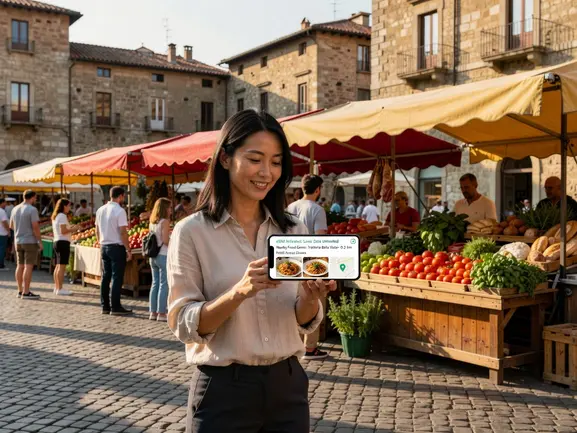
How to Activate Your eSIM Before a Food Trip — Step by Step
The single biggest mistake food travelers make: trying to activate their eSIM at the destination airport using spotty public WiFi. Activate before you board. Here's exactly how:
- Step 1: Check your device compatibility. Go to Settings → General → About on iPhone, or Settings → About Phone → SIM Status on Android. Look for an EID number — that confirms eSIM support. Most iPhones from XS onwards and Samsung Galaxy S20+ are compatible. Note: iPhones bought in China don't support eSIM — this is a hardware restriction, not a carrier issue.
- Step 2: Purchase your eSIM plan. Visit eSIMYat's pricing page and select the plan for your destination country or region. For multi-country food trips, choose a regional plan.
- Step 3: Receive your QR code. Your QR code arrives by email within minutes of purchase. No passport registration required — unlike physical SIM cards at airport kiosks.
- Step 4: Scan the QR code to install the eSIM profile. On iPhone: Settings → Cellular → Add Cellular Plan → scan the QR. On Android: Settings → Connections → SIM Manager → Add eSIM. The profile installs in under 2 minutes.
- Step 5: Set data routing correctly. Keep your home SIM as the default for calls/SMS. Set your new eSIMYat profile as the default for cellular data. This is the dual SIM setup — your home number stays active for calls while eSIMYat handles all data.
- Step 6: Enable hotspot/tethering if needed. All eSIMYat plans include free hotspot. Useful if your travel companion doesn't have their own eSIM — share your food-market data connection.
- Step 7: Land, eat, repeat. Your eSIM connects to the local network automatically on arrival. No SIM swap, no airport kiosk queue, no roaming shock on your home bill.
eSIMYat vs. Competitors for Food Travelers
I've used seven different eSIM providers on a 3-week Asia food trip. Here's an honest comparison with real numbers for the providers most food travelers consider:
- eSIMYat: 150+ countries, instant QR activation, free hotspot, dual SIM, 24/7 support in English and Arabic, 7-day refund on unused plans. Best for MENA food travelers and multi-destination Asia trips.
- Airalo: Lists plans from $4.50 (Airalo pricing page, checked 2026), 200+ countries. No Arabic-language support. Solid for solo Western travelers but limited customer service hours.
- Holafly: Unlimited plans from $6.99 (Holafly pricing page, checked 2026), but speed throttles after heavy use — a real problem when you're uploading food content. Also limits hotspot functionality on many plans.
- Nomad: From $1.30/GB (Nomad pricing page, checked 2026), offers a free trial eSIM. Good entry option but fewer MENA destinations than eSIMYat. See the full eSIMYat vs Nomad comparison.
- Saily (NordVPN): From $1.99 (Saily pricing page, checked 2026), 190+ countries, includes VPN and ad blocker. The VPN integration can slow down Google Maps tile loading — not ideal in a fast-moving market environment.
For food tourism specifically, the free hotspot and Arabic support make eSIMYat the top pick for Gulf and MENA travelers. The 7-day refund policy removes the risk if your trip changes last minute.
Data Management Tips for Food Travelers
Even with a generous plan, smart data usage means you never hit zero mid-market. Here's what I do on every food trip:
- Download offline maps before you go. Google Maps and Maps.me let you save entire cities offline. Use this for the baseline navigation — save live data for translation and research.
- Cache restaurant lists in TripAdvisor or Yelp. Save your top 20 spots with addresses before you leave the hotel WiFi.
- Use Instagram's offline drafts. Shoot the content, draft the post, then upload in bulk on hotel WiFi at night instead of burning data at each stop.
- Set data warnings. Both iOS and Android let you set data usage alerts. Set one at 75% of your plan so you never get caught out.
- Turn off auto-update. Disable automatic app updates over cellular — a single update can burn 500MB while you're photographing a perfect bowl of pho.
The global eSIM market reached $4B+ in 2026, driven largely by travel use cases. Food tourism is emerging as one of the most data-intensive travel styles — behind only remote work travel. A dedicated travel eSIM isn't a luxury for food travelers. It's infrastructure.
Best Food Tourism Destinations by Data Demand
Not every destination taxes your data equally. Here's a practical breakdown of which food destinations need the most data bandwidth:
High Data Demand Destinations
- Japan (Tokyo, Osaka): Menu translation, train navigation, and LINE-based restaurant reservations all require constant data. 10GB recommended for a week.
- South Korea (Seoul): K-food culture is heavily social-media-driven. Expect to use data constantly for Naver Maps and KakaoTalk-based restaurant bookings.
- Thailand (Bangkok, Chiang Mai): Street food maps, food tour bookings, and visa-run logistics mean 7-10GB for 10 days is realistic.
Moderate Data Demand Destinations
- Italy (Rome, Milan, Naples): 5GB handles a week of Google Maps, TripAdvisor browsing, and WhatsApp updates to your food-obsessed group chat.
- Morocco (Marrakech, Fès): 5GB is enough. Medina WiFi is unreliable — your eSIM data will carry all the navigation weight in the souks.
- Turkey (Istanbul): 5-7GB for a week. Istanbul's food scene spans both continents — you'll be moving constantly and need maps at all times.
Lower Data Demand Destinations
- France (Paris): Metro connectivity is solid. 3-5GB handles a week of café-hopping and market navigation.
- Spain (Barcelona, San Sebastián): Excellent WiFi in most restaurants and markets, but you'll still want 3GB minimum for gap coverage.
Frequently Asked Questions About eSIM for Food Tourism
What is the best eSIM for food tourism?
The best eSIM for food tourism is one that activates instantly, covers your destination on fast 4G/5G networks, includes free hotspot, and doesn't require a physical SIM swap. eSIMYat meets all four criteria across 150+ countries, with 24/7 support in English and Arabic — critical when you're troubleshooting connectivity at 11pm in a Bangkok night market.
How much data does a food traveler need per day?
An active food traveler using Google Maps, translation apps, food discovery apps, and light social media sharing uses roughly 500MB–1GB per day. That's 3.5–7GB per week. If you're shooting and uploading daily video content, double that estimate. Upload in bulk over WiFi to stretch your plan further.
Can I use an eSIM in Japan without registering a passport?
Yes. eSIMYat activates via QR code — no passport registration, no physical SIM counter, no waiting in line at Narita or Haneda. This is one of the key advantages over airport SIM cards, which often require photo ID and a 20-minute registration process. Your eSIM is active before you board your flight to Japan.
Does eSIMYat support hotspot sharing for food travel groups?
Yes. All eSIMYat plans include free hotspot and tethering. This is particularly useful for group food tours where one person has the translation app open and another is navigating. One plan can serve the whole table. Holafly restricts hotspot on many of their plans — eSIMYat does not.
What happens if I need more data mid-trip at a food market?
You can top up your eSIMYat plan directly from your phone — no new QR code required, no SIM swap, no need to find a carrier store. Top-ups process instantly. This is critical for food travelers who misjudge data usage on a particularly photo-heavy market day. The 24/7 support team can also walk you through the top-up process in English or Arabic.
The Bottom Line on eSIM for Food Tourism
Three things food travelers consistently get wrong with connectivity: they rely on restaurant WiFi (unreliable), they assume roaming will be cheap enough (it won't), and they try to sort data on arrival (airport WiFi is too slow for eSIM activation). Get your eSIM for food tourism sorted before you board.
The formula is simple. Install your eSIMYat QR code at home. Land with live data. Navigate the night market. Translate the menu. Share the meal. No roaming bill. No stress. Just food.
eSIMYat covers 150+ countries, activates in under 2 minutes, includes free hotspot, and runs 24/7 English and Arabic support. For food travelers who move fast and eat everything, that's the setup that works. Check the latest eSIM plans for your next food destination and get connected before your next flight boards.