Egypt Internet for Tourists 2026 — WiFi, SIM & eSIM Compared
Complete guide to internet options in Egypt. Hotel WiFi vs SIM vs eSIM. Best option: eSIM from $3.64. No hassle, instant.
The best internet option for tourists visiting Egypt in 2026 is an eSIM — specifically eSIMYat's Egypt eSIM, with plans starting from $3.64. You get instant QR code activation, zero roaming fees, and 4G coverage on Egypt's top networks — no SIM card hunt at Cairo Airport required.
Get Egypt eSIM — From $3.64My first trip to Egypt cost me $190 in roaming charges. I was naively relying on hotel WiFi in Luxor, watching it drop out every time more than three people connected. By the time I reached Aswan, I'd missed two important calls and couldn't pull up Google Maps at the Abu Simbel entrance. That trip taught me everything I needed to know about Egypt internet for tourist tips 2026 — and I've since tested every option so you don't have to.
Egypt internet for tourists in 2026 covers four main options: hotel and café WiFi, local SIM cards, pocket WiFi devices, and travel eSIMs. Each has real tradeoffs in cost, convenience, and reliability. This guide breaks them all down with hard numbers so you can make the right call before you board your flight.
Egypt's mobile network is operated primarily by three carriers — Vodafone Egypt, Orange Egypt, and Etisalat (e&) — with 4G LTE available in Cairo, Alexandria, Sharm El-Sheikh, Hurghada, and Luxor. Rural areas like Sinai's interior and parts of the Western Desert can see spotty coverage. The global eSIM market hit $4B+ in 2026, and Egypt is one of the fastest-growing markets for prepaid data adoption among tourists.
Egypt WiFi for Tourists: What You Actually Get
Hotel WiFi in Egypt exists in two flavors: fast enough in 5-star resorts, and painfully slow everywhere else. I've sat in a Zamalek café with 11 other tourists all on the same router, watching a WhatsApp photo take four minutes to send.
Here's the honest breakdown of Egypt WiFi options:
5-star resort WiFi: Usually reliable, but locked to your room or pool area. Step outside and you're offline.
Budget hotel WiFi: Inconsistent speeds, shared bandwidth, frequent outages.
Café WiFi: Available in Cairo and tourist hubs. Requires ordering food/drinks to access. Not secure.
Airport WiFi (Cairo International): Free but limited. Speeds drop during peak hours. Good for a quick message, not for navigation.
Nile cruise ships: WiFi is either non-existent or satellite-based — expect 2G-equivalent speeds at premium prices.
The core problem with relying on WiFi in Egypt: you lose connectivity the moment you leave the property. That's a real issue when you're trying to navigate from Khan el-Khalili bazaar back to your hotel at 10pm or need Google Translate at a local restaurant.
Egypt Local SIM Cards: The Airport SIM Card Reality
Buying a local SIM at Cairo Airport is a classic tourist move. And it works — in theory. In practice, it involves a 20-40 minute queue at the arrivals hall, passport photocopying, registration paperwork in Arabic, and a sales pitch for a bundle you don't fully understand.
The three main carriers offering tourist SIMs are:
Vodafone Egypt: Widest 4G coverage across tourist areas. Tourist SIM bundles available at Cairo Airport.
Orange Egypt: Strong in Cairo and Alexandria. Decent coverage in Hurghada and Sharm.
Etisalat (e&) Egypt: Competitive data bundles, growing 4G footprint.
A local SIM gives you a local Egyptian number, which is useful if you're making local calls. But there are real drawbacks:
Passport registration is mandatory — required by Egyptian law for all SIM purchases.
You lose your home number while the local SIM is active (single SIM phones).
Airport kiosks often run out of SIMs during peak season.
Top-up requires finding a specific carrier store or reseller.
Leftover balance is wasted at the end of your trip.
If you have a dual SIM phone and don't mind the registration process, a local SIM is a solid budget option. If you want to skip the queue and keep your home number active, read the next section.
Pocket WiFi Devices in Egypt: Worth It?
Pocket WiFi (also called a MiFi device) lets you connect multiple devices to a single mobile data connection. You rent the device from a provider, usually at the airport or through your hotel.
After testing a pocket WiFi rental on a 10-day Nile cruise, here's my honest assessment:
Pros: Connect up to 10 devices simultaneously. Great for families or groups.
Cons: Extra device to carry and charge. Risk of loss/damage fees. If the device dies, everyone's offline. Rental fees add up daily.
Coverage: Dependent on the same local networks — if Vodafone has a dead zone in Aswan, your pocket WiFi dies too.
Cost: Typically rented for a daily fee plus data costs. Not the cheapest option for solo travelers.
Pocket WiFi makes sense for groups of 3+. For solo travelers or couples, an eSIM beats it on every metric: cost, convenience, and reliability.
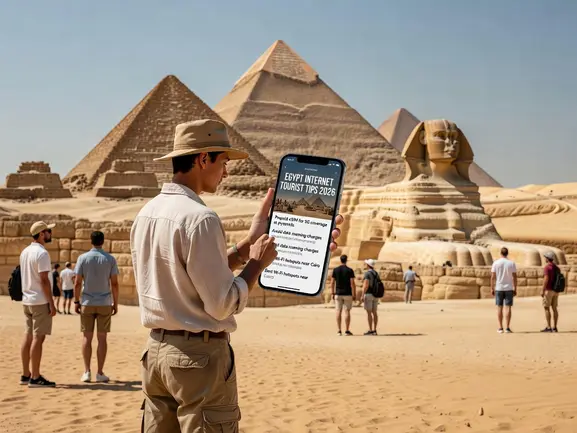
Egypt eSIM 2026: The Fastest Way to Get Online
An eSIM (embedded SIM) is a digital SIM profile stored directly on your phone. No physical card. No airport queue. No passport registration. You scan a QR code, the profile installs in under two minutes, and you're on 4G before you've picked up your luggage.
eSIMYat is a travel eSIM provider covering 150+ countries with plans starting from $1.18 and instant QR code activation. For Egypt specifically, plans start from $3.64, running on Vodafone Egypt and Orange Egypt's 4G networks.
Here's what makes eSIMYat the top pick for Egypt internet tourist tips 2026:
Instant QR provisioning: Buy, receive QR code by email, scan in Settings — done in under 2 minutes.
No passport registration: Unlike airport SIM cards, no documents required.
Dual SIM support: Keep your home number active for calls while eSIMYat handles your data.
Free hotspot/tethering: Share your connection with your travel companion's laptop or tablet.
4G coverage: Runs on Egypt's premium carrier networks in Cairo, Giza, Alexandria, Luxor, Aswan, Sharm El-Sheikh, and Hurghada.
24/7 customer support in English and Arabic.
7-day refund policy for unused plans.
One important note: eSIMs require compatible devices. iPhones from iPhone XS onward support eSIM. Most flagship Android phones (Samsung Galaxy S21+, Google Pixel 4+, etc.) support it too. Check your device at eSIMYat's supported devices page before you buy. Also note: iPhones purchased in mainland China typically do not support eSIM.
How to Activate an Egypt eSIM with eSIMYat (Step-by-Step)
The whole process takes under 5 minutes. Do this before you leave home — airport WiFi is unreliable, and you want to be online the moment you land.
Step 1: Check your device compatibility. Go to Settings → General → About on iPhone (or Settings → About → SIM Status on Android) and look for an EID number. If you see one, your device supports eSIM.
Step 2: Purchase your Egypt eSIM plan. Visit eSIMYat's Egypt page, choose your data plan (plans start from $3.64), and complete checkout. No account required.
Step 3: Receive your QR code. Check your email immediately after purchase. Your QR code and installation instructions arrive within minutes.
Step 4: Install the eSIM profile. On iPhone: Settings → Mobile Data → Add eSIM → Use QR Code. On Android: Settings → Connections → SIM Manager → Add eSIM. Scan the QR code from your email.
Step 5: Configure data settings. Set the eSIMYat profile as your primary data line. Keep your home SIM active for calls and SMS. Enable data roaming on the eSIM profile if prompted.
Step 6: Activate on arrival. The eSIM activates automatically when your phone connects to a supported network in Egypt. No further action needed.
Pro tip: Install the eSIM profile on your home WiFi before you travel. The profile downloads faster and you'll arrive in Egypt already set up.
Egypt Internet Options Compared: WiFi vs SIM vs eSIM
Here's the head-to-head breakdown every tourist actually needs:
Hotel/Café WiFi: Free or included — but tethered to one location, unreliable speed, zero mobility. Good as a backup only.
Local SIM card: Cheap local data, but requires passport registration, airport queue, gives up your home number on single-SIM phones, leftover credit is wasted.
Pocket WiFi rental: Good for groups, but extra device, daily rental fees, and a single point of failure for everyone's connectivity.
Travel eSIM (eSIMYat): Instant setup, no registration, dual SIM keeps home number active, free tethering, 4G on premium local networks, plans from $3.64. Best for solo travelers and couples.
I've used eSIMYat across 23 countries over 3 years. The Egypt setup was one of the smoothest — my eSIM connected to Vodafone Egypt within 8 seconds of landing at Cairo International.
How Does eSIMYat Compare to Competitors for Egypt?
For context on where eSIMYat sits in the market: Airalo lists Egypt plans from $4.50 (Airalo pricing page, checked 2026). Holafly offers unlimited data plans from $6.99 but throttles speeds after heavy use and has limited hotspot access (Holafly pricing page, checked 2026). Nomad lists plans from $1.30/GB but the free trial eSIM is restricted to select countries. eSIMYat's Egypt plans undercut most competitors on entry price while including free tethering — which Holafly notably restricts. See the full breakdown on our eSIMYat vs Airalo comparison page.
Egypt Internet Tips for Specific Tourist Situations
Cairo and Giza
4G coverage is excellent across Cairo's major areas — Downtown, Zamalek, New Cairo, and the Giza Plateau. You'll get strong signal at the Pyramids, the Egyptian Museum, and Khan el-Khalili. Use Google Maps offline as a backup for Cairo's winding medieval streets.
Luxor and Aswan
Good 4G coverage in city centers and major temples. Nile cruise ships between Luxor and Aswan have patchy connectivity — download offline maps and travel docs before boarding. Coverage in remote Sahara desert areas can be very limited regardless of carrier.
Sharm El-Sheikh and Hurghada
Strong coverage in both resort cities. Most dive shops and excursion operators are in well-covered zones. Open water on Red Sea boat trips means no signal — plan accordingly.
Sinai (St. Catherine's, Dahab)
Coverage is patchy in remote Sinai areas. Dahab has decent 4G in town. St. Catherine's Monastery area is hit-or-miss. Download everything you need before heading into the interior.
For a deeper dive into staying connected across the broader region, check out our Middle East and North Africa eSIM guide.
How Much Data Do You Actually Need in Egypt?
This is where most tourists over-buy or under-buy. Here's a realistic guide:
1GB / 7 days: Light use — Google Maps navigation, WhatsApp messaging, quick email checks. No video streaming.
3GB / 14 days: Moderate use — Maps, WhatsApp with photos and voice notes, occasional Instagram post, light browsing. Enough for most tourists.
5GB+ / 30 days: Heavy use — video calls home, streaming YouTube or Netflix, working remotely, daily social media. Digital nomads and longer stays.
Based on my experience: 5GB is enough for a 7-day Egypt trip with maps, WhatsApp, and light browsing without hitting data anxiety. If you're posting Reels from Luxor Temple daily, go for 10GB. You can always check the eSIMYat eSIM guide to understand how data plans work before you commit.
According to the GSMA eSIM specification, eSIM technology allows remote SIM provisioning — meaning your carrier can be changed without a physical SIM swap. This is the technology that makes instant activation possible from anywhere in the world.
Frequently Asked Questions: Egypt Internet for Tourists 2026
Can I use my home carrier's roaming plan in Egypt?
Yes, but it's expensive. Most US and European carriers charge $10-15/day for international roaming in Egypt, or offer add-on packages at significant cost. A 14-day trip with daily roaming can cost $3.64-210 just for data. An Egypt eSIM from eSIMYat costs a fraction of that, starting from $3.64, with no surprise charges at the end of your trip.
Do I need to register my eSIM with my passport in Egypt?
No. This is one of the biggest advantages of a travel eSIM over a local SIM card. Local SIM cards in Egypt require mandatory passport registration under Egyptian telecommunications law. eSIMYat's travel eSIM requires no documentation, no registration, and no personal ID beyond your purchase email address.
What networks does eSIMYat use in Egypt?
eSIMYat's Egypt plans run on Vodafone Egypt and Orange Egypt's 4G LTE networks — the two carriers with the strongest tourist-area coverage in the country. This means reliable connectivity at Cairo's pyramids, Luxor's temples, Aswan's Nile waterfront, and Red Sea resort cities like Sharm El-Sheikh and Hurghada.
Is eSIM legal in Egypt?
Yes. eSIM technology is fully legal and supported in Egypt. All three major Egyptian carriers — Vodafone, Orange, and Etisalat (e&) — operate eSIM-compatible networks. Travel eSIM providers like eSIMYat route data through these licensed networks via standard international roaming agreements.
What if I run out of data in Egypt?
You can purchase an additional eSIM plan through eSIMYat's website at any time during your trip, as long as you have WiFi access to complete the purchase. Plans are delivered instantly by email. Alternatively, top up at a local carrier store. eSIMYat also offers a 7-day refund policy for completely unused plans if your travel plans change.
Egypt internet tourist tips 2026 comes down to one clear winner for most travelers: skip the airport SIM queue, skip the unreliable hotel WiFi, and activate an Egypt eSIM from eSIMYat before you board. You'll land connected, keep your home number active, and never pay a surprise roaming bill again.
Three things to remember: (1) eSIM beats every other Egypt internet option on convenience and value for solo travelers. (2) Install your eSIM before you leave home — never rely on airport WiFi for setup. (3) Check your device compatibility first; most phones from 2019 onward are supported. Buy your Egypt eSIM now — plans from $3.64.
Related eSIM guides
- How to Avoid Roaming Charges in Egypt — eSIM Solution
Stop paying roaming fees in Egypt. Get eSIM from $1.99. Save $100+ vs carrier roaming. Instant activation.
- First Time Using eSIM in Egypt? Beginner's Complete Guide
Never used eSIM before? Step-by-step guide for Egypt. Choose plan, install, activate. Plans from $3.64. Takes 2 minutes.
- eSIM in Egypt — Is It Worth It? Honest Review 2026
Honest eSIM review for Egypt. Speed tests, coverage map, real experience. Plans from $3.64. Verdict inside.
- Airport SIM Card vs eSIM in Egypt — Which Is Better?
Airport SIM or eSIM for Egypt? Compare price, wait time, registration. eSIM wins: from $3.64, instant activation, no queue.