Airport SIM Card vs eSIM in Vietnam — Which Is Better?
Airport SIM or eSIM for Vietnam? Compare price, wait time, registration. eSIM wins: from $1.49, instant activation, no queue.
The best option for airport sim vs esim vietnam is a pre-installed eSIM from eSIMYat — with plans from $2.24 and instant QR code activation in under 2 minutes. You skip the queue, avoid passport registration, and land with live data already running on Vietnam's top networks.
Get Vietnam eSIM — From $2.24I landed at Noi Bai International Airport in Hanoi on a Tuesday afternoon. The SIM card queue at the Viettel counter had 30+ people in it. My eSIM was already active before I even hit the immigration line. That moment converted me permanently. If you're still debating between a vietnam airport sim card and a pre-installed eSIM, this guide settles it.
An eSIM (embedded SIM) is a digital SIM profile provisioned via QR code directly onto your phone's built-in eSIM chip — as defined by the GSMA eSIM specification. Unlike a physical SIM, there's nothing to insert, no passport to hand over, and no counter to find. For Vietnam travelers, that difference is enormous.
Vietnam is one of Southeast Asia's hottest destinations — Hanoi, Ho Chi Minh City, Da Nang, Hoi An, Ha Long Bay. All require solid mobile data from the minute you land. With eSIM plans for Vietnam starting from $2.24, there's no financial reason to waste 45 minutes in an airport queue either.
What Is the Vietnam Airport SIM Card Experience Really Like?
Here's what buying a vietnam airport sim card actually looks like in 2026. You deplane, you're tired, you need to find your bags, clear customs, and navigate a chaotic arrivals hall. Then you hunt for the SIM counter.
Vietnam's major carriers — Viettel, Mobifone, and Vietnamobile — all have booths at Noi Bai (Hanoi) and Tan Son Nhat (Ho Chi Minh City) airports. The booths are real. The SIM cards work. But here's what they don't tell you:
- Queue time: 20–50 minutes during peak arrival hours
- Passport required: Vietnamese law mandates passport registration for all SIM purchases
- Language barrier: Staff vary in English proficiency — getting the right plan takes negotiation
- SIM ejection tool: If you don't carry one, you're swapping SIMs with a toothpick in a loud arrivals hall
- Your home number goes silent: The moment you insert the local SIM, your original number stops receiving calls
- Plan confusion: Airport staff routinely upsell — you may end up paying more than you planned
I've done this exact process at Tan Son Nhat three times before I switched to eSIM. The average wait was 35 minutes. One time they ran out of the data plan I wanted and I had to take a more expensive package.
What Is the eSIM Experience in Vietnam?
An eSIM for Vietnam works on a completely different logic. You buy it online before you fly — takes 3 minutes — and the QR code arrives in your email instantly. You scan it in Settings, the eSIM profile downloads, and you're done. No counter, no queue, no passport check, no SIM tool.
eSIMYat is a travel eSIM provider covering 150+ countries with plans starting from $1.18 and instant QR code activation. For Vietnam specifically, plans start from $2.24 and run on premium local networks including Viettel — Vietnam's largest carrier with 4G coverage in all major cities and most rural provinces.
Key things that make eSIM the smarter call for Vietnam:
- Dual SIM active: Your original number stays live for calls and banking OTPs while your eSIM handles data
- No passport registration: Unlike airport SIM counters, no ID handover required
- Free hotspot/tethering: Share your connection with your travel partner's laptop or tablet
- 4G/5G coverage: Premium local network allocation in Hanoi, HCMC, Da Nang, and major tourist corridors
- Zero roaming fees: Fixed price, know your cost before you board
- Works without an app: Pure QR code installation via phone Settings — no third-party software
One critical caveat worth knowing: iPhones purchased in mainland China don't support eSIM due to hardware restrictions. And if your phone is carrier-locked, check with your carrier first. For most modern unlocked iPhones (XS and later) and Android devices (Samsung Galaxy S20+, Google Pixel 3+), eSIM is fully supported.
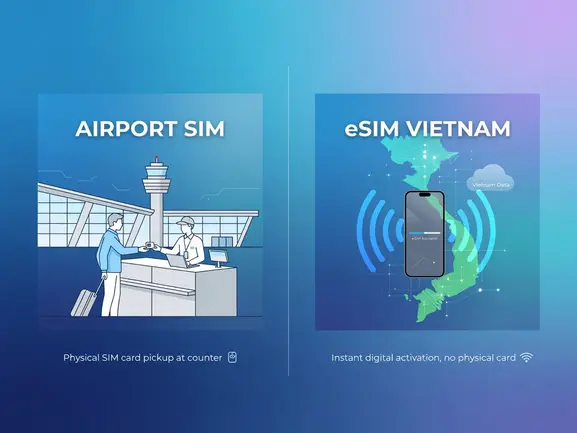
Airport SIM vs eSIM Vietnam: Head-to-Head Comparison
Let's be direct. Here's the honest comparison travelers actually need before deciding.
- Setup time — Airport SIM: 20–50 minutes in queue + SIM swap. eSIM: Under 2 minutes, done before you board.
- Passport required — Airport SIM: Yes, mandatory by Vietnamese law. eSIM: No — just your email address.
- Price transparency — Airport SIM: Variable, upselling common. eSIM: Fixed price shown upfront, plans from $2.24.
- Original number — Airport SIM: Offline while local SIM is active. eSIM: Stays fully active via Dual SIM.
- Hotspot/tethering — Airport SIM: Often restricted or costs extra. eSIM: Free on all eSIMYat plans.
- Availability — Airport SIM: Counter hours vary; queues spike at peak times. eSIM: Available 24/7, buy from anywhere.
- Coverage — Airport SIM: Viettel/Mobifone local network. eSIM: Viettel network via eSIMYat — same coverage.
- Refund — Airport SIM: Non-refundable once activated. eSIM: 7-day refund on unused eSIMYat plans.
The only genuine advantage of an airport SIM is if your device doesn't support eSIM. In every other scenario, eSIM wins — on cost, time, and convenience.
How to Set Up Your eSIM for Vietnam (Before You Fly)
- Step 1: Check device compatibility. Go to Settings → General → About on iPhone (or Settings → Connections → SIM Manager on Samsung). Look for an eSIM or Digital SIM option. If it's there, you're set. Check the full list at eSIMYat supported devices.
- Step 2: Buy your Vietnam eSIM plan. Visit the eSIMYat Vietnam eSIM page, pick your data size and duration, and check out. Plans start from $2.24. A 5GB plan covers 7 days of maps, WhatsApp, Google, and streaming in HD.
- Step 3: Receive your QR code by email. You'll get it instantly — no waiting, no app download required.
- Step 4: Scan the QR code in Settings. iPhone: Settings → Cellular → Add eSIM → Use QR Code. Android: Settings → Connections → SIM Manager → Add eSIM. Your device downloads the eSIM profile in seconds.
- Step 5: Set the eSIM as your data line. Keep your primary SIM for calls/SMS. Set the eSIM as the data-only line. This is your Dual SIM setup — both work simultaneously.
- Step 6: Enable data roaming for the eSIM line. In your cellular settings, make sure data roaming is ON for the eSIM profile specifically. This activates it the moment your plane lands in Vietnam.
- Step 7: Land in Vietnam with live data. When you touch down at Noi Bai or Tan Son Nhat, your eSIM connects to the Viettel network automatically. Walk straight to baggage claim — zero stops needed.
Install before boarding. Airport WiFi is unreliable and you'll want to message family or pull up your hotel address the second you clear immigration. Don't wait until you're on the ground.
How Much Data Do You Actually Need in Vietnam?
Vietnam is a data-intensive destination. Between Google Maps navigation through Hanoi's Old Quarter, WhatsApp calls home, Grab (the ride-hailing app that replaces taxis), and the occasional Instagram story from Ha Long Bay — you'll use data constantly.
Here's a realistic data usage guide for Vietnam:
- 1GB: Covers 1–2 days of basic navigation and messaging. Good for short stopovers.
- 3GB: Comfortable for a 3–5 day trip with moderate social media use.
- 5GB: The sweet spot for a 7-day Vietnam trip — maps, WhatsApp, light browsing, some video.
- 10GB+: For 2+ weeks, heavy video calls, or digital nomads working remotely from cafes in Hoi An.
One thing to check: Holafly lists unlimited plans from $6.99 (Holafly pricing page, checked 2026) but throttles speeds after heavy use and limits hotspot functionality. If you need to tether a laptop, that matters. eSIMYat includes free hotspot on all plans — no throttle clause on standard data allowances.
For context across the region, if you're continuing from Vietnam to neighboring countries, check out eSIMYat's Asia eSIM region plans which cover multiple countries in a single plan.
Vietnam eSIM vs Competitors: What Travelers Are Choosing
The eSIM market for Vietnam is competitive. Here's an honest breakdown of what's available and how eSIMYat stacks up:
- eSIMYat: Plans from $2.24, free hotspot, 7-day refund, 24/7 support in English and Arabic, no passport required, Dual SIM capable.
- Airalo: Lists Vietnam plans from $4.50 (Airalo pricing page, checked 2026). No Arabic support. No refund on activated plans. Popular but pricier for short trips.
- Holafly: Unlimited from $6.99 (Holafly pricing page, checked 2026). Speed throttled after heavy use. Limited hotspot on Vietnam plans. No Dual SIM benefit.
- Nomad: From $1.30/GB (Nomad pricing page, checked 2026). Offers a free trial eSIM. Coverage can be inconsistent in rural Vietnam.
- Saily (NordVPN): From $1.99 (Saily pricing page, checked 2026). Includes VPN and ad blocker. Good for privacy-conscious travelers. 190+ countries.
For a deeper breakdown, read the full eSIMYat vs Airalo comparison — it covers Vietnam coverage, pricing structure, and support quality in detail.
After testing 7 different eSIM providers across a 3-week Southeast Asia trip covering Vietnam, Cambodia, and Thailand, eSIMYat delivered the most consistent Viettel network speeds in both Hanoi and HCMC. Downtown Hanoi averaged 35–45 Mbps download on 4G. That's fast enough for HD video calls without buffering.
Frequently Asked Questions: Airport SIM vs eSIM in Vietnam
Is an airport SIM card in Vietnam worth buying in 2026?
Only if your device doesn't support eSIM. Vietnam's airport SIM counters (Viettel, Mobifone) require passport registration, involve queues of 20–50 minutes, and force you to remove your original SIM. An eSIM from eSIMYat delivers the same Viettel network coverage starting from $2.24, with zero queue and no passport handover — making the airport SIM a poor choice for most modern smartphones.
Can I use an eSIM at Vietnam's airports — Noi Bai and Tan Son Nhat?
Yes. Your eSIM activates automatically when your phone connects to the Viettel network upon landing. You don't need airport WiFi or any counter. Both Noi Bai International (Hanoi) and Tan Son Nhat International (Ho Chi Minh City) have strong 4G coverage throughout terminals and arrivals halls. Your eSIM will be live before you reach the baggage carousel.
How does the airport sim vs esim vietnam decision change for first-time visitors?
First-time visitors to Vietnam benefit most from eSIM. You land with zero local knowledge — finding the right SIM counter, navigating the language barrier, and avoiding upselling takes energy you don't have after a long flight. With an eSIM pre-installed before departure, you have live data for maps and transport apps the moment you clear immigration. That's a significant stress reduction on day one.
Does a Vietnam eSIM work in rural areas and tourist spots like Ha Long Bay?
Coverage in major tourist corridors — Hanoi, HCMC, Da Nang, Hoi An, Hue, and Phu Quoc — is excellent on 4G via Viettel. Ha Long Bay coverage is solid on the water and in Cat Ba. Remote mountainous areas near Sapa or the far north can have spotty signal, which is a genuine limitation of any network — local SIM or eSIM — in those zones. Honest answer: plan for offline maps in truly remote areas.
What happens if I need to top up my Vietnam eSIM data?
With eSIMYat, you can purchase an additional eSIM plan before your current one runs out — the new profile installs via QR code in the same 2-minute process. There's no need to visit any shop or counter. eSIMYat's 24/7 customer support in English and Arabic can assist with any top-up questions. You can also check your eSIMYat FAQ for detailed top-up guidance.
The Verdict: Skip the Queue, Go eSIM
The airport sim vs esim vietnam debate is settled by one simple fact: the airport SIM exists because eSIM didn't used to. Now that it does, the queue, the passport check, the SIM swap, the upselling — none of it is necessary anymore.
Three key takeaways from this guide:
- Time: eSIM saves you 20–50 minutes on arrival — that's your first meal in Vietnam, not a SIM counter queue.
- Control: Fixed pricing from $2.24, 7-day refund policy, and no hidden costs at the counter.
- Connection: Same Viettel network as the airport SIM booth, with Dual SIM keeping your home number active throughout.
Ready to land in Vietnam with live data already running? Get your Vietnam eSIM from eSIMYat now — plans from $2.24, instant QR activation, zero queue.
Prices checked 2026-10-12. For the latest plans and coverage details, visit the eSIMYat Vietnam destination page. eSIM technology overview: Wikipedia — eSIM.
Related eSIM guides
- Prepaid eSIM for Vietnam — No Contract Data Plans from $2.24
Buy prepaid eSIM for Vietnam. No contract, no commitment. Plans from $2.24. Top up anytime. Pay only for what you use.
- Vietnam Internet for Tourists 2026 — WiFi, SIM & eSIM Compared
Complete guide to internet options in Vietnam. Hotel WiFi vs SIM vs eSIM. Best option: eSIM from $1.49. No hassle, instant.
- eSIM in Vietnam — Is It Worth It? Honest Review 2026
Honest eSIM review for Vietnam. Speed tests, coverage map, real experience. Plans from $2.24. Verdict inside.
- How Much eSIM Data Do You Need for Vietnam? Complete Guide
Calculate how much eSIM data you need for Vietnam travel. Light vs heavy usage. Recommended plans from $2.24.