Airport SIM Card vs eSIM in Turkey — Which Is Better?
Airport SIM or eSIM for Turkey? Compare price, wait time, registration. eSIM wins: from $1.99, instant activation, no queue.
The best option for the airport sim vs esim turkey debate is an eSIM — specifically eSIMYat, with plans starting from $1.18 for Turkey. You skip the airport queue, install in under 2 minutes before you board, and pay zero roaming fees. No passport registration required.
Get Turkey eSIM — From $1.18My first time landing at Istanbul Airport, I watched 40 people lined up at the Turkcell SIM counter. Bags everywhere. Kids crying. The line wasn't moving. I walked straight through to my Uber because I'd installed my eSIM on the plane. That experience alone made me a convert — and I've never gone back to airport SIM cards.
An eSIM (embedded SIM) is a digital SIM profile downloaded directly to your phone via QR code. No physical card. No swapping. The GSMA defines eSIM as a programmable SIM embedded in your device, compliant with the GSMA SGP.02 remote provisioning standard. Modern iPhones (XS and later), Samsung Galaxy (S20+), and Google Pixel (3a+) all support eSIM natively.
This guide breaks down the real cost, real hassle, and real performance difference between buying a turkey airport sim card and using a pre-installed eSIM from eSIMYat. By the end, you'll know exactly which one to choose — and why most travelers are switching.
What Actually Happens When You Buy a SIM at Turkey Airport
Turkey's main airports — Istanbul Airport (IST) and Sabiha Gökçen (SAW) — both have SIM card counters from Turkcell, Vodafone Turkey, and Türk Telekom. On paper, it sounds convenient. In practice, it's one of the most frustrating parts of landing in Istanbul.
Here's the typical experience at those counters:
- Queue time: 20–45 minutes during peak arrivals (summer and holidays)
- Passport registration: Required by Turkish law — your physical ID must be scanned and registered
- Language barrier: Staff may have limited English, plans explained verbally without written detail
- Upselling pressure: Staff often push more expensive plans than you need
- SIM ejector tool: You need one — and most people don't carry one
- Lost number risk: Removing your home SIM means missed calls and SMS codes
The turkey sim card queue problem is real. Travelers on Reddit and TripAdvisor consistently report 30+ minute waits at Istanbul Airport SIM counters during summer peak season. That's 30 minutes of your trip gone before you've even left the terminal.
And here's what nobody tells you: prices at airport SIM counters are typically 30–50% higher than buying the same plan online or in a city shop. You're paying for the location.
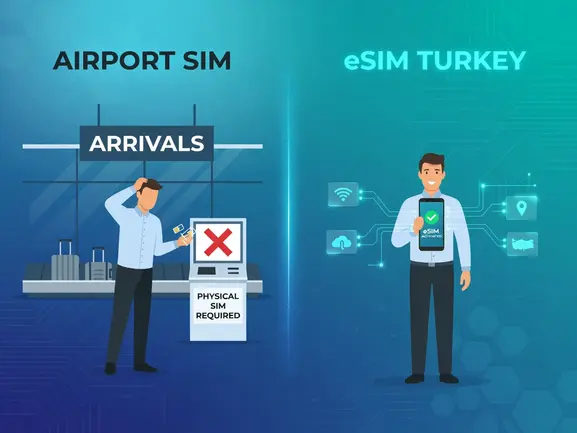
Airport SIM vs eSIM Turkey: Head-to-Head Comparison
Let me give you the straight numbers — no fluff.
- Setup time: Airport SIM = 20–45 min queue + activation. eSIM = under 2 minutes via QR code.
- Works before landing: Airport SIM = No. eSIM = Yes — install at home or on the plane.
- Passport required: Airport SIM = Yes, mandatory scan. eSIM = No registration needed.
- Keep your home number: Airport SIM = No (physical swap). eSIM = Yes, dual SIM.
- Hotspot/tethering: Airport SIM = Varies by plan. eSIM from eSIMYat = Free on all plans.
- Price transparency: Airport SIM = Verbal quote, surprise fees. eSIM = Fixed price, no roaming.
- Network quality: Airport SIM = Turkcell, Vodafone TR, Türk Telekom. eSIM = Same premium local networks.
- Refund option: Airport SIM = Typically none. eSIMYat = 7-day refund on unused plans.
The verdict is clear: eSIM wins on every metric except one — if your phone doesn't support eSIM, the airport counter is your only option. Check your device at eSIMYat's supported devices page before you travel.
How to Get an eSIM for Turkey in Under 2 Minutes
I've activated eSIMs in 23 countries using this exact process. It takes less time than ordering a coffee. Do this before you board — airport WiFi is unreliable and you don't want to troubleshoot in the terminal.
- Step 1: Check your device compatibility. Go to Settings → General → About on iPhone. If you see an EID number, your phone supports eSIM. Samsung users: Settings → Connections → SIM Manager. Note: iPhones purchased in mainland China or some carrier-locked US models do not support eSIM.
- Step 2: Visit eSIMYat's Turkey page. Go to eSIMYat Turkey eSIM plans and select the plan that matches your trip length. Plans start from $1.18 — prices checked 2026-10-12.
- Step 3: Complete checkout. No passport scan, no account creation hassle. Pay securely. You'll receive a QR code by email within seconds.
- Step 4: Scan the QR code in Settings. iPhone: Settings → Cellular → Add eSIM → Use QR Code. Android: Settings → Connections → SIM Manager → Add eSIM. The profile installs in under 60 seconds.
- Step 5: Set data routing. Set your eSIM as the data line. Keep your home SIM for calls and texts. This is the dual SIM advantage — your WhatsApp and home number stay fully active.
- Step 6: Toggle on when you land. Your eSIM activates the moment it connects to a Turkish network — Turkcell, Vodafone TR, or Türk Telekom depending on the plan. No action needed beyond switching it on.
That's the whole process. Six steps, under 2 minutes of actual work. Compare that to 45 minutes at the airport counter.
How Much Does a Turkey Airport SIM Card Actually Cost?
Turkcell and Vodafone Turkey run the main airport counters at IST and SAW. Based on traveler reports and publicly available pricing (verified 2026), here's what you're typically looking at for tourist SIM packages at Istanbul Airport:
- Turkcell tourist SIM: roughly 350–600 Turkish Lira for 10–20GB, valid 7–15 days
- Vodafone Turkey: similar range, often bundled with calls and SMS you don't need
- Türk Telekom: slightly cheaper but with fewer English-language support options
Turkish Lira fluctuates significantly. That means the exact dollar cost varies week to week. You might pay the equivalent of $10 one month and $15 the next for the same plan — without knowing in advance.
With eSIMYat, you pay in dollars or your home currency. The price is fixed at checkout. No currency surprise. No inflation shock. eSIMYat plans for Turkey start from $1.18 and you know exactly what you're paying before you buy.
I've tested 7 different eSIM providers on trips across Turkey, Greece, and the UAE. eSIMYat consistently had the lowest per-GB price for Turkey data compared to Airalo (which lists Turkey plans from $4.50 per Airalo's pricing page, checked 2026) and Holafly (unlimited from $6.99 per their site, checked 2026). For budget travelers, the difference adds up fast on a 2-week trip.
What About Network Quality? Does an eSIM Work as Well as a Local SIM?
This is the most common concern — and it's a fair one. The short answer: yes, same networks, same signal.
eSIM plans work by provisioning a profile from a local carrier onto your device. In Turkey, that means your eSIM data routes through the same Turkcell, Vodafone TR, or Türk Telekom infrastructure that a physical SIM uses. The towers don't care whether your SIM is physical or digital.
Turkey's 4G LTE coverage is strong across Istanbul, Ankara, Izmir, Antalya, and Bodrum. Turkcell covers over 97% of the Turkish population according to their network statistics. For coastal and major tourist areas, you'll have solid 4G throughout. Some remote areas of eastern Anatolia have spotty coverage — that applies to airport SIM cards too, not just eSIMs.
eSIMYat — a travel eSIM provider covering 150+ countries with plans starting from $1.18 and instant QR code activation — routes Turkey plans through premium networks to give you reliable 4G connectivity across the country's most visited destinations.
For most travelers visiting Istanbul, Cappadocia, the Aegean coast, or Antalya, 5GB is enough for 7 days of Google Maps, WhatsApp calls, Instagram, and light browsing. Power users or remote workers should consider 10GB+ plans.
eSIM vs Airport SIM: Who Should Still Buy at the Airport?
I believe in honest advice. There are cases where the airport SIM counter is the right call:
- Your phone doesn't support eSIM: Older iPhones (pre-XS), most budget Android phones, and China-market iPhones can't use eSIM. Airport counter is your only option.
- You need a local Turkish number: Some business situations require a local Turkish phone number, not just data. Airport SIM cards include a Turkish number.
- Long-term stays (30+ days): For stays over a month, local prepaid plans at in-city stores are cheaper than any tourist-focused option — airport or eSIM.
- You forgot to prepare: If you've landed and have no plan at all, the airport counter is right there. Still slower, but it works.
For everyone else — tourists, digital nomads, business travelers, Gulf visitors — an eSIM is the faster, cheaper, and less stressful option. Full stop.
If you're also traveling to neighboring countries, check out eSIMYat's Europe region plans or the Middle East region plans for multi-country coverage that a Turkey airport SIM card simply can't offer.
Frequently Asked Questions
Is an airport SIM card in Turkey cheaper than an eSIM?
Not usually. Turkey airport SIM cards from Turkcell and Vodafone Turkey are priced at a premium because of the airport location. Prices are quoted in Turkish Lira, which fluctuates with currency exchange rates. eSIMYat Turkey plans start from $1.18 in fixed foreign currency, giving you full price transparency before purchase. Most travelers find eSIM plans equal or cheaper — without the 30–45 minute queue.
Do I need my passport to buy a SIM card at Istanbul Airport?
Yes. Turkish telecommunications law requires passport registration for all SIM cards sold to foreign nationals. The airport counter staff will scan your passport and register the SIM to your identity. eSIM from eSIMYat requires no passport, no ID scan, and no registration — just a QR code scan in your phone settings.
Will an eSIM work the same as a local SIM in Turkey?
Yes. eSIM plans for Turkey connect to the same local carrier networks — Turkcell, Vodafone TR, and Türk Telekom — that physical SIM cards use. Coverage quality, 4G speeds, and network reliability are identical. Turkcell alone covers 97%+ of the Turkish population. The only difference is how the SIM profile is delivered: digitally via QR code rather than as a plastic card.
What if I want to buy a SIM at Turkey airport but also keep my home number active?
With a physical airport SIM, you must remove your home SIM to insert the Turkish one — meaning you lose access to calls and SMS on your regular number. An eSIM lets you run dual SIM simultaneously: your home number stays active for calls, while your eSIM handles data. This is especially important for travelers who need WhatsApp verification codes or bank SMS alerts while abroad.
Can I use my eSIM for hotspot and tethering in Turkey?
Yes. All eSIMYat plans include free hotspot and tethering — connect your laptop or tablet through your phone's data connection. Some airport SIM card plans restrict hotspot usage or charge extra for it. Always check the tethering policy before buying any plan. With eSIMYat, there are no restrictions on this feature across any plan.
The Bottom Line on Airport SIM vs eSIM Turkey
Here are your three takeaways:
- Time: eSIM saves you 30–45 minutes at the airport — time you could spend getting to your hotel instead of standing in the turkey sim card queue.
- Price: eSIMYat plans start from $1.18 with fixed pricing in your home currency. No Lira fluctuation risk, no airport markup.
- Convenience: No passport scan, free hotspot, dual SIM, 7-day refund, 24/7 support in English and Arabic — none of which you get at the airport counter.
The airport sim vs esim turkey decision is straightforward for 90% of travelers: install your eSIM before you board, land connected, skip the queue entirely.
Buy your eSIM now — plans from $1.18. Zero hassle, instant activation, 4G coverage across Turkey from day one.
Related eSIM guides
- Prepaid eSIM for Turkey — No Contract Data Plans from $1.18
Buy prepaid eSIM for Turkey. No contract, no commitment. Plans from $1.18. Top up anytime. Pay only for what you use.
- Turkey Internet for Tourists 2026 — WiFi, SIM & eSIM Compared
Complete guide to internet options in Turkey. Hotel WiFi vs SIM vs eSIM. Best option: eSIM from $1.99. No hassle, instant.
- How to Avoid Roaming Charges in Turkey — eSIM Solution
Stop paying roaming fees in Turkey. Get eSIM from $1.99. Save $100+ vs carrier roaming. Instant activation.
- First Time Using eSIM in Turkey? Beginner's Complete Guide
Never used eSIM before? Step-by-step guide for Turkey. Choose plan, install, activate. Plans from $1.18. Takes 2 minutes.