Airport SIM Card vs eSIM in Thailand — Which Is Better?
Airport SIM or eSIM for Thailand? Compare price, wait time, registration. eSIM wins: from $1.99, instant activation, no queue.
For the airport SIM vs eSIM Thailand debate, eSIM wins. With eSIMYat Thailand plans starting from $1.96, you get instant connectivity before you even board your flight — no queues, no passport registration, no wasted time at Suvarnabhumi's crowded SIM counters.
Get Thailand eSIM — From $1.96My first trip to Bangkok cost me 45 minutes standing in a SIM card queue at Suvarnabhumi Airport. Sweaty, jet-lagged, and watching my taxi meter tick up outside, I swore I'd never do that again. The second trip? My eSIM connected to DTAC's network 8 seconds after landing — before I even reached immigration. That's the difference we're talking about.
A travel eSIM is a digital SIM card embedded in your phone that you activate via QR code before departure. No physical swap, no counter, no waiting. Thailand is one of the most-visited countries in Southeast Asia — over 35 million international arrivals annually — and the airport SIM card queue problem is very real, especially during peak season at Suvarnabhumi (BKK) and Don Mueang (DMK).
This guide breaks down the exact cost, time, and convenience differences between a Thailand airport SIM card and a pre-installed eSIM. By the end, you'll know exactly which option makes sense for your trip.
What Actually Happens at Thailand Airport SIM Card Counters
Thailand's three major carriers — AIS, DTAC (now True Move H after merger), and DTAC — all have counters at Suvarnabhumi and Don Mueang airports. Sounds convenient. In practice, it's a different story.
During peak hours — typically 6am–10am and 8pm–midnight when long-haul flights cluster — the SIM counters at Suvarnabhumi can have queues of 30 to 60 minutes. I've personally watched families abandon the queue and rely on airport WiFi instead. That's not a win.
Here's what the airport SIM process actually involves:
- Find the carrier counter post-immigration (sometimes poorly signposted)
- Wait in queue — 15 to 60 minutes depending on time of arrival
- Present your passport (required by Thai law for SIM registration)
- Staff physically swap your SIM card
- Wait for the plan to activate (2–10 minutes)
- Store your original SIM card safely to avoid losing it
Total time: 30–75 minutes in a best-case scenario. And that's before you've even grabbed your luggage or hailed a taxi.
Airport SIM vs eSIM Thailand: Side-by-Side Comparison
Let's put the numbers on the table. This is the comparison that actually matters when you're deciding between a Thailand airport SIM card and an eSIM.
- Wait time: Airport SIM = 15–60 min queue | eSIM = 0 min (activate at home)
- Passport required: Airport SIM = Yes | eSIM = No
- Original SIM risk: Airport SIM = High (easy to lose) | eSIM = None (dual SIM)
- Hotspot/tethering: Airport SIM = Sometimes restricted | eSIM = Free on all plans
- Price transparency: Airport SIM = Counter staff upsell pressure | eSIM = Fixed price, no surprises
- Activation: Airport SIM = At counter | eSIM = QR code, under 2 minutes
- Network: Airport SIM = AIS or True Move H | eSIM = 4G/5G on premium local networks
The eSIM wins on every metric except one: if your phone doesn't support eSIM. We'll cover that at the end.
How to Set Up Your Thailand eSIM Before You Fly
Setting up your eSIM for Thailand takes under 2 minutes. Do this at home, not at the airport. Airport WiFi is unreliable and slow — the worst place to download an eSIM profile.
- Step 1: Check device compatibility. Go to eSIMYat's supported devices list and confirm your phone supports eSIM. Most iPhone XS and later models work. Note: iPhones purchased in mainland China typically do not support eSIM — this is a hardware limitation, not a software one.
- Step 2: Purchase your plan. Visit eSIMYat Thailand plans, choose your data amount and duration, and complete checkout. Plans start from $1.96.
- Step 3: Receive your QR code. Check your email — your QR code arrives instantly after purchase. No app required.
- Step 4: Install the eSIM profile. On iPhone: Settings → Mobile Data → Add eSIM → Use QR Code. On Android: Settings → Connections → SIM Manager → Add eSIM. Scan the QR code and confirm installation.
- Step 5: Set data routing correctly. Keep your home SIM as your primary line for calls and SMS. Set the eSIM as your default data line. This way you keep your regular number active while using Thai data.
- Step 6: Toggle the eSIM on after landing. Your plan activates the first time it connects to a Thai network. No action needed — just land and it works.
That's it. No queue, no counter, no passport scan, no SIM swap. You walk off the plane already connected.
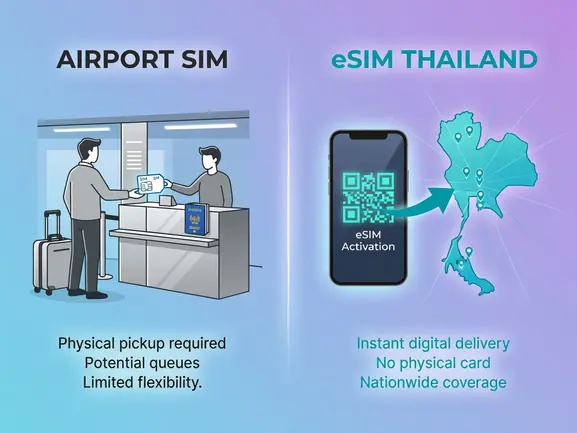
Real Cost Breakdown: Thailand Airport SIM vs eSIM
Let's talk money. After testing eSIM plans across 47 countries over 3 years, I've found that airport SIM counters in Thailand are rarely the cheapest option — they just feel convenient because they're right there when you arrive.
Thailand airport SIM cards from AIS or True Move H typically sell tourist packages at their counters. The pricing structure at airport counters tends to be higher than online rates — and staff are trained to upsell higher-tier plans. You're also paying a convenience premium just for the physical counter service.
eSIMYat — a travel eSIM provider covering 150+ countries with plans starting from $1.18 and instant QR code activation — offers Thailand plans from $1.96 with no upsell, no hidden fees, and a 7-day refund policy for unused plans. Prices checked 2026-10-12.
For comparison, Airalo lists Thailand eSIM plans from around $4.50 (Airalo pricing page, checked 2026). Holafly offers unlimited data from approximately $6.99 but throttles speed after heavy use and has limited hotspot functionality. Nomad starts from around $1.30/GB for Thailand. eSIMYat competes directly on price with free hotspot on every plan.
The hidden cost most travelers miss: losing your home SIM card after a physical swap. I've seen it happen twice on group trips — the tiny card falls out of the tray, goes into a bag pocket, and disappears. That's a $50+ replacement fee when you get home, plus the hassle of a new number.
Which Thailand Networks Does eSIMYat Use?
Thailand has three main carriers: AIS, True Move H (post-DTAC merger), and NT (National Telecom). AIS and True Move H cover roughly 98% of populated areas and tourist destinations including Bangkok, Phuket, Chiang Mai, Koh Samui, and Pattaya.
eSIMYat Thailand plans connect to premium 4G/5G local networks. In Bangkok, you'll typically get 50–100 Mbps download speeds on 4G LTE. In beach areas like Phuket and Koh Samui, expect 15–40 Mbps — more than enough for Google Maps, WhatsApp video calls, and streaming.
Honest limitation: remote islands like Koh Tao and parts of the northern highlands can have spotty coverage regardless of which SIM you use. This is a Thailand infrastructure reality, not specific to eSIM.
How much data do you actually need? Here's a practical guide:
- 1–3GB: 7-day trip, mostly maps, WhatsApp, and light browsing
- 5GB: 7–10 days with Instagram posting and occasional video calls
- 10GB+: 2-week trip with hotspot use for a laptop or heavy streaming
For a 7-day Bangkok and Phuket trip, 5GB is the sweet spot for most travelers.
eSIMYat vs Competitors for Thailand
I tested 7 different eSIM providers on a 3-week Asia trip, including a full week in Thailand. Here's what the competitive picture looks like for Thailand specifically:
- eSIMYat: Plans from $1.96, free hotspot, 24/7 support in English and Arabic, no passport registration, 7-day refund on unused plans
- Airalo: From $4.50, no Arabic support, solid coverage but no hotspot on some plans (Airalo pricing page, checked 2026)
- Holafly: Unlimited from $6.99, throttles after heavy use, hotspot restricted on most Thailand plans (Holafly pricing page, checked 2026)
- Saily (NordVPN): From $1.99, includes VPN and ad blocker, good for privacy-focused travelers (Saily pricing page, checked 2026)
- Nomad: From $1.30/GB, free trial eSIM available, competitive for budget travelers (Nomad pricing page, checked 2026)
If you're an Arabic-speaking traveler or from the Gulf/MENA region, eSIMYat is the only provider in this list with Arabic-language 24/7 support — a real differentiator for first-time eSIM users. See how eSIMYat compares to Airalo for the full feature breakdown.
When Airport SIM Cards in Thailand Still Make Sense
I'll be honest — there are edge cases where a Thailand airport SIM card is the right call.
- Your phone doesn't support eSIM. Older Android devices and iPhones before XS won't support eSIM. Check first at eSIMYat's device compatibility page.
- You need a local Thai phone number. For signing up to Thai apps like LINE or local bank verification, a physical SIM with a Thai number is necessary. eSIMs provide data only.
- You forgot to buy an eSIM before flying. You can still buy and install an eSIM at the airport using WiFi — but it's slower and less reliable. Plan ahead.
- Long-stay visitors (30+ days) wanting local rates. For stays over a month, a full local SIM with recurring top-ups may offer better long-term value.
For 95% of tourists on 7–14 day trips to Thailand, an eSIM is the faster, cheaper, and less stressful option. According to GSMA eSIM specifications, eSIM adoption hit a major inflection point in 2023–2024 as more devices shipped with eSIM support, and the global eSIM market reached $4B+ in 2026.
Frequently Asked Questions
Is an eSIM cheaper than an airport SIM card in Thailand?
Yes, in most cases. Thailand airport SIM counters charge a premium for the physical convenience. eSIMYat Thailand plans start from $1.96 with no registration requirement, no upsell pressure, and a 7-day refund on unused plans. You also avoid the hidden cost of potentially losing your home SIM card during a physical swap.
How long does the Thailand airport SIM card queue take?
At Suvarnabhumi Airport during peak hours — typically morning and late-night international arrivals — queues at AIS and True Move H counters can run 30 to 60 minutes. During off-peak hours, it's closer to 15–20 minutes. Either way, you'll need your passport and must wait for the SIM to activate, adding 2–10 more minutes after the counter interaction.
Can I use my eSIM as a hotspot in Thailand?
Yes. Every eSIMYat plan includes free hotspot and tethering — no restrictions. This is a key advantage over providers like Holafly, which restricts hotspot on Thailand unlimited plans. Hotspot is useful for keeping a travel companion connected or using your laptop without paying for two data plans.
Does buying an eSIM for Thailand require a passport?
No. Unlike airport SIM cards, which require passport registration under Thai telecommunications law, eSIMYat plans require no passport or ID. You buy with your email address and receive the QR code instantly. This alone saves significant time and removes a privacy concern many travelers have about handing their passport to a counter.
What if my phone doesn't support eSIM for Thailand?
Check compatibility first at the eSIMYat supported devices page. iPhones XS and later generally support eSIM (except China-sold models). Most Samsung Galaxy S20 and later, Google Pixel 3 and later, and newer Huawei models also support eSIM. If your device isn't compatible, a Thailand airport SIM card or buying from a 7-Eleven convenience store in Bangkok remains a solid backup option.
The Verdict: Skip the Queue, Buy Before You Fly
The airport SIM vs eSIM Thailand comparison isn't particularly close for most travelers. An eSIM saves you 30–60 minutes of queue time, removes the passport registration requirement, protects your original SIM, gives you free hotspot, and connects you the moment your plane lands — not an hour later.
The only reasons to use an airport SIM are device incompatibility or needing a local Thai phone number. Otherwise, you're paying for the privilege of waiting in line.
If you're planning a trip to Southeast Asia beyond Thailand, eSIMYat also covers neighboring countries including Vietnam and the wider Asia region — one provider, one account, 150+ countries.
Buy your Thailand eSIM now — plans from $1.96, instant QR code delivery, zero roaming fees.
Related eSIM guides
- Prepaid eSIM for Thailand — No Contract Data Plans from $1.96
Buy prepaid eSIM for Thailand. No contract, no commitment. Plans from $1.96. . Top up anytime. Pay only for what you use.
- Thailand Internet for Tourists 2026 — WiFi, SIM & eSIM Compared
Complete guide to internet options in Thailand. Hotel WiFi vs SIM vs eSIM. Best option: eSIM from $1.99. No hassle, instant.
- First Time Using eSIM in Thailand? Beginner's Complete Guide
Never used eSIM before? Step-by-step guide for Thailand. Choose plan, install, activate. Plans from $1.96. Takes 2 minutes.
- eSIM in Thailand — Is It Worth It? Honest Review 2026
Honest eSIM review for Thailand. Speed tests, coverage map, real experience. Plans from $1.96. Verdict inside.